Thursday, February 05, 2015

Holy Trinity, Hull

click photo to enlarge
Holy Trinity, Hull, is one of those medieval churches that should be much better known. Its absence from lists of renowned churches is probably due to its location in a city that, for people south of Watford, is imagined to to be a depressed northern backwater. In fact, it sits near the ancient heart of an old settlement, one that had and continues to have national importance, and which still retains many fine historic buildings in a very distinctive and different kind of urban setting. The church of Holy Trinity would grace any city, and were it in the home counties, would be feted and a major visitor attraction.

So, what does the building, erected between 1285 and the mid-1500s, offer. Firstly it is big (length 285ft/87m, width 72ft/22m, height 150ft/46m), often described as the biggest English parish church by area, bigger in fact than some small cathedrals. The size gives grandeur and awe to the interior, and the painted ceilings are spectacular. Then there is the transept walls and the lower stage of the crossing tower. These were built of brick in the 1300s, a very early use of this material in the medieval period, and said to be the first use of brick for a large building in Britain since the time of the Romans. The tower itself is a particularly fine example of the Perpendicular style and still able to hold its own against more recent tall buildings in the city. Finally there is the west front that overlooks the Market Place. It too is an exceptional piece of work, well-proportioned, symmetrical with good window tracery and a lovely entrance doorway. It has to be said that the setting of the church adds to its appeal. Around it are narrow streets, the old Market Place, the newer (1902-4) Market Hall, the old Grammar School (also brick, 1583-5), Trinity House, and a host of Victorian and earlier buildings.

The January day on which I took my photograph was cold and bright. I liked the way Holy Trinity's tower and the upper parts of the nave, transepts and chancel appeared to rise towards the light out of the deep shadows of the surrounding streets.

photograph and text © Tony Boughen

Camera: Nikon D5300
Mode: Aperture Priority
Focal Length: 18mm (27mm - 35mm equiv.)
F No: f7.1
Shutter Speed: 1/125 sec
ISO:100
Exposure Compensation: -0.33 EV
Image Stabilisation: On

Tuesday, February 03, 2015

Out of focus highlights

click photo to enlarge
One of the things I like about photography is the "accidental" effects that lenses and sensors produce. Of course they are not really accidental - all can be explained scientifically - so perhaps unforeseen is a better way to describe them. What am I referring to? Well, it can be the way that shooting contre jour sometimes produces a sepia effect. Or it can be the flare that the sun introduces as it bounces around inside the lens elements. But for me the best unforeseen effects are present in out of focus highlights.

In 2011 I was using a macro lens to photograph some glass marbles; shiny, spherical glass balls with colours inside them. I was captivated by the beautiful out of focus highlight effects that I saw before I brought the lens into focus. At the end of the session I decided that these out of focus shots were far superior to the sharp photographs of the subject that I had originally intended to take. The other day, as I was photographing some sunlit steel mesh that filled in the rails at the side of a footbridge, I noticed some unusual out of focus highlights, examples that looked positively three dimensional. The small photograph above shows the mesh as I initially photographed it, with it gradually appearing and intensifying as sharpness decreases. The main image is a crop of a shot I took solely of the effect. Not great photography I think, but noteworthy and an addition to my collection of such phenomena.

photograph and text © Tony Boughen

Photo 2
Camera: Nikon D5300
Mode: Aperture Priority
Focal Length: 140mm (210mm - 35mm equiv.)
F No: f8
Shutter Speed: 1/500 sec
ISO:100
Exposure Compensation: -0.33 EV
Image Stabilisation: On

Sunday, February 01, 2015

West End

click photo to enlarge
I remember learning in my school geography lessons that in Britain poorer housing and industry is often located on the east side of a city and better housing on the west. This is apparently due to the prevailing wind being a westerly or south westerly. The well-heeled preferred not to have noxious odours brought to them on the breeze and so, in the main, they chose the western side of the city in which to live. The poor had less choice or no choice at all.

I recall thinking that this seemed to apply to London in so far as I knew it; that the West End was upmarket compared with the downmarket East End. When I moved, several years later, to the city of Kingston upon Hull, the rule applied there too, though it was somewhat spoiled by the fact that the fish dock was in the west of the city.

On my first visit to Boston I noticed this sign on top of a cinema. Roof mounted signs are much less common in Britain than they are in other countries so they do catch my eye. Could the same rule apply in this town I wondered? Was this a West End in the London sense though on a smaller scale? The answer in both cases proved to be no. The sign seems to take its inspiration from London and the fact that the West End has many cinemas, but also leans on the fact it is located in a road called West Street. The clear January light was emphasising the sharp shapes when I looked up at it the other day so I photographed it against the cloud flecked sky in a very off-centre composition.

photograph and text © Tony Boughen

Camera: Sony RX100
Mode: Aperture Priority
Focal Length: 17.8mm (48mm - 35mm equiv.)
F No: f5
Shutter Speed: 1/1250
ISO: 125
Exposure Compensation:  - 0.3EV
Image Stabilisation: On

Friday, January 30, 2015

Dogs and me

click photo to enlarge
I've said elsewhere in this blog that I'm not a "doggy person". I have no problem with dogs, they seem to like me, I don't mind them, and I don't have any irrational fear or dislike of them. I grew up with dogs and always had at the back of my mind that one day I'd have one. But I can't see that happening. They would require me to change the way I now live and I'm not prepared to give that up for a pet. I value spontaneity, the ability to drop everything and pursue a fancy of the moment. I don't especially like planning ahead - I did too much of that in my working life - and dogs require planning. They also prevent you from entering too many buildings where dogs are not allowed.

However, the photographer in me is grateful to those who do have dogs, who exercise them, and in so doing regularly provide me with a human element or an indication of scale in my photographic compositions. I've lost count of the landscapes that I've shot where I deliberately include a dog walker. So, though dogs are not for me, I value them nonetheless.

photograph and text © Tony Boughen

Camera: Nikon D5300
Mode: Aperture Priority
Focal Length: 112mm (168mm - 35mm equiv.)
F No: f8
Shutter Speed: 1/200 sec
ISO:400
Exposure Compensation: -0.33 EV
Image Stabilisation: On

Wednesday, January 28, 2015

A River Humber skyline

click photo to enlarge
In the 1970s I moved from a relatively small settlement in the upland area of the Yorkshire Dales to the Yorkshire city of over a quarter of a million people called Kingston upon Hull. I was a country boy who, unlike most of my contemporaries, enjoyed living in the country, and I found, to my surprise, that I also liked living in a city. I relished the anonymity, enjoyed the visible history, and my photographic eye fed on the ever changing images that were daily before me.

Hull is a port built on a river and alongside a large estuary. It is a flat area, the nearest hills being the Yorkshire and Lincolnshire Wolds several miles away. One of the new things I discovered in my new home was that flat landscapes have beautiful and impressive skies that are ever changing and that make a fine substitute for hills. I also realised that just like hills and mountains, big skies have the capacity to make man, his works and habitations seem insignificant.

On a recent visit to Hull I was reminded of this when I took today's photograph. I was standing on the pier of the long-gone Humber ferry that juts out into the River Humber. Looking over the water downstream I could see on the skyline the ships, cranes, chimneys, cooling towers etc of the city's port and petrochemical site silhouetted against a sliver of pale yellow sky below dark, brooding clouds. Having walked and cycled near these industrial structures I was aware of their imposing size yet here, in this context they looked quite insignificant.

photograph and text © Tony Boughen

Camera: Nikon D5300
Mode: Aperture Priority
Focal Length: 75mm (112mm - 35mm equiv.)
F No: f7.1 Shutter Speed: 1/125 sec
ISO:110
Exposure Compensation: -0.33 EV
Image Stabilisation: On

Sunday, January 25, 2015

Starters, finishers and contre jour

click photo to enlarge
One of the lessons I've learned in life is that many people are good starters but significantly fewer are good finishers. Consequently,if you want to succeed it helps to be a finisher. What do I mean by that? Well, you've doubtless seen people who will begin a grand re-design of their garden, or begin to build an extension to their house, or start renovating an old car, or set off with great gusto on a work-related project only to slow then come to a halt before it is complete. Sometimes they get under way again, but all too often they once again give up and the task they began languishes in an unfinished state for months or years, and frequently is never accomplished. Though that doesn't stop some beginning another abortive undertaking!

Finishers have vision, determination and perseverance. Starters have vision, but lack those extra qualities necessary to see things through to a conclusion. As I took today's photograph I wondered if the builders of the new "bowstring" footbridge over the River Witham, near St Botolph's church in Boston, Lincolnshire, were finishers. The bridge has been open since February 2014, yet every time I've crossed it since that time there has been security fencing, "men at work" signs, piles of paving material etc all indicating that the finishing touches still haven't been completed. You can see some of those wretched movable barrier fences on the right of the photograph.

Purists might bridle at today's image with its flare, vignetting and blown highlights. I don't mind such things. In fact, every now and then, usually in winter, I actively seek them out with a contre jour shot, as was the case with this photograph.

photograph and text © Tony Boughen

Camera: Sony RX100
Mode: Aperture Priority
Focal Length: 10.4mm (28mm - 35mm equiv.)
F No: f5
Shutter Speed: 1/250
ISO: 125
Exposure Compensation:  - 0.3EV
Image Stabilisation: On

Friday, January 23, 2015

Belton House

click photo to enlarge
I recently went to Belton House for the first time. This large country house is now in the care of the National Trust and is open to the public. However, it being a Monday in January only the gardens and grounds were open so we didn't get to see the inside. On returning home I read a little about the building and was surprised by what I found.

Nikolaus Pevsner describes Belton as "perhaps the most satisfying among the later C17 houses in England". I can only think that he is referring to the interiors because the exterior is decidedly eighteenth century in style and fact, the whole having been given, as Pevsner says, "the facelift of 1777-8 by James Wyatt". The neat stonework and layout of the south front can only be described, to my mind, as ordinary. And the fact that the north front is very similar, a couple of details notwithstanding, doesn't help. The "H" plan hints at the seventeenth century underpinnings, but to the casual observer the building wears an eighteenth century face interesting only for its lack of interest.

For much of our visit the sun lit the south front like a floodlight, good for showing off the warm stone, but bad for modelling the architecture. This view of the facade that overlooks the formal gardens appealed more with its surface patina due to the reduced light. I particularly liked the way the building sits in its carefully planned surroundings. As I took today's distant view of that elevation I had an idea that it would make a good candidate for conversion to black and white: the smooth, frosty grass, silhouetted trees, and the building's chimneyed and towered shape under a lightly figured sky all suggested it, and I'm quite pleased with the outcome.

photograph and text © Tony Boughen

Camera: Nikon D5300
Mode: Aperture Priority
Focal Length: 22mm (33mm - 35mm equiv.)
F No: f8
Shutter Speed: 1/320 sec
ISO:100
Exposure Compensation: -0.33 EV
Image Stabilisation: On

Wednesday, January 21, 2015

The taste of deer

click photo to enlarge
Yesterday I was thinking about the taste of deer. We visited the National Trust-owned stately home of Belton House, near Grantham, Lincolnshire. Part of the extensive grounds surrounding the seventeenth and eighteenth century house is a deer park and the taste of deer was prompted by the sight of the large guards round the younger trees where the deer roamed.

By the "taste of deer" I don't mean to allude to the flavour of venison, but rather, the liking of deer for particular kinds of tree bark - the reason for those guards in today's photograph. I had remembered reading, a while ago, that some species of tree bark were favoured over others. A little research turned up the list I'd seen. Apparently, though preferences vary according to deer species, the availability of other food, season and the type of site, as far as bark stripping (as opposed to leaf browsing) goes certain trees are more sought after. Willow, ash and rowan top the list followed by aspen, lodgepole pine, beech, Norway spruce and other species. There seemed to be a variety of trees protected by guards at Belton, and the fallow deer that make up the park herd had clearly been kept at bay by the steel and wood guards. Some mature trees, however, particularly beech, showed a distinct "browse line". This was where the shoots that commonly cluster at the base of the trunk had been eaten but were untouched higher up.

I spotted this shot as we drove into the grounds and walked back to take it before the sun got any higher and the silhouettes and colours were less strong and the frost had melted.

photograph and text © Tony Boughen

Camera: Nikon D5300
Mode: Aperture Priority
Focal Length: 56mm (84mm - 35mm equiv.)
F No: f7.1
Shutter Speed: 1/250 sec
ISO:100
Exposure Compensation: -0.33 EV
Image Stabilisation: On

Monday, January 19, 2015

Dark Satanic Mills?

click photo to enlarge
"And was Jerusalem builded here,
Among these dark Satanic Mills?"
from the poem, "And did those feet in ancient time", by the English poet, William Blake (1757-1827)

The poem quoted above is widely loved by the English, particularly when sung to the tune written by Sir Hubert Parry, and commonly called "Jerusalem". It is built on the story that Jesus visited England - Glastonbury in particular - in his youth, accompanied by Joseph of Arimathea. Blake contrasts the England of the time of such a visit with the rapidly industrializing England of 1804 (when the poem was written), and the England that could and should be.

His disparaging of the "dark Satanic Mills" has been attributed to his dislike of the Albion Flour Mill, one of the first large, factories built in London, in Southwark, near where Blake lived. Opinion on the new buildings of industry were divided between those who saw them as efficient parts of a burgeoning economy that brought wealth and employment, and those who saw them as inhuman, unholy places with their dirty, dangerous work, child labour and long hours. But, there are other theories about what Blake meant, including the idea that he was referring to the universities of Oxford and Cambridge, institutions that promulgated a religion he thought very different from the one he espoused.

Whatever his meaning, it was Blake I thought of when, on a darkening day I took this photograph of the distant Palm Paper mill at King's Lynn, Norfolk, from near the quayside in the town. The massive structure with its chimneys, cloudy plumes and looming bulk, put me in mind of his words, and also made me recall another photograph I took in 2013 of an industrial subject - Melton Ross chalk quarries in Lincolnshire.

photograph and text © Tony Boughen

Camera: Sony RX100
Mode: Aperture Priority
Focal Length: 37.1mm (100mm - 35mm equiv.) - cropped
F No: f4.9
Shutter Speed: 1/200
ISO: 125
Exposure Compensation:  - 0.3EV
Image Stabilisation: On

Saturday, January 17, 2015

Archilense

click photo to enlarge
Last October, in a post called "WYSIATI" I described how I was underwhelmed by a series of art installations in King's Lynn, a collaboration between Amiens, France, and the Norfolk town. What I didn't mention was that the installation that sounded the most interesting hadn't been set up and so I couldn't have a look at it. That was remedied recently when we made one of our regular visits to King's Lynn.

"Archilense", an optical installation by Thibault Zambeaux, is described as "a transparent door to a new landscape". Moreover, the website says that, "To create the distortion and images each panel has magnifying glasses inlayed (sic) to build a unique pattern related to King's Lynn." From a distance the piece looked interesting due to the shapes built into the glass. Looking through it, however, proved very disappointing. The inversions and distortions were not sufficiently interesting to engage the viewer: for me the piece failed in the main task that the artist had built into the piece. While we were there I saw a few people look through it and after a few seconds move on. The longest period of attention the work received was from a black-headed gull in its winter plumage that found it to be a very convenient riverside perch. In fact, it was reluctant to leave it and allowed me to get quite close. Looking at the bird I was reminded of some Lincoln sculpture that daily provides a similar avian resting place for both gulls and pigeons.

photograph and text © Tony Boughen

Photo 1
Camera: Sony RX100
Mode: Aperture Priority
Focal Length: 20.4mm (55mm - 35mm equiv.)
F No: f4
Shutter Speed: 1/500
ISO: 125
Exposure Compensation:  - 0.3EV
Image Stabilisation: On


Thursday, January 15, 2015

Landscapes and aspect ratios

click photo to enlarge
After thirty odd years of shooting 35mm film with an aspect ratio of 3:2 I shot with Four Thirds cameras for a few years. These had an aspect ratio of 4:3. To my surprise I found I preferred it to 3:2, particularly for portrait format shots. When you turn a 3:2 camera so that the long side is vertical it seems to me that the aspect ratio doesn't work so well as when it is horizontal (landscape format) - it's simply too tall. There are a few subjects that benefit from a taller shape (and a very few where 16:9 is best) but not too many. I definitely preferred 4:3 in those circumstances. For landscapes, streetscapes and general photography 3:2 was, by and large, fine, but not better than 4:3 and sometimes too long.

Since I've returned to 3:2 with Canon, Nikon and Sony, the three makes I use now, I've generally shot 3:2 and where I've particularly felt it looked wrong (in horizontal or portrait format), I've cropped to 4:3. Today's photograph is a case in point. When I composed the shot I knew I wanted the verticals of the two medieval churches in the shot. However, I also wanted the full width of the street. On a wet day with an overcast sky 3:2 left too much boring grey cloud in the top half of the photograph. Consequently, I shot at 3:2 knowing I would crop to 4:3. Those of you who know the Sony RX100 might wonder why I didn't dive into the menu and set the camera to 4:3. The fact is I find it easier to stick with the same aspect ratio (3:2 is native and the highest resolution) across all the cameras to benefit from a consistent view and maximum pixel dimensions. To do otherwise would be for me, just too confusing, too tedious, and would deny me the best image where 3:2 is the ratio I want.

On the other hand, if Sony had done what Panasonic did with the LX3 (and other LX models), a camera that I owned until it died, and had put the aspect ratios round the lens barrel selected by a click stop switch, then I just might have set 4:3 before shooting.

photograph and text © Tony Boughen

Camera: Sony RX100
Mode: Aperture Priority
Focal Length: 20mm (54mm - 35mm equiv.)
F No: f4.5
Shutter Speed: 1/100
ISO: 125
Exposure Compensation:  - EV
Image Stabilisation: On

Tuesday, January 13, 2015

Worcester Regiment Colours

click photo to enlarge
The original purpose of regimental "colours" or flags was to indicate the rallying points of troops on the battlefield. The loss of the colours was an actual and symbolic loss for a regiment because it was frequently a mark of failure. Fighting in their vicinity often proved to be the most fierce as the enemy sought to secure them and their owners fought to prevent their capture. The tradition of embellishing basic flags with labels naming specific campaigns engaged in by the regiment is a post-medieval phenomenon, and anyone visiting a British cathedral is likely to come upon such colours in one of its many chapels.

Worcester Cathedral's St George's Chapel, not unnaturally, holds a collection of the colours of battalions of the Worcester Regiment. In 1970 it was was amalgamated with the Sherwood Foresters and ceased to be a distinct regiment. The chapel at the cathedral holds flags that date back to the nineteenth century, as well as those from the First and Second World Wars. Light and time inevitably take their toll on the material of the flags and the examples shown in today's photograph are typically discoloured and threadbare, qualities that help the viewer to better understand the passage of time since they were carried into battle.

photograph and text © Tony Boughen

Camera: Sony RX100
Mode: Aperture Priority
Focal Length: 19.3mm (52mm - 35mm equiv.)
F No: f3.5
Shutter
Speed: 1/13
ISO: 800
Exposure Compensation:  0 EV
Image Stabilisation: On

Friday, January 09, 2015

Self-portraits and Mr Turner

click photo to enlarge
The other evening we went to see Mike Leigh's, "Mr Turner", a film about the great English painter, J. M. W. Turner. It was exquisitely shot, beautifully acted and an interesting take on the artist's life. For me it only suffered by a little too much direct connecting between the artists later, great "impressionistic" works and their sources of inspiration. I do recognise, however, that anyone coming to the film with no knowledge of Turner would value this direct explication.

As we went up to the gallery where our seats were I took a couple of self-portrait photographs in the glazed stairwell windows. This was the best of the bunch with the market place beyond, illuminated bank signs on the right, and a passer-by at bottom right balancing my silhouette on the left. Anyone who has looked at my many self-portraits (for example here, here or here) on this site will know that, with one exception, they can all best be described as "obscured", since they are designed to hide or suggest rather than reveal.

After we'd seen the film mentioned, my wife read me an extract from Wikipedia about Turner's first sale of a work (a seascape, "Staffa, Fingal's Cave", unseen by the buyer) to an American, one James Lenox of New York City. The person who bought it from Turner on behalf of Lenox reported to the artist that the new owner was "greatly disappointed" by what he described as the painting's "indistinctness". Turner is reputed to have replied, "You should tell Mr Lenox that indistinctness is my forte". I think henceforth that will be my reply to those who find my self-portraits unrevealing!

photograph and text © Tony Boughen

Camera: Sony RX100
Mode: Aperture Priority
Focal Length: 12.8mm (34mm - 35mm equiv.)
F No: f2.8 Shutter

Speed: 1/40
ISO: 640
Exposure Compensation:  0 EV
Image Stabilisation: On

Wednesday, January 07, 2015

Ghost bikes

click photo to enlarge
A ghost bike is a white painted bicycle, often changed to a fence, post or some other immovable object, sometimes without tyres and/or pedals to deter thieves. One of its purposes is to remind all who pass by, particularly motorists, that a cyclists died at the location, and that the road is a facility that motorised traffic shares with cyclists. A second, and no less important reason for a ghost bike is to serve as a memorial to the dead cyclist.

I periodically come across ghost bikes when I travel around the country. They are more usual in cities than elsewhere, and they are often decorated with floral and other tributes to the deceased. I came across the example in today's photograph in Deptford Church Street in London. A quick web search revealed that it is a tribute to seventeen year old Olatunji Adeyanju. He was hit by a car driven by a motorist who drove off after the collision, and was subsequently traced by the police, prosecuted and jailed.

The ghost bike initiative is a development that one wishes wasn't necessary. It shouldn't be beyond motorists and cyclists to co-exist on the roads, but too often they are characterised as enemies rather than fellow travellers. This is nonsense, of course, because many people are both cyclists and motorists. It is often argued by anti-cyclist motorists that segregated routes are required for cyclists, but whilst these are helpful and necessary they can never be the whole answer in a city with a tightly packed grid of roads. A little more goodwill will solve what a lot of concrete and tarmac never can.

photograph and text © Tony Boughen

Camera: Sony RX100
Mode: Aperture Priority
Focal Length: 30.5mm (82mm - 35mm equiv.)
F No: f5
Shutter Speed: 1/100
ISO: 160
Exposure Compensation:  -0.3 EV
Image Stabilisation: On

Monday, January 05, 2015

Greenwich Square's public space

click photo to enlarge
Over the past year, in our visits to Greenwich, I've watched the Greenwich Square development start to take shape. This mix of housing, retail space, leisure facilities and a public square is being developed on the site of the former Greenwich District Hospital. Some of the apartments, as can be seen by the balcony furniture in today's photograph, appear to be inhabited, but elsewhere there is much work to be done before the scheme is complete.

What has interested me, especially, about Greenwich Square is the public square at its centre. More particularly, I'd like to know if it is really a public space with all the rights and responsibilities that entails, or is it actually a private space to which the public are admitted on terms devised by the owners. An increasing number of these private/public spaces are being built in cities across the country. London's most frequented example is the ridiculously named "More London" near Tower Bridge, the only seemingly public place I have ever been told that I must stop taking photographs. The most recent private space to be described as public ("London's highest public park") is the Sky Garden at the top of the tower at 20 Fenchurch Street (the "Walkie Talkie"), London's ugliest tower by a big margin. It admits the public but it certainly cannot claim to be a public space. So what is the square at Greenwich Square? We'll eventually find out.

Incidentally, the colour of the cladding of these apartments makes me ask this question once more.

photograph and text © Tony Boughen

Camera: Sony RX100
Mode: Aperture Priority
Focal Length: 37.1mm (100mm - 35mm equiv.)
F No: f4.9
Shutter Speed: 1/125
ISO: 160
Exposure Compensation:  -0.3 EV
Image Stabilisation: On

Saturday, January 03, 2015

Ash, mud and the vanished

click photo to enlarge
Yesterday I grew by two inches. In case you think I over-indulged on the turkey, Christmas cake and assorted festive fare, I hasten to add that it wasn't my girth that grew, but my height. The cause of this was a walk across two fields of winter wheat to the pasture that holds the deserted medieval village of Walmsgate on the Lincolnshire Wolds. The mud of the field stuck to the soles of my shoes to the point where, not only was I taller, but I felt that I was shod with a diver's boots.

The remains of the village are, as is typical in England, very spare. The undulations of the field on the south-west facing slope reveal to the tutored eye the hollow ways (see small photo) that mark roads and tracks, house walls and enclosures and little else. At Walmsgate, unusually, the bottom few courses of the walls of the medieval church remain, here in a fenced off area that includes the graveyard with some nineteenth or early twentieth century graves - it is probably still consecrated ground. The village is recorded in 1377 as having 30 people who paid poll tax. This had declined to 8 families in 1563 when the last priest is recorded. The muddy walk was worth it for what we saw of the deserted village, but also for the experience of the wonderful light that, following a gloomy couple of days, lifted our spirits. The old ash tree of the main photograph made a fine sight with the cloud-studded blue sky, the green grass and the long afternoon shadows.

photograph and text © Tony Boughen

Photo 1
Camera: Sony RX100
Mode: Aperture Priority
Focal Length: 10.4mm (28mm - 35mm equiv.)
F No: f8
Shutter Speed: 1/250
ISO: 125
Exposure Compensation:  -0.3 EV
Image Stabilisation: On

Tuesday, December 30, 2014

A public lounge?

click photo to enlarge
Words come and words go. I learnt the other day that "bae" has been added to the Oxford English Dictionary (OED). Apparently this word is used by many young people on social media to mean "before anyone else" i.e. their nearest and dearest, significant other, the person (or even thing) to whom (or which) they attach most importance. I've listed elsewhere in this blog several words such as paling, aerodrome and petticoat, terms that in my childhood were widely used, that today have fallen almost completely out of use. We shouldn't lament the birth and death of words unless the newcomers replace perfectly good synonyms or the departures carry a meaning that becomes lost when it is is still needed.

But, there is a modern way with words about which we should be concerned. I refer to the use of a perfectly serviceable and widely used word for a different meaning: a usage that confuses, is lazy or is just plain stupid. One of my early blog posts concerned the appropriation of the word "boutique" by hoteliers in the term "boutique hotel". The original English meaning of boutique was principally, a small shop, or by extension an independent shop, specialising in fashionable clothing. The wider use referring to exclusive, upmarket services appears to have been coined in the U.S. and then applied widely. It reminded me of Lewis Carroll's Through the Looking Glass" where Humpty Dumpty says, "When I use a word it means just what I choose it to mean, neither more nor less."

That quotation came to mind when I looked up details about a photograph I took in London over Christmas. What I'd assumed was Deptford Library is actually grandly and confusingly titled "Deptford Lounge". Now the word "lounge" is today more usually associated with "departure lounge", but in my childhood it was a synonym for "living room" or "sitting room" (the latter also on the way out). What, I wondered, could have caused the local authority to call the building a "Lounge"? Was it a place of rest and repose? A gathering place of loungers? A public sitting room? All these are OED definitions of the word. In fact, this large building provides a range of community services including a public library, computer labs, study areas, a café, room hire and a roof-top ball court. None of these, apart from perhaps the café, incorporate lounging. So why the silly name?

Why too, I wondered, the external screen wall of pierced metal? This feature made me think the building was designed to survive urban unrest because it reminded me of the clip on panels that tanks and APCs sometimes wear that are designed to cause ant-tank rockets to explode early before penetrating the body of the vehicle. What were the councillors of Deptford expecting? A quick look at Architecture Today tells me that the architects, Pollard Thomas Edwards chose the cladding "...to symbolise cultural richness, the facades comprise a perforated brise-soleil constructed from gold-coloured, Aurubis Architectural Nordic Royal copper alloy panels. In addition to its aesthetic appeal, the material was favoured for its durability, long lifespan and environmental credentials." Who would have thought it?

photograph and text © Tony Boughen

Camera: Sony RX100
Mode: Aperture Priority
Focal Length: 10.4mm (28mm - 35mm equiv.)
F No: f5
Shutter Speed: 1/80
ISO: 125
Exposure Compensation:  -0.3 EV
Image Stabilisation: On
 

Sunday, December 28, 2014

The fall of the light

click photo to enlarge
I sometimes think that the way we appreciate photography, in fact any kind of art, can be reduced to two descriptors: "intellectually" or "viscerally", or a combination of the two. By viscerally I mean as near to emotionally as makes little difference. Moreover, I don't think we should give primacy to any of these modes of appreciation: the outcome is more important than the method.

There are those who feel that to say one appreciates or likes something for unexplainable reasons is to enjoy it in an inferior way. Others, of course, take the opposite view; that the emotional engagement and reaction is paramount and is deeper than words can express. Ultimately these "ways of seeing" are not mutually exclusive. Take today's photograph, a shot of sunlight falling through the turned balusters on to the red carpet of the stairs in our house. Due to the way the house is aligned this doesn't happen very often. However, when I saw it recently I was moved to photograph the event. Why? Largely because I had a visceral reaction to the sight. To put it into words, I enjoyed the rich red of the lit carpet glowing against the un-illuminated areas. I liked the way the balusters' shadows zig-zagged down the steps, and I appreciated the water-colour softness of the whole. It's a slight subject but none the worse for that. In photography sometimes the thing that converts the mundane to the transcendent is simply a matter of the fall of the light.

photograph and text © Tony Boughen

Camera: Sony RX100
Mode: Aperture Priority
Focal Length: 10.4mm (28mm - 35mm equiv.)
F No: f5
Shutter Speed: 1/20
ISO: 6400
Exposure Compensation:  -0.3 EV
Image Stabilisation: On

Friday, December 26, 2014

The bridge over the Humber

click photo to enlarge
Today's photograph shows what was once the longest single span suspension bridge in the world, the Humber Bridge. It crosses the River Humber linking Lincolnshire on the south bank with East Yorkshire on the north. A few decades ago I lived in East Yorkshire not many miles from where the bridge would be built. I was familiar with the politics behind the decision to construct it, the enormous cost, and the way that the toll charges were insufficient to prevent the price of the bridge (including interest charges) from constantly rising. And yet, I welcomed the bridge as a structure that would link two areas that were otherwise only connected by a ferry (the "Lincoln Castle" paddle steamer) or a sixty or so miles journey by road or rail.

At the time (the 1980s) I had an interest in the bridge's construction and in the technological solutions that were deployed by this wonderful feat of engineering. I took part in the agitation for a free footpath and cycle route to be incorporated which, I'm glad to say, was conceded. Today, I still get a thrill when I see the tall towers, the slender-looking (though actually quite large) cables, and the arc of the deck as it gracefully spans the water. It has always looked a relatively insubstantial structure to perform the task that it does. And yet, it continues to function as intended, regular maintenance ensuring that it is rarely closed.

It makes a good photographic subject and I've taken quite a few shots as we've paused after one of our fairly regular crossings. Different light, different weather, changing seasons and a number of possible viewpoints, as well as the ability to walk across it, all make that job easier than it is with many such structures. Today's shot was taken in the afternoon in December light that has that yellow tinge from the sun being low in the sky.

photograph and text © Tony Boughen

Camera: Sony RX100
Mode: Aperture Priority
Focal Length: 11.8mm (32mm - 35mm equiv.)
F No: f5
Shutter Speed: 1/250
ISO: 125
Exposure Compensation:  -0.3 EV
Image Stabilisation: On

Wednesday, December 24, 2014

My second portrait assignment

click photo to enlarge
Earlier this year I had a portrait assignment. Some photographs were needed to accompany a local magazine article about someone's hobby. So, off I went to photograph...some hens! The other day the call came again. Once more a photograph to accompany a short magazine article was required. So off I went to photograph...Father Christmas!

I long ago worked out what others have slowly realised - that portrait photography isn't for me. I take my share of family portraits-cum-snaps:  which photographer doesn't? But, deliberately setting out to photograph people I know and people I don't know, in a way that clearly says "this is a real portrait, well-lit, revealing of the person, etc" is something I've never wanted to do. Looking at some of the work of the great Jane Bown who died on 21st December only convinced me that I was right in my self-assessment. But never mind, hens and Santa Claus I can manage! A very Merry Christmas to everyone!!!

photograph and text © Tony Boughen

Camera: Canon 5D2
Mode: Aperture Priority
Focal Length: 65mm
 F No: f4
Shutter Speed: 1/80 sec
ISO: 500
Exposure Compensation:  -0.33 EV
Image Stabilisation: On

Monday, December 22, 2014

Using up the left-overs

click photo to enlarge
I've never been a big fan of Christmas. The increasing commercialisation of it has made the holiday into an orgy of consumerism. The "12 days of Christmas" are long gone and now it seems to last for about four months, from the moment the first shop puts out Christmas items in September to the last of the decorations coming down in January, to be replaced by the chocolate eggs and hot cross buns of Easter. Some traditional Christmas food I like - cake, pudding, mince pies - but in general I prefer to spread my merry-making and celebrating throughout the year. The coming of grandchildren has softened my Scrooge-like demeanour somewhat, but on the whole I'm glad when Christmas has passed and the new year with all its promise is upon us.

In fact, I think I sometimes enjoy the aftermath of Christmas more than the event. There have been times when I've found the picked left-over turkey, cold, with cold sage and onion stuffing, in a sandwich, more appealing than the meal with all the trimmings. A cup of tea and the last of the mince pies appeals more than the first of them. The remainder of the Christmas cake goes down better in January and February with further cups of tea than it does during the season proper when it can't be fully appreciated among the other culinary riches. Yes, left-overs have something to recommend them. I was reflecting on this when I was scanning the rejects for posting from the past month or so. Sitting among them was the photograph I've posted today -  a left-over that I initially didn't think good enough. Well, the passage of time has changed my mind. I quite like the way the camera caught the light of sky and the water of the elongated pond rather grandly called Crowland Lake, the delicacy of the branches and grasses, and the subdued, almost sepia colour that suffuses the scene.

photograph and text © Tony Boughen

Camera: Sony RX100
Mode: Aperture Priority
Focal Length: 10.4mm (28mm - 35mm equiv.)
F No: f5.6
Shutter Speed: 1/500 sec
ISO: 125
Exposure Compensation: -0.3 EV
Image Stabilisation: On

Saturday, December 20, 2014

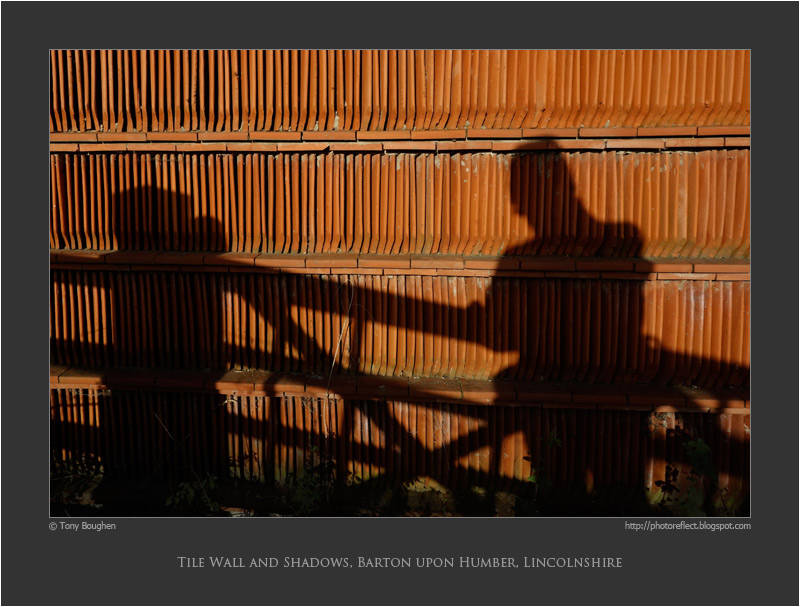
Tile walls, Barton upon Humber

click photo to enlarge
Along the southern bank of the River Humber, on each side of the Humber Bridge and adjacent to the town of Barton upon Humber, is a string of pools. Today many of them are nature reserves or are used for dinghy sailing. However, they almost all have their origins as clay pits dug for the raw material of tile and brick making. Today tiles are still made there. The company of William Blyth, established at Barton in 1840, continues to manufacture roof tiles - pantiles, plain tiles, French tiles, corrugated tiles and much more - using local clay and traditional methods.

A majority of the housing and farm buildings of the county of Lincolnshire are brick built with tile roofs. Companies such as William Blyth supply roof tiles for the renovation of old buildings and for new buildings that follow the traditional pattern. In the area immediately around the tile works damaged tiles and sometimes new ones are also used for the construction of perimeter walls and some constructional walls. For example, the works of the supplier mentioned has a pierced wall made of various kinds of pantile (see smaller photo), a cheap way of marking the boundary of the tilery. The wall in the main photograph is made plain tiles and is part of an ancillary building of "Water's Edge", a multi-purpose visitor and business centre of 2006 by the edge of the Humber. The designers (Gerard Bareham Architects) of this very modern looking building deliberately made use of the local roof tiles. More than that, they consciously followed the unusual practice of building and facing some of the structure's walls with them.

photograph and text © Tony Boughen

Photo 1
Camera: Sony RX100
Mode: Aperture Priority
Focal Length: 10.4mm (28mm - 35mm equiv.)
F No: f5
Shutter Speed: 1/800
ISO: 125
Exposure Compensation:  -0.3 EV
Image Stabilisation: On

Thursday, December 18, 2014

Maud Foster windmill - again

click photo to enlarge
Today's post is my fourth featuring what I have described as my favourite windmill - the Maud Foster Mill at Boston, Lincolnshire. It's the third taken from approximately the same spot - a bridge over the Maud foster Drain. And, given the way it looks in this photograph you may wonder what all the fuss is about. If so, admire its full beauty and interest in this shot.

I took today's photograph during a morning shopping expedition into Boston. The weather was slightly overcast but the forecasters had promised sun and cloud, a combination I like for compositions in flat regions where a big area of sky is often unavoidable in a landscape shot. When I framed this photograph the cloud was starting to break up and some blue sky was peeping through. Its reflection on the surface of the large, canal-like drain was quite striking. So I made that the real subject of my shot with the windmill an eye-catcher point of focus at the top of the frame. Its a photograph that makes use of the windmill without showing it off in any way.

photograph and text © Tony Boughen

Camera: Sony RX100
Mode: Aperture Priority
Focal Length: 14.2mm (38mm - 35mm equiv.)
F No: f5
Shutter Speed: 1/250
ISO: 125
Exposure Compensation:  -0.3 EV
Image Stabilisation: On

Tuesday, December 16, 2014

Harry Harvey stained glass

click photo to enlarge
When I lived in East Yorkshire it was my delight, when visiting churches, to come upon stained glass by one or other of the two Harrys - Harry Stammers and Harry Harvey. The former was twenty years the senior, and had worked for Powell & Sons, then Wippells in Exeter, before establishing his own studio in York where he did many windows for the churches of the diocese. The styles of the two artists had certain similarities but they were quite unlike most of their contemporaries, producing work that was modern in appearance (and often subject) but still deeply grounded in the traditions of English glass making.

Harry Harvey was born in 1922 and began his career in stained glass with the Birmingham firm of Pearce & Cutler. After serving in the navy during the Second World War he worked for Wippells. Then, in 1947, at the invitation of Harry Stammers, he moved to York to become his assistant, a position he held for nine years. In 1957 he opened his own studio in York and worked in the county until his retirement in 1987. Harry Harvey he designed stained glass for about seventy Yorkshire churches, medieval and modern, including those of the architect G. G. Pace. He also did work for about sixty other churches throughout England. The church of St Mary and St Nicolas at Spalding has two of his stained glass windows, both dating from 1966.

I like the example above, one of the Spalding windows, for its characteristic clear, angular drawing, mixture of modern and traditional subjects and fine use of colour. The locality's secular side is represented by workers picking tulips and gathering potatoes. The communion scene at the bottom is all the better for showing the fashions of the day, and the religious subjects are handled in a typically direct and bold manner.

photograph and text © Tony Boughen

Camera: Sony RX100
Mode: Aperture Priority
Focal Length: 37.1mm (100mm - 35mm equiv.)
F No: 5
Shutter Speed: 1/250
ISO: 125
Exposure Compensation:  -1.0 EV
Image Stabilisation: On

Sunday, December 14, 2014

Churches and bowling greens

click photo to enlarge
Speaking of English scenes and John Constable (see yesterday's post), I've often felt that the view in today's photograph represents a certain kind of England. The manicured lawn (itself an English obsession), is actually a bowling green. Now bowls is another English obsession; just about every village has a green, and certainly every town and city has multiple greens. Beyond the example in the photograph are large deciduous trees and hedges that mrk the border between the recreational space of the green and the sacred space of both the churchyard and the medieval church of St Mary and St Nicolas. What makes it even more representative is the fact that the bowling green is part of Ayscoughfee Gardens that surround Ayscoughfee Hall. These are now a museum and park having formerly been the residence of one of the richest and most influential men of the town.

The conversion of the houses of the rich gentry into either public or semi-public spaces is a theme that is commonly found in England, and frequently such buildings and grounds are next to the Anglican church. The twin powers of the local clergy and the state's local representative in the form of the lord of the manor often sat shoulder to shoulder in this way, each buttressing the position and influence of the other and hence the dominance of both. None of this, of course, influenced my decision to take this photograph. Here I was motivated by the lovely late afternoon light, the contrast of the church's stonework against the dark sky, and the long shadows falling across the perfection of the grass.

photograph and text © Tony Boughen

Camera: Sony RX100
Mode: Aperture Priority
Focal Length: 15.1mm (41mm - 35mm equiv.)
F No: f5
Shutter Speed: 1/250
ISO: 125
Exposure Compensation:  -0.33 EV
Image Stabilisation: On

Friday, December 12, 2014

Constable, Lik, Lutyens and ducks

click photo to enlarge
Just as absence makes the heart grow fonder so too does repetition make the eye grow weary. The sort of repetition I'm thinking of is the far too frequent pictorial representation of something. In my childhood it was the painting by John Constable called "The Haywain". It's an image that, for many, encapsulates a lost England, a past of horses, thatched cottages, roads that have never seen or heard the motor car, villages unadulterated by mass housing, superstores and the showy paraphernalia of modern life. In short, somewhere that really only exists in fond imaginings. When I was young "The Haywain" featured on calendars, chocolate boxes, reproduction paintings, advertisements, jigsaws, birthday cards, coasters - just about anything that would take its image. This mass bombardment by Constable's fine painting not only devalued it in the eyes of many, but also made people fed up with the sight of it.

Today, in photography, Antelope Canyon, a beautiful geographical feature in the United States has, in recent years, received "The Haywain" treatment. It too features in everything from advertisements to calendars to motivational posters. Worse than that, far too many enthusiastic photographers seem to have journeyed to this phenomenon simply to take their over-saturated version of the "Antelope Canyon" shot. And one is bound to ask - Why?!  What is the point in reproducing a photograph that has been seen so many times before? Why add to the hundreds of thousands of existing photographs? Isn't it better to find a subject that hasn't been photographed to death and try and make something of it? Something or somewhere in your locality, something that you are familiar with? There's a challenge, and there's an opportunity to add something new and original to photography.

Of course, the answer to my question about why would you photograph this much snapped canyon has been answered in recent days: "Because you may be able to sell the image for millions of dollars just as Peter Lik has done." Well, perhaps the opposite is true. Perhaps now that Lik has "monetized" (as they say today) the subject, maybe people will give it a rest and take to more mundane but no less interesting subjects, such as silhouetted ducks on water in front of a Lincolnshire cenotaph designed by the architect Edwin Lutyens.

photograph and text © Tony Boughen

Camera: Sony RX100
Mode: Aperture Priority
Focal Length: 20.2mm (54mm - 35mm equiv.)
F No: f5
Shutter Speed: 1/200
ISO:125
Exposure Compensation:  -0.3 EV
Image Stabilisation: On

Wednesday, December 10, 2014

Worcester Cathedral, tripods and good enough

click photo to enlarge
I've photographed in churches for forty years or so. I began with an SLR, a rangefinder camera, a variety of films and a tripod. Today I'm shooting with a couple of DSLRs, a compact camera and I rarely use a tripod. What liberation the higher ISOs and image stabilisation of today's cameras have conferred on the photographer! Not only are you less burdened by the weight of a tripod, you get in people's way much less. Moreover, in locations such as the cathedral shown in today's photograph, you don't get someone asking if your photographs are for commercial purposes.

In the minds of many the equation "tripod = professional photography" still exists. And, while it's true that many people who actively and purposely seek to produce saleable pictures do use a tripod to get the sharpest image and the required depth of field, there are many instances where that goal can be achieved with a hand-held shot. However, the interior of a cathedral during the late afternoon of a dark day at the end of November isn't one of them. To get a sharp shot with a decent depth of field a tripod is a great help. But, if, as here, you are looking for a "good enough" image, then a wide aperture, a higher ISO and image stabilisation can produce the goods. What appealed to me about this shot was the contrast between the areas of dark and light, and the different colours that the incandescent, fluorescent, LED and natural lighting added to the scene.

photograph and text © Tony Boughen

Camera: Sony RX100
Mode: Aperture Priority
Focal Length: 10.4mm (28mm - 35mm equiv.)
F No: f1.8
Shutter Speed: 1/30
ISO: 640
Exposure Compensation:  0 EV
Image Stabilisation: On

Monday, December 08, 2014

Winter sunshades

click photo to enlarge
Sunshades are something that we usually associate with summer. When the sun is beating down from on high, hot and bright, we shade ourselves to keep from being burnt and to see better. But, the onset of winter doesn't completely do away with the need to shade ourselves from the sun. Driving east in the morning and west in the afternoon is made difficult and sometimes dangerous by the nearness of the sun to the horizon. The car's in-built windscreen shades are indispensable at these times. I'm not one of those who wear sunglasses on sunny winter days, and I know that for many who do they are year-round fashion accessories worn regardless of the weather, but even I can see a need for them on occasions during the colder months. Or a peaked hat or cap. Or a strategically placed hand.

Today's photograph shows a resident of Walker Street, Newark, shading his eyes. He's not, as appears to be the case, looking at me, but is watching the departure of a visitor. As I scanned the facade of this interesting if basic terrace of houses, his appearance at his door offered me a point around which I could build a composition. My previous photograph of this street with its colourful doors used a tree for that purpose.

Looking at my photograph on the computer, and at the man in particular, I was reminded of a photograph of someone shading his eyes that always makes me smile. It has appeared on quite a few websites in the past couple of years. The first time I saw the shot it was captioned with the words, "if only you could attach it to a hat". If you haven't seen it before I hope you enjoy it.

photograph and text © Tony Boughen

Camera: Nikon D5300
Mode: Aperture Priority
Focal Length: 70mm (105mm - 35mm equiv.)
F No: f8
Shutter Speed: 1/320 sec
ISO:100
Exposure Compensation: -0.33 EV
Image Stabilisation: On

Saturday, December 06, 2014

Rotundas

click photo to enlarge
I've often thought that the designers of the temples of classical antiquity would be horrified by the uses to which their designs were put during the Renaissance. I've seen Greek and Roman style porticos attached to decidedly secular buildings - banks, libraries, railway stations, theatres, even greenhouses. The eighteenth and nineteenth century architects and builders of England's grand country houses took enormous liberties with temple styling turning it to the main and subsidiary facades of their houses, featuring it in the stable blocks and orangeries, and using small "temples" as eyecatchers in the landscape, locations that enhanced the view and provided a destination for a short walk and, perhaps, a picnic.

Today's photograph shows the Rotunda at Croome Court, a Georgian country house in Worcestershire. This round type of building was commonly used during this period, being thought to derive from the two thousand year old Pantheon in Rome, a temple with a rotunda and an affixed portico. I've seen many rotundas in England serving, mainly, as mausoleums and eyecatchers. The latter use was the purpose of this example. It was built by either the landscape architect, Capability Brown, or the architect, Robert Adam. Both have their supporters; I lean towards the Adam. Croome Court's rotunda has, like the main house and the other buildings in the landscape, undergone sensitive restoration, and today it is the paying visitor, rather than owners of the house, who enjoy a stroll to its location on the summit of a low ridge, overlooking the nearby parkland.

photograph and text © T. Boughen

Camera: Nikon D5300
Mode: Aperture Priority
Focal Length: 35mm (52mm - 35mm equiv.)
F No: f8
Shutter Speed: 1/250 sec
ISO:100
Exposure Compensation: -0.33 EV
Image Stabilisation: On

Thursday, December 04, 2014

Meliorative murals

click photo to enlarge
Most towns have a grubby corner, a place where time and weather do their work without anyone fighting back. Grubby, dilapidated buildings, litter, weeds and saplings growing wherever they choose, broken glass, rust and rubble; somewhere that slowly declines and tries to drag the surrounding area down with it.

On a recent visit to Ross-on-Wye in Herefordshire I came across just such a place. A site with rusty, corrugated metal buildings surrounded by rusty, corrugated fencing. I have no idea what it was or is - except an eye-sore. However, someone, perhaps the town council, perhaps the owner, perhaps guerrilla artists, had decided that something needed to be done to brighten up this corner of what is, largely, a pleasant town. The answer seems to have been to commission someone to paint murals on the perimeter fencing. And what a good job they have done. On the dark, end of November day that we walked by the fence was positively neon in its impact. I liked the unnatural colours, the contrast with the rust-brown beyond, the way I had to work a little to decipher the images, eventually picking out the people with their umbrellas (or are they parasols?). I've said elsewhere in this blog that I'm generally not particularly keen on murals as a means of brightening up an area. Here, however, I readily concede that they are doing a great job.

photograph and text © Tony Boughen

Photo 1
Camera: Sony RX100
Mode: Aperture Priority
Focal Length: 17.2mm (46mm - 35mm equiv.)
F No: f8
Shutter Speed: 1/200
ISO: 125
Exposure Compensation:  -0.33 EV
Image Stabilisation: On

Wednesday, December 03, 2014

The dead blue tit

click photo to enlarge
This dead blue tit (Parus caeruleus) was on the gravel near our back door when we went out the other day. Its lifeless body retained something of the beauty of the living bird, especially the blended, muted blues, greens and yellows. The night had sprinkled jewels of rain on its inanimate form, the smooth rounded shapes contrasting with the detail of the feathers, and giving them a quality rarely seen in life.

How had it died? It clearly wasn't a cat or a sparrow hawk that had caused its demise - the body was too perfect and uneaten. My guess is that it hit one of our windows, momentarily deceived by a reflection that it mistook for reality. As I took a quick photograph before we went shopping I reflected on the colour of its legs. Though I've seen plenty of blue tits in my time, with the naked eye and through binoculars, I've never noticed that they have blue legs. I'll make a point of looking at them on the seed and nut feeders over the next few days to see if they do, or if the colour appeared only after death.

photograph and text © Tony Boughen

Camera: Sony RX100
Mode: Aperture Priority
Focal Length: 10.4mm (28mm - 35mm equiv.)
F No: f2.2
Shutter Speed: 1/25 sec
ISO: 100
Exposure Compensation: 0 EV
Image Stabilisation: On

Monday, December 01, 2014

Welland, Nene and Rolls Royce

click photo to enlarge
Long before I moved to Lincolnshire I was familiar with the names Welland and Nene. A teenage interest in aircraft taught me that the Rolls Royce aero engine company usually named its turboprop and jet engines after Britain's rivers. Consequently I came to know the Spey, Dart, Avon, Tyne, and many others, including the Welland and the Nene. I read that rivers were chosen for these engines' names because they emphasised the steady flow of power that is a requirement when powering an aircraft. If that's true it makes more sense than the naming conventions of house-builders when they come to name the streets that they create. Poets, castles, trees, birds, flowers, warships, aircraft, bishops, generals, towns, villages, and yes, rivers, are just some of the inspirations I've come across. I'm waiting for sponsored brand names to make an appearance - it can only be a matter of time.

I think I've mentioned before in this blog that river names are some of the oldest words to be found in our language. Because of the importance of rivers as sources of water, food, soil enrichment (through flooding), defence and as territorial boundaries, the original name, given who knows when, has often continued in use, unchanged, to the present day. Which is more than can be said for the River Welland itself. Today, for much of its course, it is embanked and flows in a channel that is above the level of the surrounding land. Sections of it have been straightened to speed its flow. It has always been one of the rivers that drained the hinterland of The Wash, and today it is carefully managed to do that as efficiently as possible.

None of this is evident in my photograph of the Welland that was taken near Crowland at the end of November towards the close of an afternoon. I deliberately under-exposed the shot to increase the contrast and make more of the sky's details, the shiny ribbon of water and the delicate branches of the leafless willows.

photograph and text © Tony Boughen

Camera: Sony RX100
Mode: Aperture Priority
Focal Length: 10.4mm (28mm - 35mm equiv.)
F No: f5.6
Shutter Speed: 1/250 sec
ISO: 2000
Exposure Compensation: -2.0 EV
Image Stabilisation: On