Showing posts with label Water's Edge. Show all posts

Monday, November 02, 2015

Shadows and silhouette

click photo to enlarge
On our relatively frequent trips north of the River Humber we often stop off on our return journey at Barton on Humber, a small town located on the Lincolnshire bank. If a cup of coffee and a walk is required we park at Waters' Edge, a modern multi-use "ecological" building combining information centre, cafe and business units. Its location, with the river on one side and flooded clay pits that have been made into a wild-life area with paths and walks on the other, make it somewhere to get refreshments, have a gentle stroll, and take a few photographs.

I've pointed my camera at the building a few times - both the exterior and the interior. However, the place I come back to quite frequently is a short corridor that ends with a glass block wall. It has what appear to be elements of the heating and ventilation system at high level, and at roof level are large metal tubes. The filtered light, hard utilitarian surfaces and materials give it, to my mind, an unwelcoming atmosphere that contrasts markedly with the light, open, airy spaces with large, laminated wood spars that feature elsewhere. On a recent visit I took this photograph, with my wife as the silhouetted focal point, and added a vignette to emphasise the downbeat character of the space.

photograph and text © Tony Boughen

Camera: Sony RX100
Mode: Aperture Priority
Focal Length: 10.4mm (28mm - 35mm equiv.)
F No: f3.5
Shutter Speed: 1/200
ISO: 125
Exposure Compensation:  -0.3 EV
Image Stabilisation: On

Saturday, December 20, 2014

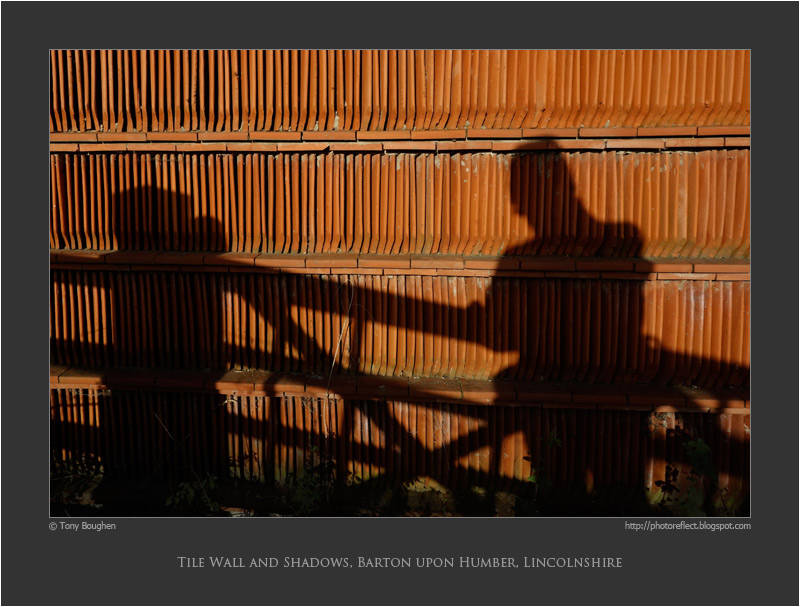
Tile walls, Barton upon Humber

click photo to enlarge
Along the southern bank of the River Humber, on each side of the Humber Bridge and adjacent to the town of Barton upon Humber, is a string of pools. Today many of them are nature reserves or are used for dinghy sailing. However, they almost all have their origins as clay pits dug for the raw material of tile and brick making. Today tiles are still made there. The company of William Blyth, established at Barton in 1840, continues to manufacture roof tiles - pantiles, plain tiles, French tiles, corrugated tiles and much more - using local clay and traditional methods.

A majority of the housing and farm buildings of the county of Lincolnshire are brick built with tile roofs. Companies such as William Blyth supply roof tiles for the renovation of old buildings and for new buildings that follow the traditional pattern. In the area immediately around the tile works damaged tiles and sometimes new ones are also used for the construction of perimeter walls and some constructional walls. For example, the works of the supplier mentioned has a pierced wall made of various kinds of pantile (see smaller photo), a cheap way of marking the boundary of the tilery. The wall in the main photograph is made plain tiles and is part of an ancillary building of "Water's Edge", a multi-purpose visitor and business centre of 2006 by the edge of the Humber. The designers (Gerard Bareham Architects) of this very modern looking building deliberately made use of the local roof tiles. More than that, they consciously followed the unusual practice of building and facing some of the structure's walls with them.

photograph and text © Tony Boughen

Photo 1
Camera: Sony RX100
Mode: Aperture Priority
Focal Length: 10.4mm (28mm - 35mm equiv.)
F No: f5
Shutter Speed: 1/800
ISO: 125
Exposure Compensation:  -0.3 EV
Image Stabilisation: On

Wednesday, July 18, 2012

Clouds, letters and imagination

click photo to enlarge
"Clouds That Look Like Things" is the very accurate title of book available from the Cloud Appreciation Society*. The photographs for the publication were supplied by Society members and come from all over the world. Flying saucers, fish, dragons, people - you name it and someone, somewhere has probably photographed a cloud that, with a little imagination, looks like it. When you think about it, it's quite an obvious subject for a book. Who, as a child, hasn't stared at the clouds and seen the profile of a face, the outline of a castle, a bird or some other shape momentarily formed then slowly dissipating into an amorphous, cotton wool-like mass? If you're like me you see such things still.

But, as I discovered the other day, sometimes clouds, like people, feel the need to break the chains of their everyday existence and venture into situations new and challenging. I was photographing the "Water's Edge" visitor centre in Barton upon Humber, Lincolnshire. I'd taken shots inside the building, and I was looking for some of the exterior. One end of the building has a very prow-like canopy that reaches out to an area of tarmac where cars can be parked. I walked away from the building, turned round, put on my wide-angle lens and raised the camera to my eye. Immediately, what hadn't been apparent in my unencumbered field of view, suddenly became very obvious within the confines of the viewfinder. Clouds were forming the letter "Z" in the sky. More than that, they were making it right next to what, with a little imagination, was the letter "A". What a fortuitous conjunction - A to Z! What are the chances? Why have I never seen anything like it before? Perhaps, I thought, these were rogue clouds, clouds that wanted to extend their aerial art by combining it with earthly shapes. Perhaps the "letters" in my photograph are forerunners, the avant garde, the shape of things to come.

*I am a proud member with a certificate, number and badge to prove it!

photograph and text © Tony Boughen

Camera: Canon
Mode: Aperture Priority
Focal Length: 17mm
F No: f7.1
Shutter Speed: 1/500 sec
ISO: 100
Exposure Compensation:  -0.67 EV
Image Stabilisation: On

Sunday, July 15, 2012

Glass blocks and connections

click photo to enlarge
Earlier this year we visited Peterborough Museum. It had re-opened after undergoing a refurbishment and very interesting it was too. The building itself started life in 1816 as a fine Georgian mansion but its time as a private residence was relatively short-lived because in 1857 it became the city's first hospital, a role that it fulfilled until 1928. The operating theatre from those days remains and is now an exhibit within the museum. When we entered that room with its white tiled walls, sinks, stainless steel and utilitarian atmosphere I was reminded, fairly appropriately I thought, of some late Victorian and early twentieth century butchers' shops. The easily cleaned surfaces from which blood could readily be swilled were very similar. The other thing that came to mind was the kind of clinical-looking modern kitchens that fill the pages of some magazines.

Connections of this kind are a very strong influence on what people buy and on how they view things. For example, I could never buy a pair of grey trousers because they would remind me too much of the uniform that I had to wear as a schoolboy. It was associations and how they affect how we see the world that came to mind on a recent visit to Water's Edge, Barton upon Humber. This fairly new Lincolnshire building combines a visitor centre and offices on land next to the River Humber. It is an aggressively modern design that, in places, makes use of glass blocks (sometimes called glass bricks). I've written elsewhere in this blog about my liking for these blocks. At Water's Edge they have been used to form short sections of north-facing walls. The regular grid, subdued light transmission, and translucence that simplifies the outside view making it a semi-abstract experience, drew the photographer in me. I took a shot of the wall, then realising that the irregularity of the human form would make a good contrast to the regularity of the grid, I asked my wife to stand in front of it.

As we wandered off to take shots of the Humber Bridge I reflected once more that there isn't enough use made of these blocks in Britain, and perhaps that's associational. They found some use in the 1950s, often in places such as bus stations, public toilets, the stairwells of flats and such like. Less often were they used in private houses (except determinedly modern higher cost examples) or for their decorative qualities rather than their utility. Perhaps those early uses coloured people's view of glass blocks and that memory will have to fade before they can be more widely adopted.

photograph and text © Tony Boughen

Camera: Canon
Mode: Aperture Priority
Focal Length: 36mm
F No: f7.1
Shutter Speed: 1/320
ISO: 100
Exposure Compensation:  -0.67 EV
Image Stabilisation: On