Showing posts with label rain. Show all posts

Wednesday, December 14, 2016

A rainy London scene

click photo to enlarge
Maybe it's the photographer in me, but I quite like London in the rain. Certainly the photographs that ensue don't look anything like the tourism shots that are used to promote the city: those glow with sun and blue skies and only tell part of the story. The fact is Britain has a temperate maritime climate that features regular wind and rain that comes in from the Atlantic. And with that rain is the inevitable cloud. So a photograph such as today's is not untypical of the kind of image that a visit to London can produce. Lest I be accused of frightening away potential visitors it needs to be said that the weather changes frequently and quickly, so rain  is a temporary inconvenience (or charm).

My photograph shows the most recent version of the London double-decker bus pulling away from a bus stop, a black taxi exiting the frame on the right, people under umbrellas,and a backdrop of part of St Paul's cathedral, Christopher Wren's magnum opus. What I like about shots such as this is the lights, the darkness contrasted with them and the pools of illumination that they provide, the shine of rain on tarmac, and the deep colours. A similar photograph taken a few years ago, but featuring modern architecture, still serves as the desktop photograph on my laptop, a testament to my predilection.

photograph and text © Tony Boughen

Photo Title: Rainy London near St Paul's Cathedral
Camera: Sony RX100
Mode: Aperture Priority
Focal Length: 12.9mm (35mm - 35mm equiv.)
F No: f4
Shutter Speed: 1/40
ISO: 1250
Exposure Compensation:  -0.7 EV
Image Stabilisation: On

Sunday, December 11, 2016

Thoroughfares and short cuts

click photo to enlarge
On a recent day in London we spent a lot of time on the highways and by-ways of the central and north central area of the city. Highway as its name implies means "main way" or route, and a by-way is a route other than the highway i.e. a side road or a less frequented, subsidiary route. We were using the main roads to get to smaller roads and passages to see some of the less obvious architecture of London, and some of the placenames and relics of former times. The terms thoroughfare and short-cut seemed more appropriate to describe what were doing because in the hierarchy of roads, Fleet Street was as big as we got and St Swithin's Lane the smallest. "Thoroughfare" today often implies a main road because its derivation is from the word "through" and "passage", in the sense of a route that is open and unhindered. And taking short-cuts down narrow lanes was what we were doing quite frequently.

The line of many of the routes in London would be familiar to medieval city dwellers because the properties that line them are still there in some instances and have been respected by later buildings in others. St Swithin's Lane, connecting Cannon Street with King William Street, is a case in point. However, that medieval person would wonder where the old church of St Swithin that bordered the lane has gone. The answer is that the medieval building was burned down in the Great Fire of London in 1666, rebuilt in the Renaissance style by Christopher Wren, and that this building was badly damaged by bombing in the second world war, and its remains were cleared from the site in 1962. Today the buildings along the lane date from the nineteenth, twentieth and twenty-first centuries.

Our evening walk between Tube stations took us down this modern short-cut, brollies up to counter the heavier rain, our passage lit by light spilling from brightly illuminated, empty offices.

photograph and text © Tony Boughen

Photo Title: Evening, St Swithin's Lane, London
Camera: Sony RX100
Mode: Aperture Priority
Focal Length: 10.4mm (28mm - 35mm equiv.)
F No: f4
Shutter Speed: 1/30
ISO: 5000
Exposure Compensation:  -0.3 EV
Image Stabilisation: On

Tuesday, July 12, 2016

Rain, King's Cross Square

click photo to enlarge
It has been an unusual summer with rain actual, and rain metaphorical being unleashed upon our islands. I could say so much about "Brexit" rain but will restrict my remarks to the collective national folly of allowing the person who has been quite the worst prime minister of my lifetime to put party unity before country and leave us, through his ill-advised referendum, in a place not of our collective choosing. That is the polite version!

Now for the the wet stuff. It hasn't actually rained every day this summer, but it feels like it has because we've had more wet days than usual. Moreover, I say this as someone who for the past nine years has lived in the drier east of England. But here too rain has followed more rain. As we've travelled about the country we've experienced rain wherever we've gone, with one exception. Very unusually our week in Settle in the Yorkshire Dales was dry. However, as we left - we were five minutes down the A65 on the way to Skipton - when a phone call told us that the town was experiencing a torrential downpour! All we saw of it was a beautiful rainbow over the Ribble valley.

A couple of recent London visits have coincided with rain, mainly showers, though some very heavy. As we waited at King's Cross for our train recently the heavens opened and people ill-prepared for precipitation had to sprint for cover. Today's photograph shows the equipped and the unequipped making bee-lines for the cover of the concourse. I took my photograph from under a large canopy!

photograph and text © Tony Boughen

Photo Title: Rain, King's Cross Square, London
Camera: Olympus E-M10
Mode: Aperture Priority
Focal Length: 80mm (160mm - 35mm equiv.) crop
F No: f5.5
Shutter Speed: 1/160 sec
ISO:640
Exposure Compensation: 0 EV
Image Stabilisation: On

Thursday, June 23, 2016

Hackney graffiti

click photo to enlarge
Over the years I've mellowed a little with regard to graffiti. I still dislike "tags" and the graffiti that is piled up one surface on top of another as spraycan-equipped passers-by superimpose their graphic on top of that of earlier "artists". However, I am better disposed towards the considered piece that seeks to add something of beauty, interest or humour to the street-scene.

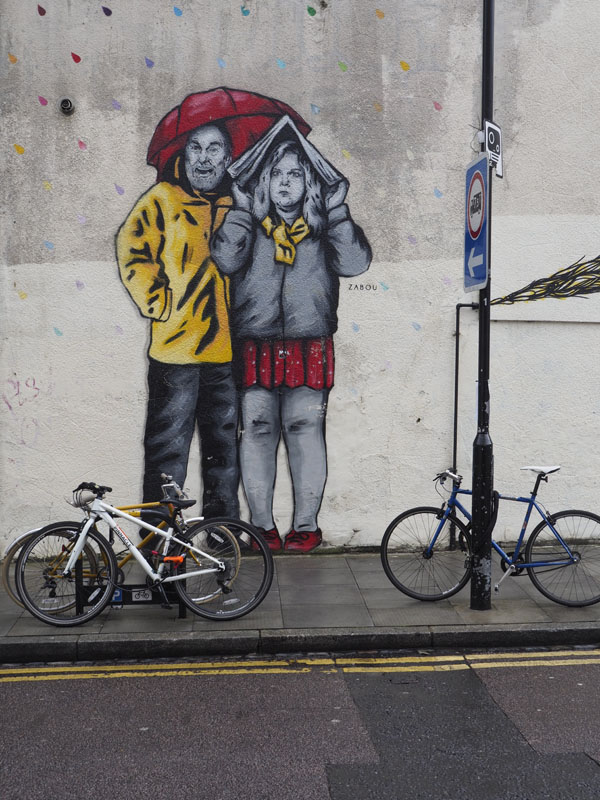
We came upon today's example in Hackney, London. It isn't particularly accomplished drawing and doesn't seek to make any obvious point, but I like the restricted pallette, it brightened up a street corner and it caused me to wonder why the raindrops were multi-coloured. The piece also causes something of an optical illusion due to the figures being much larger than life-size. This has the effect, at first glance, of making the bicycles appear to be under-sized or children's bikes. As Isay, nothing profound, but nothing offensive either, and on a wet day the subject resonated..

photograph and text © Tony Boughen


Wednesday, January 27, 2016

Wet weather photography

click photo to enlarge
I'm not really an all-weather photographer. Some of my equipment is weather-sealed but by no means everything. Moreover, many of the subjects I choose don't particularly lend themselves to rainy days. However, I do like to take photographs in wet weather as this blog shows. I appreciate the reflections that these days bring, especially when the light levels fall in heavy showers and during the evening. My umbrella comes in handy at these times and so does my photographic assistant a.k.a. my wife.

But, I also like to take photographs from the car in wet weather. My fondness for blur and semi-abstract images is frequently rewarded by shots through the car windscreen. Today's photograph was taken after we'd dashed back to the car as a heavy shower enveloped us. The raindrops on the windscreen, the condensation from our wet hair and clothes, and the almost monochromatic world on view all appealed. Even more visually enticing was the fact that some drivers turned their lights on in the temporary gloom and added points and bands of strong colour that acted as highlights to the scene.

photograph and text © Tony Boughen

Photo Title: In The Rain Through The Windscreen
Camera: Sony RX100
Mode: Aperture Priority
Focal Length: 37.1mm (100mm - 35mm equiv.)
F No: f4.9
Shutter Speed: 1/125 sec
ISO:320
Exposure Compensation: -0.3 EV
Image Stabilisation: On

Thursday, January 15, 2015

Landscapes and aspect ratios

click photo to enlarge
After thirty odd years of shooting 35mm film with an aspect ratio of 3:2 I shot with Four Thirds cameras for a few years. These had an aspect ratio of 4:3. To my surprise I found I preferred it to 3:2, particularly for portrait format shots. When you turn a 3:2 camera so that the long side is vertical it seems to me that the aspect ratio doesn't work so well as when it is horizontal (landscape format) - it's simply too tall. There are a few subjects that benefit from a taller shape (and a very few where 16:9 is best) but not too many. I definitely preferred 4:3 in those circumstances. For landscapes, streetscapes and general photography 3:2 was, by and large, fine, but not better than 4:3 and sometimes too long.

Since I've returned to 3:2 with Canon, Nikon and Sony, the three makes I use now, I've generally shot 3:2 and where I've particularly felt it looked wrong (in horizontal or portrait format), I've cropped to 4:3. Today's photograph is a case in point. When I composed the shot I knew I wanted the verticals of the two medieval churches in the shot. However, I also wanted the full width of the street. On a wet day with an overcast sky 3:2 left too much boring grey cloud in the top half of the photograph. Consequently, I shot at 3:2 knowing I would crop to 4:3. Those of you who know the Sony RX100 might wonder why I didn't dive into the menu and set the camera to 4:3. The fact is I find it easier to stick with the same aspect ratio (3:2 is native and the highest resolution) across all the cameras to benefit from a consistent view and maximum pixel dimensions. To do otherwise would be for me, just too confusing, too tedious, and would deny me the best image where 3:2 is the ratio I want.

On the other hand, if Sony had done what Panasonic did with the LX3 (and other LX models), a camera that I owned until it died, and had put the aspect ratios round the lens barrel selected by a click stop switch, then I just might have set 4:3 before shooting.

photograph and text © Tony Boughen

Camera: Sony RX100
Mode: Aperture Priority
Focal Length: 20mm (54mm - 35mm equiv.)
F No: f4.5
Shutter Speed: 1/100
ISO: 125
Exposure Compensation:  - EV
Image Stabilisation: On

Tuesday, December 30, 2014

A public lounge?

click photo to enlarge
Words come and words go. I learnt the other day that "bae" has been added to the Oxford English Dictionary (OED). Apparently this word is used by many young people on social media to mean "before anyone else" i.e. their nearest and dearest, significant other, the person (or even thing) to whom (or which) they attach most importance. I've listed elsewhere in this blog several words such as paling, aerodrome and petticoat, terms that in my childhood were widely used, that today have fallen almost completely out of use. We shouldn't lament the birth and death of words unless the newcomers replace perfectly good synonyms or the departures carry a meaning that becomes lost when it is is still needed.

But, there is a modern way with words about which we should be concerned. I refer to the use of a perfectly serviceable and widely used word for a different meaning: a usage that confuses, is lazy or is just plain stupid. One of my early blog posts concerned the appropriation of the word "boutique" by hoteliers in the term "boutique hotel". The original English meaning of boutique was principally, a small shop, or by extension an independent shop, specialising in fashionable clothing. The wider use referring to exclusive, upmarket services appears to have been coined in the U.S. and then applied widely. It reminded me of Lewis Carroll's Through the Looking Glass" where Humpty Dumpty says, "When I use a word it means just what I choose it to mean, neither more nor less."

That quotation came to mind when I looked up details about a photograph I took in London over Christmas. What I'd assumed was Deptford Library is actually grandly and confusingly titled "Deptford Lounge". Now the word "lounge" is today more usually associated with "departure lounge", but in my childhood it was a synonym for "living room" or "sitting room" (the latter also on the way out). What, I wondered, could have caused the local authority to call the building a "Lounge"? Was it a place of rest and repose? A gathering place of loungers? A public sitting room? All these are OED definitions of the word. In fact, this large building provides a range of community services including a public library, computer labs, study areas, a café, room hire and a roof-top ball court. None of these, apart from perhaps the café, incorporate lounging. So why the silly name?

Why too, I wondered, the external screen wall of pierced metal? This feature made me think the building was designed to survive urban unrest because it reminded me of the clip on panels that tanks and APCs sometimes wear that are designed to cause ant-tank rockets to explode early before penetrating the body of the vehicle. What were the councillors of Deptford expecting? A quick look at Architecture Today tells me that the architects, Pollard Thomas Edwards chose the cladding "...to symbolise cultural richness, the facades comprise a perforated brise-soleil constructed from gold-coloured, Aurubis Architectural Nordic Royal copper alloy panels. In addition to its aesthetic appeal, the material was favoured for its durability, long lifespan and environmental credentials." Who would have thought it?

photograph and text © Tony Boughen

Camera: Sony RX100
Mode: Aperture Priority
Focal Length: 10.4mm (28mm - 35mm equiv.)
F No: f5
Shutter Speed: 1/80
ISO: 125
Exposure Compensation:  -0.3 EV
Image Stabilisation: On
 

Wednesday, December 03, 2014

The dead blue tit

click photo to enlarge
This dead blue tit (Parus caeruleus) was on the gravel near our back door when we went out the other day. Its lifeless body retained something of the beauty of the living bird, especially the blended, muted blues, greens and yellows. The night had sprinkled jewels of rain on its inanimate form, the smooth rounded shapes contrasting with the detail of the feathers, and giving them a quality rarely seen in life.

How had it died? It clearly wasn't a cat or a sparrow hawk that had caused its demise - the body was too perfect and uneaten. My guess is that it hit one of our windows, momentarily deceived by a reflection that it mistook for reality. As I took a quick photograph before we went shopping I reflected on the colour of its legs. Though I've seen plenty of blue tits in my time, with the naked eye and through binoculars, I've never noticed that they have blue legs. I'll make a point of looking at them on the seed and nut feeders over the next few days to see if they do, or if the colour appeared only after death.

photograph and text © Tony Boughen

Camera: Sony RX100
Mode: Aperture Priority
Focal Length: 10.4mm (28mm - 35mm equiv.)
F No: f2.2
Shutter Speed: 1/25 sec
ISO: 100
Exposure Compensation: 0 EV
Image Stabilisation: On

Wednesday, January 29, 2014

Rain over the Humber Bridge

click photo to enlarge
How long does it take to judge the quality of a photograph? I'm thinking more about the "keepers", not the ones I cull immediately. How long is it before I consider them to be one of my better efforts or one of the much larger, "O.K" group? You might think that an odd question since quality must always shine through. However, I think that most people can more quickly judge quality in other photographers' images than their own. Photographs that you and I make carry more information and have more invested in them by us, than do those made by strangers. We know the circumstances in which we make our own photographs, where the image stands alongside other versions of the same shot, any difficulties overcome in securing it, etc. In other words we don't always judge it solely on its photographic merit, whereas that is something we can much more easily do with the work of a stranger.

So, how long does it take to judge the quality of a photograph? For me, I know that if I live with it for a couple of weeks I've usually come to a settled opinion as to its worth. That is the point at which I confirm a judgement made earlier, whether good or bad, or more often, slightly shift one way or the other from my initial thoughts, making a promotion or demotion if you will. Of course, when you run a blog that has the self-imposed task of showing a new photograph every other day, then sometimes you run low on images, and the luxury of considering one for a fortnight becomes impossible. Today's photograph is a case in point. It was taken on Sunday, was one of only three shots taken on the day (yesterday's post shows another), and I haven't really made my mind up about it. One thing I do like, that probably tipped me into using it before some other, older photographs, is the way it conveys a certain type of wet, English winter day, with its leaden sky and reduced visibility. The other thing that appealed to me was the contrast of the brown and greens of the grass and reeds with the monochrome sky, river, bridge and trees.

photograph and text © Tony Boughen

Camera: Sony RX100
Mode: Aperture Priority
Focal Length: 18.2mm (49mm - 35mm equiv.)
F No: f5.6
Shutter Speed: 1/250 sec
ISO:125
Exposure Compensation: -0.3 EV
Image Stabilisation: On

Monday, January 27, 2014

Rainy days

click photo to enlarge
There are a number of reasons why I moved to eastern England. One of them is to experience the drier weather. I was born and raised in north-west England, a part of the country known for its regular and relatively high rainfall. I lived in Hull for a number of years and experienced there something of the drier weather that side of the country offers. But then I moved back to west Lancashire for about twenty years, once again subjecting myself to the wetness of the west. Now, however, living in Lincolnshire, I find that my love of the great outdoors is more easily sated and need not incur the drenchings that accompanied more than a few forays in the west. Moreover, I can usually plan to do something outdoors without needing to calculate whether or not it will be rained off - because it usually isn't.

Consequently, the recent days, most of which seem to have included a spell of rain at some point or another, have been something of a let-down. I've come to expect better! Or at least, different. It even poured down for much of our regular monthly trip north, over the Humber Bridge, into Yorkshire. So, with the expectation that I couldn't insert any photography based detours into our itinerary, we decided to do the weekly shopping a little earlier than was required, thereby making the most of the day that way instead. Today's photograph was taken after we'd parked in the supermarket car park, just before we scurried into the dry in search of groceries. The darkness of the afternoon, the rain-spattered windscreen,the glistening cars and tarmac, and the early lights necessitated by the murk of the day, offered one of only three photographs I took on the whole outing. Not my greatest shot, but not without some interest I think.

photograph and text © Tony Boughen

Camera: Sony RX100
Mode: Aperture Priority
Focal Length: 15.3mm (41mm - 35mm equiv.)
F No: f5.6
Shutter Speed: 1/50 sec
ISO:800
Exposure Compensation: -0.3 EV
Image Stabilisation: On

Friday, October 11, 2013

The photographic attractions of rain

click photo to enlarge
The other evening we were in the Lincolnshire town of Louth. Unusually I wasn't there with photography in mind. However, I was carrying my pocket camera. As we walked up Eastgate, dodging the showers and occasionally pausing in closed shop doorways as the downpours intensified, I admired the reflections of the car headlights on the wet road, the glow from the street lamps and the brightness of the windows that were still lit. Those features, together with the light that remained in the cloudy sky, suggested a photograph and so I took several quick shots. This is the best of the bunch with its balanced composition achieved by the road and buildings leading from the main point of interest, the prominent car on the right, to the secondary point of interest,the church spire on the left.

As we continued to the business that brought us to the town I reflected on how something as unpromising, and often unwelcome and unpleasant, as rain can change a scene so that it becomes a much better subject for a photograph. It's essentially those reflections on the wet surfaces of the roads and pavements that effect the transformation, multiplying the highlights against the dark background. It reminds me of the way the sea or any stretch of water magnifies the power of a sunset.

Over the years I've found rain both a fruitful subject in itself and a great enhancer of a subject. Raindrops on the window pane can make a fascinating subject when paired with good light and an interesting background. So too can raindrops on leaves or flowers. And familiar subjects can be transformed when bright sunlight and fair weather is eschewed in favour of a downpour, even if you are sheltering under an umbrella at the time.

photograph and text © Tony Boughen

Camera: Sony RX100
Mode: Aperture Priority
Focal Length: 24.1mm (65mm - 35mm equiv.)
F No: f4
Shutter Speed: 1/80
ISO: 1600
Exposure Compensation:  -1.0 EV
Image Stabilisation: On

Saturday, April 27, 2013

Advertising puzzles me

click photo to enlarge
Ever since the invention of the TV remote control our household has muted the adverts. Consequently I am unable to take part in conversations about such things since, while I may have seen the advert in question I won't have heard it. Choosing to avoid advertisements seems to me a perfectly reasonable thing to do, though I know not everyone will agree. The fact is I can't understand why we should willingly co-operate with companies trying to sell us things we neither want or need.

The particular pitches that advertisers choose puzzles me too. Take celebrity endorsement. We all know that such people are paid to either wear, use or promote the product in question. That being the case, why would we be influenced by the blandishments of David Beckham, George Clooney, Sienna Miller (whoever she is) or anyone else? Or what about the way so-called "up-market", that is to say expensive, products are sold. Muted, often monochrome colours, plenty of white space in print advertisements, few words but in classic fonts, "under-stated" design, models that don't smile and other "less is more" tricks are used to suggest that a product sits at the top of its market. But if all this is obvious - and surely it is - why do advertisers persist with it and why are buyers influenced by it? Perhaps the pitches are not as unsubtle as I think, or maybe people want to believe it all and suspend their critical faculties in such situations.

I pondered advertising methods recently after coming upon a whisky company publicising its wares outside The Design Museum in London. They'd set up a framework from which models of dark clouds were suspended, a sound system was simulating thunder, flashing lights represented lightning, and heavy rain periodically fell on members of the public who volunteered to stand in the centre of all this wearing brand name-emblazoned waterproofs  and similarly badged umbrellas. Apparently the word "storm" featured in the whisky's name and the "weather" was intended to give the public a taste of what is regularly experienced on the Isle of Skye whence the drink comes. Oh, and the lucky punters who subjected themselves to this ordeal had the chance to win a bottle of the beverage. I suppose my reaction could be best described as bemused, so i took a couple of photographs and walked on.

photograph and text © Tony Boughen

Camera: Sony RX100
Mode: Aperture Priority
Focal Length: 37.1mm (100mm - 35mm equiv.)
F No: f4.9
Shutter Speed: 1/80
ISO: 800
Exposure Compensation:  0 EV
Image Stabilisation: On 

Wednesday, July 11, 2012

Ruskin, weather and contre jour

click photo to enlarge
"Sunshine is delicious, rain is refreshing, wind braces us up, snow is exhilarating; there is really no such thing as bad weather, only different kinds of good weather." John Ruskin (1819-1900) English art critic and author


Though an active supporter of the Pre-Raphaelites and a firm believer in the primacy of painting over all other visual arts, John Ruskin took a keen interest in photography and used a camera. He was one of the subscribers to Eadweard Muybridge's 1887 publication, "Animal Locomotion, an Electro-Photographic investigation of consecutive phases of animal movements." In 1856 he made daguerrotypes of the towers of the Swiss Fribourg, also drawing them freehand, then comparing the results. His view was that the photograph was "more right" but that the sketch "nevertheless conveys, in some respects, a truer idea of Fribourg than the other, and has, therefore, a certain use." Though he was thinking in artistic terms I am sure Ruskin would not have been slow to spot the continuing use today of technical drawing rather than photographs to illustrate car, camera and many other instruction manuals, and to use this as further proof of the value of drawing over photography.


His views on weather are ones I share, particularly from a photographic point of view, though our recent extended wet spell is testing me. Extremes of weather offer "different" kinds of images to the photographer. Snow, fog, rain and the rest, though presenting certain difficulties that fair weather doesn't, nonetheless give the opportunity for photographic drama, simplicity, contrast and much else. The recent wall-to-wall rain that has beset the British spring and summer briefly cleared one recent afternoon and we took the opportunity to venture out for a walk. The roads were lined with deep puddles that hadn't drained away, the tarmac glistened, reflecting the sun, and the ragged clouds offered every shade of grey. I caught my wife with this contre jour shot as she wended her way between the pools of water. When I looked at it on the computer screen I liked the deep contrast and almost moonlight feel to the image that appeared when I converted it to black and white. It was, I reflected, a photograph that could only have been taken in this kind of Ruskinian good weather.

photograph and text © Tony Boughen

Camera: Lumix LX3
Mode: Aperture Priority
Focal Length: 7.9mm (37mm/35mm equiv.)
F No: f8
Shutter Speed: 1/1600
ISO: 80
Exposure Compensation: -0.66 EV
Image Stabilisation: On

Monday, June 11, 2012

Banish weather forecasters

click photo to enlarge
In the UK, over the years, the profile of the TV weather forecaster has risen to the point where they are now seen as familiar figures with names and "personalities". Their exposure to the public now goes well beyond telling us about the weather and exchanging a few cheery banalities with the news presenters when their spot has ended. Some undertake public engagements, others feature in newspaper and magazine articles. Their dress, utterances, private lives and more are presented to the public by the media with the assumption that we will be interested. How has this change come about?

There seems to be, on the part of television in particular, a desire to make the weather forecast more exciting, more interesting, something to stay tuned for rather than a respite from regular programming when the audience might go off and make a cup of tea. The presenters themselves have been complicit in this. The problem with it is not just the flim-flam associated with the cult of personality: more importantly the weather forecasts are regularly skewed as a consequence. So, wet weather is presented as "bad", hot sunny weather as "good" or to use the favoured description of one male BBC presenter, "glorious". Of course, quite a few sectors of society (farmers, ice cream sales people, gardeners, etc) will not share this point of view but they seem of little consequence. Continuing "bad weather" is often reported with relish to the point where the forecaster appears to adopt the guise of a Jeremiah. Then there's the technology; the swooping camera, the animated symbols, and the specific forecast for whatever is the current newsworthy sports event. If the weather is stable (or in the presenter's eyes, "boring") the forecast is often livened up by a report about extreme weather somewhere else in the world. Why we need to know about Indonesian typhoons, mid-western tornadoes, droughts in Australia, or flooding in Bangladesh during the UK weather forecast just because the presenter needs to "sex it up" a bit, I really don't know. My answer is to banish the presenters, to have a simple voice-over connected to a visual presentation of the current weather and the weather that is anticipated for the next twenty four hours. That way we might get a little more sanity in the forecast and people might take notice of it rather than the wide-eyed, enthusiastic, over-gesticulating presenter.

Today we went to Peterborough to do a little shopping. The weather forecast was accurate I'm happy to report and we had the anticipated rain. I hope tomorrow the dry weather that was promised materialises because I have some hedges to trim. The subject of today's photograph is the Old Guildhall of 1671 in the Market Place at Peterborough. It is flanked by the church of St John the Baptist which was rebuilt in 1402-7 from the material of the old church and the nave of the now no longer extant, St Thomas. I used the medieval Outer Gate of the cathedral precinct as shelter from the rain as I took my photograph of the damp scene.

photograph and text © Tony Boughen

Camera: Canon
Mode: Aperture Priority
Focal Length: 84mm
F No: f7.1
Shutter Speed: 1/100
ISO: 200
Exposure Compensation:  -0.33 EV
Image Stabilisation: On

Saturday, April 14, 2012

Eyes, mind and camera

click photo to enlarge
Displayed on a chest of drawers in our house is a beige, glazed, clay model of an animal. It has big ears, a wide mouth and, on each side of its body, green, feathered wings. Its tail is broad, notched, and may be either feathers or hair. The general posture, if I can call it that, resembles the way a dog sits with its front legs straight and the rear legs folded under. Except that those back legs are bent the wrong way and look more like a person's would if they were kneeling. The mythical beast, which has elements of the griffin and Pegasus about it, is a treasured possession that was made by my youngest son when he was young. He must have used his memory when he modelled the back legs of the animal, because if he'd followed an actual precedent, as he did for the rest of the animal, he'd have got them right.

Our eyes and mind often deceive us in this way. We look at something and create an internal picture that is at variance with reality. Sometimes that is because we mis-interpret the subject, but other times it's because we can't clearly see the phenomenon in question. A classic example of the latter relates to the eighteenth century and earlier paintings and drawings of running horses, with their front legs stretched forwards and their back legs stretched rearwards. It was only when the English-born photographer, Eadweard Muybridge, in the nineteenth century, ran a series of sequentially taken still photographs rapidly one after the other, that the truth of the horse's gallop became clear.

I was reminded of this when I leaned out of a bedroom window to take some photographs of rain falling on our water lily pond below. When I varied the shutter speed of the camera I recorded different versions of the effect of the drops hitting the surface of the water. None of them precisely matched what I thought I was seeing with my own eyes. The shot that I've posted today is quite close but the camera saw the shadows of the ripples on the surface of the pond much darker and in greater numbers than they appeared to me. However, it's an effect that I like, and it adds a semi-abstract, unifying layer over the young leaves and dead strands of vegetation. I frequently take photographs of this pond in spring when the lily leaves unfurl below the water, and in autumn when they die back from whence they came. Why this time of year should appeal to me more than summer when the multiple showy flowers are in full bloom I leave you to work out.

photograph and text (c) T. Boughen

Camera: Canon
Mode: Aperture Priority
Focal Length: 300mm
F No: f7.1
Shutter Speed: 1/320 sec
ISO: 3200
Exposure Compensation:  0 EV
Image Stabilisation: On

Tuesday, January 03, 2012

Co-operating with the inevitable

click photo to enlarge
"If at first you don't succeed - give up!"
anonymous modified proverbial saying

Perseverance, they say, is one of the main qualities that produces success. Intelligence, education (not the same as intelligence), aptitude, money, connections and other desirable attributes are all important, but if you haven't got perseverance then there's a good chance you won't achieve your goals. Moreover, if you do have perseverance but are lacking one or more of those other qualities then you may well succeed anyway. I think that's something that many people learn in life. And just as many don't. They are the people who follow the counsel quoted above.

Perseverance can be summed up in a home-spun sort of way in the proverbial saying, "If at first you don't succeed, try, try, try again." That's sound advice, and following it can take people a long way. However, there comes a time when perseverance is pointless because you can clearly see that no good consequences will come from it. In these instances the modification of the saying proposed by W.C. Fields has a lot to recommend it: "If at first you don't succeed, try, try, try again. Then give up. No use being a damned fool about it."

A variation on this kind of advice that I've always liked says that sometimes it's wise to "co-operate with the inevitable." In other words, don't persevere where success is clearly unattainable: if the alternative is in some way satisfactory, just go with it. It was this kind of thinking that produced today's photograph. I'd gone out on an afternoon that the weather forecasters promised would be "changeable". I expected squally showers alternating with periods of sun with dramatic clouds. Well, I got about thirty minutes of that. Then, as I sat in the car park in the centre of the village of Folkingham a squall turned into a spell of prolonged heavy rain. After about forty minutes I said to myself, "It's time, Tony, to co-operate with the inevitable." So I did, took this photograph of the rain through my windscreen, then drove home. And, yes, as I turned into the road leading to my house, the sun made an appearance.

photograph and text (c) T. Boughen

Camera: Canon
Mode: Aperture Priority
Focal Length: 40mm
F No: f6.3
Shutter Speed: 1/40 sec
ISO: 360
Exposure Compensation:  -0.67 EV
Image Stabilisation: On

Monday, February 28, 2011

Reflected in the mirror

click photo to enlarge
Walking in the rain along a London street near St Pancras railway station the other day we came upon a shop selling picture frames and mirrors of all descriptions. It was one of those businesses that can thrive on a large scale only in a city. Passing its sequence of rather grubby and rain flecked windows we saw mirrors of various kinds, including the "sunburst" designs that were fashionable from the 1950s through to the 1970s, and which have re-appeared in recent years. Then we saw this rather odd looking mirror, of a shape that reminded me of a traditional English garden gate minus the diagonal bracing piece. As we studied it I saw the reflections, and the potential for a photograph, so I took out the LX3 and snapped this shot.

Earlier in the day we'd been to the Museum of London and seen the "London Street Photography" exhibition. That kind of image isn't part of my usual repertoire, but I do admire good examples of the genre, and thought we'd take advantage of this free show. The fact that we were there on the day after it opened meant that it was quite crowded, and visitors were being allowed in only as others left. However, we arrived reasonably early, so it wasn't the inconvenience that it would have been later. But, I did buy a copy of the accompanying book to study the images at home at my leisure.

As I processed the photograph above I wondered if the exhibition influenced my photography during the rest of the day because I took quite a few shots that include people in the street.

photograph and text (c) T. Boughen

Camera: Lumix LX3
Mode: Aperture Priority
Focal Length: 12.8mm (60mm/35mm equiv.)
F No: f2.8
Shutter Speed: 1/125
ISO: 200
Exposure Compensation: -0.66 EV
Image Stabilisation: On

Monday, February 07, 2011

Rainy day photography

click photo to enlarge
I've never been much of a rainy day photographer. My cameras and lenses, by and large, have never been of the weatherproof variety, and photographing from underneath an umbrella, or with a cover over the camera has never appealed as a deliberate way of securing such images. That's not to say that I haven't photographed in the rain - I have, but it's usually been from cover such as a doorway, the car or a window. There is another reason too. Most of my photography takes place when I'm out and about with my wife, and we don't deliberately choose wet days for long walks, or to visit places of interest. But, when the weather does put a dampener on one of our days out, then I try to make the best of it and grab a shot if and when it's possible.

Today's photograph is a similar subject and similar weather to the second example I link to above - a market place on a wet day. I have a habit of repeating the subject of a photograph when I've taken a shot that I like. The view of Newark market place was a different kind of image for me, and when I saw this prospect from Spalding's South Holland Centre as I sipped my coffee, I couldn't help myself and took this similar kind of photograph. I usually find that the shots that arise in this way are substantially inferior to the original. This one, however, though not as good as the Newark photograph, has qualities that I like. In particular it seems to convey more of the dreary and oppressive nature of a cold, wet, heavily overcast January day.

photograph and text (c) T. Boughen

Camera: Lumix LX3
Mode: Aperture Priority
Focal Length: 12.8mm (60mm/35mm equiv.)
F No: f2.8
Shutter Speed: 1/160
ISO: 80
Exposure Compensation: -0.66 EV
Image Stabilisation: On

Friday, September 24, 2010

Oh no, not another bench!

click photo to enlarge
"Another unsettling element in modern art is that common symptom of immaturity, the dread of doing what has been done before."
Edith Wharton (1862 - 1937) U.S. novelist

The title of this piece wasn't exactly the phrase that my wife used when she watched me get up from our dry bench and start to photograph this nearby wet one, but it is the gist of what I thought was her rather hurtful remark (I'm a sensitive soul you know :). I've commented before on my predilection for photographing public seating. Some might think this an obsession, others a harmless character trait, and there will be those who see it as a mark of the lack of imagination in the photographer. However, in my defence I offer the quotation at the head of this piece. It is by the famous U.S. author, Edith Wharton, who was the first female winner of the Pulitzer Prize, in 1921, with her book, "The Age of Innocence". I make no claims for art in my photography, but I do think that mining the seam of a defined subject is a good way for any photographer to proceed.

Thinking further about the quotation it seems to me it is truer today than it was when it was made. Certainly many UK artists of the last twenty years have skipped from one subject to another, using a variety of media ranging from paint to concrete to elephant dung to dead animals to...well, you name it. I've often thought the productions of the likes of Damien Hirst and Tracey Emin to be shallow, juvenile, the sort of work where what you see is all there is. Edith Wharton's "that common symptom of immaturity" strikes a chord with me.
I used to think that my photographic ouvre was rather wide ranging, and I recall blogging a piece to that end. However, when I stand back and look at my output I've come to realise that I do plough a fairly defined group of furrows. And yes, one of them is public benches!

I took a few shots of this rather uncomfortable bench, including this one that is deliberately slightly overexposed. I was looking to de-emphasise the ground and adjoining wall, and, even though it took the detail out of some of the highlights on the bench itself, it's the photograph I prefer. This sepia-tone finish on a black and white conversion also appealed to me.

photograph and text (c) T. Boughen

Camera: Lumix LX3
Mode: Aperture Priority
Focal Length: 5.1mm (24mm/35mm equiv.)
F No: f2.8
Shutter Speed: 1/200
ISO: 80
Exposure Compensation: 0 EV
Image Stabilisation: On

Wednesday, June 02, 2010

Sheep, Penyghent and rain

click photo to enlarge
 Anyone who knows the Three Peaks of the Yorkshire Dales (Ingleborough, Penyghent and Whernside) usually has a favourite. And most people, when asked, name Ingleborough as the one they like best. It features in countless photographs and there's a lot to like about that particular mountain. It has a great flat-topped profile against the sky, the result of the differential erosion of the rocks in the Yoredale strata. Its location next to the Chapel Beck valley gives it a looming mass that is quite awe inspiring. And the limestone on and around Ingleborough is very prominent, adding to its rugged appeal. Then there's the Iron Age hill fort on its summit and the very accessible caves and potholes on its flanks. Whernside is usually placed third in this beauty contest. It is a lump of a peak, a whaleback that is difficult to pick out from some angles, and it doesn't have the characteristic profile that the other two share. Its proximity to Ribblehead railway viaduct is a plus, but its comparative anonymity is reflected in the much smaller number of photographs that it attracts.

However, my favourite is Penyghent. Why? Well, I could see it easily daily from Settle when I was growing up in that market town: I had to go on to the hills to view Ingleborough and Whernside. I noticed its changing moods and colours through each season. I walked to it and up it on a few occasions, and in later years climbed it with my family more than I did the other two. Then there's the clinching argument that means I could choose no other - in primary school I was in the "house" named Penyghent Blues! We competed against Ingleborough Yellows, Whernside Greens, and Pendle Reds (named after the Three Peaks and a Lancashire peak, all visible from in or around Settle).

It was only in later years that I learned that Penyghent is Celtic for "hill of winds", and that it is a monadnock (also known as inselberg) that stood above the glaciers that flowed round it in the recent Ice Age. In fact I know more about that mountain than I do about the sheep in the foreground of this photograph. They are a breed that is a more common sight in the Yorkshire Dales following the foot and mouth sheep culls of 2001. It must be one of the types listed on this informative website. But which one? I really can't decide.

I took my photograph from above Little Stainforth about half way through a walk that took in Giggleswick Scars and the valley of the River Ribble. Descending from the limestone near Smearsett Scar we were glad to see the rain enveloping the mountain rather than us!

photograph & text (c) T. Boughen

Camera: Olympus E510
Mode: Aperture Priority
Focal Length: 40mm (80mm/35mm equiv.)
F No: f5.6
Shutter Speed: 1/400
ISO: 100
Exposure Compensation: -0.3 EV
Image Stabilisation: On