click photo to enlarge
I've mentioned a few times some of the themes that have developed in my photography during the lifetime of this blog - chairs, benches, church vaulting, deliberate blur, shadows, reflections, to name but a few. Today's photograph is another - leaves.
I like leaves for their shapes, colours, lines and patterns. I also like them when frost subdues their colours, adds emphasising outlines to their shapes and lines, and gives a "hairy" look to leaves. The first few frosts of the year were weak, leaving only a little impression on the fallen leaves. But a few days ago stronger frosts made much better effects, good enough for me to mount the macro lens on the camera and search some out. The photograph shows the underside of a large field maple leaf that is surrounded by smaller leaves from the same tree and flowering cherry leaves from a neighbouring tree. Soon the leaves will have decayed too much for this kind of shot so I was glad to get it.
photograph and text © Tony Boughen
Photo Title: Frosted Leaves
Camera: Olympus E-M10
Mode: Aperture Priority
Focal Length: 60mm macro (120mm - 35mm equiv.)
F No: f6.3
Shutter Speed: 1/125 sec
ISO:800
Exposure Compensation: -0.3 EV
Image Stabilisation: On
Showing posts with label autumn. Show all posts
Thursday, December 08, 2016
Tuesday, December 06, 2016
Disused swimming pool
click photo to enlarge
The other day we came across, for the first time, the former outdoor swimming pool in Grantham. This facility in Wyndham Park opened to the public in the 1880s and offered bathing to the residents of the town until the 1970s. Since then it has been used as a skate park, and more recently has been the boating pool for the local model boat club.
On the day we saw it the pool had been drained and it held only leaves and an inch or two of rain water (just enough for a grubby reflection). I read that there are plans to remodel it, a project that includes demolishing some of the Victorian buildings that are on two sides of the water. I hope that the symmetrical block in today's photograph remains; it looks better than some of the others and would be a tangible link with the site's past.
photograph and text © Tony Boughen
Photo Title: Former Outdoor Swimming Pool, Grantham, Lincolnshire
Camera: Olympus E-M10
Mode: Aperture Priority
Focal Length: 36mm (72mm - 35mm equiv.)
F No: f6.3
Shutter Speed: 1/640 sec
ISO:200
Exposure Compensation: -0.3 EV
Image Stabilisation: On
The other day we came across, for the first time, the former outdoor swimming pool in Grantham. This facility in Wyndham Park opened to the public in the 1880s and offered bathing to the residents of the town until the 1970s. Since then it has been used as a skate park, and more recently has been the boating pool for the local model boat club.
On the day we saw it the pool had been drained and it held only leaves and an inch or two of rain water (just enough for a grubby reflection). I read that there are plans to remodel it, a project that includes demolishing some of the Victorian buildings that are on two sides of the water. I hope that the symmetrical block in today's photograph remains; it looks better than some of the others and would be a tangible link with the site's past.
photograph and text © Tony Boughen
Photo Title: Former Outdoor Swimming Pool, Grantham, Lincolnshire
Camera: Olympus E-M10
Mode: Aperture Priority
Focal Length: 36mm (72mm - 35mm equiv.)
F No: f6.3
Shutter Speed: 1/640 sec
ISO:200
Exposure Compensation: -0.3 EV
Image Stabilisation: On
Labels:
autumn,
Grantham,
Lincolnshire,
outdoor,
reflection,
swimming pool,
Wyndham Park
Sunday, December 04, 2016
Built to impress
click photo to enlarge
The first two houses that we bought and lived in suffered from a problem that many buildings have suffered from down the ages - more money was spent on the front than on the back and sides. One was built in the early 1900s and the other in the 1930s. In each case the quality of the bricks on the main elevation was better than those elsewhere. Ornament in the form of stone/concrete arches, oriel windows, and large bays appeared on the front, but not on the back, or where they did, in simpler, more pared down form. The fact is, those houses and many other buildings had relatively more money spent at the front for a reason that is obvious - to impress the buyer and passers-by. Interestingly, and refreshingly, this wasn't so pronounced in a house we bought that was built in the late 1970s. Our current house, part of which is oldish and part relatively recent uses the same quality materials throughout but has a much more "composed" facade.
Constraints of this sort did not affect the affluent builders of the country houses of the Georgian period - all elevations aimed to impress. At Belton House the main (south) facade and the rear (north) elevation are almost the same. The east elevation is composed with symmetry in mind, is flusher than either north or south, but then doesn't have the main entrances that those feature. Only on the west, where stables, courtyards and other ancillary buildings are found does the main house lose something of its imposing appearance. And here this is compensated for by those subsidiary buildings being large, ornate and monumental.Today's photograph shows Belton House's plainer east elevation from one side of the wide avenue of trees that frame it. Incidentally, my composition was prompted by the desire to find a composition that was a little different, that emphasised the building's setting, but also by a desire to minimise the featureless blue sky.
photograph and text © Tony Boughen
Photo Title: Belton House, Lincolnshire
Camera: Olympus E-M10
Mode: Aperture Priority
Focal Length: 42mm (84mm - 35mm equiv.)
F No: f7.1
Shutter Speed: 1/500 sec
ISO:200
Exposure Compensation: -0.3 EV
Image Stabilisation: On
The first two houses that we bought and lived in suffered from a problem that many buildings have suffered from down the ages - more money was spent on the front than on the back and sides. One was built in the early 1900s and the other in the 1930s. In each case the quality of the bricks on the main elevation was better than those elsewhere. Ornament in the form of stone/concrete arches, oriel windows, and large bays appeared on the front, but not on the back, or where they did, in simpler, more pared down form. The fact is, those houses and many other buildings had relatively more money spent at the front for a reason that is obvious - to impress the buyer and passers-by. Interestingly, and refreshingly, this wasn't so pronounced in a house we bought that was built in the late 1970s. Our current house, part of which is oldish and part relatively recent uses the same quality materials throughout but has a much more "composed" facade.
Constraints of this sort did not affect the affluent builders of the country houses of the Georgian period - all elevations aimed to impress. At Belton House the main (south) facade and the rear (north) elevation are almost the same. The east elevation is composed with symmetry in mind, is flusher than either north or south, but then doesn't have the main entrances that those feature. Only on the west, where stables, courtyards and other ancillary buildings are found does the main house lose something of its imposing appearance. And here this is compensated for by those subsidiary buildings being large, ornate and monumental.Today's photograph shows Belton House's plainer east elevation from one side of the wide avenue of trees that frame it. Incidentally, my composition was prompted by the desire to find a composition that was a little different, that emphasised the building's setting, but also by a desire to minimise the featureless blue sky.
photograph and text © Tony Boughen
Photo Title: Belton House, Lincolnshire
Camera: Olympus E-M10
Mode: Aperture Priority
Focal Length: 42mm (84mm - 35mm equiv.)
F No: f7.1
Shutter Speed: 1/500 sec
ISO:200
Exposure Compensation: -0.3 EV
Image Stabilisation: On
Labels:
autumn,
avenue,
Belton House,
facade,
leaves,
Lincolnshire,
trees
Wednesday, November 30, 2016
Late autumn trees
click photo to enlarge
We have reached the time of year when, due to the low sun, for much of the day the daylight is tinged with yellow. Sometimes this can be a little disconcerting, giving buildings for example, what appears to be a colour cast. But, if you are photographing the last colours of autumn that yellow tinge adds to the palette that nature provides.
On a recent walk through the extensive grounds of Belton House in Lincolnshire we walked through a an area of parkland dotted with trees of many varieties. This particular section of "nature improved", as the early English Landscape Garden theorists and pioneers called such places, was not so densely planted with trees that the low morning sun could not penetrate: in fact in some spots it was flooding in and offering me the opportunity for a shot with colour and contrast.
The two photographs on offer today show much of the same contre jour scene, but differ in their approach to contrast. The main photograph has more, the smaller one less. Consequently the main shot is more muscular, the subsidiary shot, more delicate. The increased contrast comes from the composition, particularly the tree hiding the sun (and its shadow), but also by the increased negative EV.
photograph and text © Tony Boughen
Photo Title (1): Parkland Trees, Belton House, Lincolnshire
Camera: Olympus E-M10
Mode: Aperture Priority
Focal Length: 14mm (28mm - 35mm equiv.)
F No: f6.3
Shutter Speed: 1/250 sec
ISO:200
Exposure Compensation: -1.0 EV
Image Stabilisation: On
We have reached the time of year when, due to the low sun, for much of the day the daylight is tinged with yellow. Sometimes this can be a little disconcerting, giving buildings for example, what appears to be a colour cast. But, if you are photographing the last colours of autumn that yellow tinge adds to the palette that nature provides.
On a recent walk through the extensive grounds of Belton House in Lincolnshire we walked through a an area of parkland dotted with trees of many varieties. This particular section of "nature improved", as the early English Landscape Garden theorists and pioneers called such places, was not so densely planted with trees that the low morning sun could not penetrate: in fact in some spots it was flooding in and offering me the opportunity for a shot with colour and contrast.
The two photographs on offer today show much of the same contre jour scene, but differ in their approach to contrast. The main photograph has more, the smaller one less. Consequently the main shot is more muscular, the subsidiary shot, more delicate. The increased contrast comes from the composition, particularly the tree hiding the sun (and its shadow), but also by the increased negative EV.
photograph and text © Tony Boughen
Photo Title (1): Parkland Trees, Belton House, Lincolnshire
Camera: Olympus E-M10
Mode: Aperture Priority
Focal Length: 14mm (28mm - 35mm equiv.)
F No: f6.3
Shutter Speed: 1/250 sec
ISO:200
Exposure Compensation: -1.0 EV
Image Stabilisation: On
Labels:
autumn,
Belton House,
contre jour,
Lincolnshire,
trees
Monday, November 14, 2016
Wisbech's London plane tree
click photo to enlarge
More than half of central London's trees are the London plane (Platanus x acerifolia), a hybrid of the oriental plane and the American plane. The first of these trees was planted over three hundred years ago and the oldest are massive, providing not only the beauty of their leaves and bark, but also shade on hot summer days and fascinating silhouettes in winter. Some of the examples in Berkeley Square (where the nightingale sang) were planted in the 1720s and have very asymmetrical outlines with large, low hanging boughs.
Walking through the main park in the Cambridgeshire town of Wisbech recently I stopped under a large plane tree that I first noted several years ago. On the ground below the canopy were many brown leaves, the first to fall from the tree this autumn, but up above there were still plenty of green leaves clinging on and many hanging fruit balls. This tree has a large, low bough - you can see it on the right of the photograph, and in taking my wide-angle photograph I made sure to include it. The main trunk has lost its attractive pattern of old and new patches of bark, but you can still see this on the low bough. The bright sun piercing the foliage, and blue sky behind, make my photograph look like it was taken in spring. But this is an autumn sight and a fine one too.
photograph and text © Tony Boughen
Photo Title: London Plane Tree, Wisbech, Cambridgeshire
Camera: Olympus E-M10
Mode: Aperture Priority
Focal Length: 9mm (18mm - 35mm equiv.)
F No: f7.1
Shutter Speed: 1/60 sec
ISO:200
Exposure Compensation: -0.3 EV
Image Stabilisation: On
More than half of central London's trees are the London plane (Platanus x acerifolia), a hybrid of the oriental plane and the American plane. The first of these trees was planted over three hundred years ago and the oldest are massive, providing not only the beauty of their leaves and bark, but also shade on hot summer days and fascinating silhouettes in winter. Some of the examples in Berkeley Square (where the nightingale sang) were planted in the 1720s and have very asymmetrical outlines with large, low hanging boughs.
Walking through the main park in the Cambridgeshire town of Wisbech recently I stopped under a large plane tree that I first noted several years ago. On the ground below the canopy were many brown leaves, the first to fall from the tree this autumn, but up above there were still plenty of green leaves clinging on and many hanging fruit balls. This tree has a large, low bough - you can see it on the right of the photograph, and in taking my wide-angle photograph I made sure to include it. The main trunk has lost its attractive pattern of old and new patches of bark, but you can still see this on the low bough. The bright sun piercing the foliage, and blue sky behind, make my photograph look like it was taken in spring. But this is an autumn sight and a fine one too.
photograph and text © Tony Boughen
Photo Title: London Plane Tree, Wisbech, Cambridgeshire
Camera: Olympus E-M10
Mode: Aperture Priority
Focal Length: 9mm (18mm - 35mm equiv.)
F No: f7.1
Shutter Speed: 1/60 sec
ISO:200
Exposure Compensation: -0.3 EV
Image Stabilisation: On
Labels:
autumn,
Cambridgeshire,
London,
plane tree,
Wisbech
Saturday, November 12, 2016
Autumn duck pond reflections
click photo to enlarge
There's nothing like a walk on a bright autumn afternoon for suppressing in one's mind the memory of the lies, bile and bigotry that has surrounded both Brexit and U.S. presidential election. And though deep concerns would, I knew, return once the walk was finished, I determined that I would take the time to stand and stare, as well as use my camera, and drink in something of what makes this time of year special.
In the Lincolnshire village of Swineshead is a duckpond. As we walked by and the ducks, presumably well fed, shunned our presence, I admired the reflection of the sky and the surrounding trees on the slightly rippled cloudy water. The leaves floating on the surface gave a second plane to the image and added some depth. I've always liked the reflection of trees, anything in fact, in gently stirred water, and especially the painterly feel and semi-abstract quality that it can lend to a photograph. Here the wide range of colours and textures gave further interest.
photograph and text © Tony Boughen
Photo Title: Autumn Duck Pond Reflections
Camera: Sony RX100
Mode: Aperture Priority
Focal Length: 15.6mm (42mm - 35mm equiv.)
F No: f4
Shutter Speed: 1/50
ISO: 200
Exposure Compensation: -1.0 EV
Image Stabilisation: On
There's nothing like a walk on a bright autumn afternoon for suppressing in one's mind the memory of the lies, bile and bigotry that has surrounded both Brexit and U.S. presidential election. And though deep concerns would, I knew, return once the walk was finished, I determined that I would take the time to stand and stare, as well as use my camera, and drink in something of what makes this time of year special.
In the Lincolnshire village of Swineshead is a duckpond. As we walked by and the ducks, presumably well fed, shunned our presence, I admired the reflection of the sky and the surrounding trees on the slightly rippled cloudy water. The leaves floating on the surface gave a second plane to the image and added some depth. I've always liked the reflection of trees, anything in fact, in gently stirred water, and especially the painterly feel and semi-abstract quality that it can lend to a photograph. Here the wide range of colours and textures gave further interest.
photograph and text © Tony Boughen
Photo Title: Autumn Duck Pond Reflections
Camera: Sony RX100
Mode: Aperture Priority
Focal Length: 15.6mm (42mm - 35mm equiv.)
F No: f4
Shutter Speed: 1/50
ISO: 200
Exposure Compensation: -1.0 EV
Image Stabilisation: On
Labels:
autumn,
duck pond,
leaves,
reflections,
Swineshead,
trees
Tuesday, November 08, 2016
Beech leaves
click photo to enlarge
Beauty is all around us, there to be seen if we care to look. Elsewhere in this blog I've quoted the first two lines from William Henry Davies' poem, "Leisure" - "What is this life if, full of care, We have no time to stand and stare." In this post I add the next two lines, "No time to stand beneath the boughs
And stare as long as sheep or cows." A few days ago we sat beneath the boughs of a tree and ate our lunch during a break in a woodland walk. The sun was shining, the oak leaves and the silver birch seeds were falling, and around us on the ground were small pieces of prickly gorse that the wind have removed from a nearby bush. It was pleasurable to simply sit,eat and watch as autumn progressed all around us.
After we had eaten we set off and I soon stopped again beneath some boughs of beech and studied the colours in the leaves of the tree's shoots at the base of its trunk. The green leaves of summer were fast passing to be replaced by green-veined yellow and more sombre yellow-veined, brown, and the shiny twigs were reflecting the blue of the sky. I can't guarantee that I stopped as long as a sheep or a cow, but it was long enough to enjoy the colours and patterns and collect a memento of the moment in the form of this photograph.
photograph and text © Tony Boughen
Photo Title: Autumn Beech Leaves
Camera: Sony RX100
Mode: Aperture Priority
Focal Length: 28.5mm (77mm - 35mm equiv.)
F No: f4
Shutter Speed: 1/80
ISO: 320
Exposure Compensation: -0.3 EV
Image Stabilisation: On
Beauty is all around us, there to be seen if we care to look. Elsewhere in this blog I've quoted the first two lines from William Henry Davies' poem, "Leisure" - "What is this life if, full of care, We have no time to stand and stare." In this post I add the next two lines, "No time to stand beneath the boughs
And stare as long as sheep or cows." A few days ago we sat beneath the boughs of a tree and ate our lunch during a break in a woodland walk. The sun was shining, the oak leaves and the silver birch seeds were falling, and around us on the ground were small pieces of prickly gorse that the wind have removed from a nearby bush. It was pleasurable to simply sit,eat and watch as autumn progressed all around us.
After we had eaten we set off and I soon stopped again beneath some boughs of beech and studied the colours in the leaves of the tree's shoots at the base of its trunk. The green leaves of summer were fast passing to be replaced by green-veined yellow and more sombre yellow-veined, brown, and the shiny twigs were reflecting the blue of the sky. I can't guarantee that I stopped as long as a sheep or a cow, but it was long enough to enjoy the colours and patterns and collect a memento of the moment in the form of this photograph.
photograph and text © Tony Boughen
Photo Title: Autumn Beech Leaves
Camera: Sony RX100
Mode: Aperture Priority
Focal Length: 28.5mm (77mm - 35mm equiv.)
F No: f4
Shutter Speed: 1/80
ISO: 320
Exposure Compensation: -0.3 EV
Image Stabilisation: On
Friday, November 04, 2016
Virginia Creeper
click photo to enlarge
In England early November is often the best time to appreciate leaves displaying the colours of autumn. If the temperatures have been favourable ornamental cherries show reds, oranges, browns and yellows at their best. The horse chestnut glows with oranges, browns and yellows - at least those that haven't succumbed to the leaf miner moth do. Beech trees turn to hard gold, and limes to soft yellow. And on the houses and garden walls the Virginia Creeper's glossy leaves show mainly red, but with almost black patches of purple and paler flecks of yellow adding subtlety to their transformation of the bricks and stone they cling to, outshining all the other plants as they reflect the pale autumn light.
photograph and text © Tony Boughen
Photo Title: Autumn Virginia Creeper
Camera: Sony RX100
Mode: Aperture Priority
Focal Length: 37.1mm (100mm - 35mm equiv.)
F No: f4.9
Shutter Speed: 1/125
ISO: 250
Exposure Compensation: -0.7 EV
Image Stabilisation: On
In England early November is often the best time to appreciate leaves displaying the colours of autumn. If the temperatures have been favourable ornamental cherries show reds, oranges, browns and yellows at their best. The horse chestnut glows with oranges, browns and yellows - at least those that haven't succumbed to the leaf miner moth do. Beech trees turn to hard gold, and limes to soft yellow. And on the houses and garden walls the Virginia Creeper's glossy leaves show mainly red, but with almost black patches of purple and paler flecks of yellow adding subtlety to their transformation of the bricks and stone they cling to, outshining all the other plants as they reflect the pale autumn light.
photograph and text © Tony Boughen
Photo Title: Autumn Virginia Creeper
Camera: Sony RX100
Mode: Aperture Priority
Focal Length: 37.1mm (100mm - 35mm equiv.)
F No: f4.9
Shutter Speed: 1/125
ISO: 250
Exposure Compensation: -0.7 EV
Image Stabilisation: On
Labels:
autumn,
leaves,
Virginia creeper
Monday, October 17, 2016
Autumnal bracken
click photo to enlarge
A warm, sunny autumn morning suggested a walk in the woods at Woodhall Spa. This location and time of year makes for a pleasant meander down the lanes, tracks and roads, surrounded as they are by an area of lowland heath. Yellowing silver birches and oaks, fly agaric and shaggy inkcap toadstools, and spiders' webs dripping with dew are all likely subjects to find at this time of year. However, I had a feeling we were three or four weeks early for the full-blown sights of autumn. And so it proved.
But, in places the bracken was turning from green to brown with hints of red, orange and purple, and I came upon this patch illuminated by a shaft of sunlight that was penetrating the still thick leaf canopy above.
photograph and text © Tony Boughen
Photo Title: Bracken, Woodhall Spa, Lincolnshire
Camera: Sony RX100
Mode: Aperture Priority
Focal Length: 28.5mm (77mm - 35mm equiv.)
F No: f5.6
Shutter Speed: 1/80 sec
ISO:250
Exposure Compensation: -0.7EV
A warm, sunny autumn morning suggested a walk in the woods at Woodhall Spa. This location and time of year makes for a pleasant meander down the lanes, tracks and roads, surrounded as they are by an area of lowland heath. Yellowing silver birches and oaks, fly agaric and shaggy inkcap toadstools, and spiders' webs dripping with dew are all likely subjects to find at this time of year. However, I had a feeling we were three or four weeks early for the full-blown sights of autumn. And so it proved.
But, in places the bracken was turning from green to brown with hints of red, orange and purple, and I came upon this patch illuminated by a shaft of sunlight that was penetrating the still thick leaf canopy above.
photograph and text © Tony Boughen
Photo Title: Bracken, Woodhall Spa, Lincolnshire
Camera: Sony RX100
Mode: Aperture Priority
Focal Length: 28.5mm (77mm - 35mm equiv.)
F No: f5.6
Shutter Speed: 1/80 sec
ISO:250
Exposure Compensation: -0.7EV
Labels:
autumn,
bracken,
sunlight,
Woodhall Spa
Thursday, November 12, 2015
Photographing spires
click photo to enlarge
Pevsner calls St Mary Magdalen, Newark, in Nottinghamshire, "among the two or three dozen grandest parish churches of England." It is quite big - 222 feet (68 metres) long, with a spire reaching 237 feet (72 metres). The tower and spire of Newark church are a particularly fine pairing and a landmark that can be seen from miles around. The tower itself is unusual in that it is "engaged" i.e. positioned flush with the west facade. This isn't common. The lower part was begun in the thirteenth century (Early English). At the level of the bell openings we have a crocketed gable indicating the fourteenth century (Decorated). The spire above was completed during the same architectural period.
Newark's church is surrounded by a group of narrow streets and a fine, open market place. None of the surrounding buildings are particularly tall and so the view of the tower and spire are uninterrupted. This makes photography difficult in so far as a lot of sky is inevitable if you wish to include the complete spire. One answer to this problem is to tilt the camera and use trees, lamps and buildings to fill the area that would otherwise be clouds or sky.
Today's photograph was taken in just that way from a nearby footpath called Church Walk. The verticals were corrected in post processing. A November sky is, to my mind, one of the best for church tower photography. There is usually some interest in the clouds, which when combined with the shadows of autumn and any glint of sun make for an atmospheric feel.
photograph and text © Tony Boughen
Camera: Olympus E-M10
Mode: Aperture Priority
Focal Length: 16mm (32mm - 35mm equiv.)
F No: f6.3
Shutter Speed: 1/400 sec
ISO:200
Exposure Compensation: 0EV
Image Stabilisation: On
Pevsner calls St Mary Magdalen, Newark, in Nottinghamshire, "among the two or three dozen grandest parish churches of England." It is quite big - 222 feet (68 metres) long, with a spire reaching 237 feet (72 metres). The tower and spire of Newark church are a particularly fine pairing and a landmark that can be seen from miles around. The tower itself is unusual in that it is "engaged" i.e. positioned flush with the west facade. This isn't common. The lower part was begun in the thirteenth century (Early English). At the level of the bell openings we have a crocketed gable indicating the fourteenth century (Decorated). The spire above was completed during the same architectural period.
Newark's church is surrounded by a group of narrow streets and a fine, open market place. None of the surrounding buildings are particularly tall and so the view of the tower and spire are uninterrupted. This makes photography difficult in so far as a lot of sky is inevitable if you wish to include the complete spire. One answer to this problem is to tilt the camera and use trees, lamps and buildings to fill the area that would otherwise be clouds or sky.
Today's photograph was taken in just that way from a nearby footpath called Church Walk. The verticals were corrected in post processing. A November sky is, to my mind, one of the best for church tower photography. There is usually some interest in the clouds, which when combined with the shadows of autumn and any glint of sun make for an atmospheric feel.
photograph and text © Tony Boughen
Camera: Olympus E-M10
Mode: Aperture Priority
Focal Length: 16mm (32mm - 35mm equiv.)
F No: f6.3
Shutter Speed: 1/400 sec
ISO:200
Exposure Compensation: 0EV
Image Stabilisation: On
Labels:
autumn,
church,
Newark,
Nottinghamshire,
spire,
St Mary Magdalene,
tower
Monday, December 22, 2014
Using up the left-overs
click photo to enlarge
I've never been a big fan of Christmas. The increasing commercialisation of it has made the holiday into an orgy of consumerism. The "12 days of Christmas" are long gone and now it seems to last for about four months, from the moment the first shop puts out Christmas items in September to the last of the decorations coming down in January, to be replaced by the chocolate eggs and hot cross buns of Easter. Some traditional Christmas food I like - cake, pudding, mince pies - but in general I prefer to spread my merry-making and celebrating throughout the year. The coming of grandchildren has softened my Scrooge-like demeanour somewhat, but on the whole I'm glad when Christmas has passed and the new year with all its promise is upon us.
In fact, I think I sometimes enjoy the aftermath of Christmas more than the event. There have been times when I've found the picked left-over turkey, cold, with cold sage and onion stuffing, in a sandwich, more appealing than the meal with all the trimmings. A cup of tea and the last of the mince pies appeals more than the first of them. The remainder of the Christmas cake goes down better in January and February with further cups of tea than it does during the season proper when it can't be fully appreciated among the other culinary riches. Yes, left-overs have something to recommend them. I was reflecting on this when I was scanning the rejects for posting from the past month or so. Sitting among them was the photograph I've posted today - a left-over that I initially didn't think good enough. Well, the passage of time has changed my mind. I quite like the way the camera caught the light of sky and the water of the elongated pond rather grandly called Crowland Lake, the delicacy of the branches and grasses, and the subdued, almost sepia colour that suffuses the scene.
photograph and text © Tony Boughen
Camera: Sony RX100
Mode: Aperture Priority
Focal Length: 10.4mm (28mm - 35mm equiv.)
F No: f5.6
Shutter Speed: 1/500 sec
ISO: 125
Exposure Compensation: -0.3 EV
Image Stabilisation: On
I've never been a big fan of Christmas. The increasing commercialisation of it has made the holiday into an orgy of consumerism. The "12 days of Christmas" are long gone and now it seems to last for about four months, from the moment the first shop puts out Christmas items in September to the last of the decorations coming down in January, to be replaced by the chocolate eggs and hot cross buns of Easter. Some traditional Christmas food I like - cake, pudding, mince pies - but in general I prefer to spread my merry-making and celebrating throughout the year. The coming of grandchildren has softened my Scrooge-like demeanour somewhat, but on the whole I'm glad when Christmas has passed and the new year with all its promise is upon us.
In fact, I think I sometimes enjoy the aftermath of Christmas more than the event. There have been times when I've found the picked left-over turkey, cold, with cold sage and onion stuffing, in a sandwich, more appealing than the meal with all the trimmings. A cup of tea and the last of the mince pies appeals more than the first of them. The remainder of the Christmas cake goes down better in January and February with further cups of tea than it does during the season proper when it can't be fully appreciated among the other culinary riches. Yes, left-overs have something to recommend them. I was reflecting on this when I was scanning the rejects for posting from the past month or so. Sitting among them was the photograph I've posted today - a left-over that I initially didn't think good enough. Well, the passage of time has changed my mind. I quite like the way the camera caught the light of sky and the water of the elongated pond rather grandly called Crowland Lake, the delicacy of the branches and grasses, and the subdued, almost sepia colour that suffuses the scene.
photograph and text © Tony Boughen
Camera: Sony RX100
Mode: Aperture Priority
Focal Length: 10.4mm (28mm - 35mm equiv.)
F No: f5.6
Shutter Speed: 1/500 sec
ISO: 125
Exposure Compensation: -0.3 EV
Image Stabilisation: On
Labels:
autumn,
Christmas,
Crowland Lake,
landscape,
left-overs,
Lincolnshire
Monday, November 03, 2014
Autumn leaves
click photo to enlarge
Today's photograph shows the multicoloured hues of a selection of plane tree leaves that I saw blown into a drift in a park. I took the shot for the shapes of the leaves, the contrast between the bright hues of the freshly fallen and the earth tones of the older examples, and for the way that the signs of decay gave them a hint of melancholy. Looking at them I reflected that soon the bright reds, yellows, greens and oranges would be gone and all would be brown, then ragged, and finally a wet, decomposing sludge that would return to the earth.
However, looking anew at my photograph, I decided that I would reprieve this particular group of leaves and let their fading beauty shine on through the winter and into next year. How? By making the shot into my computer's desktop image. When I think about the photographs that I've chosen for that particular purpose I find that I've chosen leaves more than any other subject. Leaves against buildings, leaves against sky, new leaves, dying leaves in water, crisp, dry leaves, fiery leaves and many more have been the image that I see when I turn on my computer. Until the fresh green leaves of next spring make an appearance it will once more be autumn leaves that greet me each morning as I sit down to my work.
photograph and text © Tony Boughen
Camera: Sony RX100
Mode: Aperture Priority
Focal Length: 10.4mm (28mm - 35mm equiv.)
F No: f4.5
Shutter Speed: 1/100
ISO: 125
Exposure Compensation: 0 EV
Image Stabilisation: On
Today's photograph shows the multicoloured hues of a selection of plane tree leaves that I saw blown into a drift in a park. I took the shot for the shapes of the leaves, the contrast between the bright hues of the freshly fallen and the earth tones of the older examples, and for the way that the signs of decay gave them a hint of melancholy. Looking at them I reflected that soon the bright reds, yellows, greens and oranges would be gone and all would be brown, then ragged, and finally a wet, decomposing sludge that would return to the earth.
However, looking anew at my photograph, I decided that I would reprieve this particular group of leaves and let their fading beauty shine on through the winter and into next year. How? By making the shot into my computer's desktop image. When I think about the photographs that I've chosen for that particular purpose I find that I've chosen leaves more than any other subject. Leaves against buildings, leaves against sky, new leaves, dying leaves in water, crisp, dry leaves, fiery leaves and many more have been the image that I see when I turn on my computer. Until the fresh green leaves of next spring make an appearance it will once more be autumn leaves that greet me each morning as I sit down to my work.
photograph and text © Tony Boughen
Camera: Sony RX100
Mode: Aperture Priority
Focal Length: 10.4mm (28mm - 35mm equiv.)
F No: f4.5
Shutter Speed: 1/100
ISO: 125
Exposure Compensation: 0 EV
Image Stabilisation: On
Labels:
autumn,
colour,
decay,
leaves,
plane tree
Sunday, October 26, 2014
Vanbrugh Castle
click photo to enlarge
Walking over Blackheath and in Greenwich Park, London, the other day it occurred to me that, as far as the UK goes, castles can be grouped into three categories. There are those castles that were designed, built and functioned solely as fortified strongholds and that is pretty much all they have ever been: for example, Castle Rising, Norfolk. Then there are those castles that were built as fortifications but, down the centuries, were transformed into grand residences: for example, Grimsthorpe Castle in Lincolnshire. And finally there are those castles that are castles in name only, buildings that were never intended to be military structures, but which borrowed architectural elements such as turrets and battlements to give an imposing appearance to a residence. It was an example of one of these - Vanbrugh Castle - by the edge of the park, that prompted this reflection.
Sir John Vanbrugh (1664-1726) was an English dramatist and architect. His best known buildings are Blenheim Palace and Castle Howard. One of his last works was the Baroque north elevation at the above-mentioned Grimsthorpe Castle. Vanbrugh Castle was built by the architect as a home for his family. He chose a medieval Gothic style for the house which was completed in 1719. Though the architectural details that he employed could not be mistaken for the originals on which they were based, it is noteworthy that his "castle" pre-dates what is regarded as the first Gothic Revival building, Horace Walpole's villa, Strawberry Hill (also in London), by thirty years.
My photograph shows a view of the upper parts of the building rising above the trees at the edge of the park. It suggests how the building might have been seen when it was first built, but misrepresents the surroundings today - the site is actually in a residential street and the surrounding buildings are decidedly domestic in character.
photograph and text © Tony Boughen
Camera: Sony RX100
Mode: Aperture Priority
Focal Length: 37.1mm (100mm - 35mm equiv.)
F No: f5.6
Shutter Speed: 1/250
ISO: 125
Exposure Compensation: 0 EV
Image Stabilisation: On
Walking over Blackheath and in Greenwich Park, London, the other day it occurred to me that, as far as the UK goes, castles can be grouped into three categories. There are those castles that were designed, built and functioned solely as fortified strongholds and that is pretty much all they have ever been: for example, Castle Rising, Norfolk. Then there are those castles that were built as fortifications but, down the centuries, were transformed into grand residences: for example, Grimsthorpe Castle in Lincolnshire. And finally there are those castles that are castles in name only, buildings that were never intended to be military structures, but which borrowed architectural elements such as turrets and battlements to give an imposing appearance to a residence. It was an example of one of these - Vanbrugh Castle - by the edge of the park, that prompted this reflection.
Sir John Vanbrugh (1664-1726) was an English dramatist and architect. His best known buildings are Blenheim Palace and Castle Howard. One of his last works was the Baroque north elevation at the above-mentioned Grimsthorpe Castle. Vanbrugh Castle was built by the architect as a home for his family. He chose a medieval Gothic style for the house which was completed in 1719. Though the architectural details that he employed could not be mistaken for the originals on which they were based, it is noteworthy that his "castle" pre-dates what is regarded as the first Gothic Revival building, Horace Walpole's villa, Strawberry Hill (also in London), by thirty years.
My photograph shows a view of the upper parts of the building rising above the trees at the edge of the park. It suggests how the building might have been seen when it was first built, but misrepresents the surroundings today - the site is actually in a residential street and the surrounding buildings are decidedly domestic in character.
photograph and text © Tony Boughen
Camera: Sony RX100
Mode: Aperture Priority
Focal Length: 37.1mm (100mm - 35mm equiv.)
F No: f5.6
Shutter Speed: 1/250
ISO: 125
Exposure Compensation: 0 EV
Image Stabilisation: On
Labels:
architecture,
autumn,
castle,
Greenwich,
house,
park,
Vanbrugh Castle
Tuesday, October 21, 2014
Acer leaves and real colours
click photo to enlarge
The widespread use of photographic enhancement is starting becoming a problem. I don't frequent social media websites, but the images that I see associated with them frequently have an effect applied - bleached colours, heavy vignetting, "antiquing", heavily saturated colour, etc. Enthusiast websites such as Flickr, 500px and the rest all too often feature shots that have been heavily processed to the point where I'm often tempted to ask, "On which planet were these taken?"
Now, I'm aware that photography comes in many forms, and manipulated images have always featured in the craft. However, too often the manipulation is to achieve no other end than to make the image more eye-catching; in other words they are a substitute for vision and skill, and they frequently take the photograph into the realm of painting. Down the road of ever more effects, lies an escalation that ends in madness.
The other problem with the omni-presence of manipulation is that it makes us disparage reality and even forget what it looks like. Consequently it can make some examples of photographic reality look like examples of manipulation. Take today's photograph of fallen acer leaves. The colours on display have a similarity to shots that have received a washed-out magenta cast. But, there has be no such trickery involved. These are the colours the camera recorded and they are quite close to what my eye saw. The only effect I've added here is that old stalwart, vignetting, where I used it to accentuate the shadows that were naturally invading the scene. My armoury of effects, by and large, involves the digital equivalents of the wet process effects we used in pre-digital days, especially dodging, burning and vignetting. Am I old-fashioned? In this regard, probably.
photograph and text © Tony Boughen
Camera: Nikon D5300
Mode: Aperture Priority
Focal Length: 100mm (150mm - 35mm equiv.)
F No: f5.6 Shutter
Speed: 1/160 sec
ISO:720
Exposure Compensation: -1.0 EV
Image Stabilisation: On
The widespread use of photographic enhancement is starting becoming a problem. I don't frequent social media websites, but the images that I see associated with them frequently have an effect applied - bleached colours, heavy vignetting, "antiquing", heavily saturated colour, etc. Enthusiast websites such as Flickr, 500px and the rest all too often feature shots that have been heavily processed to the point where I'm often tempted to ask, "On which planet were these taken?"
Now, I'm aware that photography comes in many forms, and manipulated images have always featured in the craft. However, too often the manipulation is to achieve no other end than to make the image more eye-catching; in other words they are a substitute for vision and skill, and they frequently take the photograph into the realm of painting. Down the road of ever more effects, lies an escalation that ends in madness.
The other problem with the omni-presence of manipulation is that it makes us disparage reality and even forget what it looks like. Consequently it can make some examples of photographic reality look like examples of manipulation. Take today's photograph of fallen acer leaves. The colours on display have a similarity to shots that have received a washed-out magenta cast. But, there has be no such trickery involved. These are the colours the camera recorded and they are quite close to what my eye saw. The only effect I've added here is that old stalwart, vignetting, where I used it to accentuate the shadows that were naturally invading the scene. My armoury of effects, by and large, involves the digital equivalents of the wet process effects we used in pre-digital days, especially dodging, burning and vignetting. Am I old-fashioned? In this regard, probably.
photograph and text © Tony Boughen
Camera: Nikon D5300
Mode: Aperture Priority
Focal Length: 100mm (150mm - 35mm equiv.)
F No: f5.6 Shutter
Speed: 1/160 sec
ISO:720
Exposure Compensation: -1.0 EV
Image Stabilisation: On
Labels:
Acer,
autumn,
digital photography,
leaves,
photographic effects
Monday, September 29, 2014
Autumn dead heads
click photo to enlarge
The pattern of life slowly emerges as you age. From early punctuations, such as birthdays, holidays and Christmas, more are added with each passing year - a new school year, new college terms, a new house, your children's birthdays followed all too rapidly it seems by their departure as adults, then, in later life, the passing, with ever greater frequency, of people that you know.
As a background to the milestones of our human lives there are the constantly changing seasons. You are taught about these as a child, and you understand them at a literal level. However, it's not until you have more than a few decades under your belt that their rhythm becomes an integral part of your life. At least that's how it's been with me. When I was a child I felt the seasons. As a youth, a young man, particularly when work became one of my main focuses, I lost that proper feeling for the different times of year. Since I stopped paid work that has returned and assumed its rightful place as one of the pleasures of my life. I've said elsewhere in this blog that I relish every season's differences and am daily thankful that I live at a geographical latitude that has clearly differentiated seasons.
I gave thanks again the other day as I went about one of my early autumn jobs - collecting in a bucket the fallen crab apples and the cast-off begonia blooms. I was drawn to the faded beauty of dead heads a couple of years ago and posted a picture then. I noticed it again when I piled so many begonia flowers on top of the crab apples that I completely hid them from view. The natural vignette provided by the shadow of the rim of the bucket made the yellows, oranges and reds radiate one final, passing glow, and I recorded it in this photograph.
photograph and text © Tony Boughen
Camera: Nikon D5300
Mode: Aperture Priority
Focal Length: 122mm (183mm - 35mm equiv.)
F No: f5.6 Shutter
Speed: 1/200 sec
ISO:140
Exposure Compensation: 0.33 EV
Image Stabilisation: On
The pattern of life slowly emerges as you age. From early punctuations, such as birthdays, holidays and Christmas, more are added with each passing year - a new school year, new college terms, a new house, your children's birthdays followed all too rapidly it seems by their departure as adults, then, in later life, the passing, with ever greater frequency, of people that you know.
As a background to the milestones of our human lives there are the constantly changing seasons. You are taught about these as a child, and you understand them at a literal level. However, it's not until you have more than a few decades under your belt that their rhythm becomes an integral part of your life. At least that's how it's been with me. When I was a child I felt the seasons. As a youth, a young man, particularly when work became one of my main focuses, I lost that proper feeling for the different times of year. Since I stopped paid work that has returned and assumed its rightful place as one of the pleasures of my life. I've said elsewhere in this blog that I relish every season's differences and am daily thankful that I live at a geographical latitude that has clearly differentiated seasons.
I gave thanks again the other day as I went about one of my early autumn jobs - collecting in a bucket the fallen crab apples and the cast-off begonia blooms. I was drawn to the faded beauty of dead heads a couple of years ago and posted a picture then. I noticed it again when I piled so many begonia flowers on top of the crab apples that I completely hid them from view. The natural vignette provided by the shadow of the rim of the bucket made the yellows, oranges and reds radiate one final, passing glow, and I recorded it in this photograph.
photograph and text © Tony Boughen
Camera: Nikon D5300
Mode: Aperture Priority
Focal Length: 122mm (183mm - 35mm equiv.)
F No: f5.6 Shutter
Speed: 1/200 sec
ISO:140
Exposure Compensation: 0.33 EV
Image Stabilisation: On
Labels:
autumn,
begonia,
dead flowers,
dead heads,
still-life,
vignette
Saturday, November 30, 2013
Fallen leaves and Blogger colour
Over the years I've been generally quite happy with Blogger, the Google-owned service that provides the blogging platform I use. It is free, easy to operate, easy to adapt, doesn't require me to host advertisements and it is very reliable. It has fewer bells and whistles than Wordpress, a blogging service I use for a different site, but overall I prefer Blogger for the reasons listed: it does all I require.
However, a while ago something happened to the way that my photographs were displayed. Instead of showing just as I had prepared them, as soon as I uploaded them the colours became over-saturated. I take a lot of care in preparing my images and the last thing I wanted was for them to glow with artificially bright colour. I searched to see if there was a reason for this but came up with nothing. So I muted the colours of the shots I posted hoping to compensate for what was happening. It did somewhat ameliorate the effect, but I wanted an answer to why it was happening and a better solution. A search some time later turned up the answer. At a point I couldn't determine Google's Picasa photograph hosting had been placed under the wing of Google+. A feature of these galleries is that photographs there are always made brighter because Google in its wisdom has a feature called Auto Enhance turned on by default. Why? I can only think that they assume people like the "vivid" or "saturated" look of TV, magazines and some phones and cameras. Well, many don't, and so I looked for a way to turn it off. After much searching I discovered that the only way to do so was to join Google+. I was not happy with that at all because I've deliberately ignored all the social media services for reasons I won't go into here. But, Blogger is free, I pay nothing for it so I can demand nothing of it. I had no choice but to sign up to Google+. I did with bad grace and in a minimal manner. I then turned off Auto Enhance, found all was well, and I now carry on as I was, and ignore Google+. At some point I intend to find out if I can exit from it without Auto Enhance turning back on again.
I was reminded of all this when I took today's photograph of fallen acer leaves we came across in Lincoln. When I looked at the camera screen after I'd taken my shot I showed it to my wife. The colours weren't saturated, they were unnaturally muted! I assume the white balance was wrong. But I was out shopping and photographing only incidentally so rather than change it until I got it right I made a mental note of the brightness of everything and went on my way. I was glad I did because when we came to the fallen willow leaves the camera recorded the colours perfectly. Go figure!
photograph and text © Tony Boughen
Photo 1
Camera: Sony RX100
Mode: Aperture Priority
Focal Length: 10.4mm (28mm - 35mm equiv.)
F No: f3.5
Shutter Speed: 1/100 sec
ISO: 125
Exposure Compensation: 0 EV
Image Stabilisation: On
Tuesday, November 26, 2013
Incidental photographs
click photo to enlarge
Some of my best images I think of as "incidental photographs". That is to say, they came about when I was engaged in other business. In other words, I hadn't gone out with the express intention of taking photographs, I had other things in mind, but I had a camera with me "just in case". If I'm visiting my family in another part of the country I carry one. Shopping in town or city, one is with me. When I take the car for its service a camera is in my pocket. If I ... well you get the picture. And so do I!! It's an often repeated truism that the best camera is the one you have with you and, by and large, I've learnt my lesson on that score.
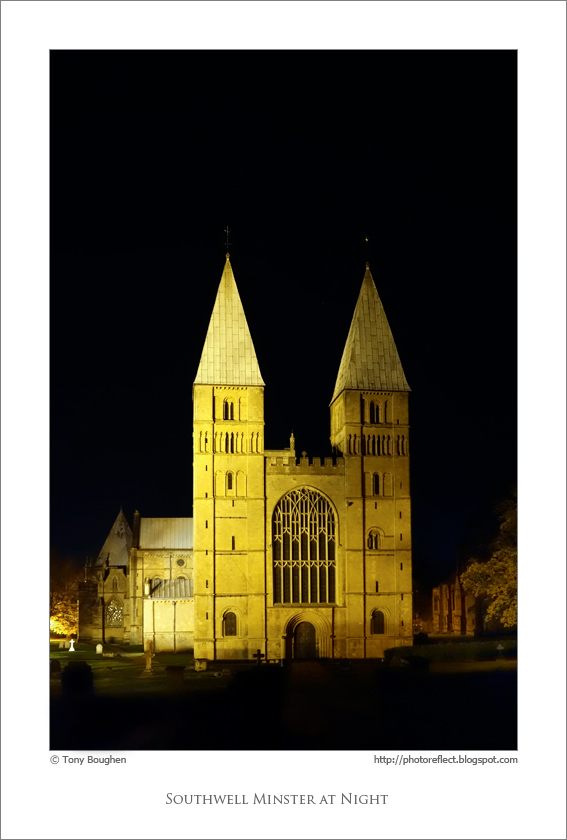
I've done this for more years than I care to remember, and my "go everywhere and anywhere" camera has always been a reasonable quality, small, pocketable device. It's currently a Sony RX100. Prior to that it was a Panasonic Lumix LX3. I had the Sony with me recently when we popped into Spalding for some shopping and I took a photograph of the Sessions House, a stone-built, castle-like, court building of 1842 by Charles Kirk senior, as the low sun illuminated the leaves of a nearby tree. I also had it when we visited Southwell in Nottinghamshire one evening and we came upon the Minster, a Norman and later church of cathedral size, floodlit in its leafy precinct. Of course there is the odd occasion when I forget to carry it, and it's then that opportunities for a photograph are seen and lost. And, like the fisherman who loses the big fish, the lost photograph takes on ever more impressive qualities the more you think about what might have been. Neither of these photographs are ever going to feature in my top ten or even top one hundred photographs. But both have qualities that I like and that, I think, make them good enough to post on the blog.
photograph and text © Tony Boughen
Photo 1
Camera: Sony RX100
Mode: Aperture Priority
Focal Length: 13.6mm (37mm - 35mm equiv.)
F No: f2
Shutter Speed: 1/8 sec
ISO: 2000
Exposure Compensation: 0 EV
Image Stabilisation: On
Some of my best images I think of as "incidental photographs". That is to say, they came about when I was engaged in other business. In other words, I hadn't gone out with the express intention of taking photographs, I had other things in mind, but I had a camera with me "just in case". If I'm visiting my family in another part of the country I carry one. Shopping in town or city, one is with me. When I take the car for its service a camera is in my pocket. If I ... well you get the picture. And so do I!! It's an often repeated truism that the best camera is the one you have with you and, by and large, I've learnt my lesson on that score.
I've done this for more years than I care to remember, and my "go everywhere and anywhere" camera has always been a reasonable quality, small, pocketable device. It's currently a Sony RX100. Prior to that it was a Panasonic Lumix LX3. I had the Sony with me recently when we popped into Spalding for some shopping and I took a photograph of the Sessions House, a stone-built, castle-like, court building of 1842 by Charles Kirk senior, as the low sun illuminated the leaves of a nearby tree. I also had it when we visited Southwell in Nottinghamshire one evening and we came upon the Minster, a Norman and later church of cathedral size, floodlit in its leafy precinct. Of course there is the odd occasion when I forget to carry it, and it's then that opportunities for a photograph are seen and lost. And, like the fisherman who loses the big fish, the lost photograph takes on ever more impressive qualities the more you think about what might have been. Neither of these photographs are ever going to feature in my top ten or even top one hundred photographs. But both have qualities that I like and that, I think, make them good enough to post on the blog.

photograph and text © Tony Boughen
Photo 1
Camera: Sony RX100
Mode: Aperture Priority
Focal Length: 13.6mm (37mm - 35mm equiv.)
F No: f2
Shutter Speed: 1/8 sec
ISO: 2000
Exposure Compensation: 0 EV
Image Stabilisation: On
Labels:
architecture,
autumn,
church,
flood lit,
leaves,
Lincolnshire,
medieval,
night,
Sessions House,
Southwell Minster,
Spalding
Friday, November 22, 2013
Autumn in London
click photo to enlarge
When I engaged in paid, daily work I always regretted that I didn't have the time to watch the seasons change in the way that I knew they did - slowly and incrementally. The transition from autumn to winter involves not only a peaks and troughs decline in the temperature, but a change in the light from blue-white to yellow tinged as the sun moves closer to the horizon. The autumnal tints of the trees and the drifts of leaves against walls and kerbs were easy to see. Less visible was the subtle colours of individual species - the red-orange of the cherries, the yellow of the limes and field maples, and the lingering green of the willow.
When I lived in a city such changes were masked by the prevalence of concrete, brick, tarmac and grass. Yes, there were trees, parks and gardens, but the daily grind meant that often you could pay little attention to seasonal metamorphosis. Before you knew it the end of August had turned to November and you had only a vague notion of how the transformation had been achieved. The pace of modern life means that we rarely have the time to stop, stand, stare and fully appreciate the beauty of the changing seasons.
The other day I took a couple of "autumn" shots in London. The first was of the tower and spire of St Mary's church at Rotherhithe. The current building, completed in 1716, replaced a church of the twelfth century. As I walked along the cobbles of the adjacent road I looked up through the yellows, browns and greens of the trees and took a photograph that, when I viewed it on the camera screen, looked like it could have been taken in a small town, a village or the open countryside almost anywhere in England. The presence of a churchyard with its old trees was enough to turn autumn in the city into a more universal view of the season. That couldn't be said of the second photograph of what looks like a red oak near the glass curtain wall of some offices near the centre of the city. Here a grid of man-made, regular, modernity contrasts strongly with the irregularity of the branches and leaves of the specimen trees tat are dotted among the gleaming towers. The contrast of of the two photographs taken only a couple of miles apart in the capital city couldn't be greater, and yet I think both say something about autumn in the city.
photographs and text © Tony Boughen
Photo 1
Camera: Sony RX100
Mode: Aperture Priority
Focal Length: 19.3mm (52mm - 35mm equiv.)
F No: f5.6
Shutter Speed: 1/200 sec
ISO: 125
Exposure Compensation: 0 EV
Image Stabilisation: On
When I engaged in paid, daily work I always regretted that I didn't have the time to watch the seasons change in the way that I knew they did - slowly and incrementally. The transition from autumn to winter involves not only a peaks and troughs decline in the temperature, but a change in the light from blue-white to yellow tinged as the sun moves closer to the horizon. The autumnal tints of the trees and the drifts of leaves against walls and kerbs were easy to see. Less visible was the subtle colours of individual species - the red-orange of the cherries, the yellow of the limes and field maples, and the lingering green of the willow.
When I lived in a city such changes were masked by the prevalence of concrete, brick, tarmac and grass. Yes, there were trees, parks and gardens, but the daily grind meant that often you could pay little attention to seasonal metamorphosis. Before you knew it the end of August had turned to November and you had only a vague notion of how the transformation had been achieved. The pace of modern life means that we rarely have the time to stop, stand, stare and fully appreciate the beauty of the changing seasons.
The other day I took a couple of "autumn" shots in London. The first was of the tower and spire of St Mary's church at Rotherhithe. The current building, completed in 1716, replaced a church of the twelfth century. As I walked along the cobbles of the adjacent road I looked up through the yellows, browns and greens of the trees and took a photograph that, when I viewed it on the camera screen, looked like it could have been taken in a small town, a village or the open countryside almost anywhere in England. The presence of a churchyard with its old trees was enough to turn autumn in the city into a more universal view of the season. That couldn't be said of the second photograph of what looks like a red oak near the glass curtain wall of some offices near the centre of the city. Here a grid of man-made, regular, modernity contrasts strongly with the irregularity of the branches and leaves of the specimen trees tat are dotted among the gleaming towers. The contrast of of the two photographs taken only a couple of miles apart in the capital city couldn't be greater, and yet I think both say something about autumn in the city.photographs and text © Tony Boughen
Photo 1
Camera: Sony RX100
Mode: Aperture Priority
Focal Length: 19.3mm (52mm - 35mm equiv.)
F No: f5.6
Shutter Speed: 1/200 sec
ISO: 125
Exposure Compensation: 0 EV
Image Stabilisation: On
Labels:
autumn,
church,
curtain wall,
glass,
leaves,
London,
Rotherhithe,
St Mary
Thursday, November 14, 2013
No budget for photographs
click photo to enlarge
When I changed my contact and enquiries page in February 2012 (modified in April) I had an email from a regular visitor suggesting that my wording was, perhaps, a touch off-putting to people interested in using my photographs. I explained that it was meant to be because I was getting fed up of people contacting me and asking to use an image commercially, but unwilling to pay for doing so. The last straw, and the prompt for my somewhat brusque re-write, was a communication from a company working in the field of Combined Heat and Power units. They explained that my photograph of the undulating, rather artistic cladding that surrounds one of the CHP units at Guy's and St Thomas' Hospitals in London, would be perfect for a publication they were putting together. They explained that they were a "non-profit" company and regretted that they had no budget for photography so couldn't pay for the image. However, should I consent to them using my photograph, they explained, I could be sure that they would give me full written credit.
My response was polite, curt and in the negative. When I re-wrote my contact information I wrote my reasons for this approach in a blog post called "Something for nothing". I was reminded of it the other day when browsing a photography website. One of the posts was a copy of a letter from a musician who had been approached by a TV production company seeking music and regretting that they had "no budget for music" to pay for it. His eloquent and heartfelt response to the solicitation (originally posted on music websites) chimed with a lot of professional and enthusiast photographers who are regularly asked for their work without the offer of recompense and consequently it has been widely circulated on photography websites too. It's well worth reading.
All of which has nothing to do with today's photograph of the upturned, broken top of a Victorian cast iron fountain basin. Except, I've discovered that you never know just what kind of photograph is going to be attractive to a company. Who would have thought the hospital CHP unit would be attractive to anyone? Is this broken fountain? It makes me glad that photography is my interest rather than my job.
photograph and text © Tony Boughen
Camera: Canon
Mode: Aperture Priority
Focal Length: 88mm
F No: f7.1
Shutter Speed: 1/100
ISO: 100
Exposure Compensation: -0.33 EV
Image Stabilisation: On
When I changed my contact and enquiries page in February 2012 (modified in April) I had an email from a regular visitor suggesting that my wording was, perhaps, a touch off-putting to people interested in using my photographs. I explained that it was meant to be because I was getting fed up of people contacting me and asking to use an image commercially, but unwilling to pay for doing so. The last straw, and the prompt for my somewhat brusque re-write, was a communication from a company working in the field of Combined Heat and Power units. They explained that my photograph of the undulating, rather artistic cladding that surrounds one of the CHP units at Guy's and St Thomas' Hospitals in London, would be perfect for a publication they were putting together. They explained that they were a "non-profit" company and regretted that they had no budget for photography so couldn't pay for the image. However, should I consent to them using my photograph, they explained, I could be sure that they would give me full written credit.
My response was polite, curt and in the negative. When I re-wrote my contact information I wrote my reasons for this approach in a blog post called "Something for nothing". I was reminded of it the other day when browsing a photography website. One of the posts was a copy of a letter from a musician who had been approached by a TV production company seeking music and regretting that they had "no budget for music" to pay for it. His eloquent and heartfelt response to the solicitation (originally posted on music websites) chimed with a lot of professional and enthusiast photographers who are regularly asked for their work without the offer of recompense and consequently it has been widely circulated on photography websites too. It's well worth reading.
All of which has nothing to do with today's photograph of the upturned, broken top of a Victorian cast iron fountain basin. Except, I've discovered that you never know just what kind of photograph is going to be attractive to a company. Who would have thought the hospital CHP unit would be attractive to anyone? Is this broken fountain? It makes me glad that photography is my interest rather than my job.
photograph and text © Tony Boughen
Camera: Canon
Mode: Aperture Priority
Focal Length: 88mm
F No: f7.1
Shutter Speed: 1/100
ISO: 100
Exposure Compensation: -0.33 EV
Image Stabilisation: On
Wednesday, October 23, 2013
Cemeteries and red oaks
click photo to enlarge
A new crematorium is currently being built near Surfleet in Lincolnshire. Its purpose is to supplement the existing crematoria in the area and reduce the journey times for funerals in the south of the county. One of the first things that the contractors did, after a service road had been built, was to plant two hundred trees and a kilometre of hedging on the ten acre site. As with most such facilities the aim is to surround the main building withattractive parkland. Reading a newspaper report about progress on the development I noted that hornbeam has been chosen as the tree to form an avenue from the main road to the crematorium building and chapel. Cemeteries and crematoria are good places to go in search of interesting trees. The desire to beautify the place where people are laid to rest leads to careful consideration of the disposition and type of trees that feature in the grounds. Boston cemetery has a big avenue of mixed trees featuring both pines and limes. Long Sutton cemetery is reached by an avenue of lime trees. The much smaller cemetery in the village of Bicker has a couple of noteworthy silver birches.
I was in Boston cemetery the other day having a look at the architecture. However, I also took some time to see the kinds of trees that were planted there. The older part of the site is something of a wildlife haven, and here the trees have, for the most part, reached maturity. It was in this section that I came across the red oak (a tree of North American origin) shown in the main photograph. It's deeply cut and pointed leaves were begining to show the hues of autumn. These are appearing a little later than usual due to the recent mild weather. In an area that seemed to have closely packed graves of the 1930s and 1940s I came upon a copper leaved tree that I foolishly didn't take the time to identify - is it a beech? Perhaps its something else entirely. I'll check if I visit there again.photograph and text © Tony Boughen
Photo 1
Camera: Sony RX100
Mode: Aperture Priority
Focal Length: 37.1mm (100mm - 35mm equiv.)
F No: f4.9
Shutter Speed: 1/125
ISO: 200
Exposure Compensation: -0.3 EV
Image Stabilisation: On
Subscribe to:
Comments (Atom)


-Leaves.jpg)