click photo to enlarge
On our relatively frequent trips north of the River Humber we often stop off on our return journey at Barton on Humber, a small town located on the Lincolnshire bank. If a cup of coffee and a walk is required we park at Waters' Edge, a modern multi-use "ecological" building combining information centre, cafe and business units. Its location, with the river on one side and flooded clay pits that have been made into a wild-life area with paths and walks on the other, make it somewhere to get refreshments, have a gentle stroll, and take a few photographs.
I've pointed my camera at the building a few times - both the exterior and the interior. However, the place I come back to quite frequently is a short corridor that ends with a glass block wall. It has what appear to be elements of the heating and ventilation system at high level, and at roof level are large metal tubes. The filtered light, hard utilitarian surfaces and materials give it, to my mind, an unwelcoming atmosphere that contrasts markedly with the light, open, airy spaces with large, laminated wood spars that feature elsewhere. On a recent visit I took this photograph, with my wife as the silhouetted focal point, and added a vignette to emphasise the downbeat character of the space.
photograph and text © Tony Boughen
Camera: Sony RX100
Mode: Aperture Priority
Focal Length: 10.4mm (28mm - 35mm equiv.)
F No: f3.5
Shutter Speed: 1/200
ISO: 125
Exposure Compensation: -0.3 EV
Image Stabilisation: On
Showing posts with label Barton upon Humber. Show all posts
Monday, November 02, 2015
Tuesday, July 28, 2015
Benefaction board
click photo to enlarge
Until the advent of the Poor Law Act of 1832, legislation that set in motion Unions and then workhouses of the kind seen at Southwell, the support of the poor was organised at the parish level and involved charity, bequests and benefactions made by groups and individuals. Many churches still display old benefaction boards that describe the money, rents, land etc that was given to produce an income to be spent supporting the poor. Often these benefactions were very precise in what they stipulated should be done with the money, and the fact that they were publicly displayed in church made the terms of the gift widely known and less open to abuse.
The example shown above is displayed in the church of St Peter at Barton upon Humber in Lincolnshire. It appears to date from the eighteenth century and is more ornate than many, but is quite typical in terms of what the benefactor stipulates. Though the spelling isn't quite standardised, abbreviations abound, and initial "s" can be confused with "f", it is still quite easy to read. I hope you enjoy doing so.
photograph and text © Tony Boughen
Camera: Olympus E-M10
Mode: Aperture Priority
Focal Length: 45mm (90mm - 35mm equiv.)
F No: f5
Shutter Speed: 1/100 sec
ISO:1000
Exposure Compensation: -0.33 EV
Image Stabilisation: On
Until the advent of the Poor Law Act of 1832, legislation that set in motion Unions and then workhouses of the kind seen at Southwell, the support of the poor was organised at the parish level and involved charity, bequests and benefactions made by groups and individuals. Many churches still display old benefaction boards that describe the money, rents, land etc that was given to produce an income to be spent supporting the poor. Often these benefactions were very precise in what they stipulated should be done with the money, and the fact that they were publicly displayed in church made the terms of the gift widely known and less open to abuse.
The example shown above is displayed in the church of St Peter at Barton upon Humber in Lincolnshire. It appears to date from the eighteenth century and is more ornate than many, but is quite typical in terms of what the benefactor stipulates. Though the spelling isn't quite standardised, abbreviations abound, and initial "s" can be confused with "f", it is still quite easy to read. I hope you enjoy doing so.
photograph and text © Tony Boughen
Camera: Olympus E-M10
Mode: Aperture Priority
Focal Length: 45mm (90mm - 35mm equiv.)
F No: f5
Shutter Speed: 1/100 sec
ISO:1000
Exposure Compensation: -0.33 EV
Image Stabilisation: On
Labels:
Barton upon Humber,
benefaction board,
charity,
church,
Lincolnshire,
St Peter
Saturday, December 20, 2014
Tile walls, Barton upon Humber
click photo to enlarge
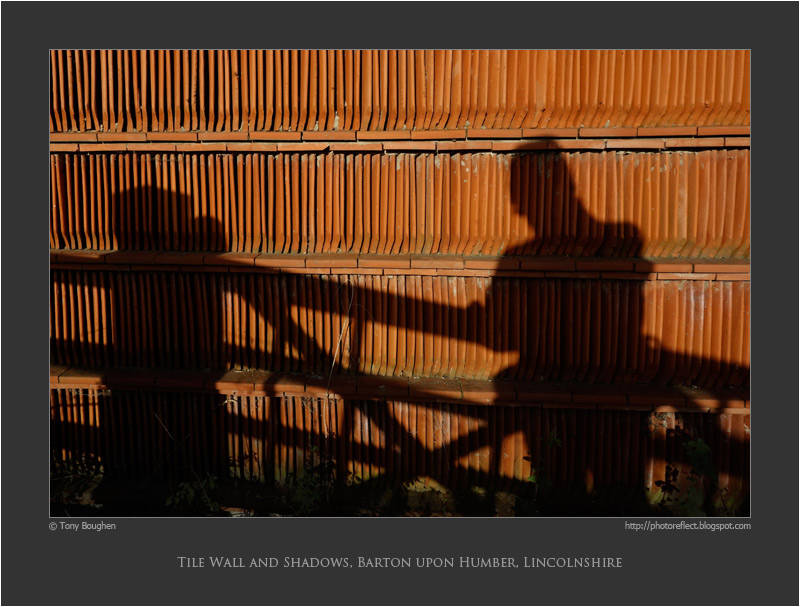
Along the southern bank of the River Humber, on each side of the Humber Bridge and adjacent to the town of Barton upon Humber, is a string of pools. Today many of them are nature reserves or are used for dinghy sailing. However, they almost all have their origins as clay pits dug for the raw material of tile and brick making. Today tiles are still made there. The company of William Blyth, established at Barton in 1840, continues to manufacture roof tiles - pantiles, plain tiles, French tiles, corrugated tiles and much more - using local clay and traditional methods.
A majority of the housing and farm buildings of the county of Lincolnshire are brick built with tile roofs. Companies such as William Blyth supply roof tiles for the renovation of old buildings and for new buildings that follow the traditional pattern. In the area immediately around the tile works damaged tiles and sometimes new ones are also used for the construction of perimeter walls and some constructional walls. For example, the works of the supplier mentioned has a pierced wall made of various kinds of pantile (see smaller photo), a cheap way of marking the boundary of the tilery. The wall in the main photograph is made plain tiles and is part of an ancillary building of "Water's Edge", a multi-purpose visitor and business centre of 2006 by the edge of the Humber. The designers (Gerard Bareham Architects) of this very modern looking building deliberately made use of the local roof tiles. More than that, they consciously followed the unusual practice of building and facing some of the structure's walls with them.
photograph and text © Tony Boughen
Photo 1
Camera: Sony RX100
Mode: Aperture Priority
Focal Length: 10.4mm (28mm - 35mm equiv.)
F No: f5
Shutter Speed: 1/800
ISO: 125
Exposure Compensation: -0.3 EV
Image Stabilisation: On
Along the southern bank of the River Humber, on each side of the Humber Bridge and adjacent to the town of Barton upon Humber, is a string of pools. Today many of them are nature reserves or are used for dinghy sailing. However, they almost all have their origins as clay pits dug for the raw material of tile and brick making. Today tiles are still made there. The company of William Blyth, established at Barton in 1840, continues to manufacture roof tiles - pantiles, plain tiles, French tiles, corrugated tiles and much more - using local clay and traditional methods.
A majority of the housing and farm buildings of the county of Lincolnshire are brick built with tile roofs. Companies such as William Blyth supply roof tiles for the renovation of old buildings and for new buildings that follow the traditional pattern. In the area immediately around the tile works damaged tiles and sometimes new ones are also used for the construction of perimeter walls and some constructional walls. For example, the works of the supplier mentioned has a pierced wall made of various kinds of pantile (see smaller photo), a cheap way of marking the boundary of the tilery. The wall in the main photograph is made plain tiles and is part of an ancillary building of "Water's Edge", a multi-purpose visitor and business centre of 2006 by the edge of the Humber. The designers (Gerard Bareham Architects) of this very modern looking building deliberately made use of the local roof tiles. More than that, they consciously followed the unusual practice of building and facing some of the structure's walls with them.
photograph and text © Tony Boughen
Photo 1
Camera: Sony RX100
Mode: Aperture Priority
Focal Length: 10.4mm (28mm - 35mm equiv.)
F No: f5
Shutter Speed: 1/800
ISO: 125
Exposure Compensation: -0.3 EV
Image Stabilisation: On
Labels:
Barton upon Humber,
Lincolnshire,
plain tile,
roof tiles,
shadows,
Water's Edge
Monday, February 24, 2014
Making the best of time
click photo to enlarge
"Which of us is not saying to himself -- which of us has not been saying to himself all his life: "I shall alter that when I have a little more time"? We never shall have any more time. We have, and we have always had, all the time there is."
from "How to Live on 24 Hours a Day" by Arnold Bennett (1867-1931), English novelist and writer
In 1910, Arnold Bennett, an English novelist best known for his novels such as "Anna of the Five Towns" and "Clayhanger", wrote a short, improving text called "How to Live on 24 Hours a Day"(Project Gutenberg download here). It wasn't the first such piece to come from his pen. Only the previous year he had written, "Literary Taste: How to Form It", in 1903 "How to become and Author", and in 1898 "Journalism for Women". There were other such texts too, pieces that contemporary writers saw as "Victorian", old fashioned, not "modern". Bennett freely acknowledged that he wrote profusely and with an income in mind, and yet as more recent critics have come to acknowledge, that motivation didn't prevent him writing works that bear reading today.
In the essay quoted at the head of this piece Bennett sought to show how, though incomes varied, with some amassing much and many accumulating little, rich and poor alike share exactly the same number of hours every day. He lamented the kind of tedious work that many engaged in and tried to show how people could make better use of their time away from paid work, looking at how, for example, the journey to work could be made more productive, or how the time after the evening meal could be better utilised. Put in those terms the tract sounds mundane, and coming from someone who had made himself very comfortable through his writing, more than a little patronising. Yet, as I discovered a few years ago, taken in its entirety this piece repays reading even today.
On a recent visit to Barton upon Humber I saw the scene I captured in today's photograph and pondered the great value that can attach to unplanned conversation, wherever it takes place. As I've grown older and the pressures of work are now less, self-imposed rather than employment-imposed, I've stopped seeing this kind of socialising as something of a waste of time and started to value it as an activity that can be life-enhancing. The other, quite unrelated, thought that came to mind as I framed this scene was the patched up wall behind the sheltered seating. Graffiti had been roughly painted over and the broken render filled but not painted. The latter, when I first looked at it, appeared to be a cloud trying to put a symbolic damper on the meeting of the people below. On reviewing it on my computer it took more of the form of a heavily perspiring horse! Ah, as W.H. Davies wrote in his poem, Leisure, "What is this life if, full of care, We have no time to stand and stare?"
photograph and text © Tony Boughen
Camera: Sony RX100
Mode: Aperture Priority
Focal Length: 19.5mm (53mm - 35mm equiv.)
F No: f7.1
Shutter Speed: 1/200 sec
ISO:125
Exposure Compensation: -0.3 EV
Image Stabilisation: On
"Which of us is not saying to himself -- which of us has not been saying to himself all his life: "I shall alter that when I have a little more time"? We never shall have any more time. We have, and we have always had, all the time there is."
from "How to Live on 24 Hours a Day" by Arnold Bennett (1867-1931), English novelist and writer
In 1910, Arnold Bennett, an English novelist best known for his novels such as "Anna of the Five Towns" and "Clayhanger", wrote a short, improving text called "How to Live on 24 Hours a Day"(Project Gutenberg download here). It wasn't the first such piece to come from his pen. Only the previous year he had written, "Literary Taste: How to Form It", in 1903 "How to become and Author", and in 1898 "Journalism for Women". There were other such texts too, pieces that contemporary writers saw as "Victorian", old fashioned, not "modern". Bennett freely acknowledged that he wrote profusely and with an income in mind, and yet as more recent critics have come to acknowledge, that motivation didn't prevent him writing works that bear reading today.
In the essay quoted at the head of this piece Bennett sought to show how, though incomes varied, with some amassing much and many accumulating little, rich and poor alike share exactly the same number of hours every day. He lamented the kind of tedious work that many engaged in and tried to show how people could make better use of their time away from paid work, looking at how, for example, the journey to work could be made more productive, or how the time after the evening meal could be better utilised. Put in those terms the tract sounds mundane, and coming from someone who had made himself very comfortable through his writing, more than a little patronising. Yet, as I discovered a few years ago, taken in its entirety this piece repays reading even today.
On a recent visit to Barton upon Humber I saw the scene I captured in today's photograph and pondered the great value that can attach to unplanned conversation, wherever it takes place. As I've grown older and the pressures of work are now less, self-imposed rather than employment-imposed, I've stopped seeing this kind of socialising as something of a waste of time and started to value it as an activity that can be life-enhancing. The other, quite unrelated, thought that came to mind as I framed this scene was the patched up wall behind the sheltered seating. Graffiti had been roughly painted over and the broken render filled but not painted. The latter, when I first looked at it, appeared to be a cloud trying to put a symbolic damper on the meeting of the people below. On reviewing it on my computer it took more of the form of a heavily perspiring horse! Ah, as W.H. Davies wrote in his poem, Leisure, "What is this life if, full of care, We have no time to stand and stare?"
photograph and text © Tony Boughen
Camera: Sony RX100
Mode: Aperture Priority
Focal Length: 19.5mm (53mm - 35mm equiv.)
F No: f7.1
Shutter Speed: 1/200 sec
ISO:125
Exposure Compensation: -0.3 EV
Image Stabilisation: On
Labels:
24 hours,
Arnold Bennett,
Barton upon Humber,
Lincolnshire,
public seating,
time
Wednesday, January 29, 2014
Rain over the Humber Bridge
click photo to enlarge
How long does it take to judge the quality of a photograph? I'm thinking more about the "keepers", not the ones I cull immediately. How long is it before I consider them to be one of my better efforts or one of the much larger, "O.K" group? You might think that an odd question since quality must always shine through. However, I think that most people can more quickly judge quality in other photographers' images than their own. Photographs that you and I make carry more information and have more invested in them by us, than do those made by strangers. We know the circumstances in which we make our own photographs, where the image stands alongside other versions of the same shot, any difficulties overcome in securing it, etc. In other words we don't always judge it solely on its photographic merit, whereas that is something we can much more easily do with the work of a stranger.
So, how long does it take to judge the quality of a photograph? For me, I know that if I live with it for a couple of weeks I've usually come to a settled opinion as to its worth. That is the point at which I confirm a judgement made earlier, whether good or bad, or more often, slightly shift one way or the other from my initial thoughts, making a promotion or demotion if you will. Of course, when you run a blog that has the self-imposed task of showing a new photograph every other day, then sometimes you run low on images, and the luxury of considering one for a fortnight becomes impossible. Today's photograph is a case in point. It was taken on Sunday, was one of only three shots taken on the day (yesterday's post shows another), and I haven't really made my mind up about it. One thing I do like, that probably tipped me into using it before some other, older photographs, is the way it conveys a certain type of wet, English winter day, with its leaden sky and reduced visibility. The other thing that appealed to me was the contrast of the brown and greens of the grass and reeds with the monochrome sky, river, bridge and trees.
photograph and text © Tony Boughen
Camera: Sony RX100
Mode: Aperture Priority
Focal Length: 18.2mm (49mm - 35mm equiv.)
F No: f5.6
Shutter Speed: 1/250 sec
ISO:125
Exposure Compensation: -0.3 EV
Image Stabilisation: On
How long does it take to judge the quality of a photograph? I'm thinking more about the "keepers", not the ones I cull immediately. How long is it before I consider them to be one of my better efforts or one of the much larger, "O.K" group? You might think that an odd question since quality must always shine through. However, I think that most people can more quickly judge quality in other photographers' images than their own. Photographs that you and I make carry more information and have more invested in them by us, than do those made by strangers. We know the circumstances in which we make our own photographs, where the image stands alongside other versions of the same shot, any difficulties overcome in securing it, etc. In other words we don't always judge it solely on its photographic merit, whereas that is something we can much more easily do with the work of a stranger.
So, how long does it take to judge the quality of a photograph? For me, I know that if I live with it for a couple of weeks I've usually come to a settled opinion as to its worth. That is the point at which I confirm a judgement made earlier, whether good or bad, or more often, slightly shift one way or the other from my initial thoughts, making a promotion or demotion if you will. Of course, when you run a blog that has the self-imposed task of showing a new photograph every other day, then sometimes you run low on images, and the luxury of considering one for a fortnight becomes impossible. Today's photograph is a case in point. It was taken on Sunday, was one of only three shots taken on the day (yesterday's post shows another), and I haven't really made my mind up about it. One thing I do like, that probably tipped me into using it before some other, older photographs, is the way it conveys a certain type of wet, English winter day, with its leaden sky and reduced visibility. The other thing that appealed to me was the contrast of the brown and greens of the grass and reeds with the monochrome sky, river, bridge and trees.
photograph and text © Tony Boughen
Camera: Sony RX100
Mode: Aperture Priority
Focal Length: 18.2mm (49mm - 35mm equiv.)
F No: f5.6
Shutter Speed: 1/250 sec
ISO:125
Exposure Compensation: -0.3 EV
Image Stabilisation: On
Labels:
Barton upon Humber,
Humber Bridge,
landscape,
Lincolnshire,
rain
Sunday, December 29, 2013
Normal service is about to resume
click photo to enlarge
Unusually for this blog it's been on autopilot for a few days while I've been at home and I haven't attended to it at all. We've had a family Christmas with children and grandchildren staying, and that has been my alternate focus over the festive period. But, they've now headed off to their respective homes so here's a short post to keep things ticking over. Normal service will be resumed from tomorrow - I think.
After the colourful Christmas-themed post of bells, baubles and glitter balls I felt a need for a contrast; something simpler, starker and more restful. So, here is a photograph I took a week or so ago when we stopped off in Barton upon Humber having returned from the part of Yorkshire just over the river. It shows a rather utilitarian (and uncomfortable) chair on an equally utilitarian floor next to strictly functional walls made of painted blocks and glass bricks. On the face of it not the most inviting of rooms. However, the light through the glass wall emphasised the lines and shapes very nicely, silhouetted the chair, and gave the whole scene a luminous quality that looked like it would convert to black and white very well. And so it did. Or at least I think it did!
I've written elsewhere on the blog about how I like the effects that glass bricks produce and how I wish they were more widely used. I'm pleased to say that appears to be the case. I've seen quite a few more of them in new buildings in recent years, though I'm sure I can't claim any credit for that!
photograph and text © Tony Boughen
Camera: Lumix G6
Mode: Aperture Priority
Focal Length: 24mm (48mm - 35mm equiv.)
F No: f4.5
Shutter Speed: 1/125 sec
ISO: 160
Exposure Compensation: 0 EV
Image Stabilisation: On
Unusually for this blog it's been on autopilot for a few days while I've been at home and I haven't attended to it at all. We've had a family Christmas with children and grandchildren staying, and that has been my alternate focus over the festive period. But, they've now headed off to their respective homes so here's a short post to keep things ticking over. Normal service will be resumed from tomorrow - I think.
After the colourful Christmas-themed post of bells, baubles and glitter balls I felt a need for a contrast; something simpler, starker and more restful. So, here is a photograph I took a week or so ago when we stopped off in Barton upon Humber having returned from the part of Yorkshire just over the river. It shows a rather utilitarian (and uncomfortable) chair on an equally utilitarian floor next to strictly functional walls made of painted blocks and glass bricks. On the face of it not the most inviting of rooms. However, the light through the glass wall emphasised the lines and shapes very nicely, silhouetted the chair, and gave the whole scene a luminous quality that looked like it would convert to black and white very well. And so it did. Or at least I think it did!
I've written elsewhere on the blog about how I like the effects that glass bricks produce and how I wish they were more widely used. I'm pleased to say that appears to be the case. I've seen quite a few more of them in new buildings in recent years, though I'm sure I can't claim any credit for that!
photograph and text © Tony Boughen
Camera: Lumix G6
Mode: Aperture Priority
Focal Length: 24mm (48mm - 35mm equiv.)
F No: f4.5
Shutter Speed: 1/125 sec
ISO: 160
Exposure Compensation: 0 EV
Image Stabilisation: On
Labels:
Barton upon Humber,
black and white,
chair,
glass bricks,
Lincolnshire
Tuesday, May 14, 2013
Saxon architecture
click photo to enlarge
There are 238 churches in England with traces or substantial parts that are of Anglo-Saxon, that is to say pre-Conquest, origin. The Saxons were fine sculptors and illustrators who gave primacy to the line above all else. They were a people who built mainly in wood and for this reason none of their houses have survived. Many of their churches were made of wood too, and of these only one example remains, at Greensted, near Ongar, in Essex. However, they did build churches in stone. Some, such as that at Bradford-on-Avon, Wiltshire, is as it was first built. Most of the others have been enlarged during the Norman or the Gothic periods.
The church at Barton upon Humber, Lincolnshire, was originally a small Saxon building of the late 900s. It consisted of three parts: a western porticus/baptistery, a 22 feet by 22feet (exterior measurements) tower that served as a nave, and a chancel 15 feet long. This was extended in the mid-eleventh century and the twelfth century, but this later work was taken down when a larger extension was built in the thirteenth, mid-fourteenth and fifteenth centuries. What is surprising, but not unique, is the fact that the original Saxon work was allowed to remain. Perhaps it was because the tower continued to serve its purpose and the cost and difficulty of replacing it couldn't be countenanced.
A visitor to the church today is struck by the bright, airy space of the Gothic nave, aisles and chancel compared with the diminutive, badly lit spaces of the Saxon structure. The quality of workmanship and the contrast between the amount and style of decoration is also marked: the Saxon looks positively crude next to the Gothic. And yet, this crudity has an elemental sturdiness that is quite appealing. Capitals are not elaborately carved and decorated with faces and leaves as in the Gothic nave, rather they are simple, heavy blocks. The arches - above we see the one linking the tower with the porticus/baptistery - are narrow due to the semi-circular head and the understandable caution the Saxon builders exercised when spanning spaces in this way. But decoration of a sort there is. Those outer strips that frame the arch using alternating long and short strips of stone (often called, appropriately enough, "long and short work") are decorative with no structural purpose. It has been conjectured that these strips (they are visible on the outside of the tower too) hark back to the Saxons' wooden constructions.
This building is now in the care of English Heritage and it is their lighting that drew me into taking the photograph. Its brightness is necessary to allow visitors to safely negotiate the dimly lit spaces. However, it is sufficiently subdued that it both gives something of the effect there must have been when the Saxon church was lit by candles or tallow lamps, and also offers the photographer an attractive, contrasty, atmospheric composition.
photograph and text © Tony Boughen
Camera: Sony RX100
Mode: Aperture Priority
Focal Length: 12.5mm (34mm - 35mm equiv.)
F No: f2.8
Shutter Speed: 1/30
ISO: 800
Exposure Compensation: 0 EV
Image Stabilisation: On
There are 238 churches in England with traces or substantial parts that are of Anglo-Saxon, that is to say pre-Conquest, origin. The Saxons were fine sculptors and illustrators who gave primacy to the line above all else. They were a people who built mainly in wood and for this reason none of their houses have survived. Many of their churches were made of wood too, and of these only one example remains, at Greensted, near Ongar, in Essex. However, they did build churches in stone. Some, such as that at Bradford-on-Avon, Wiltshire, is as it was first built. Most of the others have been enlarged during the Norman or the Gothic periods.
The church at Barton upon Humber, Lincolnshire, was originally a small Saxon building of the late 900s. It consisted of three parts: a western porticus/baptistery, a 22 feet by 22feet (exterior measurements) tower that served as a nave, and a chancel 15 feet long. This was extended in the mid-eleventh century and the twelfth century, but this later work was taken down when a larger extension was built in the thirteenth, mid-fourteenth and fifteenth centuries. What is surprising, but not unique, is the fact that the original Saxon work was allowed to remain. Perhaps it was because the tower continued to serve its purpose and the cost and difficulty of replacing it couldn't be countenanced.
A visitor to the church today is struck by the bright, airy space of the Gothic nave, aisles and chancel compared with the diminutive, badly lit spaces of the Saxon structure. The quality of workmanship and the contrast between the amount and style of decoration is also marked: the Saxon looks positively crude next to the Gothic. And yet, this crudity has an elemental sturdiness that is quite appealing. Capitals are not elaborately carved and decorated with faces and leaves as in the Gothic nave, rather they are simple, heavy blocks. The arches - above we see the one linking the tower with the porticus/baptistery - are narrow due to the semi-circular head and the understandable caution the Saxon builders exercised when spanning spaces in this way. But decoration of a sort there is. Those outer strips that frame the arch using alternating long and short strips of stone (often called, appropriately enough, "long and short work") are decorative with no structural purpose. It has been conjectured that these strips (they are visible on the outside of the tower too) hark back to the Saxons' wooden constructions.
This building is now in the care of English Heritage and it is their lighting that drew me into taking the photograph. Its brightness is necessary to allow visitors to safely negotiate the dimly lit spaces. However, it is sufficiently subdued that it both gives something of the effect there must have been when the Saxon church was lit by candles or tallow lamps, and also offers the photographer an attractive, contrasty, atmospheric composition.
photograph and text © Tony Boughen
Camera: Sony RX100
Mode: Aperture Priority
Focal Length: 12.5mm (34mm - 35mm equiv.)
F No: f2.8
Shutter Speed: 1/30
ISO: 800
Exposure Compensation: 0 EV
Image Stabilisation: On
Labels:
arch,
Barton upon Humber,
church,
interior,
Lincolnshire,
Saxon architecture,
St Peter,
tower
Sunday, February 17, 2013
Small museums and broken windows
click photo to enlarge
I enjoy visiting the large, national and regional museums of Britain. Places such as the Natural History Museum, the National Maritime Museum, the Imperial War Museum (Duxford), the Fitzwilliam Museum (Cambridge) or the Harris Museum (Preston) hold rare and important treasures of great interest, often displaying them in beautiful spaces to great effect. However, the smaller museums of our country, the places that document towns and villages, that were often established in the eighteenth, nineteenth or early twentieth centuries by philanthropic donation, enthusiastic individuals or a motivated group of citizens, can also offer interest and delight. Such places are frequently run on a very modest budget and few staff, or rely on the support of a small and dedicated band of volunteers. The Wisbech and Fenland Museum, Lynn Museum (King's Lynn) and Newark Air Museum are examples of such places that I've visited recently.
The other day we visited another example, the Baysgarth House Museum in Barton upon Humber, Lincolnshire. This mid-eighteenth century house was given to the town in 1930. Since that time it has had various uses including housing a school. It continues to be the place where the town council meets, but today the buildings and the historic collections it now holds are managed by a charity supported by volunteers. Displays about the history of the house, Georgian and Victorian rooms, collections of pottery, artefacts and displays about the industries of Barton upon Humber, as well as much else, can be found there, all well-presented and cared for by enthusiasts. It is a good example of the sort of museum that a small town can offer, given a little funding, local support and dedicated volunteers.
The house has a fine main staircase, typical of the period, in which are hung three large oil paintings. The window that lights the stairwell is south facing and therefore has a blind to protect the paintings. I took a photograph of this space and its lighting (small photograph) before ascending the stairs. On the landing I looked across at the window and noticed a broken pane in the top corner casting its fractured shadow on the blind. This blemish was all the more eye-catching being set against the carefully managed and well-decorated stairwell. And, with my photographer's hat on I took a shot (main photograph in black and white) of the imperfection, quite liking the way it interfered with the regularity of the glazing and its shadows.
photograph and text © Tony Boughen
Camera: Canon
Mode: Aperture Priority
Focal Length: 209mm
F No: f7.1
Shutter Speed: 1/640
ISO: 100
Exposure Compensation: -0.33 EV
Image Stabilisation: On
I enjoy visiting the large, national and regional museums of Britain. Places such as the Natural History Museum, the National Maritime Museum, the Imperial War Museum (Duxford), the Fitzwilliam Museum (Cambridge) or the Harris Museum (Preston) hold rare and important treasures of great interest, often displaying them in beautiful spaces to great effect. However, the smaller museums of our country, the places that document towns and villages, that were often established in the eighteenth, nineteenth or early twentieth centuries by philanthropic donation, enthusiastic individuals or a motivated group of citizens, can also offer interest and delight. Such places are frequently run on a very modest budget and few staff, or rely on the support of a small and dedicated band of volunteers. The Wisbech and Fenland Museum, Lynn Museum (King's Lynn) and Newark Air Museum are examples of such places that I've visited recently.
The other day we visited another example, the Baysgarth House Museum in Barton upon Humber, Lincolnshire. This mid-eighteenth century house was given to the town in 1930. Since that time it has had various uses including housing a school. It continues to be the place where the town council meets, but today the buildings and the historic collections it now holds are managed by a charity supported by volunteers. Displays about the history of the house, Georgian and Victorian rooms, collections of pottery, artefacts and displays about the industries of Barton upon Humber, as well as much else, can be found there, all well-presented and cared for by enthusiasts. It is a good example of the sort of museum that a small town can offer, given a little funding, local support and dedicated volunteers.
The house has a fine main staircase, typical of the period, in which are hung three large oil paintings. The window that lights the stairwell is south facing and therefore has a blind to protect the paintings. I took a photograph of this space and its lighting (small photograph) before ascending the stairs. On the landing I looked across at the window and noticed a broken pane in the top corner casting its fractured shadow on the blind. This blemish was all the more eye-catching being set against the carefully managed and well-decorated stairwell. And, with my photographer's hat on I took a shot (main photograph in black and white) of the imperfection, quite liking the way it interfered with the regularity of the glazing and its shadows.
photograph and text © Tony Boughen
Camera: Canon
Mode: Aperture Priority
Focal Length: 209mm
F No: f7.1
Shutter Speed: 1/640
ISO: 100
Exposure Compensation: -0.33 EV
Image Stabilisation: On
Subscribe to:
Posts (Atom)