Showing posts sorted by relevance for query reflections. Sort by date Show all posts

Thursday, May 01, 2008

Myths, mirrors and ponds

click photo to enlarge
When, as a child, I first heard the Greek myth about Narcissus and Echo, I found it interesting but highly improbable! Was I really expected to believe that this thirsty young man was so vain that he wouldn't drink from the pond he knelt over for fear of spoiling his own reflection, and so died for want of water? Yeah right! As we might say today.

The other thought that it prompted was, "Who invented the first mirror?" If dark pools of water were the place where man first saw a reflected image of himself, who took this concept a step further and made a portable, solid mirror? Today, by the wonder that is Wikipedia we can read that polished obsidian (a naturally occurring volcanic glass) was used for this purpose in Anatolia (modern Turkey) in 6000 BC. Further, that the Mesopotamians had polished copper mirrors in 4000 BC. And that metal-coated glass mirrors are thought to have been invented in Sidon (modern Lebanon) in the first century AD. Thereafter developments in coating glass improved over the centuries until today's mirrors with coatings of aluminium or silver came into general use.

But, the ready availability of cheap, high quality mirrors hasn't banished the fascination we have with reflections in water. I think many people have garden ponds, not only for the animals, plants and the different surface they add to a plot, but for the reflections and quality of light that they bring. Ponds change character with the weather, season and time of day, just like the rest of the garden, and their reflections change too.

Today's photograph is of the pond in my garden. It shows the water lily leaves that have started to grow strongly and break through the surface of the water. It also shows the wind-disturbed reflection of a dark and broken sky shortly before a heavy shower disturbed the surface of the water. I thought it had a nice semi-abstract quality, and it was with the shapes, colours and tones in mind that I took the shot, not as a representation of lilies. I've taken shots of reflections here before, usually featuring a willow tree, but today the sky and the lilies seemed to offer something better.

photograph & text (c) T. Boughen

Camera: Olympus E510
Mode: Aperture Priority
Focal Length: 35mm macro (70mm/35mm equiv.)
F No: f16
Shutter Speed: 1/80
ISO: 100
Exposure Compensation: -0.7 EV
Image Stabilisation: On

Saturday, May 13, 2006

Confusing reflections

click photo to enlarge
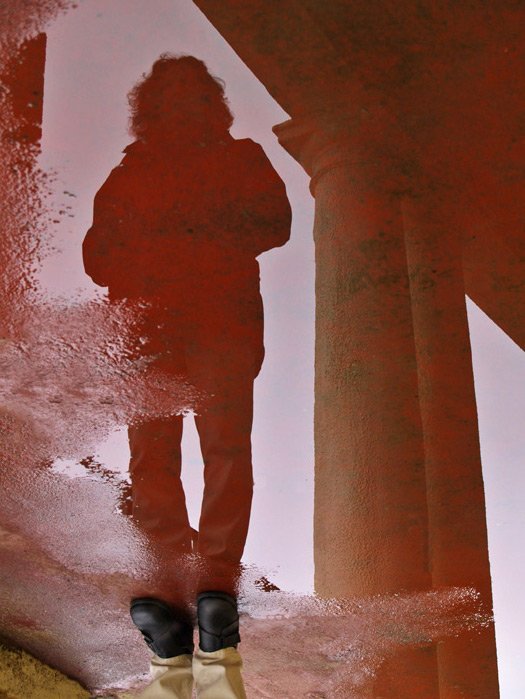
Reflections are confusing aren't they? When you look in the mirror the face that stares back at you is not quite the face that everyone else sees. That's because faces are rarely symmetrical, and the mirror reverses features with which we have become familiar. My wife tells me that in the mirror my face looks "lop-sided"! So does hers, but I'm too much of a gentleman to mention such a thing!

Similarly, in the mirror our left hand appears to be our right hand, and writing gets confusingly flipped. I've never understood the way that some emergency vehicles have their name written on the bonnet so that it can be read correctly in the rear-view mirror of the car in front. If that is necessary for the driver to realise that the big brightly coloured vehicle behind with the deafening siren is a fire engine, won't the writing just confuse all the other drivers on the road, and don't they need it the correct way round so they know its a fire engine too?

And what about reflections in puddles? They usually turn other people upside down, though if you're Narcissus looking into a pool you get yourself the right way up. The photograph above shows my wife reflected in a puddle next to a column. The ground around has red tarmac, and the effect of this is to make the image look very bloody. I took this photograph the right way up of course. However, when I flipped it through 180 degrees I liked the disconcerting effect that it has on the viewer's perceptions. The picture looks "right" until you see the feet. By showing the photograph like this I feel, in some small way, to be getting my own back on these confusing reflections! Now, having got that off my chest, I think I'll go and lie down!!
photograph & text (c) T. Boughen

Monday, August 22, 2011

Grids and reflections

click photo to enlarge
What I consider to be one of my better photographs shows a regular grid of glazing bars holding tinted glass that is reflecting a blue sky and clouds. Glass curtain walls have a certain fascination for me. I appreciate that they are not everyone's cup of tea, but the regularity of the rectangles contrasting with the irregularity of the reflections is someting that I find attractive. This photograph that I took at Canary Wharf, London perfectly exemplifies the appeal to me.

Such reflections, however, are often combined with a glimpse of the interior of the building and when that happens it is the complexity that I like; the difficulty discerning just what it is that I'm looking at definitely has its attraction. I've posted images of this kind of effect before too, as in this example at Imperial College, London. I took a further photograph in this vein on a recent visit to King's Lynn, Norfolk. The side of the town's municipal offices are glazed and as I passed by I saw a modern building, the pretty lead spire of the medieval church of St Nicholas, and a tree reflected in it. But the reflection was not perfect and through the glass I could see the zig-zag of stairs connecting the floors with people going up and down them. Its a shot that I find pleasingly confusing.

photograph and text (c) T. Boughen

Camera: Canon
Mode: Aperture Priority
Focal Length: 70mm
F No: f7.1
Shutter Speed: 1/80
ISO: 125
Exposure Compensation:  0 EV
Image Stabilisation: On

Thursday, April 05, 2012

One from the vaults

click photo to enlarge
Recently I've been feeling, as a television advertisement of yesteryear used to say, "one degree under". It's nothing of great significance, but set against my usual healthy self, it's an unwelcome change that probably accounts for my recent photography being more sporadic than usual and somewhat uninspired. So I've done what I often do in these circumstances and trawled though the vaults for a few shots worthy of posting.

Today's was taken in February last year in the Wellhead Gardens at Bourne, Lincolnshire. It shows willow branches and their reflections in one of the stretches of water that run through the small public park. It's a shot that I like for the semi-abstract effect produced by the soft, water-colour, cloud reflections overlaid with the veil of dark, delicate, almost ink-like lines of the slender willow branches. The subtle range of colours and the difficulty of working out what is real and what is reflected also appeals to me. Reflections in water are a recurring theme in my photographs, one I never tire of, but which I suppose is an acquired taste.

If you do like this photograph you may wonder how it got overlooked or left behind. There are a few reasons. Sometimes the rate of my photography is such that I move on to the most recent crop of images before I've exhausted the previous one. On other occasions the time of year changes, and I do like to reflect the seasons in the shots I post. I also like to ring the changes over the course of a week or so, so sometimes I forsake a shot because it has too many characteristics of one I've recently used. And finally, I'm sometimes just plain careless and don't properly notice an image that I think is good enough to be posted. Today's falls into the latter category.

photograph and text (c) T. Boughen

Camera: Canon
Mode: Aperture Priority
Focal Length: 32mm
F No: f8
Shutter Speed: 1/100 sec
ISO: 200
Exposure Compensation:  -0.66 EV
Image Stabilisation: On

Thursday, January 26, 2012

Low key teapot

click photos to enlarge
My high key photograph of hydrangea petals made me think that I should complement it with a low key photograph that consists mainly of dark tones. And, since we bought a new stainless steel teapot recently that still retains the perfect lustre of its newness, it occurred to me that would make a suitable subject. So I took it to a spot that was lit by a single window, set it up on a piece of black vinyl that I curved up the wall behind to create a shadowless background, and took a few shots. As you can see, I dialled EV -1.33 into the camera to make the dark parts of the reflected steel merge with the black background and I made the subject of the photograph the light reflections as much as the elegant shape itself.

The difficulty in photographing shiny surfaces is that the photographer and/or the camera tend to be seen in the reflections. The first shot largely overcomes that problem by having the camera above the subject, though my legs and two tripod legs can still be seen. However, you wouldn't have known that was what they were if I hadn't told you, would you?! The other photographs have several colours in the reflection that give clues to what the room contains. But the conversion to black and white masks those distractions quite well. One method of avoiding reflections of this sort is to have a large flat sheet of card, paper, plastic or some such material that you stand behind, with a hole in for the camera lens. That way the reflection is pretty much a uniform surface.

Incidentally, when we bought the teapot our main concern was that we should buy one that pours well. You'd think that after millennia of making containers designed to pour properly this was a problem that mankind had cracked. But no, as we found out with a previous teapot, what is learnt can be unlearnt and it is perfectly possible to buy a teapot that pours badly. Fortunately, this one pours perfectly.

photographs and text (c) T. Boughen

Photo 1
Camera: Canon
Mode: Aperture Priority
Focal Length: 100mm macro
F No: f11
Shutter Speed: 2 sec
ISO: 100
Exposure Compensation:  -1.33 EV
Image Stabilisation: Off

Saturday, October 31, 2009

Autumn reflections at Deeping St James

click photo to enlarge
The earliest stone bridges in Britain - the clapper bridges - are simply large pieces of stone that span streams: sometimes just one, and on wider waters two or more with intervening supports. The technology of those early days didn't stretch to anything more elaborate and fashion wasn't a consideration; it was purely function that drove the design.

When arched bridges made of stone examples with semi-circular arches and pointed arches were often built during the medieval period. The Romans introduced the former, and the Gothic builders the latter, so it was these stone bridges were constructed from the C12 to the C15. In theory the pointed arch can span a wider waterway but the disadvantage is that it has to be built quite high to do so. Often a series of rounded arches with intervening piers was chosen instead, though many medieval bridges followed the fashion and have pointed arches. In the sixteenth and seventeenth centuries, with the influence of the Rennaisance, fashion turned to semi-circular, rounded arches, and also to segmental arches which involve a segment of a circle smaller than 180 degrees on vertical piers. However, the technology had not developed to the extent that earlier features could be jettisoned.

Today's photograph shows the Deeping Gate Bridge over the River Welland at Deeping St James. It connects Cambridgeshire (the left bank) with Lincolnshire (the right). This structure was built in 1651, a date that is carved into the stonework on the upstream side, and is typical of its period. Gone are the pointed arches and ribs underneath that allowed stone bridges to be lighter, but the short spans, heavy piers, triangular cutwaters and simple chamfered decoration of the arches remains. Not until the next century would balustrades, niches, panelling, statuary, urns and segmental arches wide enough to span a small river appear.

I have photographed this bridge before, but stopping at it the other day I was tempted into another shot by the reflections, autumnal tints and saturated colours produced by the largely overcast sky. On this occasion I positioned myself downstream on a footbridge.

photograph & text (c) T. Boughen

Camera: Olympus E510
Mode: Aperture Priority
Focal Length: 40mm (80mm/35mm equiv.)
F No: f6.3
Shutter Speed: 1/250
ISO: 100
Exposure Compensation: -1.0 EV
Image Stabilisation: On

Thursday, July 22, 2010

The challenge of mid-day photography

click photo to enlarge
In a recent post I talked about the difficulties and disatisfaction that can come from photography during the middle of the day in high summer. High contrast, short shadows, very bright light and desaturated colours resulting from reflections on leaves and grass were some of the issues I reflected on.

Yesterday I was in Market Deeping for lunch. We ate at a Georgian hotel, a former coaching inn, that backs on to the River Welland. After we'd eaten we went to have a look at the river which at that time of day was cloaked in deep areas of shade from the bankside trees. As we stood there looking at the ducks and fish in the clear water a rowing boat came into view and my friend and I raised our pocket cameras to take a photograph. It may have been the prospect of being snapped by strangers, or perhaps it was an unwillingness to run the gamut of the hotel's eaters and drinkers along the riverside terrace, but whatever the reason, the rower immediately turned the small craft and headed back downstream. But not before I'd managed to frame a shot that included an off-centre boat against shadow, a foreground of delicate grasses, and an over-hanging frame of trees.

Looking at the image on the computer later that day I was disappointed by the glossy reflections off the leaves above the boat. The foreground leaves also had a brightness that made for good shapes against the darker water, but they were a touch "blown". What to do? Well, I subdued the overhead leaves and did the same with the leaves at the bottom (though with less success). Then I thought I'd try a black and white conversion. It has qualities that appeal.  Both shots still reveal the time of day when they were taken, but perhaps less than they would have done before my "tinkering". An image taken at that time with an overcast sky, or earlier or later in the day would definitely have been easier to work with.

photograph and text (c) T. Boughen

Camera: Lumix LX3
Mode: Aperture Priority
Focal Length: 12.8mm (60mm/35mm equiv.)
F No: f2.8
Shutter Speed: 1/200
ISO: 80
Exposure Compensation: -0.66 EV
Image Stabilisation: On

Saturday, November 12, 2016

Autumn duck pond reflections

click photo to enlarge
There's nothing like a walk on a bright autumn afternoon for suppressing in one's mind the memory of the lies, bile and bigotry that has surrounded both Brexit and U.S. presidential election. And though deep concerns would, I knew, return once the walk was finished, I determined that I would take the time to stand and stare, as well as use my camera, and drink in something of what makes this time of year special.

In the Lincolnshire village of Swineshead is a duckpond. As we walked by and the ducks, presumably well fed, shunned our presence, I admired the reflection of the sky and the surrounding trees on the slightly rippled cloudy water. The leaves floating on the surface gave a second plane to the image and added some depth. I've always liked the reflection of trees, anything in fact, in gently stirred water, and especially the painterly feel and semi-abstract quality that it can lend to a photograph. Here the wide range of colours and textures gave further interest.

photograph and text © Tony Boughen

Photo Title: Autumn Duck Pond Reflections
Camera: Sony RX100
Mode: Aperture Priority
Focal Length: 15.6mm (42mm - 35mm equiv.)
F No: f4
Shutter Speed: 1/50
ISO: 200
Exposure Compensation:  -1.0 EV
Image Stabilisation: On

Tuesday, July 29, 2014

Photographing water reflections

click photo to enlarge
"It looks like it's swimming in paint", said my wife, when she saw this photograph on the screen of my computer. And so it does. Yet, when I took this shot of the cygnet (not far off adulthood) on the canalised stretch of the River Witham in the centre of Lincoln, my eye saw little of these striking colours and patterns. The wildly distorted lines of the river-bank buildings and the blue sky were lost in the flickering sheen of the water's surface. However, the photographic experience that I've gathered down the years told me that the camera would present the water in a way that made a bold, colourful, semi-abstract backdrop for the swimming bird.

In the past I've photographed reflected branches, clouds, tree trunks and even steel fences. The way that the shutter freezes movement that the eye doesn't see, or echoes the tangible intangibly, is something that I like, and I make a point of looking for good water reflections whenever I'm out and about with the camera.

photograph and text © Tony Boughen

Camera: Nikon D5300
Mode: Aperture Priority
Focal Length: 66mm (99mm - 35mm equiv.)
F No: f8
Shutter Speed: 1/125 sec
ISO:100
Exposure Compensation: 0.33 EV
Image Stabilisation: On

Sunday, November 16, 2014

Glass curtain wall reflections

click photo to enlarge
It's almost become a reflex action, a tic that I can't stop. I pass a tall office block or other large building with a glass curtain wall and I begin to search its reflections. I'm looking for either an interesting mirroring of the street, people, trees and other buildings; or I'm searching for the airy, almost diaphanous lightness that often arises between the plane of the wall and the sky beyond. There's something that fascinates me about the way the regular grid of slender glazing bars seems to lay across the sky like the rectilinear web of a robotic spider, and how it abruptly ends as it wraps around the corner of the building.

I've photographed glass curtain walls many times over the years and quite a few of  the shots have made it onto the blog. Probably my favourite is one that was, like the shot above, taken in London; though this time in the early evening so featuring incandescent clouds. And though it may look like the example in todays's post features the same building, it doesn't.

photograph and text © Tony Boughen

Camera: Nikon D5300
Mode: Aperture Priority
Focal Length: 112mm (168mm - 35mm equiv.)
F No: f8
Shutter Speed: 1/1600 sec
ISO:100
Exposure Compensation: -0.33 EV
Image Stabilisation: On

Thursday, October 25, 2012

Waterside colour

click photo to enlarge
The trees and bushes of town and country are full of colour at the moment as autumn's progress wreaks its toll on deciduous leaves. In my garden the cherry trees and the silver birches show the brightest hues; orange/red and yellow respectively, and their leaves daily pile up on the lawns and gravel, inviting us to gather them up with rake and barrow.

On my recent trip into Spalding, during a stroll round Springfields Gardens, I came across a fine reflection in the stream that was duplicating the strong colours of the waterside shrubs. The yellow and green looked natural enough, the sort of tints that can be seen everywhere. However, the pink/purple leaves were obviously not a native species, and they gave this corner of the garden a slightly exotic feel. As far as I could see it was a variety of dogwood (Cornus), a shrub grown as much for the winter colour of its stems as for the beauty of its leaves.

Reflections in water are a recurring theme in my photography. I like the element of confusion that the doppelganger introduces and the hint of abstraction that comes from a subject that has no very obvious main subject. In fact, the reliance on colour and texture often gives such images a painterly quality - another reason I favour them. If you like the photograph above you might also like these earlier examples involving water and reflections: willow branches, trees with cherry blossom, reeds and a fence.

photograph and text © Tony Boughen

Camera: Canon
Mode: Aperture Priority
Focal Length: 92mm
F No: f7.1
Shutter Speed: 1/500
ISO: 125
Exposure Compensation:  -0.33 EV
Image Stabilisation: On

Friday, September 28, 2012

321 Triptych

click photo to enlarge
My blog post on the last day of 2009 featured three photographs presented in the form of a triptych. For anyone who doesn't know, a triptych is either a single picture divided into three parts but joined together or three different pictures joined together. In each case they are presented as a whole. I first came across the term when studying Renaissance painting. Often the reredos of an altar was in the form of a painted triptych of the Crucifixion, Nativity or Annunciation, that could be folded up when the altar wasn't in use. The Victorians made the religious triptych fashionable again, and they are still being produced today in one form or another for secular as well as church purposes.

My first triptych was intensely secular: how else can you describe photographs of the detergent and grease left on the roasting tray as I cleaned it after the Christmas meal? The same can be said of today's photograph(s) - my second foray into the world of the triptych. I'd taken a photograph of the number on a new sign that indicated the floor of a building that I was in. As I ascended the stairs in the stairwell I discovered that a different colour had been used for the walls of each floor. So, with the idea of a triptych in mind I made sure I got a shot of the numbers for the floors of the first, second and third storeys. The glass or plastic that the signs were made from reflected the windows and stairs, and I made sure to include these reflections. What appealed to me about these images was the high gloss and the sharp, clear delineation of the numbers contrasted with the out of focus softness ofthe reflections. The sequence - either ascending or descending - seemed the obvious way to sequence them.

photograph and text © Tony Boughen

Photo 1 (i.e. 3!)
Camera: Lumix LX3
Mode: Aperture Priority
Focal Length: 7.9mm (37mm/35mm equiv.)
F No: f2.4
Shutter Speed: 1/50
ISO: 100
Exposure Compensation: -0.33 EV
Image Stabilisation: On 

Thursday, August 11, 2016

Watery reflections, Canary Wharf

click photo to enlarge
We were in London's Canary Wharf at about 7.30am recently,  Our reason for being there wasn't photographic but family-related. However, with a little time on our hands, I was photographing buildings and people in the clear, sharp, morning light. My photographic assistant, a.k.a my wife, knowing my liking for semi-abstract subjects, pointed out these patterns in some of the remaining water of one of the former docks. The reflections in the moving surface of the water were made by a building with a facade with very finely detailed fenestration. I took several shots of the subject but liked this one best showing the contrast between the building reflection and a section of water that mirrors only the blue of the sky.

photograph and text © Tony Boughen

Photo Title: Reflected Building and Sky, Canary Wharf, London
Camera: Olympus E-M10
Mode: Aperture Priority
Focal Length: 70mm (140mm - 35mm equiv.)
F No: f5.5
Shutter Speed: 1/60 sec
ISO:400
Exposure Compensation: 0 EV
Image Stabilisation: On

Thursday, June 26, 2014

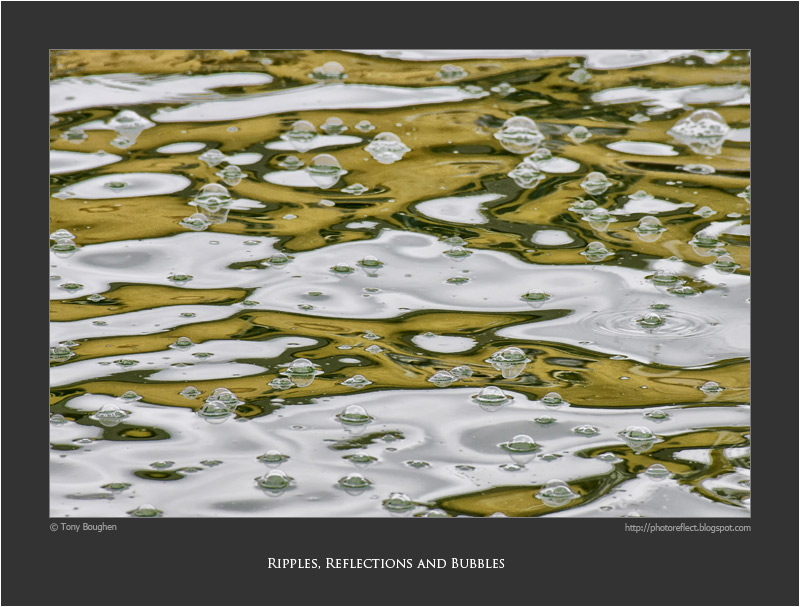
Ripples, reflections and bubbles

click photo to enlarge
I've been doing less photography than is usual for me in recent months - other activities and interests have been consuming more of my time. And, as a consequence, I think my photographic eye has become somewhat dulled. The fact is, with photography as with many other undertakings, pursuing the act on a regular basis is the only way of maintaining an acceptable level of performance. Just as the soccer player or musician loses their touch without regular training, matches or performances, so too does a photographer find it harder to see subjects once he or she begins taking fewer shots.

I've experienced troughs of this kind before. The way I dealt with it then was to keep on snapping or - and this works for me but may not for others - by giving more attention to seeking out semi-abstract subjects. I don't know why this should be effective, but it has been in the past and it may help again. My shot with the out of focus barbed wire was an example of my endeavours in this direction, and so too is today's photograph. I'd been photographing the large, formal fountain in Queen's Gardens, Hull, and producing nothing of interest. So, in pursuit of my short-term aim I concentrated on the reflections and bubbles produced by the falling drops of water. Not the best example of this genre that I've produced, but better than most of what I've been producing lately.

photograph and text © Tony Boughen

Camera: Nikon D5300
Mode: Aperture Priority
Focal Length: 140mm (210mm - 35mm equiv.)
F No: f8
Shutter Speed: 1/250 sec
ISO:280
Exposure Compensation: 0 EV
Image Stabilisation: On

Wednesday, June 20, 2012

Politics, ripples and reflections

click photo to enlarge
The present British coalition government is the most inept that I have known in my lifetime, a period lest I forget, that includes the woeful Conservative government led by John Major. Today we are governed by people who have the best education that money can buy but promote policies that display little evidence of commonplace, basic intelligence, an elite drawn almost exclusively from the rich, with a background of public (i.e. private) schools and Oxbridge, a majority of whom are millionaires. They exhibit a dearth of experience of the people they govern, have an air that suggests they think they are born to rule, and manifest few deep political beliefs or understanding beyond a "private sector good, public sector bad", "the market knows best" dogma.

In the two years they have been in power the coalition has made, at the last count, 29 policy U-turns, converted a modest recovery into a double-dip recession, mis-read the steps necessary to stimulate the economy, made the poor shoulder the the cost of the economic mistakes of the rich, and actively promoted legislation that has increased inequality. Moreover, their policies have reversed the reduction in child poverty achieved by the previous government. Following the inverse Damascene conversion of the Work and Pensions Secretary, Ian Duncan-Smith, they now assert that there is no link between poverty and low wages, that it results from either a conscious choice, fecklessness, or is the consequence of too generous state benefits! Today I read that Duncan-Smith's Centre for Social Justice admits that in arriving at these conclusions it "missed in-work poverty" i.e. didn't take account of the fact that 62% of children living in poverty (under the current definition, that the government wants to change!) are in families where one or more parent is working. What kind of society is it that is unable to pay someone a living wage for a full week's work? Inept doesn't begin to describe people who don't notice this and can't appreciate its consequences.

It seems to me that one of the problems of politics today is that too many politicians are responding to the dominance of consumerism, one of the areas of people's lives over which individuals think they have real control. So, instead of offering us, for example, a national education system, organised, standardised and quality controlled across the country, politicians seek to give us a selection of school types, managed by different bodies, in quasi-competition with each other. In recent years they have imposed this consumerist/market ethic on virtually every public institution, from the utilities of gas, electric, water and telephones to aspects of defence and the civil service. The result has been baleful. Now they want the individual's contract with the health service to resemble buying a can of baked beans - "Would you like Tesco, Sainsburys, Asda or Morrisons to replace your hip sir?" The motivation behind all this is to remove community enterprise and provision and replace it with market-driven, self-serving individuality, to make every social transaction financial, to bring to fruition Margaret Thatcher's pernicious claim that there is no such thing as society. What we must never forget is that when that moment is achieved every government we elect will look like today's, our lives will be ruled by financial transactions, and the inequalities within our society will have returned to Victorian levels.

Isn't it odd what thoughts can be prompted by staring at the colours, reflections and ripples in the water of Lincolnshire's South Forty Foot drain?

photograph and text © Tony Boughen

Camera: Canon
Mode: Aperture Priority
Focal Length: 42mm
F No: f7.1
Shutter Speed: 1/640
ISO: 100
Exposure Compensation:  -1.00 EV
Image Stabilisation: On

Sunday, March 13, 2011

Blue glass and anonymity

click photo to enlarge
There's quite a lot to dislike about the building in today's photograph. It is faceless, it tells us nothing about those who inhabit it, and it allows them to look at us but not us at them. It is the sort of building that might feature in George Orwell's 1984 or Fritz Lang's Metropolis, a place of secret policemen, anonymous bureaucrats or super-rich tycoons. In fact, according to my researches, it is the offices of a company that owns a chunk of the British media including the Daily Express, the Daily Star, and Channel 5 TV - the populist end of the market, and in terms of the newspapers, the conservative end.

But, having said that, buildings are inanimate objects, and though they can influence society and contribute to our quality of life, they are not "political" in the sense that we usually understand the term. I seem to recall that

before the building was acquired by its present owners HSBC had offices here. And, whilst I can see things I don't like about the building, there are a couple of things that I do like. The first is the colour. Towers with curtain walls of blue glass are commonplace - More London, near the Assembly building, is a nearby example. This glass, however, is darker than usual, and that gives the building a weight and solidity that lighter coloured glass cannot offer. Moreover, with those qualities comes a greater emphasis on the surface and the blocks that comprise its overall shape. I like the way the architect has put these together, and the way the reflections in the glass repeat the blocky projections adding to the apparent complexity of the structure.

This building stands next to the Thames, and today's photograph was taken from the riverside path that runs past both it and its next door neighbour, Old Billingsgate Market. When you look at it from across the river it stands out from the buildings around it on colour alone. It also offers a fine grid of distorted reflections, and when lit by yellow internal lights at night looks quite stunning. On the day I took this photograph I could see only two lights on in the building. In my photograph they look like the sort under which someone - an overworked editor perhaps! - is getting the "third degree" treatment.

photograph and text (c) T. Boughen

Camera: Canon
Mode: Aperture Priority
Focal Length: 28mm
F No: f8
Shutter Speed: 1/30
ISO: 100
Exposure Compensation: -1.0 EV
Image Stabilisation: On

Wednesday, August 22, 2012

Reflecting on reflections

click photo to enlarge
Today's photograph brings together two Peterborough buildings that I've featured before. One is the determinedly modern and reflective offices of a firm of solicitors (lawyers), and the other is a large, brick building, full of fine, simple details, a former teacher training college of 1856-64 by the eminent Victorian architect, Sir George Gilbert Scott.

I suppose it's quite natural for a photographer to be fascinated by reflections. After all, the art of photography is, in part, making a permanent reflection of the world using a camera. A photograph of the sort I've posted today could be seen as a reflection of a reflection. One of the reasons architects use mirror glass is to reflect the surroundings in their creation and thereby better "anchor" the structure in its setting. Sometimes it's to acknowledge or respect an adjacent building. That would seem to be the motivation behind the glass wall shown in one of my earliest blog posts. At other times the reflective glass is used to visually lighten the building, to reduce its apparent mass. And then there are times when the mirroring seeks to retain the actual light in the locality, ameliorating the shadows and gloom that a new, big building can bring to its neighbours.

The modern building is a good example of this kind of structure. Though only a modest four storeys it graces its location. I particularly like the faceted bays that reach from the ground to the top of the elevations, and the way they are turned into two storey oriels where the building fronts the major road. The paving, trees, grass and ivy ground-cover that takes up quite a lot of the site works well with the building and enhances this part of the road. My photograph shows part of the side elevation facing the side of Peterscourt, and contrasts the modern materials of the new building with the traditional bricks and tiles of its neighbour. It was good to find that the architects wrapped their reflective glazing around the building and didn't, as many still do, concentrate their spending at the front.

photograph and text (c) T. Boughen

Camera: Canon
Mode: Aperture Priority
Focal Length: 45mm
F No: f8
Shutter Speed: 1/100
ISO: 100
Exposure Compensation:  -0.67 EV
Image Stabilisation: On

Saturday, May 09, 2009

Spring reflections

click photo to enlarge
Several years ago my wife wanted to sew some cross-stitch pictures. She'd tried her hand at a few subjects, but wanted to get her teeth into a bigger project. I'd designed the first of her pieces using graph paper, coloured crayons and a list of the available coloured threads, so I had the task of coming up with a subject. Eventually we settled on "The Four Seasons". It meant embarking on 4 separate pictures, and designing a themed subject for each. I eventually decided on a design that incorporated the name of the season written in the centre, with birds and plants that I found characteristic of that season and personally significant to me, disposed around the edge.

For spring I placed a tortoiseshell butterfly in the centre on blue forget-me-nots with daisies nearby. To the left I had a lapwing standing over its nest of four eggs, with yellow celandines adjacent, and to the right a wheatear stood on a lichen covered piece of limestone. Flying above were curlews, sand martins and swallows, a cuckoo, and a hovering, singing skylark. The top left and top right corners featured a willow and a mountain ash. As someone who grew up in the Yorkshire Dales these were all important markers of spring for me - with the exception of the willow which is more of a lowland plant that comes into leaf early, but one I had grown to admire.

If your abode is in the city your markers of spring are very different, as I came to realise when I lived in one. Women's dress (and the amount of visible flesh), the colour of the sky and the fluffiness of the clouds, the light green of the leaves, the harlequin colours from the flowerbeds, and the smell of mown lawns are much more important. If you have a park or river nearby then ducklings might feature too. The other week I was in Peterborough and photographed this quite interesting office building. It had an undulating glass curtain wall and pieces of concrete that delineated the rooms and floors. What attracted me to it, however, was its reflections - the soft green of the trees, the blue sky and the wispy white clouds that all said spring - spring in the city.

photograph & text (c) T. Boughen

Camera: Olympus E510
Mode: Aperture Priority
Focal Length: 22mm (44mm/35mm equiv.)
F No: f7.1
Shutter Speed: 1/100
ISO: 100
Exposure Compensation: -0.7 EV
Image Stabilisation: On
Sunday, August 25, 2013

Semi-abstract, man and nature

click photo to enlarge
When it comes to composing photographs of a semi-abstract nature I've always found it easier to use man-made subjects. By judicious selection I've often put together images that ignore the reality of what is on view and encourage the viewer to see simply colour, shape, line, tone etc. Living in close proximity to fairly large urban areas near the Fylde coast of Lancashire it was easier to find such subjects. Moving to rural Lincolnshire I've found it much harder and have had to re-think my approach. But, over the past few years, I've started to see possibilities in reeds, trees, water, ice, flowers etc.

On our recent shopping trip to King's Lynn I leaned over the quayside of the River Great Ouse, the RX100 gripped tightly in hand, and looked down at the incoming tide. The slowly rising river was gradually covering two banks of mud that had been exposed at low tide. On the surface of the water I could see the reflections of the clouds and blue sky, with shafts of sunlight making momentary appearances. The two areas of mud looked like a pair of amorous whales casting their eyes over one another, and so with the actuality of what I was seeing banished from my mind by the reflections and my imagination I took my shot. It isn't the best "natural semi-abstract" photograph I've ever taken. In fact I'd be hard pressed to describe why I quite like it and what qualities it has that make me think it suitable for posting. But then sometimes one doesn't have to explain why something appeals; a visceral feeling is quite sufficient.

photograph and text © Tony Boughen

Camera: Sony RX100
Mode: Aperture Priority
Focal Length: 10.4mm (28mm - 35mm equiv.)
F No: f5.6
Shutter Speed: 1/60
ISO: 125
Exposure Compensation:  -0.7 EV
Image Stabilisation: On

Sunday, February 13, 2011

Leisure, pleasure and reflections

click photo to enlarge
There are two contemporary leisure activities that I find completely baffling. Actually there are several, but for now I'll restrict my comments to just two - shopping and driving. Like many men I have a very utilitarian approach to buying things that usually follows this basic outline: a need arises, I decide on the product to meet that need, I look for the best price and the place to buy it, I go to the shop, buy it, then go home. This is sometimes called the "surgical strike" approach to shopping because it tends to have the deep focus of a military operation. Shopping as a leisure activity seems to involve going to the shops to see what's for sale, trying a few things on (it frequently involves buying clothes), having a coffee and chat, browsing a bit more, buying a few things that may or may not have been on a "wanted" list, then going home. But it doesn't end there because the leisure shopper then goes back to the stores the next day to return an item or items that turn out not to fit or weren't really wanted in the first place. It's an approach to shopping that strikes me as very strange.

Then there are men (it's usually men) who do something called "going for a drive". Not anywhere in particular, just for a drive. For the pleasure of it. They are the kind of men who can sit through a whole episode of "Top Gear", who can discuss into the early hours of the morning things such as "ride", "understeer", "torque" and whether a Porsche Boxster offers a better driving experience than a Mercedes SLK280. When I'm within earshot of such discussions (which isn't very often) I want to shout, "They're all cars, tin boxes with a wheel at each corner, they all get you where you want to go, they are a form of transport." In fact I sometimes do, but to little avail because anyone who can "go for a drive" or discuss the merits of sports cars is impervious to both ridicule and reason. And anyone who suggests that slinging a camera bag over your shoulder and going for a long walk simply to find some photographs to take, is not too different from either of these activities is clearly not thinking straight!

The location where I took today's photograph - the Springfields shopping outlet at Spalding, Lincolnshire - prompted this reflection. As a purpose-built retail centre with acres of parking, rows of clone shops, and piped music everywhere, Springfields is very much like anywhere else, and is clearly a leisure shopper's paradise. From my point of view it does, however, have one redeeming feature: the adjoining Festival Gardens with its ponds, water features, woodland walks, flower beds etc. My wife spotted the the silver birch reflections in one of the formal pools as we had a stroll after buying a couple of things, and it seemed a useful addition to my ongoing collection of motion blur images.

photograph and text (c) T. Boughen

Camera: Canon
Mode: Aperture Priority
Focal Length: 249mm
F No: 7.1
Shutter Speed: 1/250
ISO: 500
Exposure Compensation: -0.33 EV
Image Stabilisation: On