click photo to enlarge
We were in London's Canary Wharf at about 7.30am recently, Our reason for being there wasn't photographic but family-related. However, with a little time on our hands, I was photographing buildings and people in the clear, sharp, morning light. My photographic assistant, a.k.a my wife, knowing my liking for semi-abstract subjects, pointed out these patterns in some of the remaining water of one of the former docks. The reflections in the moving surface of the water were made by a building with a facade with very finely detailed fenestration. I took several shots of the subject but liked this one best showing the contrast between the building reflection and a section of water that mirrors only the blue of the sky.
photograph and text © Tony Boughen
Photo Title: Reflected Building and Sky, Canary Wharf, London
Camera: Olympus E-M10
Mode: Aperture Priority
Focal Length: 70mm (140mm - 35mm equiv.)
F No: f5.5
Shutter Speed: 1/60 sec
ISO:400
Exposure Compensation: 0 EV
Image Stabilisation: On
Showing posts with label water. Show all posts
Thursday, August 11, 2016
Wednesday, August 26, 2015
Under the bridge
click photo to enlarge
It is a children's story that I blame for my fascination with bridges; specifically, "The Three Billy Goats Gruff". When I first heard about them going "trip-trap, trip-trap over the rickety bridge" I began to look at bridges in a new light, as structures with a mysterious underneath as well as a very useful top. The small town where I was raised has a rocky river passing through it so footbridges and road bridges, old and new were well-known to me. I never saw any trolls beneath them but I discovered that the water under a bridge was a good place to spot trout, and the underside of the bridge itself frequently held nooks and crannies where dippers would sometimes build their nests.
This interest in bridges has been life-long and this blog contains many photographs of these interesting structures. Today's photograph shows the underside of a bridge on the River Witham at Boston, Lincolnshire. It is old, rarely used, and supported by both steel and timber, though the latter, as you can see, is somewhat the worse for wear. I liked the bold, semi-abstract shapes that the dark structure and its reflection made against the water - it reminded me of the paintings of Franz Kline.
photograph and text © Tony Boughen
Camera: Olympus E-M10
Mode: Aperture Priority
Focal Length: 63mm (126mm - 35mm equiv.)
F No: f5.5
Shutter Speed: 1/640 sec
ISO:200
Exposure Compensation: 0
Image Stabilisation: On
It is a children's story that I blame for my fascination with bridges; specifically, "The Three Billy Goats Gruff". When I first heard about them going "trip-trap, trip-trap over the rickety bridge" I began to look at bridges in a new light, as structures with a mysterious underneath as well as a very useful top. The small town where I was raised has a rocky river passing through it so footbridges and road bridges, old and new were well-known to me. I never saw any trolls beneath them but I discovered that the water under a bridge was a good place to spot trout, and the underside of the bridge itself frequently held nooks and crannies where dippers would sometimes build their nests.
This interest in bridges has been life-long and this blog contains many photographs of these interesting structures. Today's photograph shows the underside of a bridge on the River Witham at Boston, Lincolnshire. It is old, rarely used, and supported by both steel and timber, though the latter, as you can see, is somewhat the worse for wear. I liked the bold, semi-abstract shapes that the dark structure and its reflection made against the water - it reminded me of the paintings of Franz Kline.
photograph and text © Tony Boughen
Camera: Olympus E-M10
Mode: Aperture Priority
Focal Length: 63mm (126mm - 35mm equiv.)
F No: f5.5
Shutter Speed: 1/640 sec
ISO:200
Exposure Compensation: 0
Image Stabilisation: On
Labels:
Boston,
bridge,
Lincolnshire,
reflection,
River Witham,
semi-abstract,
water
Tuesday, July 29, 2014
Photographing water reflections
click photo to enlarge
"It looks like it's swimming in paint", said my wife, when she saw this photograph on the screen of my computer. And so it does. Yet, when I took this shot of the cygnet (not far off adulthood) on the canalised stretch of the River Witham in the centre of Lincoln, my eye saw little of these striking colours and patterns. The wildly distorted lines of the river-bank buildings and the blue sky were lost in the flickering sheen of the water's surface. However, the photographic experience that I've gathered down the years told me that the camera would present the water in a way that made a bold, colourful, semi-abstract backdrop for the swimming bird.
In the past I've photographed reflected branches, clouds, tree trunks and even steel fences. The way that the shutter freezes movement that the eye doesn't see, or echoes the tangible intangibly, is something that I like, and I make a point of looking for good water reflections whenever I'm out and about with the camera.
photograph and text © Tony Boughen
Camera: Nikon D5300
Mode: Aperture Priority
Focal Length: 66mm (99mm - 35mm equiv.)
F No: f8
Shutter Speed: 1/125 sec
ISO:100
Exposure Compensation: 0.33 EV
Image Stabilisation: On
"It looks like it's swimming in paint", said my wife, when she saw this photograph on the screen of my computer. And so it does. Yet, when I took this shot of the cygnet (not far off adulthood) on the canalised stretch of the River Witham in the centre of Lincoln, my eye saw little of these striking colours and patterns. The wildly distorted lines of the river-bank buildings and the blue sky were lost in the flickering sheen of the water's surface. However, the photographic experience that I've gathered down the years told me that the camera would present the water in a way that made a bold, colourful, semi-abstract backdrop for the swimming bird.
In the past I've photographed reflected branches, clouds, tree trunks and even steel fences. The way that the shutter freezes movement that the eye doesn't see, or echoes the tangible intangibly, is something that I like, and I make a point of looking for good water reflections whenever I'm out and about with the camera.
photograph and text © Tony Boughen
Camera: Nikon D5300
Mode: Aperture Priority
Focal Length: 66mm (99mm - 35mm equiv.)
F No: f8
Shutter Speed: 1/125 sec
ISO:100
Exposure Compensation: 0.33 EV
Image Stabilisation: On
Labels:
cygnet,
Lincoln,
mute swan,
reflections,
River Witham,
semi-abstract,
water
Thursday, June 26, 2014
Ripples, reflections and bubbles
click photo to enlarge
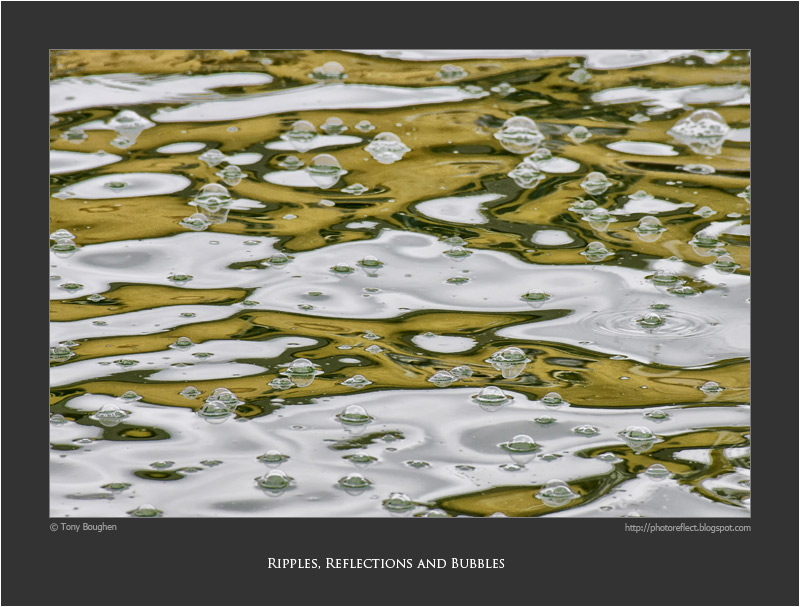
I've been doing less photography than is usual for me in recent months - other activities and interests have been consuming more of my time. And, as a consequence, I think my photographic eye has become somewhat dulled. The fact is, with photography as with many other undertakings, pursuing the act on a regular basis is the only way of maintaining an acceptable level of performance. Just as the soccer player or musician loses their touch without regular training, matches or performances, so too does a photographer find it harder to see subjects once he or she begins taking fewer shots.
I've experienced troughs of this kind before. The way I dealt with it then was to keep on snapping or - and this works for me but may not for others - by giving more attention to seeking out semi-abstract subjects. I don't know why this should be effective, but it has been in the past and it may help again. My shot with the out of focus barbed wire was an example of my endeavours in this direction, and so too is today's photograph. I'd been photographing the large, formal fountain in Queen's Gardens, Hull, and producing nothing of interest. So, in pursuit of my short-term aim I concentrated on the reflections and bubbles produced by the falling drops of water. Not the best example of this genre that I've produced, but better than most of what I've been producing lately.
photograph and text © Tony Boughen
Camera: Nikon D5300
Mode: Aperture Priority
Focal Length: 140mm (210mm - 35mm equiv.)
F No: f8
Shutter Speed: 1/250 sec
ISO:280
Exposure Compensation: 0 EV
Image Stabilisation: On
I've been doing less photography than is usual for me in recent months - other activities and interests have been consuming more of my time. And, as a consequence, I think my photographic eye has become somewhat dulled. The fact is, with photography as with many other undertakings, pursuing the act on a regular basis is the only way of maintaining an acceptable level of performance. Just as the soccer player or musician loses their touch without regular training, matches or performances, so too does a photographer find it harder to see subjects once he or she begins taking fewer shots.
I've experienced troughs of this kind before. The way I dealt with it then was to keep on snapping or - and this works for me but may not for others - by giving more attention to seeking out semi-abstract subjects. I don't know why this should be effective, but it has been in the past and it may help again. My shot with the out of focus barbed wire was an example of my endeavours in this direction, and so too is today's photograph. I'd been photographing the large, formal fountain in Queen's Gardens, Hull, and producing nothing of interest. So, in pursuit of my short-term aim I concentrated on the reflections and bubbles produced by the falling drops of water. Not the best example of this genre that I've produced, but better than most of what I've been producing lately.
photograph and text © Tony Boughen
Camera: Nikon D5300
Mode: Aperture Priority
Focal Length: 140mm (210mm - 35mm equiv.)
F No: f8
Shutter Speed: 1/250 sec
ISO:280
Exposure Compensation: 0 EV
Image Stabilisation: On
Labels:
bubbles,
fountain,
Hull,
reflections,
semi-abstract,
water
Saturday, February 08, 2014
Attracted to the insignificant
click photo to enlarge
It's happened to me more times than I care to remember. I'm out photographing something large and eye-catching when my attention is drawn to something small and relatively insignificant, something that I hadn't noticed until I got into position for the sought after shot. And that relatively insignificant subject produces a photograph that I like much more than the one I originally had my eye on.
My previous post, of Tattershall Castle, is a fairly routine piece of photographic reportage. The light is OK, the composition works, the content is reasonably interesting, and the shot is different from many of this subject because it's taken in winter when the building is out of use, rather than in summer. But it's not the sort of photograph that I'll look back at, ponder or seek to repeat and improve upon. However, when I was standing on the outer wall of the moat I noticed below me the skeletal remains of plants that had grown up through the water. Initially I thought they were umbellifers of one kind or another, but I now think they must be something else. What attracted me was their pale, winter-blasted stalks and seed heads against the deep, shadowy blue of the water. Then I noticed that the plants were throwing reflections on the surface that were dark doppelgangers. Looking through the viewfinder I liked the sharp, scratchy lines against the dark background and I ended up taken rather more shots of this unimportant subject than of the historic and significant pile only a hundred yards away. Which, I suppose, takes us back once more to the Aaron Rose quotation I mentioned last month.
Reviewing the photograph on my computer I was reminded of a photograph I posted in April 2012, one that was languishing in the vaults, that I plucked out and used. It shows willow branches and twigs over water. Its a shot that sits quite nicely alongside today's, and would look even better with a third to make a short series or triptych. I must look out for something suitable.
photograph and text © Tony Boughen
Camera: Sony RX100
Mode: Aperture Priority
Focal Length: 37.1mm (100mm - 35mm equiv.)
F No: f7.1
Shutter Speed: 1/125 sec
ISO:400
Exposure Compensation: -0.7 EV
Image Stabilisation: On
It's happened to me more times than I care to remember. I'm out photographing something large and eye-catching when my attention is drawn to something small and relatively insignificant, something that I hadn't noticed until I got into position for the sought after shot. And that relatively insignificant subject produces a photograph that I like much more than the one I originally had my eye on.
My previous post, of Tattershall Castle, is a fairly routine piece of photographic reportage. The light is OK, the composition works, the content is reasonably interesting, and the shot is different from many of this subject because it's taken in winter when the building is out of use, rather than in summer. But it's not the sort of photograph that I'll look back at, ponder or seek to repeat and improve upon. However, when I was standing on the outer wall of the moat I noticed below me the skeletal remains of plants that had grown up through the water. Initially I thought they were umbellifers of one kind or another, but I now think they must be something else. What attracted me was their pale, winter-blasted stalks and seed heads against the deep, shadowy blue of the water. Then I noticed that the plants were throwing reflections on the surface that were dark doppelgangers. Looking through the viewfinder I liked the sharp, scratchy lines against the dark background and I ended up taken rather more shots of this unimportant subject than of the historic and significant pile only a hundred yards away. Which, I suppose, takes us back once more to the Aaron Rose quotation I mentioned last month.
Reviewing the photograph on my computer I was reminded of a photograph I posted in April 2012, one that was languishing in the vaults, that I plucked out and used. It shows willow branches and twigs over water. Its a shot that sits quite nicely alongside today's, and would look even better with a third to make a short series or triptych. I must look out for something suitable.
photograph and text © Tony Boughen
Camera: Sony RX100
Mode: Aperture Priority
Focal Length: 37.1mm (100mm - 35mm equiv.)
F No: f7.1
Shutter Speed: 1/125 sec
ISO:400
Exposure Compensation: -0.7 EV
Image Stabilisation: On
Labels:
dead flowers,
moat,
reflections,
semi-abstract,
Tattershall Castle,
water,
winter
Sunday, February 02, 2014
The camera and the eye
click photo to enlarge
Something that I like about photography is that the camera often sees what the eye doesn't, and sometimes it sees what the eye can't. Take this photograph. Had I been walking by the River Slea in Sleaford without my camera, and with my mind on anything but photography, I wouldn't have noticed this semi-abstract composition. I wouldn't have seen the line of three posts in the water supporting the boarding that stabilises the river bank. Nor would I have seen the way they make a lower left to upper right diagonal across which the branches of a nearby tree makes wavy diagonals at right angles to them. More than that, without a camera I wouldn't have seen the extent to which the shifting surface of the water was making a scribble of lines out of those branches. I know the latter to be the case because my eye noticed a lot less movement than was recorded by the camera, and before I pressed the shutter I wondered if the composition would have enough interest.
It is said that the camera never lies, but, as I've said elsewhere in this blog, it's truer to say that the camera always lies, in one way or another. Sometimes the lies matter little, as when the perspective is altered by the focal length or the dynamic range is less than our eye can see. At other times it matters more, for example when colours are noticeably shifted, or what appears sharp to the eye is blurred, or a scene that looks deserted is only empty of people because you waited for a rare moment when no one was in the field of view. In fact, the camera induced effects that impinge on some photographs can make a shot what it is and sometimes it's worth deliberately trying to generate them: or at least be welcoming of them when they unexpectedly appear. Here are a few examples -silhouettes of ducks under an overhanging tree, the sun deliberately included in the frame, a sepia effect resulting from contre jour lighting and laser pen light and distorted colour (that radiator is white!) from a long exposure.
photograph and text © Tony Boughen
Camera: Sony RX100
Mode: Aperture Priority
Focal Length: 27.9mm (75mm - 35mm equiv.)
F No: f4
Shutter Speed: 1/80 sec
ISO:400
Exposure Compensation: -0.3 EV
Image Stabilisation: On
Something that I like about photography is that the camera often sees what the eye doesn't, and sometimes it sees what the eye can't. Take this photograph. Had I been walking by the River Slea in Sleaford without my camera, and with my mind on anything but photography, I wouldn't have noticed this semi-abstract composition. I wouldn't have seen the line of three posts in the water supporting the boarding that stabilises the river bank. Nor would I have seen the way they make a lower left to upper right diagonal across which the branches of a nearby tree makes wavy diagonals at right angles to them. More than that, without a camera I wouldn't have seen the extent to which the shifting surface of the water was making a scribble of lines out of those branches. I know the latter to be the case because my eye noticed a lot less movement than was recorded by the camera, and before I pressed the shutter I wondered if the composition would have enough interest.
It is said that the camera never lies, but, as I've said elsewhere in this blog, it's truer to say that the camera always lies, in one way or another. Sometimes the lies matter little, as when the perspective is altered by the focal length or the dynamic range is less than our eye can see. At other times it matters more, for example when colours are noticeably shifted, or what appears sharp to the eye is blurred, or a scene that looks deserted is only empty of people because you waited for a rare moment when no one was in the field of view. In fact, the camera induced effects that impinge on some photographs can make a shot what it is and sometimes it's worth deliberately trying to generate them: or at least be welcoming of them when they unexpectedly appear. Here are a few examples -silhouettes of ducks under an overhanging tree, the sun deliberately included in the frame, a sepia effect resulting from contre jour lighting and laser pen light and distorted colour (that radiator is white!) from a long exposure.
photograph and text © Tony Boughen
Camera: Sony RX100
Mode: Aperture Priority
Focal Length: 27.9mm (75mm - 35mm equiv.)
F No: f4
Shutter Speed: 1/80 sec
ISO:400
Exposure Compensation: -0.3 EV
Image Stabilisation: On
Labels:
Lincolnshire,
photographic effects,
reflections,
River Slea,
semi-abstract,
Sleaford,
water
Sunday, August 25, 2013
Semi-abstract, man and nature
click photo to enlarge
When it comes to composing photographs of a semi-abstract nature I've always found it easier to use man-made subjects. By judicious selection I've often put together images that ignore the reality of what is on view and encourage the viewer to see simply colour, shape, line, tone etc. Living in close proximity to fairly large urban areas near the Fylde coast of Lancashire it was easier to find such subjects. Moving to rural Lincolnshire I've found it much harder and have had to re-think my approach. But, over the past few years, I've started to see possibilities in reeds, trees, water, ice, flowers etc.
On our recent shopping trip to King's Lynn I leaned over the quayside of the River Great Ouse, the RX100 gripped tightly in hand, and looked down at the incoming tide. The slowly rising river was gradually covering two banks of mud that had been exposed at low tide. On the surface of the water I could see the reflections of the clouds and blue sky, with shafts of sunlight making momentary appearances. The two areas of mud looked like a pair of amorous whales casting their eyes over one another, and so with the actuality of what I was seeing banished from my mind by the reflections and my imagination I took my shot. It isn't the best "natural semi-abstract" photograph I've ever taken. In fact I'd be hard pressed to describe why I quite like it and what qualities it has that make me think it suitable for posting. But then sometimes one doesn't have to explain why something appeals; a visceral feeling is quite sufficient.
photograph and text © Tony Boughen
Camera: Sony RX100
Mode: Aperture Priority
Focal Length: 10.4mm (28mm - 35mm equiv.)
F No: f5.6
Shutter Speed: 1/60
ISO: 125
Exposure Compensation: -0.7 EV
Image Stabilisation: On
When it comes to composing photographs of a semi-abstract nature I've always found it easier to use man-made subjects. By judicious selection I've often put together images that ignore the reality of what is on view and encourage the viewer to see simply colour, shape, line, tone etc. Living in close proximity to fairly large urban areas near the Fylde coast of Lancashire it was easier to find such subjects. Moving to rural Lincolnshire I've found it much harder and have had to re-think my approach. But, over the past few years, I've started to see possibilities in reeds, trees, water, ice, flowers etc.
On our recent shopping trip to King's Lynn I leaned over the quayside of the River Great Ouse, the RX100 gripped tightly in hand, and looked down at the incoming tide. The slowly rising river was gradually covering two banks of mud that had been exposed at low tide. On the surface of the water I could see the reflections of the clouds and blue sky, with shafts of sunlight making momentary appearances. The two areas of mud looked like a pair of amorous whales casting their eyes over one another, and so with the actuality of what I was seeing banished from my mind by the reflections and my imagination I took my shot. It isn't the best "natural semi-abstract" photograph I've ever taken. In fact I'd be hard pressed to describe why I quite like it and what qualities it has that make me think it suitable for posting. But then sometimes one doesn't have to explain why something appeals; a visceral feeling is quite sufficient.
photograph and text © Tony Boughen
Camera: Sony RX100
Mode: Aperture Priority
Focal Length: 10.4mm (28mm - 35mm equiv.)
F No: f5.6
Shutter Speed: 1/60
ISO: 125
Exposure Compensation: -0.7 EV
Image Stabilisation: On
Labels:
mud,
reflections,
semi-abstract,
water
Tuesday, April 23, 2013
Water lily leaves and macro lenses
click photo to enlarge
Over the years I've discovered that a garden becomes much bigger when you own a macro lens. If I were to photograph my garden solely with a 35mm or 50mm lens of the sort I used for many years with a film SLR the number and variety of photographs that my garden provides for me would be significantly reduced.
I enjoy taking macro photographs of plants, but the interesting thing is, even if you aren't using a macro lens at what we might consider to be a macro level of magnification the very fact that you have it mounted on your camera makes you look closely at smaller areas of the garden, at individual plants, single blooms or at one or two leaves. A camera with a wider angle of view and without the ability to focus at close range, though it doesn't always makes such shots impossible, usually makes them difficult, and more importantly doesn't give you the mindset where you go in close, focusing on small details.
Today's photograph is a case in point. I was in the garden with the 100mm macro lens with the camera on the tripod photographing individual blooms. Then, when I took it off the tripod, even though it has technically a telephoto length, I took several hand-held shots from no more than close range. The lily leaves in our small pond hold endless fascination for me. At this time of year the new ones are emerging from below the surface of the water, brown in colour, but soon to be green when they start photosynthesising. I like their shape and size, the way they look against the water and the submerged vegetation, and how the meniscus layer of the water is very evident as they slowly push upwards into the air and light. This isn't the first such shot that I've taken of these leaves and regular visitors will be relieved to find that I'm not going to provide links to those previous shots!
photograph and text © Tony Boughen
Camera: Canon
Mode: Aperture Priority
Focal Length: 100mm macro
F No: f11
Shutter Speed: 1/80 sec
ISO: 640
Exposure Compensation: -0.33 EV
Image Stabilisation: On
Over the years I've discovered that a garden becomes much bigger when you own a macro lens. If I were to photograph my garden solely with a 35mm or 50mm lens of the sort I used for many years with a film SLR the number and variety of photographs that my garden provides for me would be significantly reduced.
I enjoy taking macro photographs of plants, but the interesting thing is, even if you aren't using a macro lens at what we might consider to be a macro level of magnification the very fact that you have it mounted on your camera makes you look closely at smaller areas of the garden, at individual plants, single blooms or at one or two leaves. A camera with a wider angle of view and without the ability to focus at close range, though it doesn't always makes such shots impossible, usually makes them difficult, and more importantly doesn't give you the mindset where you go in close, focusing on small details.
Today's photograph is a case in point. I was in the garden with the 100mm macro lens with the camera on the tripod photographing individual blooms. Then, when I took it off the tripod, even though it has technically a telephoto length, I took several hand-held shots from no more than close range. The lily leaves in our small pond hold endless fascination for me. At this time of year the new ones are emerging from below the surface of the water, brown in colour, but soon to be green when they start photosynthesising. I like their shape and size, the way they look against the water and the submerged vegetation, and how the meniscus layer of the water is very evident as they slowly push upwards into the air and light. This isn't the first such shot that I've taken of these leaves and regular visitors will be relieved to find that I'm not going to provide links to those previous shots!
photograph and text © Tony Boughen
Camera: Canon
Mode: Aperture Priority
Focal Length: 100mm macro
F No: f11
Shutter Speed: 1/80 sec
ISO: 640
Exposure Compensation: -0.33 EV
Image Stabilisation: On
Labels:
leaves,
macro,
pond,
water,
water lily
Wednesday, March 27, 2013
Fishing platforms and films noir
click photo to enlarge
I think I watch too many films noir. Or perhaps it's the spate of TV police dramas of Danish origin that BBC 4 has shown in the past couple of years: all night time sets, rain, winter skies, dour expressions and dour locations. Why? Well, when I brought this photograph up on the computer screen I imagined it being a scene in such a film, the camera pulling back to show a couple of police cars, lights flashing, on the pond bank, detectives exchanging theories and a diver in a wet suit about to enter the water in search of a body.
Of course, the actual scene when I took the shot was nothing like that. I'd taken a few steps from a path by the River Slea to look at the fishing pond among the reeds with its old wooden platforms. Other people were enjoying the fresh air and the water-side walk. Cars were passing a hundred yards or so away on a busy, built-up road, and mallards and moorhens were deciding whether to bother with nest building or to wait for an improvement in the weather.
Photographs are like that. People take preconceptions, misconceptions and ideas to the viewing experience and see in an image something that isn't there for other viewers. That's not too surprising. But it is somewhat odd that the person who took the photograph, viewing his own image later on the same day that he took the shot, and knowing what the context was, should do the same.
photograph and text © Tony Boughen
Camera: Sony RX100
Mode: Aperture Priority
Focal Length: 22mm (59mm - 35mm equiv.)
F No: f4.5
Shutter Speed: 1/100
ISO: 125
Exposure Compensation: 0 EV
Image Stabilisation: On
I think I watch too many films noir. Or perhaps it's the spate of TV police dramas of Danish origin that BBC 4 has shown in the past couple of years: all night time sets, rain, winter skies, dour expressions and dour locations. Why? Well, when I brought this photograph up on the computer screen I imagined it being a scene in such a film, the camera pulling back to show a couple of police cars, lights flashing, on the pond bank, detectives exchanging theories and a diver in a wet suit about to enter the water in search of a body.
Of course, the actual scene when I took the shot was nothing like that. I'd taken a few steps from a path by the River Slea to look at the fishing pond among the reeds with its old wooden platforms. Other people were enjoying the fresh air and the water-side walk. Cars were passing a hundred yards or so away on a busy, built-up road, and mallards and moorhens were deciding whether to bother with nest building or to wait for an improvement in the weather.
Photographs are like that. People take preconceptions, misconceptions and ideas to the viewing experience and see in an image something that isn't there for other viewers. That's not too surprising. But it is somewhat odd that the person who took the photograph, viewing his own image later on the same day that he took the shot, and knowing what the context was, should do the same.
photograph and text © Tony Boughen
Camera: Sony RX100
Mode: Aperture Priority
Focal Length: 22mm (59mm - 35mm equiv.)
F No: f4.5
Shutter Speed: 1/100
ISO: 125
Exposure Compensation: 0 EV
Image Stabilisation: On
Labels:
films noir,
fishing,
pond,
reflections,
trees,
water
Wednesday, September 12, 2012
Abstraction and the Pre-Raphaelites
click photo to enlargeAn exhibition of the work of the Pre-Raphaelite painters has recently opened at Tate Britain. It seeks to show the artists, in the words of The Guardian newspaper's arts correspondent, as "Britain's first modern art movement with rebellious ideas and revolutionary methods way ahead of their time." It seems to me that every few decades the Pre-Raphaelites are re-discovered, re-interpreted and presented anew to a public who have always been aware of them to a greater or lesser degree. And with each fresh look a different aspect of their achievement is highlighted. I've been to exhibitions that stress their medievalising, the way they were all-embracing (producing craft and literature as well as fine art), and that concentrated on their depiction of nature
It was the latter thread that came to mind when I reviewed my photographs of the surface of the River Witham where it runs through the Lincolnshire town of Grantham. Like many slow moving, lowland rivers,the Witham has a lot of weed growing in its main course. The long strands writhe in the flow, either as single strands or as bunches of aquatic tresses. The banks have lush grasses and reeds with overhanging trees casting dappled shade - willow, alder, black poplar and more. In places one is transported to the scene of Millais' depiction of the drowning Ophelia. The artist's eye lovingly shows the flowers, waterside plants and aquatic weeds of the Hogsmill River, a tributary of the River Thames, and one can easily get lost in the natural detail that his brush lingered over.
However, in my photograph of the River Witham I wasn't looking for a literal interpretation of the scene so much as trying to create a semi-abstract image that treats the reflections and weeds as lines, patches of colour and contrasting tones. It's an approach that in painting had to wait for Impressionism and later art movements though the seeds for the style were sown by the likes of Turner, Cotman and others. One of the things I like about photography is the way the camera can be used as a device to show the world in a literal way but can also represent it with an element of abstraction. It's a while since I've done a shot like this, so when I saw this interesting piece of water and weed below some overhanging trees my camera went straight to my eye.
photograph and text © Tony Boughen
Camera: Canon
Mode: Aperture Priority
Focal Length: 238mm
F No: f7.1
Shutter Speed: 1/250 sec
ISO: 1600
Exposure Compensation: -0.67 EV
Image Stabilisation: On
Labels:
Ophelia,
Pre-Raphaelite Brotherhood,
reflections,
river,
River Witham,
semi-abstract,
water,
weed
Thursday, July 05, 2012
Eau, the confusion
click photo to enlarge
"A little learning is a dangerous thing;Drink deep, or taste not the Pierian spring."
Alexander Pope (1688-1744), English poet
A few years ago I read some research indicating that the further you go with formal learning the unhappier you are likely to become. Learning, the authors suggested, was characterised by an upward payback curve that stopped after a first degree and thereafter went downwards. If this is true then Pope's observation isn't entirely accurate - at least as far as happiness goes.
One could argue that it isn't true anyway because a little learning - if it is presented to the student well - is a catalyst for further self-directed learning that continues throughout life, and far from being dangerous, is life enhancing. The problem is that much education doesn't achieve this goal. It used to be a characteristic of English primary education. However, the introduction of the dead hand of the National Curriculum and the utilitarian and market demands placed on the already moribund secondary and higher education put paid to that.
Pope's famous lines and education in general came to mind when I looked at my semi-abstract photograph of Bourne Eau, a stream that runs through the town of Bourne in Lincolnshire. The word "Eau" is, today, usually pronounced like the French word for water that has the same spelling. However, this is, in the words of "A Dictionary of Lincolnshire Place-Names", "a spurious Frenchified form" of "ea" (prononounced as in "bead"), a word deriving from the Old English for a river or stream that was variously written as ea, eay, ei, ee etc. The spelling "eau" and the current pronunciation has come into use, presumably, due to the "little learning" of French in English schools that has been common for seventy or so years. The old, original pronunciation clings on in some parts of the county and with some older speakers. One wonders for how long.
It's often said that a successful photograph immediately indicates its subject to the viewer. However, this aphorism, like all such sayings, is subject to exceptions. Confusion can be an appealing quality in a photograph, with the subject not immediately apparent, and the component parts of the image requiring study for the viewer to make sense of what is seen. It was those features that I noticed in this watery scene.
photograph and text © Tony Boughen
Camera: Canon
Mode: Aperture Priority
Focal Length: 105mm
F No: f8
Shutter Speed: 1/100 sec
ISO: 640
Exposure Compensation: -0.33 EV
Image Stabilisation: On
Labels:
Bourne,
bridge,
Eau,
leaves,
Lincolnshire,
reflections,
river,
semi-abstract,
stream,
water
Wednesday, June 20, 2012
Politics, ripples and reflections
click photo to enlarge
The present British coalition government is the most inept that I have known in my lifetime, a period lest I forget, that includes the woeful Conservative government led by John Major. Today we are governed by people who have the best education that money can buy but promote policies that display little evidence of commonplace, basic intelligence, an elite drawn almost exclusively from the rich, with a background of public (i.e. private) schools and Oxbridge, a majority of whom are millionaires. They exhibit a dearth of experience of the people they govern, have an air that suggests they think they are born to rule, and manifest few deep political beliefs or understanding beyond a "private sector good, public sector bad", "the market knows best" dogma.In the two years they have been in power the coalition has made, at the last count, 29 policy U-turns, converted a modest recovery into a double-dip recession, mis-read the steps necessary to stimulate the economy, made the poor shoulder the the cost of the economic mistakes of the rich, and actively promoted legislation that has increased inequality. Moreover, their policies have reversed the reduction in child poverty achieved by the previous government. Following the inverse Damascene conversion of the Work and Pensions Secretary, Ian Duncan-Smith, they now assert that there is no link between poverty and low wages, that it results from either a conscious choice, fecklessness, or is the consequence of too generous state benefits! Today I read that Duncan-Smith's Centre for Social Justice admits that in arriving at these conclusions it "missed in-work poverty" i.e. didn't take account of the fact that 62% of children living in poverty (under the current definition, that the government wants to change!) are in families where one or more parent is working. What kind of society is it that is unable to pay someone a living wage for a full week's work? Inept doesn't begin to describe people who don't notice this and can't appreciate its consequences.
It seems to me that one of the problems of politics today is that too many politicians are responding to the dominance of consumerism, one of the areas of people's lives over which individuals think they have real control. So, instead of offering us, for example, a national education system, organised, standardised and quality controlled across the country, politicians seek to give us a selection of school types, managed by different bodies, in quasi-competition with each other. In recent years they have imposed this consumerist/market ethic on virtually every public institution, from the utilities of gas, electric, water and telephones to aspects of defence and the civil service. The result has been baleful. Now they want the individual's contract with the health service to resemble buying a can of baked beans - "Would you like Tesco, Sainsburys, Asda or Morrisons to replace your hip sir?" The motivation behind all this is to remove community enterprise and provision and replace it with market-driven, self-serving individuality, to make every social transaction financial, to bring to fruition Margaret Thatcher's pernicious claim that there is no such thing as society. What we must never forget is that when that moment is achieved every government we elect will look like today's, our lives will be ruled by financial transactions, and the inequalities within our society will have returned to Victorian levels.
Isn't it odd what thoughts can be prompted by staring at the colours, reflections and ripples in the water of Lincolnshire's South Forty Foot drain?
photograph and text © Tony Boughen
Camera: Canon
Mode: Aperture Priority
Focal Length: 42mm
F No: f7.1
Shutter Speed: 1/640
ISO: 100
Exposure Compensation: -1.00 EV
Image Stabilisation: On
Labels:
Britain,
government,
politics,
poverty,
reflections,
ripples,
South Forty Foot Drain,
water
Thursday, April 05, 2012
One from the vaults
Today's was taken in February last year in the Wellhead Gardens at Bourne, Lincolnshire. It shows willow branches and their reflections in one of the stretches of water that run through the small public park. It's a shot that I like for the semi-abstract effect produced by the soft, water-colour, cloud reflections overlaid with the veil of dark, delicate, almost ink-like lines of the slender willow branches. The subtle range of colours and the difficulty of working out what is real and what is reflected also appeals to me. Reflections in water are a recurring theme in my photographs, one I never tire of, but which I suppose is an acquired taste.
If you do like this photograph you may wonder how it got overlooked or left behind. There are a few reasons. Sometimes the rate of my photography is such that I move on to the most recent crop of images before I've exhausted the previous one. On other occasions the time of year changes, and I do like to reflect the seasons in the shots I post. I also like to ring the changes over the course of a week or so, so sometimes I forsake a shot because it has too many characteristics of one I've recently used. And finally, I'm sometimes just plain careless and don't properly notice an image that I think is good enough to be posted. Today's falls into the latter category.
photograph and text (c) T. Boughen
Camera: Canon
Mode: Aperture Priority
Focal Length: 32mm
F No: f8
Shutter Speed: 1/100 sec
ISO: 200
Exposure Compensation: -0.66 EV
Image Stabilisation: On
Labels:
Bourne,
branches,
choice,
clouds,
Lincolnshire,
reflections,
semi-abstract,
water,
willow
Thursday, May 19, 2011
A mouse's-eye view
click photo to enlarge
It's said that 99% of photographs are taken from a height of between 5 feet and 6 feet above the ground; that is to say, eye-level. Moreover, in most of those photographs the camera was level, pointing neither up nor down to any great extent. That being the case, one of the easiest things for anyone to do, anyone that is who wants to make his or her photograph stand out from the crowd, is to get either down low, up high, or point the camera upwards or downwards. Of course many enthusiast and professional photographers do this on a reasonably regular basis, but surprisingly many frequently forget this basic strategy. Including me! Apart from the shot of the swan remants I can't think of any photographs I've taken from a low viewpoint (flowers excepted) in recent months.So, when I came to take a photograph of my wife in what has become a characteristic pose over the past nine weeks - hosepipe in hand, water sprinkling the flower borders and vegetables - I wondered how to give the shot a "different" character. Then I remembered the low viewpoint: what I call the "mouse's-eye view". I set my compact camera to the 16:9 aspect ratio, positioned it above the hosepipe, and used the latter as the leading line taking the viewer's eye to the main subject: simple and reasonably effective. One day, perhaps, I'll have a camera with a tilting LCD and shots of this kind will be easier to compose. With the LX3 I had to lay prone! Fortunately (though unfortunately for farmers and gardeners) everywhere is dry as a bone and I rose from the lawn with trousers and shirt as clean as when I got down.
click photo to enlarge
Camera: Lumix LX3
Mode: Aperture Priority
Focal Length: 5.1mm (24mm/35mm equiv.)
F No: f3.2
Shutter Speed: 1/500
ISO: 80
Exposure Compensation: 0 EV
Image Stabilisation: On
Labels:
garden,
hosepipe,
low viewpoint,
water
Sunday, April 17, 2011
Mining the seam
click photo to enlarge"Anything you want - love stories, murders, whatever - can be written in these few streets."
Roddy Doyle (1958-), Irish novelist, dramatist and screenwriter
In a recent Guardian interview the writer Roddy Doyle articulated a truth many artists come to realise - that mining a seam that has close limits, and is well-known, can be more revealing and inspiring than trawling the world for new sensations. He was referring to the suburban area of Kilbarrack on the outskirts of Dublin. For others it has been the landscape around Dedham Vale ( the painter John Constable), the Yorkshire port of Whitby (the photographer Frank Meadow Sutcliffe), or the county of Dorset (the writer Thomas Hardy). But it's not just the limitations of a location that can offer this kind of liberation and focus: the same interest and depth can also be found in restricting oneself to a narrow subject range.
For the painter John Ward of Hull, it was marine subjects, for photographers Bernd and Hilla Becher it was systematic industrial subjects, and for the writer, Isaac Asimov it was the fact and fiction of the future. One of the best known examples of an artist's almost obsessive focus on a single subject is the attention that the painter Claude Monet gave to his garden and particularly his water lilies during the later period of his life. It's the example of Monet that I think of when I approach my modest lily pond each year as the leaves break through the surface of the water once more. The plants, water and reflections are ever changing, with the time of day, season and weather all contriving to bring something different and interesting to the same small area. The other evening it was the bright glow of the sunset that coloured the scene and had me reaching for my camera.
For my other shots of this subject, taken at different times of year, see here, here, here, here and (if you can bear any more!) here.
photograph and text (c) T. Boughen
Camera: Canon
Mode: Aperture Priority
Focal Length: 81mm
F No: f7.1
Shutter Speed: 1/100
ISO: 400
Exposure Compensation: -0.33 EV
Image Stabilisation: On
Labels:
leaves,
photography,
pond,
water,
water lily
Sunday, February 13, 2011
Leisure, pleasure and reflections
click photo to enlarge
There are two contemporary leisure activities that I find completely baffling. Actually there are several, but for now I'll restrict my comments to just two - shopping and driving. Like many men I have a very utilitarian approach to buying things that usually follows this basic outline: a need arises, I decide on the product to meet that need, I look for the best price and the place to buy it, I go to the shop, buy it, then go home. This is sometimes called the "surgical strike" approach to shopping because it tends to have the deep focus of a military operation. Shopping as a leisure activity seems to involve going to the shops to see what's for sale, trying a few things on (it frequently involves buying clothes), having a coffee and chat, browsing a bit more, buying a few things that may or may not have been on a "wanted" list, then going home. But it doesn't end there because the leisure shopper then goes back to the stores the next day to return an item or items that turn out not to fit or weren't really wanted in the first place. It's an approach to shopping that strikes me as very strange.Then there are men (it's usually men) who do something called "going for a drive". Not anywhere in particular, just for a drive. For the pleasure of it. They are the kind of men who can sit through a whole episode of "Top Gear", who can discuss into the early hours of the morning things such as "ride", "understeer", "torque" and whether a Porsche Boxster offers a better driving experience than a Mercedes SLK280. When I'm within earshot of such discussions (which isn't very often) I want to shout, "They're all cars, tin boxes with a wheel at each corner, they all get you where you want to go, they are a form of transport." In fact I sometimes do, but to little avail because anyone who can "go for a drive" or discuss the merits of sports cars is impervious to both ridicule and reason. And anyone who suggests that slinging a camera bag over your shoulder and going for a long walk simply to find some photographs to take, is not too different from either of these activities is clearly not thinking straight!
The location where I took today's photograph - the Springfields shopping outlet at Spalding, Lincolnshire - prompted this reflection. As a purpose-built retail centre with acres of parking, rows of clone shops, and piped music everywhere, Springfields is very much like anywhere else, and is clearly a leisure shopper's paradise. From my point of view it does, however, have one redeeming feature: the adjoining Festival Gardens with its ponds, water features, woodland walks, flower beds etc. My wife spotted the the silver birch reflections in one of the formal pools as we had a stroll after buying a couple of things, and it seemed a useful addition to my ongoing collection of motion blur images.
photograph and text (c) T. Boughen
Camera: Canon
Mode: Aperture Priority
Focal Length: 249mm
F No: 7.1
Shutter Speed: 1/250
ISO: 500
Exposure Compensation: -0.33 EV
Image Stabilisation: On
Labels:
motion blur,
pond,
reflections,
silver birch,
trees,
water
Tuesday, November 23, 2010
The fascination of weirs
click photo to enlarge
Over the years I must have spent many happy hours staring at river water as it pours over a weir. Being raised in the the Yorkshire Dales near the fast-flowing River Ribble exposed me to a number, and I remember, as a child, being fascinated by the way water passed over them, changing from a slowly moving, smooth sheen to an organised, falling turbulence which finally became a turmoil of frothing foam. Like most people, when I see one today, I still stop and look at it.The weir in today's photograph is small compared with those at, say, Settle or Langcliffe on the upper Ribble. However, size isn't a crucial factor in enjoying a weir, and a diminutive example has the advantage of concentrating your attention on a smaller, ever-changing area. This one is on the River Slea in Sleaford, Lincolnshire, near Cogglesford Mill. The old water-mill is at a point where a navigable part of the river falls into the natural, meandering water-course, and has structures around it - walls, bars, grilles etc - that are no longer used. What caught my eye here was the complementary contrast of the reflected yellow leaves of the overhanging tree with the blue of the sky. I consciously composed the shot with three distinct horizontal bands. However, it wasn't until I got home and had the image in front of me on the computer that I saw the solid, dark lines - one large, and the other smaller - across the bottom of the top of the three sections. What caused them? Then I remebered that there was a bar, wooden I think, fixed across the watercourse a foot or two above the lip of the weir, and the lines are its reflections.
Incidentally, the water above the weir was smooth and quite reflective, but the passage of a few ducks had caused the turbulence that broke up the tree's reflection a few seconds before I took the photograph. For another of my weir images see here.
photograph and text (c) T. Boughen
Camera: Canon
Mode: Aperture Priority
Focal Length: 154mm
F No: f7.1
Shutter Speed: 1/160
ISO: 1250
Exposure Compensation: 0 EV
Image Stabilisation: On
Labels:
Cogglesford Mill,
complementary colours,
Lincolnshire,
reflections,
River Slea,
water,
weir
Sunday, August 01, 2010
Catching your eye
click photo to enlarge
A couple of evenings ago, during the course of a talk I was giving about photography, I made the observation that the human figure placed in a photograph will usually catch the viewer's eye before anything else. This is something that seems to be part of our natural makeup, and probably has its origins in the hundreds of thousands of years of our development when there was no rule of law. If you lived in a world where other people could be a mortal danger to you the ability to spot humans was one that you developed and honed as a matter of self-preservation.Today, in our complex world there are, in countries where peace prevails, few direct dangers from other humans, but there are many other hazards. These range from fast moving cars to electrified rails and bottles of lethal liquids. Consequently societies have had to invent systems that warn people of these dangers, and which draw their attention to them. The other day, during my walk around the Brayford Pool in Lincoln, I noticed one such device. It was a multicoloured vertical chequered strip fixed to a wall just above the level of the water in the river. At the bottom it was white, the central section was day-glow yellow, and at the top it was day-glow red. I assume it was a variation on the depth gauges that are frequently seen by the edge of freshwater, but which more usually measure depth in metres, and presumably the colours showed the level of danger associated with the rise in the water level.
I say I saw it, but that's not strictly true. It was inaccessible to me, and what I saw was its reflection in the water just past the underside of a bridge. The very bright colours, moving from side to side with the waves, caught my eye, and their stark juxtaposition with predominantly earth colours suggested a photograph. So, adjusting my position, and zooming in on a section, I composed this image.
photograph and text (c) T. Boughen
Camera: Olympus E510
Mode: Aperture Priority
Focal Length: 150mm (300mm/35mm equiv.)
F No: f6.3
Shutter Speed: 1/125
ISO: 100
Exposure Compensation: 0 EV
Image Stabilisation: On
Labels:
Brayford Pool,
Lincoln,
motion blur,
reflection,
river depth gauge,
water
Friday, February 26, 2010
British, Americans and the problem of names
click photo to enlargePeople get confused about the name of the group of small islands off the western edge of mainland Europe. Geographically speaking they are known as the British Isles, though people in Eire (The Republic of Ireland) might wish for a name that doesn't emphasise Britain quite so much. The political name for the majority of the area of the islands is the United Kingdom of Great Britain and Northern Ireland (UK), a term that embraces the constituent countries of England, Scotland, Wales and Northern Ireland. Great Britain is a name that covers the first three of these but excludes Northern Ireland. The Republic of Ireland (Eire) is an independent country in its own right. This isn't properly understood by many in the UK, so it's not surprising that people from other countries struggle with it.
There is further confusion about how to term a native of the UK. "British" (not the hideous modern term, "Brit") is used to describe anyone from the four countries. However, people who should know better - journalists especially - often use England and English instead, much to the annoyance of the Welsh, Scottish and Northern Irish. Is there any wonder that the other day the Argentine foreign minister made the same mistake when some of the natives of these islands aren't sufficiently precise in their usage.
But it's not only in the UK where these kind of problems are found. Take the United States of America. The people of that country refer to themselves as Americans; and so they are. But they use the name in such a way that suggests it applies only to natives of the U.S.A., something that doesn't go down well in Canada, Mexico and the myriad countries of Central and South America who also see themselves (quite rightly) as Americans because that is the continent on which they reside. Perhaps the people of the United States need a second name in the way that the people of Canada, Chile and all the other countries on the American continent do. I have heard Usanian put forward as a possible answer! How does that sound, or would it be as unwelcome as Brit is to me?
What has this got to do with a small water-course among the trees at Woodhall Spa, Lincolnshire? Not a great deal. In fact nothing at all.
photograph & text (c) T. Boughen
Camera: Lumix LX3
Mode: Aperture Priority
Focal Length: 5.1mm (24mm/35mm equiv.)
F No: f2
Shutter Speed: 1/30
ISO: 160
Exposure Compensation: 0 EV
Image Stabilisation: On
Labels:
leaves,
Lincolnshire,
reflection,
water,
Woodhall Spa,
woodland
Thursday, December 11, 2008
The water's edge
click photo to enlargeWhen the Pre-Raphaelite painters turned their attention to nature they produced work that rejoiced in the minutiae of leaves, flowers, branches, rocks and water. They saw this verdant world like a child does, and examined it closely, marvelling at the nooks and crannies, insects and dark places. Paint was richly worked to show the detail of their subjects. Works such as "A Study, in March" (1855) by John William Inchbold (1830-1888), or the better-known "Ophelia" (1852 ) by John Everett Millais(1829-1896) exemplify these characteristics.
Critics of the Pre-Raphaelites - and there are many - see a lack of focus in this approach. They complain that the compositions do not direct the eye to a main subject (if one even exists). Camille Paglia talks about the "Keatsian ardor" with which the painting of nature was pursued, and compares it unfavourably with "High Romance energy" and "dynamic process", suggesting that it is only one step removed from the Symbolist decadence of Gustave Moreau. But, like many critics, she lets her preferences get in the way of seeing this aspect of Pre-Raphaelite work for what it is - a different and straightforward way of looking at nature, a reaction to "Sir Sloshua Reynolds" and what had gone before in English painting. And, whilst she is right to say that "part triumphs over whole", there is pleasure to be had in the simple revelation of nature and the decorative effect that this can produce. This is largely art for the eye and the emotional response: it isn't as completely cerebral as some painting. Critics of this aspect of the Pre-Raphaelites' work are like those who decry the unaccompanied folk song but praise the conservatoire setting of the tune, denying themselves the different enjoyment that each offers.
I was reflecting on this as I processed my image. Did it suffer from a lack of focus? It was taken on a walk that I regularly undertake from my house, part of which follows a stream that is reed-lined in summer. The other day only a few reeds were left standing, and the water was reflecting the nearby trees and the blue sky. I took a shot of the water's edge, to capture both the sharp foliage, and the softer reflections that were being distorted by the ripples and eddies. Does the image lack a main subject? Yes, but I think it offers distinct and the indistinct interest for the searching eye.
photograph & text (c) T. Boughen
Camera: Olympus E510
Mode: Aperture Priority
Focal Length: 98mm (196mm/35mm equiv.)
F No: f5
Shutter Speed: 1/30
ISO: 100
Exposure Compensation: -0.7 EV
Image Stabilisation: On
Subscribe to:
Posts (Atom)