click photo to enlarge
The names given to rivers are some of the oldest words to be found in the British Isles. Many of them are pre-Celtic in origin, belonging to a time of which we have little knowledge concerning the languages that were used. The river in today's photograph - the River Welland - is one such name. All we know of the word "welland" is that it occurs in the earliest written documents: we know nothing of its meaning. The same is true of the Lincolnshire rivers Ancholme, Humber and Witham.
When we come to rivers with Celtic names we are often in a position to ascribe a meaning, though sometimes this is no more than an educated guess. In Lincolnshire the name of the River Glen is likely to be of Celtic origin and probably means "the clean one", echoing the derivation of the Northumbrian river of the same name. The River Lymn is also Celtic and derives from the Primitive Welsh "lemo" meaning an elm tree, hence the river's name is "the place where many elms are found". The names of the rivers Trent and Nene are also thought to have Celtic roots.
Why should river names be among our oldest words? The answer is that rivers are important and enduring features of the landscape, a source of food and water, useful for transport and an effective and immutable boundary or defensive line. Such a significant geographical feature would be named before settlements, hills or perhaps even people.
I've photographed Deeping St James church and the River Welland from this location before at different times of year. It makes a fine composition and is an archetypal English rural lowland scene.
photograph and text © Tony Boughen
Camera: Sony RX100
Mode: Aperture Priority
Focal Length: 37.1mm (100mm - 35mm equiv.)
F No: f7.1
Shutter Speed: 1/500
ISO: 125
Exposure Compensation: -1.0 EV
Image Stabilisation: On
Showing posts with label Deeping St James. Show all posts
Sunday, September 29, 2013
Tuesday, February 28, 2012
Survival or revival
click photo to enlarge
Anyone with an interest in the history of English church architecture, visiting St James at Deeping St James in Lincolnshire for the first time, will immediately think, "What's been going on here?" It's not the basic shape of the church that you see when you walk through the churchyard gate that provokes the question: that's very conventional with the west tower, nave and aisle, chancel and south porch. What's puzzling is, firstly, the elevation of the aisle with its short buttresses topped by pilasters with no pinnacles above, the size of those windows, and the suspicious "Gothic" of the tower.
Stepping inside reveals that it was once a major church, in fact a Benedictine Priory founded by Thorney Abbey in 1139. The seven bay, Late Norman south arcade (see small photograph), with its thirteenth century triforium looks like it belongs in a much larger church. Did it ever link up with a structure of the same magnitude elsewhere in the building, or was it the start of a grandiose idea that was then slimmed down? And what about that tower. Stylistically it is Georgian Gothic, a stripped down version of the older style made palatable for a new age. It was built after the old tower collapsed in 1717, the victim of bad foundations due to repeated flooding over the centuries. There is some question over when precisely the new tower was erected, but 1732 is scratched on the exterior west wall, and this is the likely date rather than 1819 which is more carefully carved beneath the parapet.As with much of the building in the Gothic style that the seventeenth and eighteenth century added to medieval churches we are prompted to ask whether it is a survival or a revival. That is to say, did the builders simply continue to build in the style that was for centuries the only one applied to churches, or did they deliberately forsake the classical idiom of much public building of the period and modishly seek to revive a "forgotten" style. Historians of art and architecture make much of the revival of Gothic in the eighteenth century by the likes of Horace Walpole, William Kent, Robert Adam, James Wyatt and the rest. However, it never entirely went away. Provincial churches sometimes used it in the seventeenth century, as did some colleges at Oxford and Cambridge when they were being extended. It may be that the people at Deeping St James wanted a tower that both reminded them of the one that fell down, but also showed that they were "up to date".
photograph and text (c) T. Boughen
Photo 1
Camera: Canon
Mode: Aperture Priority
Focal Length: 28mm
F No: f7.1
Shutter Speed: 1/500 sec
ISO: 100
Exposure Compensation: -0.33 EV
Image Stabilisation: On
Labels:
black and white,
church,
Deeping St James,
Georgian,
Gothic,
Gothic Revival,
Lincolnshire,
medieval,
St James
Saturday, November 19, 2011
Autumn at Deeping St James
click photo to enlarge
The other evening, with a friend, I gave a talk to a group in the village about photography. We divided the alphabet up between us and we each spoke about 13 of our own images (a couple with secondary images to support the main one). At one point I mentioned a quotation by Aaron Rose that I have always liked and which I first used very early in the life of this blog: "In the right light, at the right time, everything is extraordinary". This observation makes the important point that light has the power to change things, even the most mundane, into objects of beauty and visual interest. I think the author and most people, me included, assume the quote is about the value of strongly directional light, and a lot of my photography - in fact quite a bit of every photographer's output - makes use of this kind of illumination.However, as I've got older I've come to realise that every sort of light has qualities that can be used in photography, even the uninspiring flat light that is produced by a blanket of stratus cloud. Whereas hard, directional light makes for contrast, drama and in-your-face eye-catching qualities, diffuse, almost directionless light softens the scene, mutes everything and confers a quiet quality that can be very appealing in its own way. I blogged about this in connection with a photograph I took last year of some boats drawn up on the shingle beach at Aldeburgh, Suffolk. A couple of days ago similar light prevailed when I took this photograph of the River Welland at Deeping St James in Lincolnshire. I think it's not only the subject but also the light that gives the photograph some of the qualities that I admire in English landscape painting of the first half of the nineteenth century. Who knows, it may be a liking for the work of artists such as Crome, Cotman, Constable, Stark, Stannard and Colkett (mainly members of the "Norwich School") that accounts for me every now and then producing images like the one above.
photograph and text (c) T. Boughen
Camera: Canon
Mode: Aperture Priority
Focal Length: 65mm
F No: f6.3
Shutter Speed: 1/160
ISO: 100
Exposure Compensation: -0.67 EV
Image Stabilisation: On
Labels:
autumn,
Deeping St James,
landscape,
Lincolnshire,
River Welland,
rowing boat,
soft light
Saturday, October 31, 2009
Autumn reflections at Deeping St James
click photo to enlargeThe earliest stone bridges in Britain - the clapper bridges - are simply large pieces of stone that span streams: sometimes just one, and on wider waters two or more with intervening supports. The technology of those early days didn't stretch to anything more elaborate and fashion wasn't a consideration; it was purely function that drove the design.
When arched bridges made of stone examples with semi-circular arches and pointed arches were often built during the medieval period. The Romans introduced the former, and the Gothic builders the latter, so it was these stone bridges were constructed from the C12 to the C15. In theory the pointed arch can span a wider waterway but the disadvantage is that it has to be built quite high to do so. Often a series of rounded arches with intervening piers was chosen instead, though many medieval bridges followed the fashion and have pointed arches. In the sixteenth and seventeenth centuries, with the influence of the Rennaisance, fashion turned to semi-circular, rounded arches, and also to segmental arches which involve a segment of a circle smaller than 180 degrees on vertical piers. However, the technology had not developed to the extent that earlier features could be jettisoned.
Today's photograph shows the Deeping Gate Bridge over the River Welland at Deeping St James. It connects Cambridgeshire (the left bank) with Lincolnshire (the right). This structure was built in 1651, a date that is carved into the stonework on the upstream side, and is typical of its period. Gone are the pointed arches and ribs underneath that allowed stone bridges to be lighter, but the short spans, heavy piers, triangular cutwaters and simple chamfered decoration of the arches remains. Not until the next century would balustrades, niches, panelling, statuary, urns and segmental arches wide enough to span a small river appear.
I have photographed this bridge before, but stopping at it the other day I was tempted into another shot by the reflections, autumnal tints and saturated colours produced by the largely overcast sky. On this occasion I positioned myself downstream on a footbridge.
photograph & text (c) T. Boughen
Camera: Olympus E510
Mode: Aperture Priority
Focal Length: 40mm (80mm/35mm equiv.)
F No: f6.3
Shutter Speed: 1/250
ISO: 100
Exposure Compensation: -1.0 EV
Image Stabilisation: On
Labels:
autumn,
bridge,
Deeping Gate Bridge,
Deeping St James,
River Welland
Wednesday, August 26, 2009
River Welland landscape
click photo to enlargeOn a recent walk at Deeping St James I passed the point on the bank of the River Welland where I'd taken a photograph on the last day of February. So, in the interests of comparison I took another shot, though this time in portrait format, from what I thought was the same point. When I came to compare the images it proved to be near the place where I'd stood before, but not precisely the same spot.
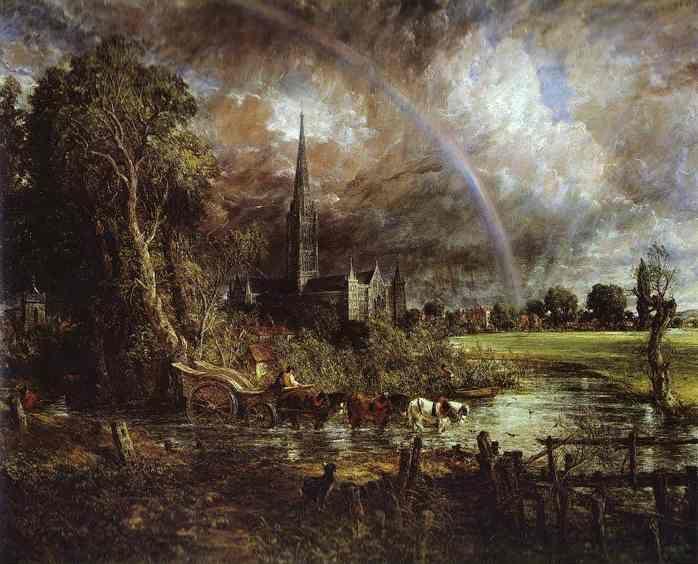
Anyone with an interest in English landscape painting will understand the appeal of a composition such as this and the earlier one. It has most of the component parts that Constable, Girtin, Cotman, Turner, Cozens and the rest arranged in countless drawings, sketches and finished works. There is the nominal subject of an old church, its spire piercing the sky. Then there is the river wending its way towards it, offering a line to take our eye through the composition. This line is echoed by the river banks, one side light, the other darker, depending on how the sun falls. A reflection of the church in the river is not something that always appears in such paintings, but here it adds to the mid-ground interest. And finally there is the trees - clumps of leaves and arching branches, their softness contrasting with the sharpness of the stone building.
There are, however, two things my image doesn't have in order to properly conform to this artistic genre. The first is a dramatic sky laden with billowing clouds of the kind so beloved by this group of painters. But, as I'm not one for pasting in skies from other photographs, here I've happily taken what nature offered, knowing that my photograph can be seen as both a record and a picture. The second thing that's missing is the animals or people that give scale and another area of focus to so many of these paintings. Often a few cows at the water's edge provide this, though sometimes it's a peasant leaning on a gate, or perhaps accompanying a horse and cart. Unfortunately, in Lincolnshire in 2009, cows have given way to cabbages, and bucolic peasants are difficult to find, so for my next photograph at this location I'll have to see about persuading my wife to fulfill this role. If I take along a few suitably rustic props, say a pitchfork, a smock, and a straw hat, who knows what could be achieved...
photograph & text (c) T. Boughen
Camera: Olympus E510
Mode: Aperture Priority
Focal Length: 64mm (128mm/35mm equiv.)
F No: f10
Shutter Speed: 1/200
ISO: 100
Exposure Compensation: -0.3 EV
Image Stabilisation: On
Labels:
church,
Deeping St James,
landscape,
River Welland,
St James
Wednesday, August 19, 2009
The Institute, Deeping St James
click photo to enlargeAs I passed this Victorian building on Church Street, at Deeping St James in Lincolnshire, two thoughts crossed my mind. The first was, "That's an interesting way of dressing up a facade." The second concerned the wire that stretches from the top left to the centre, then drops down to disappear into a hole above the doorway. It occurred to me that it had been positioned with all the sensitivity of a tattoo on the end of a person's nose.
I photographed the building, known as "The Institute", mainly because of the unusual yellow brickwork designs that form both the quoins to the left and right, and the surrounds for the tall windows and the door. However, once I'd got my photograph onto the computer, had corrected the converging verticals, and began to study the facade, a lot more details caught my eye, and quite a few questions came to mind. For example, why did the builder or architect place a large piece of stone at the bottom left and bottom right corners? Why did he use stone for the sills of the three windows rather than wrapping the brickwork surrounds underneath? Why does his design for the "shoulders" of the door surround differ from those of the windows? Why is the band of yellow brickwork that crosses the facade at the level of the window sills flush with the wall and hence barely visible?
The building's style borrows from that of a church or chapel (tall and pointed openings), and from classical precedents (the brick plinth, quoins and hints of "Gibbs surrounds" in the work around the windows and doorway). It is Classical too in its severe symmetry: note that even the bootscrapers are doubled up, one on each side of the door, lest the building become even slightly unbalanced. The use, almost exclusively, of brick, and the vernacular touch of a dog-tooth corbel just below the eaves, betrays its provincial origins, lower cost, and lower status. Despite its relatively elaborate decoration it is still quite a utilitarian building. I haven't been able to find out much about its origins. Was it always an Institute? Was it a non-conformist chapel originally? Whatever its past, its present includes housing the Parish Council of Deeping St James, and offering more than a little interest and intrigue to passers-by who care to stop and stare.
photograph & text (c) T. Boughen
Camera: Olympus E510
Mode: Aperture Priority
Focal Length: 11mm (22mm/35mm equiv.)
F No: f6.3
Shutter Speed: 1/640
ISO: 100
Exposure Compensation: -0.3 EV
Image Stabilisation: On
Tuesday, August 18, 2009
Deeping Gate Bridge
click photo to enlargeIn my working past I sometimes used to talk to groups of children about the importance of good manners. To illustrate my point I would often use the analogy of bicycle maintenance, observing that the purpose of oiling a bike chain is to lubricate it such that the links engage with the sprockets smoothly, with minimal friction. So, I would continue, good manners are like that oil, and enable people to get along better by reducing the friction between them. I think those who were keen cyclists might have understood my point, but probably the rest reflected that it was their father who maintained their bicycle and wondered what the old duffer at the front was on about.
The subject of today's photograph, the Deeping Gate Bridge at Deeping St James, Lincolnshire, would not work without good manners. A stone-built, three-arched structure, it was constructed in 1651 to cross the River Welland in both directions, a function it carries out to this day. However, when it was erected the traffic that used it would have been pedestrians, horses, farm animals, carts and carriages. Today's traffic is mainly a regular flow of any motor vehicles that will fit on its single track roadway, but also a regular sprinkling of walkers and cyclists. Passage over the bridge is not regulated by lights, so courtesy is required of the drivers to ensure that traffic keeps flowing. And flow it does, not with the calm serenity of the river below, but in spurts and gushes, first from one side, then the other, as drivers reciprocally give way to each other. Pedestrians crossing the bridge have triangular refuges at the top of each of the cut-waters, which accounts for these being not only on the upstream side, where they are necessary to divide the flow around the piers, but also on the downstream side (shown above).
During a recent longish walk by the River Welland, the bridge, its clear reflection, and the general setting with the C19 pub, thatched houses, trees and waterside plants all suggested a photograph. Had the ducks and swans further upstream been in the water nearby I could have composed using the full frame, but in their absence I took the shot knowing I was going to crop the bottom of the image.*
* Sometimes the first posting of my blog entries contains mangled prose, as the last paragraph of this one did today. However, my proof reader (aka my wife) invariably spots my lapses into gibberish, draws it to my attention, and a quick edit soon puts things right (or at least better).
photographs & text (c) T. Boughen
Camera: Olympus E510
Mode: Aperture Priority
Focal Length: 14mm (28mm/35mm equiv.)
F No: f6.3
Shutter Speed: 1/500
ISO: 100
Exposure Compensation: -0.7 EV
Image Stabilisation: On
Thursday, March 05, 2009
Landscape at Deeping St James
click photo to enlargeLast weekend I followed the course of the River Welland from the outskirts of Deeping St James to the centre of Market Deeping. The end of February is a time of year when the first real flush of spring flowers is appearing, the light is noticably brighter, I'm willing spring to get a move on, but the trees still wear their winter dress, and there's an edge to the wind cold enough to keep my hat on my head. All around the landscape has a grey/brown look, except where winter wheat is providing rectangles of fresh green.
That particular walk is an interesting one because the back gardens of houses line the river all the way. It's fun to see how some households embrace the river, setting up summer houses, paved areas with tables and seating, jetties and small boats, whilst others turn their backs on it, erecting fences and hedges to keep it out of sight and mind. Many of the buildings are a couple of hundred years old, and show the accretions of successive generations of owners, whilst others are quite new, sometimes featuring an upstairs balcony to take advantage of the view. A couple of weirs and a three-arched stone packhorse-bridge built in 1651 are also passed on the walk, as is the medieval church of St James at Deeping St James, a former Benedictine priory founded in 1139, with a west tower of 1717.
As I turned a bend on the walk the tower of this church came into view, with its reflection in the river, and a couple of well-placed trees. I took this photograph, meaning to present it in the colours characteristic of the time of year - all greys, whites, greens and browns. However, it looked like it had a composition and subject that would respond to a black and white treatment. I think it does, and even (dare I say) gives the landscape a Dutch/Flemish character - possibly "a touch of the Breughels" - as the punch line of an old joke has it!
photograph & txt (c) T.Boughen
Camera: Olympus E510
Mode: Aperture Priority
Focal Length: 43mm (86mm/35mm equiv.)
F No: f7.1
Shutter Speed: 1/160 seconds
ISO: 100
Exposure Compensation: -0.3 EV
Image Stabilisation: On
Tuesday, March 03, 2009
Reflecting on the River Welland
click photo to enlargeYou're walking through the countryside and your path leads to a bridge over a river or a stream. You walk forward onto the bridge, and then what? Well, if you're like me, and just about everyone I've ever observed doing this, you stop in the middle and turn to look either upstream or downstream. It feels like the natural thing to do. We don't seem to be able to help ourselves. So what is it about bridges over water that make us stop and look, when discretion might be urging us to keep going until we're back with our feet fixed firmly on terra firma?
I suppose it's the pleasure that comes from surveying a stretch of moving water, no matter how small. And the curiosity about what it might contain - the fish, frogs, rocks, weed and the other things that we can see: and the lurking things we can't see, but wonder about, in the dark, still pools. Could it be a relic of our primitive past when a stretch of water offered the chance of fresh food? Or maybe it's an aesthetic urge to trace a river's course with our eye, following the banks, the depths and shallows, the brooding shadows and dancing highlights, the never still ripples and eddies, as they move towards us, under our feet, and away. Then there's the smell of the air above water, fresh clean and sharp from streams that flow quickly over rocky beds, slightly musty and dank from slow flowing waterways as they meander through the lowlands. And finally, there's the sound that varies from the crashing roar of a rocky river in spate, to the gentle swish and occasional plop of a slow moving stream.
The other day I stood on a small footbridge that spans part of the River Welland at Deeping St James. This is a fairly slow moving, quiet river, but at this particular point it was noisy because there was a man-made weir below me. I'd heard it from a distance as I approached the river, and found it, fast-moving, with spray, swirling ripples, and shooting water. I stopped half way across to take a few photographs, closing down the aperture to f22 to slow the shutter speed and blur the moving water. I've taken shots of this kind before, but here I concentrated on where the water tipped over the edge of the small weir and slid down an incline before hitting the pool below. The differing speeds of the water in each part of its journey gave differing effects, and I reflected that making images like this is yet another reason for pausing when your path leads across a bridge over water.
photograph & text (c) T. Boughen
Camera: Olympus E510
Mode: Aperture Priority
Focal Length: 106mm (212mm/35mm equiv.)
F No: f22
Shutter Speed: 1/13 seconds
ISO: 100
Exposure Compensation: -2.0 EV
Image Stabilisation: On
Labels:
Deeping St James,
Lincolnshire,
motion blur,
river,
River Welland,
weir
Subscribe to:
Posts (Atom)