click photos to enlarge
I find my visits to the National Centre for Craft and Design (NCCD) at Sleaford, Lincolnshire, hit and miss affairs. Sometimes I am delighted, excited, provoked, intrigued and surprised. On other occasions I am bored, bewildered, depressed, disheartened, and affronted. My recent visit to see the main gallery exhibition of Gordon Baldwin's ceramic sculptures definitely fell into the second category. After viewing the pieces, looking at the curatorial commentary, listening to the artist on a video, and reading quotations by him I left, regretting that I had devoted time to the experience. On this occasion I won't elaborate on my reasons for feeling that way because I can think of little to say that is positive, a situation that I can recall occurring only once before when I briefly viewed an exhibition of Vivienne Westwood shoes.
One of the virtues of the NCCD is that there are two further exhibition spaces: a smaller top-floor room (The Roof Gallery) and the stairwell (Window Space), so if you are disappointed by one exhibition you can hope that you'll discover something to enjoy elsewhere. Unfortunately I found the offering at the top of the building - "Class of 2012" - only minimally diverting. However, the exhibits on the landing, window ledges and walls of the stairwell were much more interesting. They were the work of an Italian ceramic sculptor, Pina Lavelli. She had created small, white shapes with surfaces that resembled leaf cell structures or some other plant texture. These fractal-like patterns didn't cover all the shapes so they contrasted with the remaining smooth roundedness. Other white, pebble-like shapes were gathered in black openwork wire spheres. The pieces stood on surfaces in groups as sculpture or were fixed to flat white frames to form relief pictures. Plants had inspired the artist, and one could see that connection, but the beautiful, unsullied whiteness of many of the pieces most closely resembled, to my mind, water-worn pebbles, pumice stone, perhaps sea-urchin shells or, to return to plants, newly-appeared toadstools and mushrooms.
I took a few quick snaps of the exhibits and show here a closeup, two of the spheres and a photograph of a relief. The latter I shot at an angle, showing only part of the artwork and I included a segment of a nearby wall light. I left the NCCD as I usually do, glad that I'd gone, and ready for the next exhibitions be they good, bad or indifferent.
photographs © Tony Boughen
Photo 1
Camera: LX3
Mode: Aperture Priority
Focal Length: 12.1mm (57mm - 35mm equiv.)
F No: 2.8
Shutter Speed: 1/100
ISO: 100
Exposure Compensation: -0.33 EV
Image Stabilisation: On
Thursday, November 15, 2012
Tuesday, November 13, 2012
The exterior of Ely Cathedral
click photo to enlarge
The exterior form of Ely is something of an oddity among English cathedrals. As you approach it across the flat Fenland landscape its appearance above the town, on a rise only 68 feet high, is long and low with towers at the crossing and the west end. That is a quintessentially English profile. However, the crossing tower is lower and wider than usual, and there is but one west tower, not the usual two. It is principally this arrangement and the attendant details that make the cathedral something, to my mind, of an ugly duckling.
The low, wide crossing tower was built after the more typical tower of Norman date collapsed on 22 February 1322. The replacement is octagonal, the lower part stone and the upper corona or lantern, timber. It quickly acquired the name of The Octagon. This curious structure that looks wide rather than tall, is surrounded by pinnacles and topped by slender castellated turrets that echo those of the west tower. The west tower itself was built in the early thirteenth century, and in 1230 a spire was erected on the top. However, in the later fourteenth century the spire was taken down and replaced by the current octagon and the slender corner turrets. A small lead spire was added to this at an unknown date, but this too was removed in 1801 to leave the building looking as it does today. Germany is the home of cathedrals with a single west tower, so to see one in England, and with such an unusual design - more castle-like than ecclesiastical - is unusual. Moreover, to have the big tower echoed in a smaller tower to the south (see main photograph) makes for a strongly asymmetrical west facade, something that is equally odd in an English context. But, whilst the overall form of Ely is strange and awkward, the details of the exterior are interesting and often beautiful, particularly the blank arcading of the walls. The large, rectangular Lady Chapel that is a separate building but for the linking corridor is a further Ely quirk. However, the location and style make it look like a chapter house so it does not stand out in the way that the towers do.
Photographing the exterior of Ely is quite a challenge. It is closely surrounded by buildings, and where there is a big sloping pasture on the south side, there are plenty of large trees that get in the way. The cathedral green in front of the west facade offers just enough space for a reasonably satisfactory shot, and I took advantage of this on a recent visit. Incidentally, the incongruous looking cannon in the left foreground has these words on a nearby plaque: "Russian canon captured during the Crimean War. Presented to the people of Ely by Queen Victoria in 1860 to mark the creation of the Ely Rifle Volunteers." Around the edge of the plaque are the words, "Give peace in our time O Lord."
photographs and text © Tony Boughen
Photo 1
Camera: Canon
Mode: Aperture Priority
Focal Length: 27mm
F No: f7.1
Shutter Speed: 1/320
ISO: 100
Exposure Compensation: -0.67 EV
Image Stabilisation: On
The exterior form of Ely is something of an oddity among English cathedrals. As you approach it across the flat Fenland landscape its appearance above the town, on a rise only 68 feet high, is long and low with towers at the crossing and the west end. That is a quintessentially English profile. However, the crossing tower is lower and wider than usual, and there is but one west tower, not the usual two. It is principally this arrangement and the attendant details that make the cathedral something, to my mind, of an ugly duckling.
The low, wide crossing tower was built after the more typical tower of Norman date collapsed on 22 February 1322. The replacement is octagonal, the lower part stone and the upper corona or lantern, timber. It quickly acquired the name of The Octagon. This curious structure that looks wide rather than tall, is surrounded by pinnacles and topped by slender castellated turrets that echo those of the west tower. The west tower itself was built in the early thirteenth century, and in 1230 a spire was erected on the top. However, in the later fourteenth century the spire was taken down and replaced by the current octagon and the slender corner turrets. A small lead spire was added to this at an unknown date, but this too was removed in 1801 to leave the building looking as it does today. Germany is the home of cathedrals with a single west tower, so to see one in England, and with such an unusual design - more castle-like than ecclesiastical - is unusual. Moreover, to have the big tower echoed in a smaller tower to the south (see main photograph) makes for a strongly asymmetrical west facade, something that is equally odd in an English context. But, whilst the overall form of Ely is strange and awkward, the details of the exterior are interesting and often beautiful, particularly the blank arcading of the walls. The large, rectangular Lady Chapel that is a separate building but for the linking corridor is a further Ely quirk. However, the location and style make it look like a chapter house so it does not stand out in the way that the towers do.
Photographing the exterior of Ely is quite a challenge. It is closely surrounded by buildings, and where there is a big sloping pasture on the south side, there are plenty of large trees that get in the way. The cathedral green in front of the west facade offers just enough space for a reasonably satisfactory shot, and I took advantage of this on a recent visit. Incidentally, the incongruous looking cannon in the left foreground has these words on a nearby plaque: "Russian canon captured during the Crimean War. Presented to the people of Ely by Queen Victoria in 1860 to mark the creation of the Ely Rifle Volunteers." Around the edge of the plaque are the words, "Give peace in our time O Lord."
photographs and text © Tony Boughen
Photo 1
Camera: Canon
Mode: Aperture Priority
Focal Length: 27mm
F No: f7.1
Shutter Speed: 1/320
ISO: 100
Exposure Compensation: -0.67 EV
Image Stabilisation: On
Labels:
Ely Cathedral,
Gothic architecture,
history
Monday, November 12, 2012
The Mereway, Ingoldsby Wood, Lincolnshire
click photo to enlarge
When I was young the woods managed by the Forestry Commission were places where the public were not welcome. Signs told us to keep out, graphic notices warned of the risk of fire, and at various points collections of implements for beating out blazes were pointedly stacked. All this served to suggest that public access was a threat that couldn't be countenanced. Today people are, I'm glad to say, welcomed into what are a national and publicly owned asset - our woods. I was reminded of this recently as we passed through Ingoldsby Wood near Boothby Pagnell, Lincolnshire, when I came across a Forestry Commission sign inviting people to enjoy the sylvan beauty.
We were walking along a route known as The Mereway, a path that follows part of the perimeter of the woodland. This area of trees is probably a patch of ancient woodland, and may be part of the larger woodland recorded in the Domesday Book. The vicinity of the wood has a number of earthworks including a circular feature with ditch and bank that may be an Iron Age enclosure though it has produced Romano-British and post-medieval artefacts. There is also the site of a medieval moated enclosure with a fishpond. This could have been the location of a grange associated with Vaudey Abbey. Then there is The Mereway track itself. Anyone seeing its name written on the Ordnance Survey map might well think that it was named after a long-gone area of water. However, the word "mere", as well being Old English for a pool or pond, can also derive from the Old English "mære" meaning a boundary, and that is clearly the intended usage here because the track follows the western edge of the wood. There is some speculation that the path may be on the line of an ancient trackway. On the other hand its name may indicate that it is simply a wood boundary, a feature serving a similar purpose to the woodbanks that frequently mark the extent of old woodland, and of which there are signs in Ingoldsby Wood.
I took today's photograph to record the track, but also for the red-orange of the beech leaves and as a record of a fine and sunny day. Some trees are still clinging to their leaves, but an increasing number of bare boughs and branches are evident as the temperatures drop, the light dims and winter edges autumn aside.
photograph and text © Tony Boughen
Camera: Canon
Mode: Aperture Priority
Focal Length: 28mm
F No: f10
Shutter Speed: 1/50
ISO: 100
Exposure Compensation: -0.33 EV
Image Stabilisation: On
When I was young the woods managed by the Forestry Commission were places where the public were not welcome. Signs told us to keep out, graphic notices warned of the risk of fire, and at various points collections of implements for beating out blazes were pointedly stacked. All this served to suggest that public access was a threat that couldn't be countenanced. Today people are, I'm glad to say, welcomed into what are a national and publicly owned asset - our woods. I was reminded of this recently as we passed through Ingoldsby Wood near Boothby Pagnell, Lincolnshire, when I came across a Forestry Commission sign inviting people to enjoy the sylvan beauty.
We were walking along a route known as The Mereway, a path that follows part of the perimeter of the woodland. This area of trees is probably a patch of ancient woodland, and may be part of the larger woodland recorded in the Domesday Book. The vicinity of the wood has a number of earthworks including a circular feature with ditch and bank that may be an Iron Age enclosure though it has produced Romano-British and post-medieval artefacts. There is also the site of a medieval moated enclosure with a fishpond. This could have been the location of a grange associated with Vaudey Abbey. Then there is The Mereway track itself. Anyone seeing its name written on the Ordnance Survey map might well think that it was named after a long-gone area of water. However, the word "mere", as well being Old English for a pool or pond, can also derive from the Old English "mære" meaning a boundary, and that is clearly the intended usage here because the track follows the western edge of the wood. There is some speculation that the path may be on the line of an ancient trackway. On the other hand its name may indicate that it is simply a wood boundary, a feature serving a similar purpose to the woodbanks that frequently mark the extent of old woodland, and of which there are signs in Ingoldsby Wood.
I took today's photograph to record the track, but also for the red-orange of the beech leaves and as a record of a fine and sunny day. Some trees are still clinging to their leaves, but an increasing number of bare boughs and branches are evident as the temperatures drop, the light dims and winter edges autumn aside.
photograph and text © Tony Boughen
Camera: Canon
Mode: Aperture Priority
Focal Length: 28mm
F No: f10
Shutter Speed: 1/50
ISO: 100
Exposure Compensation: -0.33 EV
Image Stabilisation: On
Labels:
ancient trackway,
Ingoldsby Wood,
Lincolnshire,
The Mereway
Sunday, November 11, 2012
The threatened ash tree
click photo to enlarge
The sea that separates the British Isles from continental Europe is generally thought of, by the inhabitants of these islands at least, as a blessing, a defensive moat that kept Napoleon and Hitler at bay, has stopped rabies from becoming widespread here, and prevents European integrationism from too deeply affecting our idiosyncratic ways. However, a longer view must also record how, when the ice ages covered our islands in glaciers, sending the wildlife south to escape its deadly touch, the thaw that followed and the North Sea and English Channel that it created and which separated our islands from Europe, also prevented the return of many plants and animals. Thus, fallow deer were present before the last glaciation, but did not return after it, the present herds all being introduced animals. As many school children used to know, the adder made it back to England, Scotland and Wales, but it wasn't St Patrick who banished it from Ireland, but rather the inundation that became the Irish Sea prevented it reaching that country.
However, in these days of regular international and inter-continental travel, when goods are shipped around the world with barely a thought, and when companies source products from whoever can provide them at the lowest price, the narrow stretch of sea that was once seen as a formidable barrier, is today a mere ditch that can be stepped across at will. Ash dieback disease, the Chalara fraxinea fungus that was first seen in Eastern Europe twenty years ago, which has spread rapidly across the continent, badly affecting the ash trees of Germany, France and elsewhere, and has affected 90% of Danish ash trees, is now spreading in Britain. There is some debate over whether it was brought in solely on imported saplings or whether it also arrived on the wind from across the narrow North Sea. But, it seems widely agreed that it is here, it can't be eradicated, only slowed in its progress, and it will have a major effect on our hedgerows and woodlands, as well as on the wildlife that favours this particular species. Current thinking suggests that the best course of action is to leave trees to die naturally, to identify those individual trees that seem to be resistant, and to begin a breeding programme to produce new plants from them.
This depressing business was on my mind as I processed today's photograph. I didn't notice when I took the shot, but it features a young ash tree. Five and half percent of British woodland trees are ash, but 12 million grow elsewhere, particularly in hedgerows. It is the second most commonly seen individual tree (after the oak). I read that in Lincolnshire and East Yorkshire combined the ash accounts for 40 percent of the trees. A loss of such magnitudes would be devastating nationally and locally.
photograph and text © Tony Boughen
Camera: Canon
Mode: Aperture Priority
Focal Length: 45mm
F No: f7.1
Shutter Speed: 1/800
ISO: 100
Exposure Compensation: -1.33 EV
Image Stabilisation: On
The sea that separates the British Isles from continental Europe is generally thought of, by the inhabitants of these islands at least, as a blessing, a defensive moat that kept Napoleon and Hitler at bay, has stopped rabies from becoming widespread here, and prevents European integrationism from too deeply affecting our idiosyncratic ways. However, a longer view must also record how, when the ice ages covered our islands in glaciers, sending the wildlife south to escape its deadly touch, the thaw that followed and the North Sea and English Channel that it created and which separated our islands from Europe, also prevented the return of many plants and animals. Thus, fallow deer were present before the last glaciation, but did not return after it, the present herds all being introduced animals. As many school children used to know, the adder made it back to England, Scotland and Wales, but it wasn't St Patrick who banished it from Ireland, but rather the inundation that became the Irish Sea prevented it reaching that country.
However, in these days of regular international and inter-continental travel, when goods are shipped around the world with barely a thought, and when companies source products from whoever can provide them at the lowest price, the narrow stretch of sea that was once seen as a formidable barrier, is today a mere ditch that can be stepped across at will. Ash dieback disease, the Chalara fraxinea fungus that was first seen in Eastern Europe twenty years ago, which has spread rapidly across the continent, badly affecting the ash trees of Germany, France and elsewhere, and has affected 90% of Danish ash trees, is now spreading in Britain. There is some debate over whether it was brought in solely on imported saplings or whether it also arrived on the wind from across the narrow North Sea. But, it seems widely agreed that it is here, it can't be eradicated, only slowed in its progress, and it will have a major effect on our hedgerows and woodlands, as well as on the wildlife that favours this particular species. Current thinking suggests that the best course of action is to leave trees to die naturally, to identify those individual trees that seem to be resistant, and to begin a breeding programme to produce new plants from them.
This depressing business was on my mind as I processed today's photograph. I didn't notice when I took the shot, but it features a young ash tree. Five and half percent of British woodland trees are ash, but 12 million grow elsewhere, particularly in hedgerows. It is the second most commonly seen individual tree (after the oak). I read that in Lincolnshire and East Yorkshire combined the ash accounts for 40 percent of the trees. A loss of such magnitudes would be devastating nationally and locally.
photograph and text © Tony Boughen
Camera: Canon
Mode: Aperture Priority
Focal Length: 45mm
F No: f7.1
Shutter Speed: 1/800
ISO: 100
Exposure Compensation: -1.33 EV
Image Stabilisation: On
Labels:
ash,
dieback,
disease,
Heckington,
Lincolnshire,
silhouette,
sunset,
tree
Friday, November 09, 2012
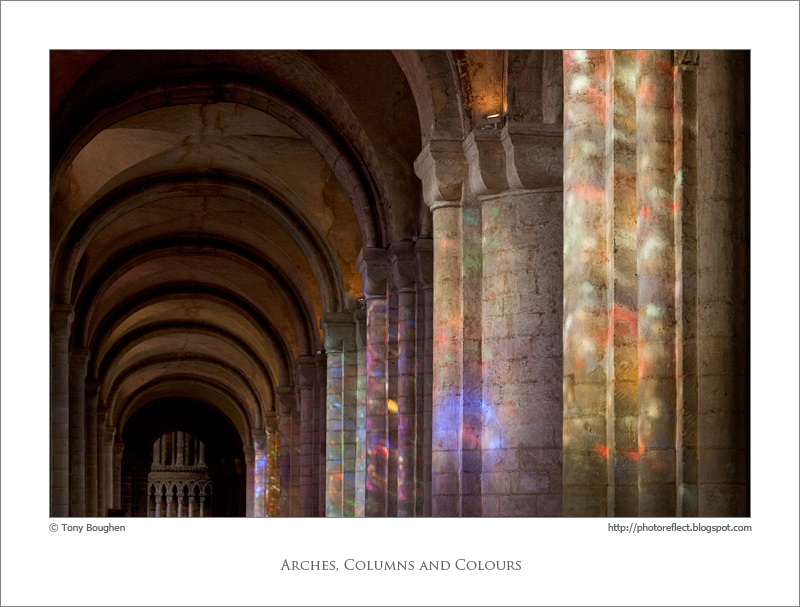
Arches, columns and colours
click photo to enlarge
Most of the interior wall surfaces of England's medieval churches and cathedrals are unadorned stone. Where this isn't the case they are generally painted with a light coloured wash, plastered, or decorated with painted patterns or pictures. In this country we've grown accustomed to the austere looking walls of stone, enlivened only by the occasional memorial tablet, hatchment, British Legion flag or Mothers' Union embroidery. But it wasn't always like this.
England's churches used to be as colourful as any to be found in Spain, Italy or France. In fact these countries were often the model for the painted patterns, figures and architecture that covered many walls. Figures such as St Christopher, Mary, King David with his harp, Adam and Eve; subjects such as the Last Judgement or the symbols of the Four Evangelists, and scenes from the morality tales provided instruction and illustration for the illiterate and decorative surroundings for all. Most of this painting was banished by the Protestant reformation, either physically removed or buried under limewash. Today some relics of these grand schemes can still be seen, examples that have been revealed by the painstaking removal of the covering paint. And, if you look carefully in the carved details of the sculpted figures and plants on column capitals or blind arcades you can often see traces of the original red ochre or blue paint that was quickly applied after the sculptors had finished their work.
We were in Ely Cathedral, Cambridgeshire recently, a building that has fragmentary examples of medieval painting still to be seen. However, as I walked down the south aisle of the nave it was a different kind of colour that was enlivening the unpainted stone of the twelfth century Norman columns and cushion capitals below the groined vaulting. The low November sun was shining through the Victorian stained glass, projecting its colours onto the stonework, temporarily returning long lost colours, but with hues and an intensity that the medieval artists could never match. It was a fine sight, and one that demanded a photograph.
photograph and text © Tony Boughen
Camera: Canon
Mode: Aperture Priority
Focal Length: 84mm
F No: f6.3
Shutter Speed: 1/800
ISO: 1600
Exposure Compensation: -0.67 EV
Image Stabilisation: On
Most of the interior wall surfaces of England's medieval churches and cathedrals are unadorned stone. Where this isn't the case they are generally painted with a light coloured wash, plastered, or decorated with painted patterns or pictures. In this country we've grown accustomed to the austere looking walls of stone, enlivened only by the occasional memorial tablet, hatchment, British Legion flag or Mothers' Union embroidery. But it wasn't always like this.
England's churches used to be as colourful as any to be found in Spain, Italy or France. In fact these countries were often the model for the painted patterns, figures and architecture that covered many walls. Figures such as St Christopher, Mary, King David with his harp, Adam and Eve; subjects such as the Last Judgement or the symbols of the Four Evangelists, and scenes from the morality tales provided instruction and illustration for the illiterate and decorative surroundings for all. Most of this painting was banished by the Protestant reformation, either physically removed or buried under limewash. Today some relics of these grand schemes can still be seen, examples that have been revealed by the painstaking removal of the covering paint. And, if you look carefully in the carved details of the sculpted figures and plants on column capitals or blind arcades you can often see traces of the original red ochre or blue paint that was quickly applied after the sculptors had finished their work.
We were in Ely Cathedral, Cambridgeshire recently, a building that has fragmentary examples of medieval painting still to be seen. However, as I walked down the south aisle of the nave it was a different kind of colour that was enlivening the unpainted stone of the twelfth century Norman columns and cushion capitals below the groined vaulting. The low November sun was shining through the Victorian stained glass, projecting its colours onto the stonework, temporarily returning long lost colours, but with hues and an intensity that the medieval artists could never match. It was a fine sight, and one that demanded a photograph.
photograph and text © Tony Boughen
Camera: Canon
Mode: Aperture Priority
Focal Length: 84mm
F No: f6.3
Shutter Speed: 1/800
ISO: 1600
Exposure Compensation: -0.67 EV
Image Stabilisation: On
Thursday, November 08, 2012
The Ouse Washes
click photo to enlarge
When, in the seventeenth century, further concerted attempts were made to increase the agricultural potential of the Fens, the 4th Earl of Bedford and his financial partners employed the Dutch engineer, Cornelius Vermuyden (1595-1677), to undertake a programme of drainage.The aim was to make pasture available for summer grazing. As part of his works Vermuyden created, on the course of the River Ouse, two straight channels. These were designed to more speedily and effectively transfer water from the rivers and drains of the Fenland area into the sea near King's Lynn. Today these straight channels, about two thirds of a mile apart, are known as the Old Bedford River and the New Bedford River (formerly the Hundred Foot River). Both are embanked, but the banking is lower on the sides where the parallel channels face each other. The purpose of this is so that when they flood they overflow into the land between the channels and the floodwater is managed without detriment to nearby villages and more productive farmland. In England land subject to periodic flooding is often called a wash, and this particular land is known as the Ouse Washes (not to be confused with the large bay and estuary near King's Lynn called The Wash). It is rough pasture and wet land when not inundated, and in winter when it is most likely to be flooded, teems with waterfowl (particularly geese and whooper swans) and waders.
The other day we went to Ely. Our preferred route takes us over the twin Bedford channels and the Ouse Washes. However, as we drove onto the bridge over the Old Bedford River we were confronted with a sign saying, "Road closed due to flooding". It hadn't occurred to me that the Ouse Washes would be under water and that our road might be affected. We drove a short way to see how bad it was, and after negotiating a small area of floodwater came upon a place where the road disappeared under a quickly flowing current. Needless to say we stopped. A tractor found the depth of water of no consequence and went through, water flying everywhere, but we decided that discretion was the better part of valour and beat a retreat. Then we consulted our maps for an alternate route, though not before I'd got out of the car to take a few photographs of the floodwaters around us. The early morning light, plus the glow of blue sky on the water all around us gave something of the feel of being on a boat on a lake. The smaller photographs were taken from the road, the larger one from the bridge over the Old Bedford River, its banks and tree trunks hidden beneath the flow.
photographs and text © Tony Boughen
Photo 1
Camera: Canon
Mode: Aperture Priority
Focal Length: 28mm
F No: f8
Shutter Speed: 1/125
ISO: 100
Exposure Compensation: -0.67 EV
Image Stabilisation: On
Labels:
Cambridgeshire,
Fens,
flooding,
Ouse Washes,
Welney
Tuesday, November 06, 2012
The tide of green paint
click photo to enlarge
Over the past twenty years a tide of green paint has lapped over our villages and towns, initially affecting the more well-to-do areas, then extending into less prosperous regions. It started out as almost exclusively sage green, then branched out into other shades of muted green, sometimes with a hint of blue, often leaning more towards grey. If you search out this range of colours you'll find them offered by suppliers of "heritage" paints. However, such is their popularity, some mainstream paint companies now stock them. Is this simply fashion or are there deeper influences at work? The change in the colours of doors, windows, fences and other exterior woodwork from white and strong colours to these more earthy hues is not something that has been widely noted or much commented upon, so here are some of my thoughts on the subject.
The increasing search for authenticity in heritage projects and building restoration during the last quarter of the twentieth century prompted interest and research into the use of paint from the seventeenth century through to the present day. By scrutiny of primary records - job specifications, contractors' estimates and bills, buyers' and visitors' diaries etc, as well as microscopic analysis of the layers of of paint on old surfaces - a revised view of the composition and colours of paint used in the past was formulated. A range of muted greens were found to be popular during the eighteenth and early nineteenth centuries. So too were colours in the off-white, brown, mauve/peach, orange, blue, grey and stone ranges. None of these, especially when used outdoors, were strident colours, though stronger colours were used indoors. For reasons difficult to determine, the range of greens became much more popular than the other muted colours. That's not to say the others weren't used, they were, especially for external render, but also for woodwork. But, the greens were much more widely used. Perhaps their popularity grew as a result of the increase in membership of organisations who first used these colours - bodies such as the National Trust and English Heritage. People visiting houses that were restored using the new thinking about paint may well have been influenced to adopt the new colours too, especially if they lived in a period property.
Today the greens described above are used fairly indiscriminately on buildings old and new. I recently passed some very new flats (styled in a modern way) in Chatteris, Cambridgeshire, that had windows and doors painted sage green and walls that were clad in hardwood. As I've travelled around the country I've also detected that this kind of green paint seems to be used as a badge of belonging by people of a certain class and outlook. This struck me most forcibly when I was recently in Tewkesbury, a town that more than most has succumbed to this fashion.
Today's photograph shows two such doors in Ely, Cambridgeshire. That the tide of green paint continues unabated is clear when you compare the colour of the rightmost house on Google Street View with that of today. As I took my photograph, drawn to the scene by the overlay of tree shadows on the yellow brick walls, I wondered what colour the painter was going to use when he had finished preparing the wood.
photograph and text © Tony Boughen
Camera: Canon
Mode: Aperture Priority
Focal Length: 45mm
F No: f7.1
Shutter Speed: 1/400
ISO: 100
Exposure Compensation: -0.33 EV
Image Stabilisation: On
Over the past twenty years a tide of green paint has lapped over our villages and towns, initially affecting the more well-to-do areas, then extending into less prosperous regions. It started out as almost exclusively sage green, then branched out into other shades of muted green, sometimes with a hint of blue, often leaning more towards grey. If you search out this range of colours you'll find them offered by suppliers of "heritage" paints. However, such is their popularity, some mainstream paint companies now stock them. Is this simply fashion or are there deeper influences at work? The change in the colours of doors, windows, fences and other exterior woodwork from white and strong colours to these more earthy hues is not something that has been widely noted or much commented upon, so here are some of my thoughts on the subject.
The increasing search for authenticity in heritage projects and building restoration during the last quarter of the twentieth century prompted interest and research into the use of paint from the seventeenth century through to the present day. By scrutiny of primary records - job specifications, contractors' estimates and bills, buyers' and visitors' diaries etc, as well as microscopic analysis of the layers of of paint on old surfaces - a revised view of the composition and colours of paint used in the past was formulated. A range of muted greens were found to be popular during the eighteenth and early nineteenth centuries. So too were colours in the off-white, brown, mauve/peach, orange, blue, grey and stone ranges. None of these, especially when used outdoors, were strident colours, though stronger colours were used indoors. For reasons difficult to determine, the range of greens became much more popular than the other muted colours. That's not to say the others weren't used, they were, especially for external render, but also for woodwork. But, the greens were much more widely used. Perhaps their popularity grew as a result of the increase in membership of organisations who first used these colours - bodies such as the National Trust and English Heritage. People visiting houses that were restored using the new thinking about paint may well have been influenced to adopt the new colours too, especially if they lived in a period property.
Today the greens described above are used fairly indiscriminately on buildings old and new. I recently passed some very new flats (styled in a modern way) in Chatteris, Cambridgeshire, that had windows and doors painted sage green and walls that were clad in hardwood. As I've travelled around the country I've also detected that this kind of green paint seems to be used as a badge of belonging by people of a certain class and outlook. This struck me most forcibly when I was recently in Tewkesbury, a town that more than most has succumbed to this fashion.
Today's photograph shows two such doors in Ely, Cambridgeshire. That the tide of green paint continues unabated is clear when you compare the colour of the rightmost house on Google Street View with that of today. As I took my photograph, drawn to the scene by the overlay of tree shadows on the yellow brick walls, I wondered what colour the painter was going to use when he had finished preparing the wood.
photograph and text © Tony Boughen
Camera: Canon
Mode: Aperture Priority
Focal Length: 45mm
F No: f7.1
Shutter Speed: 1/400
ISO: 100
Exposure Compensation: -0.33 EV
Image Stabilisation: On
Labels:
Cambridgeshire,
colour,
Ely,
heritage line,
paint,
painter
Monday, November 05, 2012
The Shard, viewed and eclipsed
click photo to enlarge
If I take my camera with the 70-300mm lens mounted on it, lean out from the balcony in Rotherhithe where I often stay, brace myself against the metal work and point it upstream towards the centre of London, I can take this photograph of The Shard. I've taken quite a few shots in this way during the construction of the building, some of which I've posted on the blog.
As well as showing the glass spike itself this view also features Guy's and St Thomas' Hospital - the tall building on the left. This utilitarian, concrete structure has sprouted what looks like scaffolding, an indication, perhaps, that it is being spruced up to be a more presentable neighbour for the new tower. A segment of the big wheel that is called the London Eye can be seen immediately to the right of The Shard. To the right of that is one of the pointed roofs of Tower Bridge visible between the two cranes. The buildings in the lower half of the photograph are the converted warehouses and new-build riverside flats along the Thames. The river itself is in the foreground.
The Shard's moment of fame as Europe's tallest building was brief. Apparently its height of 1,016 feet (310 metres) was recently eclipsed by Mercury City Tower in Moscow. It is though, by a big margin, the tallest building in the United Kingdom, though not the tallest structure. That honour belongs to the Emley Moor transmitting station, a telecommunications mast at 1,084 feet (330 metres) that was built in 1969-71 in Yorkshire. I mentioned in a recent post that I must buy a ticket to access the viewing gallery near the top of The Shard and in writing this piece I came across the fact that tickets are already on sale for the opening in February. I think I'll wait for the rush to die down before I buy one. If, that is, it does ever die down.
photograph and text © Tony Boughen
Camera: Canon
Mode: Aperture Priority
Focal Length: 228mm
F No: f5.6
Shutter Speed: 1/60
ISO: 3200
Exposure Compensation: -0.33 EV
Image Stabilisation: On
If I take my camera with the 70-300mm lens mounted on it, lean out from the balcony in Rotherhithe where I often stay, brace myself against the metal work and point it upstream towards the centre of London, I can take this photograph of The Shard. I've taken quite a few shots in this way during the construction of the building, some of which I've posted on the blog.
As well as showing the glass spike itself this view also features Guy's and St Thomas' Hospital - the tall building on the left. This utilitarian, concrete structure has sprouted what looks like scaffolding, an indication, perhaps, that it is being spruced up to be a more presentable neighbour for the new tower. A segment of the big wheel that is called the London Eye can be seen immediately to the right of The Shard. To the right of that is one of the pointed roofs of Tower Bridge visible between the two cranes. The buildings in the lower half of the photograph are the converted warehouses and new-build riverside flats along the Thames. The river itself is in the foreground.
The Shard's moment of fame as Europe's tallest building was brief. Apparently its height of 1,016 feet (310 metres) was recently eclipsed by Mercury City Tower in Moscow. It is though, by a big margin, the tallest building in the United Kingdom, though not the tallest structure. That honour belongs to the Emley Moor transmitting station, a telecommunications mast at 1,084 feet (330 metres) that was built in 1969-71 in Yorkshire. I mentioned in a recent post that I must buy a ticket to access the viewing gallery near the top of The Shard and in writing this piece I came across the fact that tickets are already on sale for the opening in February. I think I'll wait for the rush to die down before I buy one. If, that is, it does ever die down.
photograph and text © Tony Boughen
Camera: Canon
Mode: Aperture Priority
Focal Length: 228mm
F No: f5.6
Shutter Speed: 1/60
ISO: 3200
Exposure Compensation: -0.33 EV
Image Stabilisation: On
Labels:
evening,
London,
River Thames,
Rotherhithe,
The Shard,
tower
Saturday, November 03, 2012
Photograph what you like the way you like
click photo to enlarge
Photographers, perhaps more than many others who work in the field of visual arts and crafts, seem to take far too much notice of the opinions of others. Perhaps it's due to the fact that photography is a mixture of the technical and the artistic. Or it could be because the camera is a consumer durable, heavily marketed, constantly updated, available in multiple forms and hence subject to the familiar tyranny of choice, analysis paralysis and information overload that afflicts much buying today. If you agonise over the camera you buy, visiting countless websites, absorbing myriad opinions, listening to the informed, the opinionated, the "brand fans" and the mildly deranged, there's small wonder that you do the same when it comes to deciding what and how to photograph.
There are plenty of people who will tell you what is a good photographic subject and what are the "best" ways of taking a photograph. The problem is that if you follow this - often contrary - advice, you'll end up making images that look like everyone else's that please them, not you. Of course, if you ignore all the siren voices you may well end up doing that anyway because it's difficult to ignore photographs in our everyday lives and seeing so much we are very likely to be influenced by it. Nonetheless, I consider the best advice anyone can give to a photographer is, "photograph what you like the way you like." Given that is my view you'll realise I've not been one for camera clubs, books about photography, photographic qualifications, competitions or the the lure of professional photography. For me - and I'm only speaking about me here - all those have the potential to limit my photography rather than expand or deepen it. I do like to look at the photographs made by other photographers and I am interested in the wider visual arts and photography's place therein. But beyond that I just like to make pictures that please me!
Looking at today's offering and some of my other shots you might legitimately wonder whether it's so different from anyone else's output. Some of my work clearly is mainstream. However, some of my other images are, I think, less so. If I have a defining characteristic it is that I have no defining characteristic. In that respect my photography reflects my personality; I enjoy and pursue a wide range of interests and specialise in none.
The shot above of the Thames embankment lights at Rotherhithe, with Canary Wharf in the background, is a subject that I've photographed a few times before on visits to London, though I've only previously posted this fog-shrouded example.
photograph and text © Tony Boughen
Camera: Canon
Mode: Aperture Priority
Focal Length: 50mm
F No: f7.1
Shutter Speed: 1/400
ISO: 100
Exposure Compensation: -0.67 EV
Image Stabilisation: On
Photographers, perhaps more than many others who work in the field of visual arts and crafts, seem to take far too much notice of the opinions of others. Perhaps it's due to the fact that photography is a mixture of the technical and the artistic. Or it could be because the camera is a consumer durable, heavily marketed, constantly updated, available in multiple forms and hence subject to the familiar tyranny of choice, analysis paralysis and information overload that afflicts much buying today. If you agonise over the camera you buy, visiting countless websites, absorbing myriad opinions, listening to the informed, the opinionated, the "brand fans" and the mildly deranged, there's small wonder that you do the same when it comes to deciding what and how to photograph.
There are plenty of people who will tell you what is a good photographic subject and what are the "best" ways of taking a photograph. The problem is that if you follow this - often contrary - advice, you'll end up making images that look like everyone else's that please them, not you. Of course, if you ignore all the siren voices you may well end up doing that anyway because it's difficult to ignore photographs in our everyday lives and seeing so much we are very likely to be influenced by it. Nonetheless, I consider the best advice anyone can give to a photographer is, "photograph what you like the way you like." Given that is my view you'll realise I've not been one for camera clubs, books about photography, photographic qualifications, competitions or the the lure of professional photography. For me - and I'm only speaking about me here - all those have the potential to limit my photography rather than expand or deepen it. I do like to look at the photographs made by other photographers and I am interested in the wider visual arts and photography's place therein. But beyond that I just like to make pictures that please me!
Looking at today's offering and some of my other shots you might legitimately wonder whether it's so different from anyone else's output. Some of my work clearly is mainstream. However, some of my other images are, I think, less so. If I have a defining characteristic it is that I have no defining characteristic. In that respect my photography reflects my personality; I enjoy and pursue a wide range of interests and specialise in none.
The shot above of the Thames embankment lights at Rotherhithe, with Canary Wharf in the background, is a subject that I've photographed a few times before on visits to London, though I've only previously posted this fog-shrouded example.
photograph and text © Tony Boughen
Camera: Canon
Mode: Aperture Priority
Focal Length: 50mm
F No: f7.1
Shutter Speed: 1/400
ISO: 100
Exposure Compensation: -0.67 EV
Image Stabilisation: On
Labels:
black and white,
Canary Wharf,
London,
River Thames,
Rotherhithe,
street light
Friday, November 02, 2012
Look behind you
click photos to enlarge
A casual observer, watching me walk down the street or through the countryside may think that I'm paranoid, that I imagine I'm being followed, that I have a persecution complex or that I think everyone is out to get me. Why? Well, the fact is, I regularly stop and look behind. The more perceptive observer would notice the camera or at least the camera bag, and would work out that I'm looking to see if there's a shot in the opposite direction to the one in which I'm walking.
I take most of my photographs on walks, and I learned fairly early in my photographic development that we tend to see shots ahead and to the side of us, but often forget to look for those that are behind. It's now November and we've reached the time of year when, if you are walking with the low sun behind and floodlighting all before you, there may well be a contre jour shot to be found by turning round towards the sun. Yesterday's blog post illustrates that quite well. Today's photographs show that this habit of looking behind you is also helpful if the sun is from the side because it reveals a composition that you might have missed due to your attention being fixed on the direction in which you were walking.

Both shots show part of the River Witham in Boston, Lincolnshire, that is known as The Haven, a stretch a couple of miles long where inshore fishing boats berth. I took the small photograph first, using the moored boats as foreground interest and the river bank as a line through the image leading to the short curved terrace of houses. On this photograph I was keen to minimise the amount of sky and to include the figure on the left. My second shot was taken when we'd walked further downstream to a point past the most distant boat in the small photograph and I looked behind me. This view - the main photograph - is dominated by the tall tower of the church of St Botolph with its lantern top, and that meant more sky needed to be included. But once again the same group of boats is important, and with the curve of the river and the buildings by the roadside, provides the main subject of the shot. However, though the subject remains the same, the differing viewpoints make for quite different images.
photograph and text © Tony Boughen
Photo 1
Camera: Canon
Mode: Aperture Priority
Focal Length: 75mm
F No: f7.1
Shutter Speed: 1/200
ISO: 100
Exposure Compensation: -0.33 EV
Image Stabilisation: On
A casual observer, watching me walk down the street or through the countryside may think that I'm paranoid, that I imagine I'm being followed, that I have a persecution complex or that I think everyone is out to get me. Why? Well, the fact is, I regularly stop and look behind. The more perceptive observer would notice the camera or at least the camera bag, and would work out that I'm looking to see if there's a shot in the opposite direction to the one in which I'm walking.
I take most of my photographs on walks, and I learned fairly early in my photographic development that we tend to see shots ahead and to the side of us, but often forget to look for those that are behind. It's now November and we've reached the time of year when, if you are walking with the low sun behind and floodlighting all before you, there may well be a contre jour shot to be found by turning round towards the sun. Yesterday's blog post illustrates that quite well. Today's photographs show that this habit of looking behind you is also helpful if the sun is from the side because it reveals a composition that you might have missed due to your attention being fixed on the direction in which you were walking.

Both shots show part of the River Witham in Boston, Lincolnshire, that is known as The Haven, a stretch a couple of miles long where inshore fishing boats berth. I took the small photograph first, using the moored boats as foreground interest and the river bank as a line through the image leading to the short curved terrace of houses. On this photograph I was keen to minimise the amount of sky and to include the figure on the left. My second shot was taken when we'd walked further downstream to a point past the most distant boat in the small photograph and I looked behind me. This view - the main photograph - is dominated by the tall tower of the church of St Botolph with its lantern top, and that meant more sky needed to be included. But once again the same group of boats is important, and with the curve of the river and the buildings by the roadside, provides the main subject of the shot. However, though the subject remains the same, the differing viewpoints make for quite different images.
photograph and text © Tony Boughen
Photo 1
Camera: Canon
Mode: Aperture Priority
Focal Length: 75mm
F No: f7.1
Shutter Speed: 1/200
ISO: 100
Exposure Compensation: -0.33 EV
Image Stabilisation: On
Labels:
Boston,
fishing boat,
Lincolnshire,
photography,
river,
River Witham,
The Haven
Thursday, November 01, 2012
Changing London
"London is a splendid place to live in for those who can get out of it."
George John Gordon Bruce (1883-1967), English banker and peer
"I've been walking about London for the last thirty years, and I find something fresh in it every day." Walter Besant (1836-1901), English novelist and historian (words said on his death bed)
English people have differing views of their capital city. There are those who see it as the centre of the world, a place where anything and everything can and does happen, somewhere that shines brighter and more intensely than anywhere else. But there are also those for whom London is a place to avoid, a large, crowded, noisy, tumultuous place bent on making money or extracting it from the unwary visitor.
My view of London leads me to find sympathy with both of the above quotations. I really enjoy visiting London, but I wouldn't want to live there on a permanent basis. I've said elsewhere in this blog that a few years would suit me nicely, but then a yearning for the country, for the sea, for villages and small towns, for wide open spaces and wildlife would be so engulf me that I'd have to move out. So yes, a splendid place to live if you can regularly go elsewhere. As a photographer I'm always overwhelmed by the choice of photographic subjects that London offers. Like anywhere else it changes with the light, time of day and season. But it also changes because infrastructure development is an ongoing process to a much greater extent than anywhere else in the country. Buildings change use, old ones come down and new ones go up. The view up the Thames to the city from where I stay in London changes every year. A rather odd shaped building that flares out towards the top is currently under construction, a feature that has already earned it the name, "The Walkie Talkie". Then there is the view of the completed splinter of glass called "The Shard" that can be seen on the right of today's photograph (memo to self: must visit the viewing gallery when it opens to the public). For someone like me who is interested in architecture such buildings offer something fresh everyday at which I can point my camera.
Today's image, though it has a backdrop of the River Thames and the southern edge of the centre of the city is in fact a family photograph. I took it as my eldest son, his daughter, my wife and I were having a short walk. The sharp silhouettes and almost monochrome qualities softened by the clouds that threatened a further downpour suggested a contre jour shot would work, so I framed my photograph and pressed the shutter.
photograph and text © Tony Boughen
Camera: Canon
Mode: Aperture Priority
Focal Length: 45mm
F No: f7.1
Shutter Speed: 1/400
ISO: 100
Exposure Compensation: -1.00 EV
Image Stabilisation: On
Labels:
London,
River Thames,
The Shard
Tuesday, October 30, 2012
The city blacksmith
click photo to enlarge
During my lifetime I've lived in the country, in towns and in a city. I've always been grateful for that breadth of experience because it taught me that all locations have their advantages, disadvantages and interest. Moreover, I came to realise that the supposed antipathy and incomprehension that separates urban and rural dwellers is something dreamed up by slightly unhinged individuals and interest groups such as the so-called "Countryside Alliance".
When, as a child and youth, I lived in the country I was familiar with the work of the blacksmith. One of my early memories is standing watching the Kirkby Lonsdale smith, Jonty Wilson, at his work in his smithy on Fairbank mending some agricultural implements. Those premises are a smithy still. I also have a number of memories of Alf Limmer on Castlebergh Lane in Settle, shoeing horses, making gates, and fashioning some sledge runners for me. This smithy still exists today too.
But, despite the longevity of these particular premises, there are certainly fewer blacksmiths now than when I was young. However, they can still be found, usually in large villages or small towns, fashioning and repairing metal for domestic and agricultural customers and sometimes shoeing horses too, though mobile farriers seem to do most of this work now. Blacksmiths have always found work in cities and a few still do. Recently, on a short visit to London, I came across one in Rotherhithe. He was working at his forge in Surrey Docks City Farm, a place that aims to give London children a taste of farming, food production and farm animals. We'd been there before with our grand-daughter, but on this occasion I went in by a different entrance and passed the open door of the forge, allowing me to grab this shot as the blacksmith heated the metal he was working on. I added a touch of dark vignetting to my photograph to give emphasis to the figure, his forge and the glow from the flames.
photograph and text © Tony Boughen
Camera: Canon
Mode: Aperture Priority
Focal Length: 105mm
F No: f7.1
Shutter Speed: 1/100
ISO: 2000
Exposure Compensation: -0.67 EV
Image Stabilisation: On
During my lifetime I've lived in the country, in towns and in a city. I've always been grateful for that breadth of experience because it taught me that all locations have their advantages, disadvantages and interest. Moreover, I came to realise that the supposed antipathy and incomprehension that separates urban and rural dwellers is something dreamed up by slightly unhinged individuals and interest groups such as the so-called "Countryside Alliance".
When, as a child and youth, I lived in the country I was familiar with the work of the blacksmith. One of my early memories is standing watching the Kirkby Lonsdale smith, Jonty Wilson, at his work in his smithy on Fairbank mending some agricultural implements. Those premises are a smithy still. I also have a number of memories of Alf Limmer on Castlebergh Lane in Settle, shoeing horses, making gates, and fashioning some sledge runners for me. This smithy still exists today too.
But, despite the longevity of these particular premises, there are certainly fewer blacksmiths now than when I was young. However, they can still be found, usually in large villages or small towns, fashioning and repairing metal for domestic and agricultural customers and sometimes shoeing horses too, though mobile farriers seem to do most of this work now. Blacksmiths have always found work in cities and a few still do. Recently, on a short visit to London, I came across one in Rotherhithe. He was working at his forge in Surrey Docks City Farm, a place that aims to give London children a taste of farming, food production and farm animals. We'd been there before with our grand-daughter, but on this occasion I went in by a different entrance and passed the open door of the forge, allowing me to grab this shot as the blacksmith heated the metal he was working on. I added a touch of dark vignetting to my photograph to give emphasis to the figure, his forge and the glow from the flames.
photograph and text © Tony Boughen
Camera: Canon
Mode: Aperture Priority
Focal Length: 105mm
F No: f7.1
Shutter Speed: 1/100
ISO: 2000
Exposure Compensation: -0.67 EV
Image Stabilisation: On
Labels:
blacksmith,
forge,
smithy,
Surrey Docks City Farm
Monday, October 29, 2012
Avenues
click photo to enlarge
The word "avenue" in English originally comes from the French avenir and Latin advenire, to come to or to approach. In the sixteenth and seventeenth centuries the word was often spelt, "advenue", and in the eighteenth century "a'venue" was used. The Oxford English Dictionary (OED) records the first use of "avenue" meaning "approach" in a piece dating from 1639. However, by the eighteenth century the definition of the word that we use today - an approach or road lined with trees - was widely accepted. The United States seems to have modified its usage of the word to mean any fine, wide street, but in Britain trees are usually implied by "avenue".
The habit of lining a street, road or entrance driveway with trees to give it an enhanced status is a practise of long standing. It is a feature seen in the grounds of most large English country houses. Towns and cities with streets of eighteenth and and nineteenth century foundation often have such trees and feature the word "avenue" in their name. Municipal parks of the Victorian and Edwardian period usually have avenues, and the rare park of eighteenth century date, such as that at King's Lynn, frequently have them too. Go to the municipal cemetery- usually a nineteenth century creation - and here too you will find a tree lined road leading from the main entrance or to the chapel.
We recently, for the first time, walked into the cemetery at Boston, Lincolnshire, and found here a fine, imposing avenue leading from the entrance gatehouse to the chapel. Unusually it had a mixture of trees rather than being restricted to one or two species. Pines stood alongside beech and lime, with the deciduous trees shedding their leaves on the tarmac and gravestones below. we didn't venture far into the cemetery - that exploration can wait for a later date - but I lingered long enough to see two men come into view at the bottom of the avenue, figures to give some scale to my symmetrical shot down the roadway.
photograph and text © Tony Boughen
Camera: Canon
Mode: Aperture Priority
Focal Length: 105mm
F No: f7.1
Shutter Speed: 1/100
ISO: 1000
Exposure Compensation: 0 EV
Image Stabilisation: On
The word "avenue" in English originally comes from the French avenir and Latin advenire, to come to or to approach. In the sixteenth and seventeenth centuries the word was often spelt, "advenue", and in the eighteenth century "a'venue" was used. The Oxford English Dictionary (OED) records the first use of "avenue" meaning "approach" in a piece dating from 1639. However, by the eighteenth century the definition of the word that we use today - an approach or road lined with trees - was widely accepted. The United States seems to have modified its usage of the word to mean any fine, wide street, but in Britain trees are usually implied by "avenue".
The habit of lining a street, road or entrance driveway with trees to give it an enhanced status is a practise of long standing. It is a feature seen in the grounds of most large English country houses. Towns and cities with streets of eighteenth and and nineteenth century foundation often have such trees and feature the word "avenue" in their name. Municipal parks of the Victorian and Edwardian period usually have avenues, and the rare park of eighteenth century date, such as that at King's Lynn, frequently have them too. Go to the municipal cemetery- usually a nineteenth century creation - and here too you will find a tree lined road leading from the main entrance or to the chapel.
We recently, for the first time, walked into the cemetery at Boston, Lincolnshire, and found here a fine, imposing avenue leading from the entrance gatehouse to the chapel. Unusually it had a mixture of trees rather than being restricted to one or two species. Pines stood alongside beech and lime, with the deciduous trees shedding their leaves on the tarmac and gravestones below. we didn't venture far into the cemetery - that exploration can wait for a later date - but I lingered long enough to see two men come into view at the bottom of the avenue, figures to give some scale to my symmetrical shot down the roadway.
photograph and text © Tony Boughen
Camera: Canon
Mode: Aperture Priority
Focal Length: 105mm
F No: f7.1
Shutter Speed: 1/100
ISO: 1000
Exposure Compensation: 0 EV
Image Stabilisation: On
Labels:
autumn,
avenue,
Boston,
cemetery,
derivations,
gravestones,
leaves,
Lincolnshire,
trees,
words
Sunday, October 28, 2012
The ones that got away
click photo to enlarge
Photographers are like fishermen: they dwell upon the ones that got away. I can still see the shot I missed when an enormous sheet of agricultural plastic, more than 100 feet long, blew past me and floated over a bungalow, twisting and turning in the air, a surrealistic sight that I came upon when I was without a camera. And the photographs that I've missed when driving along roads where stopping was dangerous or forbidden are too numerous to mention. However, the failure to get photographs on these occasions can be be easily forgiven; you simply feel that fate, circumstance - call it what you will - were against you. What's harder to deal with is when you see a shot, consider how to secure the best that it offers, and still don't end up with the photograph you wanted. Today's two images are examples of this phenomenon.
We were walking through some trees at Woodhall Spa, Lincolnshire, when the tip of a beech tree branch hanging low against a background of foliage caught my eye. There was no light coming through the trees behind, so I knew there would be no circular highlights to detract from the serpentine line of the twig or the delicacy and fine colours of the leaves. I opened the aperture to f4.5 to blur the background and mounted the 70-300mm lens to provide a longer focal length to further increase the blur, then took the main shot at 141mm. The composition and the light through the leaves is just what I wanted. However, I could see from the LCD that the background could do with more blur. So, I took a second shot. For this one I increased the focal length to 300mm. Then, knowing that the depth of field would be very shallow, opened the aperture to f5.6 (hardly worth the change). I took my shot looking carefully at the background, and was very satisfied with it. However, when I came to look at both shots on the computer I realised that I'd missed my composition on the second shot even though I'd got my background as I wanted. If I'd been paying better attention I'd have got the composition of the main photograph with the background of the smaller one. My next chance of that particular confluence of details is probably next autumn!
photographs and text © Tony Boughen
Photo 1
Camera: Canon
Mode: Aperture Priority
Focal Length: 141mm
F No: f4.5
Shutter Speed: 1/160
ISO: 1000
Exposure Compensation: 0 EV
Image Stabilisation: On
Photographers are like fishermen: they dwell upon the ones that got away. I can still see the shot I missed when an enormous sheet of agricultural plastic, more than 100 feet long, blew past me and floated over a bungalow, twisting and turning in the air, a surrealistic sight that I came upon when I was without a camera. And the photographs that I've missed when driving along roads where stopping was dangerous or forbidden are too numerous to mention. However, the failure to get photographs on these occasions can be be easily forgiven; you simply feel that fate, circumstance - call it what you will - were against you. What's harder to deal with is when you see a shot, consider how to secure the best that it offers, and still don't end up with the photograph you wanted. Today's two images are examples of this phenomenon.
We were walking through some trees at Woodhall Spa, Lincolnshire, when the tip of a beech tree branch hanging low against a background of foliage caught my eye. There was no light coming through the trees behind, so I knew there would be no circular highlights to detract from the serpentine line of the twig or the delicacy and fine colours of the leaves. I opened the aperture to f4.5 to blur the background and mounted the 70-300mm lens to provide a longer focal length to further increase the blur, then took the main shot at 141mm. The composition and the light through the leaves is just what I wanted. However, I could see from the LCD that the background could do with more blur. So, I took a second shot. For this one I increased the focal length to 300mm. Then, knowing that the depth of field would be very shallow, opened the aperture to f5.6 (hardly worth the change). I took my shot looking carefully at the background, and was very satisfied with it. However, when I came to look at both shots on the computer I realised that I'd missed my composition on the second shot even though I'd got my background as I wanted. If I'd been paying better attention I'd have got the composition of the main photograph with the background of the smaller one. My next chance of that particular confluence of details is probably next autumn!
photographs and text © Tony Boughen
Photo 1
Camera: Canon
Mode: Aperture Priority
Focal Length: 141mm
F No: f4.5
Shutter Speed: 1/160
ISO: 1000
Exposure Compensation: 0 EV
Image Stabilisation: On
Labels:
aperture,
autumn,
background,
beech,
focus blur,
leaves,
Lincolnshire,
Woodhall Spa
Thursday, October 25, 2012
Waterside colour
click photo to enlarge
The trees and bushes of town and country are full of colour at the moment as autumn's progress wreaks its toll on deciduous leaves. In my garden the cherry trees and the silver birches show the brightest hues; orange/red and yellow respectively, and their leaves daily pile up on the lawns and gravel, inviting us to gather them up with rake and barrow.
On my recent trip into Spalding, during a stroll round Springfields Gardens, I came across a fine reflection in the stream that was duplicating the strong colours of the waterside shrubs. The yellow and green looked natural enough, the sort of tints that can be seen everywhere. However, the pink/purple leaves were obviously not a native species, and they gave this corner of the garden a slightly exotic feel. As far as I could see it was a variety of dogwood (Cornus), a shrub grown as much for the winter colour of its stems as for the beauty of its leaves.
Reflections in water are a recurring theme in my photography. I like the element of confusion that the doppelganger introduces and the hint of abstraction that comes from a subject that has no very obvious main subject. In fact, the reliance on colour and texture often gives such images a painterly quality - another reason I favour them. If you like the photograph above you might also like these earlier examples involving water and reflections: willow branches, trees with cherry blossom, reeds and a fence.
photograph and text © Tony Boughen
Camera: Canon
Mode: Aperture Priority
Focal Length: 92mm
F No: f7.1
Shutter Speed: 1/500
ISO: 125
Exposure Compensation: -0.33 EV
Image Stabilisation: On
The trees and bushes of town and country are full of colour at the moment as autumn's progress wreaks its toll on deciduous leaves. In my garden the cherry trees and the silver birches show the brightest hues; orange/red and yellow respectively, and their leaves daily pile up on the lawns and gravel, inviting us to gather them up with rake and barrow.
On my recent trip into Spalding, during a stroll round Springfields Gardens, I came across a fine reflection in the stream that was duplicating the strong colours of the waterside shrubs. The yellow and green looked natural enough, the sort of tints that can be seen everywhere. However, the pink/purple leaves were obviously not a native species, and they gave this corner of the garden a slightly exotic feel. As far as I could see it was a variety of dogwood (Cornus), a shrub grown as much for the winter colour of its stems as for the beauty of its leaves.
Reflections in water are a recurring theme in my photography. I like the element of confusion that the doppelganger introduces and the hint of abstraction that comes from a subject that has no very obvious main subject. In fact, the reliance on colour and texture often gives such images a painterly quality - another reason I favour them. If you like the photograph above you might also like these earlier examples involving water and reflections: willow branches, trees with cherry blossom, reeds and a fence.
photograph and text © Tony Boughen
Camera: Canon
Mode: Aperture Priority
Focal Length: 92mm
F No: f7.1
Shutter Speed: 1/500
ISO: 125
Exposure Compensation: -0.33 EV
Image Stabilisation: On
Labels:
autumn,
Cornus,
dogwood,
leaves,
Lincolnshire,
reflections,
Spalding,
Springfields Festival Gardens,
stream
Wednesday, October 24, 2012
Performance Art
click photo to enlarge
We stumbled on the subject of today's photographs by accident during a walk around Spalding, Lincolnshire. As we passed a large bay window at the front of the old house in Ayscoughee Gardens I noticed a young, barefooted woman standing inside on the wide window sill, a basket in her outstretched hand. It could only be some kind of "art" I thought, and when we went in we discovered it was just that.
The performance artist, Amanda Coogan, was working with seven emerging artists creating and showcasing "site-specific durational performances". Apparently Amanda's practice "involves communicating ideas through longitudinal performance. Her work often begins with her own body and challenges the expectations of discernible context, such as head banging to Beethoven’s Ode to Joy, and signing the lyrics to Gill Scott-Heron’s ‘The Revolution will not be Televised." On this occasion she was standing in an empty hall, her neck painted blue, weighed down with multiple bags, slowly rotating, one part of a work that also included other performers, film, text, and a link that wasn't clear to me with local ghosts or ghost hunters.
I'm more of a visual arts (and crafts) person myself, so whilst I often view paintings, sculpture, photography and associated media, performance art is not something that I usually seek out. However, as readers of this blog will know, I'm happy to point my camera at anything that piques my interest, and this did that. The smaller photograph shows Amanda in the context in which she was performing at the bottom of some rather fine stairs. It also includes my wife ascending those stairs to join me in looking down from above on what I can only describe as "the bag lady".
photographs and text © Tony Boughen
Photo 1
Camera: Canon
Mode: Aperture Priority
Focal Length: 40mm
F No: f7.1
Shutter Speed: 1/20
ISO: 3200
Exposure Compensation: -0.33 EV
Image Stabilisation: On
We stumbled on the subject of today's photographs by accident during a walk around Spalding, Lincolnshire. As we passed a large bay window at the front of the old house in Ayscoughee Gardens I noticed a young, barefooted woman standing inside on the wide window sill, a basket in her outstretched hand. It could only be some kind of "art" I thought, and when we went in we discovered it was just that.
The performance artist, Amanda Coogan, was working with seven emerging artists creating and showcasing "site-specific durational performances". Apparently Amanda's practice "involves communicating ideas through longitudinal performance. Her work often begins with her own body and challenges the expectations of discernible context, such as head banging to Beethoven’s Ode to Joy, and signing the lyrics to Gill Scott-Heron’s ‘The Revolution will not be Televised." On this occasion she was standing in an empty hall, her neck painted blue, weighed down with multiple bags, slowly rotating, one part of a work that also included other performers, film, text, and a link that wasn't clear to me with local ghosts or ghost hunters.
I'm more of a visual arts (and crafts) person myself, so whilst I often view paintings, sculpture, photography and associated media, performance art is not something that I usually seek out. However, as readers of this blog will know, I'm happy to point my camera at anything that piques my interest, and this did that. The smaller photograph shows Amanda in the context in which she was performing at the bottom of some rather fine stairs. It also includes my wife ascending those stairs to join me in looking down from above on what I can only describe as "the bag lady".
photographs and text © Tony Boughen
Photo 1
Camera: Canon
Mode: Aperture Priority
Focal Length: 40mm
F No: f7.1
Shutter Speed: 1/20
ISO: 3200
Exposure Compensation: -0.33 EV
Image Stabilisation: On
Tuesday, October 23, 2012
Homes, castles and inviolacy
click photo to enlarge
"An Englishman's home is his castle."
Old saying
There can be little doubt that the saying quoted above was known to whoever it was that, during the nineteenth century, built Tower House in Spalding, Lincolnshire. This relatively modest building, on Tower Lane near the River Welland, is a castle in miniature. Or rather a building with a selection of debased features typical of castles of the medieval and later periods.
If we were to look at it from an architectural viewpoint, rather than as the charming folly that it is, we'd have to question the mixture of medieval trappings. We have battlements, turrets, mock machicolations and semi-circular headed windows (Romanesque?). On the riverward side is a semi-circular window, a crow-step gable, buttressing and a pinnacle. Even the wooden gates into the enclosed area are embattled. The building and the perimeter wall at the back of the house, is constructed in brick laid, appropriately enough, in English bond (alternating rows of headers and strethers).
And yet, despite its peculiarities, the house does seem to be an example of the famous quotation made real. Where does that idea come from, the suggestion that you can do as you wish in your own abode, that home is somewhere inviolate, a place where the state cannot intrude? It seems to have become a popular belief in the sixteenth century when the headmaster of the Merchants Taylor's School in London declared of the householder that, "He is the appointer of his owne circumstance, and his home is his castle." The principle gained wider acceptance through Sir Edward Coke's, "The Institutes of the Laws of England" (1628), a book that said, ""For a man's house is his castle, and each man's home is his safest refuge."
In fact it has never been the case that the state cannot intrude into a home where significant illegality takes place, and today more organisations have rights of entry than ever before. A sham castle like the one above wouldn't be much of a deterrent to such people though some real castles, suitably defended, might be!
photograph and text © Tony Boughen
Camera: Canon
Mode: Aperture Priority
Focal Length: 17mm
F No: f7.1
Shutter Speed: 1/250
ISO: 100
Exposure Compensation: -0.33 EV
Image Stabilisation: Off
"An Englishman's home is his castle."
Old saying
There can be little doubt that the saying quoted above was known to whoever it was that, during the nineteenth century, built Tower House in Spalding, Lincolnshire. This relatively modest building, on Tower Lane near the River Welland, is a castle in miniature. Or rather a building with a selection of debased features typical of castles of the medieval and later periods.
If we were to look at it from an architectural viewpoint, rather than as the charming folly that it is, we'd have to question the mixture of medieval trappings. We have battlements, turrets, mock machicolations and semi-circular headed windows (Romanesque?). On the riverward side is a semi-circular window, a crow-step gable, buttressing and a pinnacle. Even the wooden gates into the enclosed area are embattled. The building and the perimeter wall at the back of the house, is constructed in brick laid, appropriately enough, in English bond (alternating rows of headers and strethers).
And yet, despite its peculiarities, the house does seem to be an example of the famous quotation made real. Where does that idea come from, the suggestion that you can do as you wish in your own abode, that home is somewhere inviolate, a place where the state cannot intrude? It seems to have become a popular belief in the sixteenth century when the headmaster of the Merchants Taylor's School in London declared of the householder that, "He is the appointer of his owne circumstance, and his home is his castle." The principle gained wider acceptance through Sir Edward Coke's, "The Institutes of the Laws of England" (1628), a book that said, ""For a man's house is his castle, and each man's home is his safest refuge."
In fact it has never been the case that the state cannot intrude into a home where significant illegality takes place, and today more organisations have rights of entry than ever before. A sham castle like the one above wouldn't be much of a deterrent to such people though some real castles, suitably defended, might be!
photograph and text © Tony Boughen
Camera: Canon
Mode: Aperture Priority
Focal Length: 17mm
F No: f7.1
Shutter Speed: 1/250
ISO: 100
Exposure Compensation: -0.33 EV
Image Stabilisation: Off
Labels:
castle,
folly,
house,
Lincolnshire,
privacy,
saying,
Spalding,
Tower House
Sunday, October 21, 2012
Watching the carp
When we moved into the house where we currently live there was a small pond in the garden. It's the first pond that we've had. At our previous house, and where we live now, a stream acts as one of the perimeters of the plot; water to enjoy that is labour-free. But, we've never had an area of water actually in our garden that we've needed to tend, and the fact is, it's something about which I have mixed feeling. I like the water lilies that grow in the pond and some of the waterside plants around it. I enjoy how it changes with the seasons and offers a fruitful photographic subject for me. I don't mind the wildlife that it supports directly and indirectly - water insects, newts, frogs etc - and the birds that it attracts that drink and bathe there. However, I have never been keen on the seven fish that came with it. These are an ornamental variety akin to goldfish; perhaps some kind of small carp or orfe. I see them as unnecessary and unwanted interlopers, though not everyone of my acquaintance agrees with me on this!
We've never fed these fish - they make their own arrangements - and that will account for the fact that over the years they haven't grown very much, if at all. However, earlier this year they disappeared. We'd earlier seen, for the first time in over four years, a heron in that part of the garden, and we assumed that it had eaten them. I think we were right, or almost right, because a couple of weeks later we saw, briefly, two of the fish. They'd obviously been hiding below the water lily leaves much more than usual, perhaps traumatised by the sight of their five brethren disappearing into a heron's gullet. These two continue to survive - and continue to be rarely seen - though for how long I can't say. There's a part of me hopes that our heron acquired a taste for gold coloured fish and will return to finish his meal. However, not everyone of my acquaintance agrees with me on this!
On a recent shopping expedition we once again called in at Springfield shopping centre and Festival Gardens in Spalding. The carp in the stream and ponds there are typically enormous. As I watched them, glad that I didn't have to look after such Leviathans in our pond, they briefly came together in a small shoal and I took this photograph of them. I'm not immune to the languid movement of these fish as they search for food, the flashing sheen of their scales as the light catches them, or how they slowly appear and disappear as they rise and fall in the dark water. However, I'd much rather enjoy all this in short, controlled spells rather than as a permanent feature of my garden that involved all the attendant work and worry!
photograph and text © Tony Boughen
Camera: Canon
Mode: Aperture Priority
Focal Length: 105mm
F No: f7.1
Shutter Speed: 1/100
ISO: 200
Exposure Compensation: -0.33 EV
Image Stabilisation: On
Labels:
fish,
ornamental carp
Saturday, October 20, 2012
Tree shadows
click photo to enlarge
Walking through Ayscoughee Hall Gardens in Spalding, Lincolnshire, recently our route took us behind the Lutyens war memorial. There we came upon some wonderful shadows made by the perfect conjunction of low sun, clear sky, trees and a white, rendered wall. There was a light breeze gently disturbing the autumn leaves, dislodging one every now and then, causing it to drift down from the branches onto the grass below. In front of us was the large shadow, also perceptibly stirring, some parts sharp, others soft, looking like a black and white movie projected onto a big outdoor screen.
I'm partial to good shadows; they feature frequently in my photographs. Not everyone, I'm sure, sees the attraction that I perceive in them. To me they are one of the great blessings of photographing in sunlight. If I lived in a country where the sun shone much more than it does in the British Isles I'd make shadows a really strong feature of my photography, such is the power that they can add to an image. As it is I use them where and when I can.
Today's shadows, to my mind, offer subtlety, softness and quiet interest rather than drama,but I like them nonetheless.
For more photographs featuring shadows see this violin , this winter tree shadow, this palm and this bicycle stand.
photograph and text © Tony Boughen
Camera: Canon
Mode: Aperture Priority
Focal Length: 35mm
F No: f7.1
Shutter Speed: 1/400
ISO: 100
Exposure Compensation: -0.67 EV
Image Stabilisation: On
Walking through Ayscoughee Hall Gardens in Spalding, Lincolnshire, recently our route took us behind the Lutyens war memorial. There we came upon some wonderful shadows made by the perfect conjunction of low sun, clear sky, trees and a white, rendered wall. There was a light breeze gently disturbing the autumn leaves, dislodging one every now and then, causing it to drift down from the branches onto the grass below. In front of us was the large shadow, also perceptibly stirring, some parts sharp, others soft, looking like a black and white movie projected onto a big outdoor screen.
I'm partial to good shadows; they feature frequently in my photographs. Not everyone, I'm sure, sees the attraction that I perceive in them. To me they are one of the great blessings of photographing in sunlight. If I lived in a country where the sun shone much more than it does in the British Isles I'd make shadows a really strong feature of my photography, such is the power that they can add to an image. As it is I use them where and when I can.
Today's shadows, to my mind, offer subtlety, softness and quiet interest rather than drama,but I like them nonetheless.
For more photographs featuring shadows see this violin , this winter tree shadow, this palm and this bicycle stand.
photograph and text © Tony Boughen
Camera: Canon
Mode: Aperture Priority
Focal Length: 35mm
F No: f7.1
Shutter Speed: 1/400
ISO: 100
Exposure Compensation: -0.67 EV
Image Stabilisation: On
Thursday, October 18, 2012
Pine tree bark
click photo to enlarge
With a "normal" length lens mounted on your camera - say 35mm or 50mm - or a zoom that covers the normal range a photographer wanders along looking around in much the same way that you do when you're not carrying a camera. However, putting a macro lens on a camera immediately alters the photographer's focal distance and field of view. You immediately start to look more closely at the objects nearby, and you home in narrowly on them, searching for interest in detail. At least that's what generally happens to me.
In the past I've likened seeing the world through the macro lens to returning to one's childhood, a time when small, nearby details, for example the ground, holes, tree roots, the texture of a wall or the reflection in a door handle, invited extended study and offered endless fascination. A while ago I was doing a little communal work with a group of villagers, cutting suckers and low branches from some roadside trees. As we went about our task I found myself at the base of one of a group of tall pine trees (Scot's pines, I think). The pattern and colour of the bark immediately caught my eye. Tree bark has been one of my recurring photographic subjects (see, for example, the bark of this silver birch, this Tibetan cherry and this plane tree), and I made a mental note to return with my camera and get a couple of shots of the fine texture.
When I did so, on a rather dull morning, I ended up with bark photographs that have a quality that in the past has caused me to reject such shots. Namely, the fine granularity of the bark can make the photograph appear to be out of focus when in fact it is perfectly sharp. That has happened, to an extent, here. However, in this instance I quite like how it offers a contrast to the sharp lines. Incidentally, and thinking once more about our childhood eyes and interests, the patterns in bark are rather like wallpaper, curtains and clouds in being very good at suggesting hidden faces, animals etc. I can see a vulture's head in this example, but again, that's probably just me!
photograph and text © Tony Boughen
Camera: Canon
Mode: Aperture Priority
Focal Length: 100mm macro
F No: f5
Shutter Speed: 1/100 sec
ISO: 200
Exposure Compensation: 0.33
Image Stabilisation: On
With a "normal" length lens mounted on your camera - say 35mm or 50mm - or a zoom that covers the normal range a photographer wanders along looking around in much the same way that you do when you're not carrying a camera. However, putting a macro lens on a camera immediately alters the photographer's focal distance and field of view. You immediately start to look more closely at the objects nearby, and you home in narrowly on them, searching for interest in detail. At least that's what generally happens to me.
In the past I've likened seeing the world through the macro lens to returning to one's childhood, a time when small, nearby details, for example the ground, holes, tree roots, the texture of a wall or the reflection in a door handle, invited extended study and offered endless fascination. A while ago I was doing a little communal work with a group of villagers, cutting suckers and low branches from some roadside trees. As we went about our task I found myself at the base of one of a group of tall pine trees (Scot's pines, I think). The pattern and colour of the bark immediately caught my eye. Tree bark has been one of my recurring photographic subjects (see, for example, the bark of this silver birch, this Tibetan cherry and this plane tree), and I made a mental note to return with my camera and get a couple of shots of the fine texture.
When I did so, on a rather dull morning, I ended up with bark photographs that have a quality that in the past has caused me to reject such shots. Namely, the fine granularity of the bark can make the photograph appear to be out of focus when in fact it is perfectly sharp. That has happened, to an extent, here. However, in this instance I quite like how it offers a contrast to the sharp lines. Incidentally, and thinking once more about our childhood eyes and interests, the patterns in bark are rather like wallpaper, curtains and clouds in being very good at suggesting hidden faces, animals etc. I can see a vulture's head in this example, but again, that's probably just me!
photograph and text © Tony Boughen
Camera: Canon
Mode: Aperture Priority
Focal Length: 100mm macro
F No: f5
Shutter Speed: 1/100 sec
ISO: 200
Exposure Compensation: 0.33
Image Stabilisation: On
Labels:
bark,
macro,
Scots pine,
tree
Subscribe to:
Posts (Atom)
-by-Pina-Lavelli.jpg)


