Showing posts with label Spalding. Show all posts

Monday, April 25, 2016

Miniature traction engine

click photo to enlarge
Each year, in recent years, I've helped some friends with a model engineering and hobby show. My part in the proceedings is based around photography. The event gives me the opportunity to photograph static and moving subjects - usually models of one kind or another - with specific aims in mind. It is a utilitarian kind of photography quite different from my day-to-day work which is entirely based on my interests and whims, and in which I have no one to please but myself. What I appreciate about my annual exercise is the discipline that is needed to produce the photographs that are required. And, it makes me realise how lucky I am to be able to photograph what I want rather than what someone else wants: I'd be a very poor professional photographer.

Today's photograph shows a miniature steam-powered traction engine, a vehicle based on large agricultural machines that were used from the latter part of the nineteenth century through to about the time of the Second World War. They were essentially a moveable source of mechanical power used to power threshing machines, balers, elevators etc. Some large farms would own such a machine, others would use the services of a contractor who might hire out several. These miniature models are sometimes bought from a supplier, ready-made. However, very often they are "scratch-built" i.e. entirely built from by their owner from engineering drawings. My photograph shows the lead vehicle of about a dozen such machines undertaking a "road run" through Springfield Gardens, Spalding in Lincolnshire.

photograph and text © Tony Boughen

Photo Title: Miniature Traction Engine, Springfield Gardens, Spalding, Lincs
Camera: Olympus E-M10
Mode: Aperture Priority
Focal Length: 14mm (28mm - 35mm equiv.) crop
F No: f4
Shutter Speed: 1/500 sec
ISO:200
Exposure Compensation: -0.3 EV
Image Stabilisation: On

Saturday, December 05, 2015

I was dumb, but now I'm smart

click photo to enlarge
I have an ambivalent view of technological advancement. So many new products seem to have so little reason for existence or worrisome potential liabilities attached - internet connected heating system or fridge anyone? That said, I've used computers since the early 1980s and I do have my share of hi-tech gadgets.

One device that I have managed to avoid has been the smart phone. I'm not a great fan of phones of any kind; I spent too much time using them in my work. But we do, of course, have a landline and I also had a dumb phone. You may recall dumb phones. They're the tiny ones that you could carry around that allow you to speak to people beyond shouting range and even send them little written messages, but do very little else. The disadvantage of even a dumb phone from my point of view is that you can be the recipient of these calls and messages too. I say I "had" one because it is no more and has been replaced, at my wife's insistence, by a smart phone. They're the bigger ones that don't easily fit in your pocket and cause people to bump into you on the street as they walk along watching the latest episode of heaven knows what (I don't watch much TV either). She's had one for quite a while and felt it would be useful for her and our extended family, if I had one too. So I bought a cheap one. I say "cheap" because, compared with my wife's, it is. However, it was more than I wanted, or wanted to pay. But I know when to go with the flow and so I'm no longer dumb but smart, and can do lots of things with my phone (but won't).

I noticed the thing has a camera so I took a shot of possibly the most reviled building in Spalding Lincolnshire, when we were out shopping. It's also one of the biggest buildings in this quite small town. The concrete frame and cladding used to be stained so I guess that put some people off. But, a few years ago, it had a new paint job and it looks fine now - not great, but O.K. That describes my photograph too - not great, but O.K. In fact it's a bit better than I expected. I guess the bright light helps. The shot was something of an experiment and it will probably be the only smart phone shot I post on this blog.

photograph and text © Tony Boughen

Camera: No-Name Android Phone
Mode: Auto
Focal Length: Does it matter
F No: See above
Shutter Speed: Presumably
ISO: Ditto
Exposure Compensation: Didn't bother
Image Stabilisation: Perhaps. Or maybe not

Monday, May 04, 2015

Spalding tulips under trees

click photo to enlarge
I have a particular liking for tulips. I haven't counted, but I think they will be the most frequently depicted flower on this blog. The Lincolnshire town of Spalding, and the area around it, has a long association with this flower. For many decades it has been grown in the locality both for the blooms and the bulbs, both of which are grown to be sold.

The now defunct Spalding Flower Parade featured hundreds of thousand of tulip blooms on imaginatively designed floats, and the event drew many people to the town to witness the spectacle. The other day we were in Spalding and had a look at Springfields Gardens, the area that sits alongside the purpose-built shopping centre and which makes shopping there bearable (for me anyway)!

We came across sunlit flower beds that featured a great variety of tulips and smaller numbers of other spring bulbs. This didn't surprise us. What did amaze us, however, was the sight that greeted us when we walked through the adjacent area of woodland. Large drifts of tulips had been planted there and were showing off beautifully in the dappled sunlight. It was most unusual to find this variety of flower growing in this kind of location, but it worked wonderfully well and I wondered why it wasn't done more often. The plants had managed to grow and bloom because they reached maturity before the leaf canopy was fully open and had begun restricting the amount of light that reached the ground beneath the branches - in much the same way that wild bluebells and ramsons manage to flower in this kind of setting.

photograph and text © Tony Boughen

Photo 1
Camera: Canon 5D2
Mode: Aperture Priority
Focal Length: 105mm
F No: f4
Shutter Speed: 1/320 sec
ISO:100
Exposure Compensation: -0.33 EV
Image Stabilisation: On

Monday, April 27, 2015

Old show float, Spalding

click photo to enlarge
I recently spent a couple of days photographing an event at Springfields, Gardens, Spalding, for some friends. Most of my time was spent indoors, but a procession through the Gardens got me outdoors among the trees and the tulips. It was while engaged on that activity that I spotted, in a corner of the large site by a car park, the old float. At least I think that's what it must be, probably a relic of the no longer held, Spalding Flower Parade.

At first, from a distance, I thought it was Santa's sleigh with reindeer. But, on slightly closer inspection I saw it was horses drawing a carriage. The construction involves a lot of wire, metal, and some kind of light coloured material. The latter is unravelling, each hard blow bringing more of it loose, making the horses look like equestrian mummies from a pharaoh's tomb. I quite liked the ragged look this imparted to the ensemble and I made a mental note to photograph it during a free moment. When that came about I couldn't find a satisfactory composition until I combined the "sculpture" with a background of five nearby trees. These, very uncharacteristically for the beautiful Gardens, are succumbing to a covering of ivy that is creeping ever higher up their trunks, which though harmful to the trees added some darkness and contrast to my shot.

photograph and text © Tony Boughen

Camera: Canon 5D2
Mode: Aperture Priority
Focal Length: 24mm
F No: f8
Shutter Speed: 1/500 sec
ISO: 100
Exposure Compensation:  -0.33 EV
Image Stabilisation: On

Sunday, March 01, 2015

Man-made reed beds

click photo to enlarge
A couple of days ago I got up from my sickbed* and accompanied my wife on a shopping expedition to Spalding. Because I hadn't been out for a while we also had a walk round Springfield Gardens, a 20 acre site adjacent to a shopping centre. As we came upon an area of reed bed and water I reflected on how well this feature had developed. In particular, how natural-looking it was, what a welcome contrast it made to the areas of formal planting, and how it must increase the biodiversity of the site.

There was a time in the latter decades of the twentieth century when, on the back of the rise in environmental consciousness, every garden seemed to acquire a "wild" area. It could be as little as a pile of rotting logs, a bed of nettles or a structure made of bamboo tubes for bees to colonise. Or it was a meadow area, a natural-looking pond or perhaps a stand of native trees and shrubs designed to attract birds and insects. What characterised many of these developments was their unnatural appearance; the way they were clearly bolted on to a traditional garden. Rather fewer fulfilled their aim of being a haven of wildness in an area of manicured order, a place attractive to native species that was a counter-balance to the regularity and species-poverty of many gardens and much agricultural land.

As I gazed across the greater reedmace, reeds and trees, I could, for a moment block out the sound of traffic on the nearby A17, forget the hum of air-conditioning in the buildings behind me, and imagine I was out in the marshes where bearded tits flitted about, bitterns boomed and the only sound was the reeds rustling in the wind.

* My absence from blogging in recent days is due, I think, to the generosity of one of my grandchildren. Not for the first time after a visit I was stricken by a minor illness; in this instance a sore throat, loss of voice, streaming nose and general lethargy. I seem to be on the mend.

photograph and text © Tony Boughen

Camera: Sony RX100
Mode: Aperture Priority
Focal Length: 10.4mm (28mm - 35mm equiv.)
F No: f5
Shutter Speed: 1/400
ISO: 125
Exposure Compensation:  - 0.3EV
Image Stabilisation: On

Tuesday, December 16, 2014

Harry Harvey stained glass

click photo to enlarge
When I lived in East Yorkshire it was my delight, when visiting churches, to come upon stained glass by one or other of the two Harrys - Harry Stammers and Harry Harvey. The former was twenty years the senior, and had worked for Powell & Sons, then Wippells in Exeter, before establishing his own studio in York where he did many windows for the churches of the diocese. The styles of the two artists had certain similarities but they were quite unlike most of their contemporaries, producing work that was modern in appearance (and often subject) but still deeply grounded in the traditions of English glass making.

Harry Harvey was born in 1922 and began his career in stained glass with the Birmingham firm of Pearce & Cutler. After serving in the navy during the Second World War he worked for Wippells. Then, in 1947, at the invitation of Harry Stammers, he moved to York to become his assistant, a position he held for nine years. In 1957 he opened his own studio in York and worked in the county until his retirement in 1987. Harry Harvey he designed stained glass for about seventy Yorkshire churches, medieval and modern, including those of the architect G. G. Pace. He also did work for about sixty other churches throughout England. The church of St Mary and St Nicolas at Spalding has two of his stained glass windows, both dating from 1966.

I like the example above, one of the Spalding windows, for its characteristic clear, angular drawing, mixture of modern and traditional subjects and fine use of colour. The locality's secular side is represented by workers picking tulips and gathering potatoes. The communion scene at the bottom is all the better for showing the fashions of the day, and the religious subjects are handled in a typically direct and bold manner.

photograph and text © Tony Boughen

Camera: Sony RX100
Mode: Aperture Priority
Focal Length: 37.1mm (100mm - 35mm equiv.)
F No: 5
Shutter Speed: 1/250
ISO: 125
Exposure Compensation:  -1.0 EV
Image Stabilisation: On

Sunday, December 14, 2014

Churches and bowling greens

click photo to enlarge
Speaking of English scenes and John Constable (see yesterday's post), I've often felt that the view in today's photograph represents a certain kind of England. The manicured lawn (itself an English obsession), is actually a bowling green. Now bowls is another English obsession; just about every village has a green, and certainly every town and city has multiple greens. Beyond the example in the photograph are large deciduous trees and hedges that mrk the border between the recreational space of the green and the sacred space of both the churchyard and the medieval church of St Mary and St Nicolas. What makes it even more representative is the fact that the bowling green is part of Ayscoughfee Gardens that surround Ayscoughfee Hall. These are now a museum and park having formerly been the residence of one of the richest and most influential men of the town.

The conversion of the houses of the rich gentry into either public or semi-public spaces is a theme that is commonly found in England, and frequently such buildings and grounds are next to the Anglican church. The twin powers of the local clergy and the state's local representative in the form of the lord of the manor often sat shoulder to shoulder in this way, each buttressing the position and influence of the other and hence the dominance of both. None of this, of course, influenced my decision to take this photograph. Here I was motivated by the lovely late afternoon light, the contrast of the church's stonework against the dark sky, and the long shadows falling across the perfection of the grass.

photograph and text © Tony Boughen

Camera: Sony RX100
Mode: Aperture Priority
Focal Length: 15.1mm (41mm - 35mm equiv.)
F No: f5
Shutter Speed: 1/250
ISO: 125
Exposure Compensation:  -0.33 EV
Image Stabilisation: On

Friday, December 12, 2014

Constable, Lik, Lutyens and ducks

click photo to enlarge
Just as absence makes the heart grow fonder so too does repetition make the eye grow weary. The sort of repetition I'm thinking of is the far too frequent pictorial representation of something. In my childhood it was the painting by John Constable called "The Haywain". It's an image that, for many, encapsulates a lost England, a past of horses, thatched cottages, roads that have never seen or heard the motor car, villages unadulterated by mass housing, superstores and the showy paraphernalia of modern life. In short, somewhere that really only exists in fond imaginings. When I was young "The Haywain" featured on calendars, chocolate boxes, reproduction paintings, advertisements, jigsaws, birthday cards, coasters - just about anything that would take its image. This mass bombardment by Constable's fine painting not only devalued it in the eyes of many, but also made people fed up with the sight of it.

Today, in photography, Antelope Canyon, a beautiful geographical feature in the United States has, in recent years, received "The Haywain" treatment. It too features in everything from advertisements to calendars to motivational posters. Worse than that, far too many enthusiastic photographers seem to have journeyed to this phenomenon simply to take their over-saturated version of the "Antelope Canyon" shot. And one is bound to ask - Why?!  What is the point in reproducing a photograph that has been seen so many times before? Why add to the hundreds of thousands of existing photographs? Isn't it better to find a subject that hasn't been photographed to death and try and make something of it? Something or somewhere in your locality, something that you are familiar with? There's a challenge, and there's an opportunity to add something new and original to photography.

Of course, the answer to my question about why would you photograph this much snapped canyon has been answered in recent days: "Because you may be able to sell the image for millions of dollars just as Peter Lik has done." Well, perhaps the opposite is true. Perhaps now that Lik has "monetized" (as they say today) the subject, maybe people will give it a rest and take to more mundane but no less interesting subjects, such as silhouetted ducks on water in front of a Lincolnshire cenotaph designed by the architect Edwin Lutyens.

photograph and text © Tony Boughen

Camera: Sony RX100
Mode: Aperture Priority
Focal Length: 20.2mm (54mm - 35mm equiv.)
F No: f5
Shutter Speed: 1/200
ISO:125
Exposure Compensation:  -0.3 EV
Image Stabilisation: On

Saturday, August 09, 2014

Two Spalding warehouse conversions

click photo to enlarge
In the UK finding new uses for old industrial or commercial buildings often results in them being converted into living accommodation. From power stations to old agricultural barns, fire stations to tea warehouses, apartments of varying sizes and prices are very often the first choice for a redundant building. It's not always the case; I've seen churches that became recording studios and cafes, a police station that became a restaurant, and more than one corn exchange transformed into a theatre. However, on a relatively small island with an ever growing population, housing of one form or another will often take precedence over any other use for a surplus building.

The other day we were walking around Spalding, Lincolnshire. The weather was sunny and the light clear and sharp. It was a good opportunity to photograph buildings. When I came to review my collection of shots I was prompted to reflect on the images of two Georgian warehouses that have been re-purposed (as modern parlance has it). One is barely recognisable as a structure from the eighteenth century, so complete have been its successive makeovers. Gone are the warm bricks to be replaced by painted render that is moulded to resemble ashlar blocks. The central hatches have been converted to windows and the hoist has gone too. In 1947 a main entrance with a hint of "Moderne" about it was created. It is now, I believe,either apartments or offices, with the name, White House Chambers.

The second example was formerly a warehouse belonging to the company of F. Long, but is now multiple apartments. It is a later conversion and has retained much more of its original character. Look at this building and you can immediately see its past. The original brickwork with its imperfections has not been too heavily modified. The rows of windows remain, as do the central hatches, but they are less integrated into the facade than in my other example. No attempt has been made to disguise the anchor plates of the tie rods that brace the building against lateral bowing; in fact they have been made into features. And, the pantiles of the roof, though probably not original, are characteristic of the period of the building unlike the concrete tiles of the other warehouse.

It seems to me that the way these warehouses have been converted exemplify two of the main approaches to such a task: treat the original building as a shell to be updated and made serviceable without any particular regard for its past, or retain the character of the original while doing sufficient to achieve its new purpose. Thankfully, today, the latter approach is more usual.

photograph and text © Tony Boughen

Camera: Nikon D5300
Mode: Aperture Priority
Focal Length: 66mm (99mm - 35mm equiv.)
F No: f8
Shutter Speed: 1/125 sec
ISO:100
Exposure Compensation: 0.33 EV
Image Stabilisation: On

Tuesday, February 04, 2014

Cloud clipped yews

click photo to enlarge
I've posted photographs in the past showing yew trees, often grown as hedges, that are clipped into massive, irregular mounds. It is a style popular in the gardens of English country houses. Audley End has a remarkable example, and I've photographed a fine one at Melbourne, Derbyshire. I've also posted an earlier photograph of those at Ayscoughfee Hall, Spalding, that are shown above, though it wasn't as well lit as when I took this shot. What I didn't have when I took those photographs was a name to attach to this particular type of topiary. But now I do.

Looking up some details about what is surely the biggest such hedge in Britain, the example at Montacute House, Somerset, I found a few references describing it as "cloud clipped" and some others that said it was an example of "cloud pruning". Those are both terms with which I am familiar. However, I assumed they applied to yews (and other conifers) where the branches were clipped so that each had a ball or disc of foliage and the whole tree had several irregular balls - like this or this. But apparently it has a wider application. However, I'm not sure it is the best term to describe this "lumpy" kind of topiary. Though many such hedges could be said to resemble banks of cumulonimbus, they don't resemble clouds as well as the cumulus-like examples that I used to think of as cloud-clipped. But, you live and learn!

photograph and text © Tony Boughen

Camera: Sony RX100
Mode: Aperture Priority
Focal Length: 16mm (43mm - 35mm equiv.)
F No: f5.6
Shutter Speed: 1/60 sec
ISO:125
Exposure Compensation: -0.7 EV
Image Stabilisation: On

Tuesday, November 26, 2013

Incidental photographs

click photo to enlarge
Some of my best images I think of as "incidental photographs". That is to say, they came about when I was engaged in other business. In other words, I hadn't gone out with the express intention of taking photographs, I had other things in mind, but I had a camera with me "just in case". If I'm visiting my family in another part of the country I carry one. Shopping in town or city, one is with me. When I take the car for its service a camera is in my pocket. If I ... well you get the picture. And so do I!! It's an often repeated truism that the best camera is the one you have with you and, by and large, I've learnt my lesson on that score.

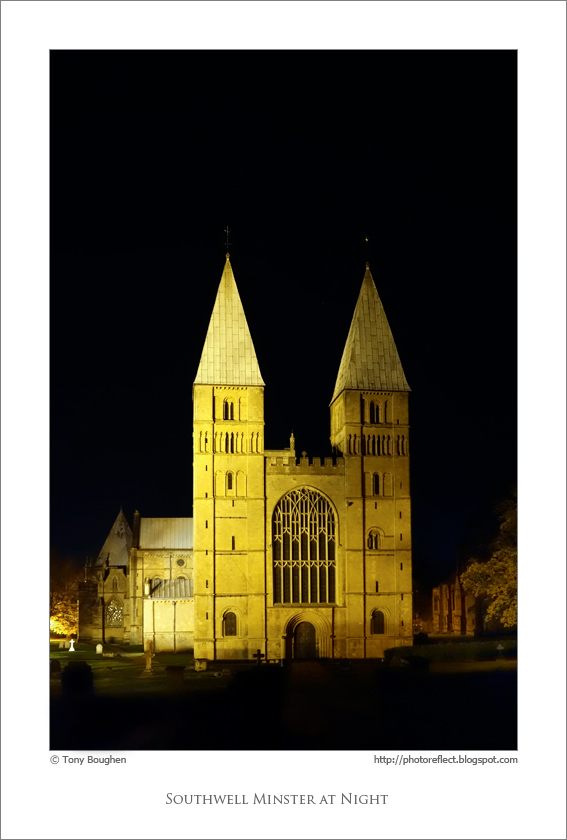
I've done this for more years than I care to remember, and my "go everywhere and anywhere" camera has always been a reasonable quality, small, pocketable device. It's currently a Sony RX100. Prior to that it was a Panasonic Lumix LX3. I had the Sony with me recently when we popped into Spalding for some shopping and I took a photograph of the Sessions House, a stone-built, castle-like, court building of 1842 by Charles Kirk senior, as the low sun illuminated the leaves of a nearby tree. I also had it when we visited Southwell in Nottinghamshire one evening and we came upon the Minster, a Norman and later church of cathedral size, floodlit in its leafy precinct. Of course there is the odd occasion when I forget to carry it, and it's then that opportunities for a photograph are seen and lost. And, like the fisherman who loses the big fish, the lost photograph takes on ever more impressive qualities the more you think about what might have been. Neither of these photographs are ever going to feature in my top ten or even top one hundred photographs. But both have qualities that I like and that, I think, make them good enough to post on the blog.

photograph and text © Tony Boughen
Photo 1

Camera: Sony RX100
Mode: Aperture Priority
Focal Length: 13.6mm (37mm - 35mm equiv.)
F No: f2
Shutter Speed: 1/8 sec
ISO: 2000
Exposure Compensation: 0 EV
Image Stabilisation: On

Sunday, October 13, 2013

The allure of dark skies

click photo to enlarge
After the coldest spring for a few decades the summer of 2013 eventually turned out to be one of the warmest and sunniest of recent years. There were blue skies and white clouds a-plenty, enough to satisfy the requirements of the lover of warmth and the photographer of sunny, congenial scenes. Even the farmers were happy because precipitation arrived reasonably regularly in ample but not excessive quantities. Early October proved to be significantly milder than usual too, with temperatures daily above 20° Celsius. However, much as I enjoy mild weather and the feel of the sun on my back, the photographer in me does eventually yearn for more dramatic weather, the sort that the British Isles is known for, with fronts moving across the land bringing cloud, rain, sun, breezes and the rest: what the forecasters describe as "changeable" weather. Well, as the previous post rather suggests, with a dip in temperatures, a rise in wind speeds and increased cloud cover, change is now upon us.

Today's photograph was taken as that change arrived. It shows the decorative roof of a building on the corner of New Road and Hall Place in Spalding, Lincolnshire. Across its ashlar face, between the ground and first floors, stone lettering proclaims that it was built for S & G Kingston, Land Agents and Surveyors. It was erected in 1907, the work of J.B.Corby & Sons, and is in a free style, a sort of modified Jacobean. The windows have mullions and transoms, decorative oriels sit over the main entrance and at each end of the curved facade, and above are turrets, a strapwork balustrade, tall chimneys and a weather vane. It was this cluster of verticals that caught my eye when I saw them sunlit against deeply dark clouds that threatened rain. The contrast of the glowing stonework against the black sky appealed to me and so I took my photograph.

The drama of a sunlit subject against an uncharacteristic dark sky has always appealed to me. Unfortunately photographs with these qualities aren't easily acquired because a suitable subject doesn't always present itself  in the right place and sometimes a camera isn't to hand. I did, however, catch an old walnut tree in these circumstances last year.

photograph and text © Tony Boughen

Camera: Sony RX100
Mode: Aperture Priority
Focal Length: 37.1mm (100mm - 35mm equiv.)
F No: f4.9
Shutter Speed: 1/800
ISO: 125
Exposure Compensation:  -0.3 EV
Image Stabilisation: On

Tuesday, April 02, 2013

Google Glass or Guardian Goggles?

click photo to enlarge
As of yesterday Google Glass has a challenger in the augmented reality, immersive technology, wearable video recording market. The announcement of Guardian Goggles means that the technology giant will face stiff competition from a home-grown alternative. Reading the specifications of the new product I'm especially taken by the "optional built-in anti-bigotry technology" that prevents Guardian newspaper readers being exposed to right-wing columns written by the likes of Melanie Phillips or Richard Littlejohn, "as soon as the user attempts to look at them". Particularly innovatory is the ability to have your blurted out loud, incredulous response to a Guardian article added to the newspaper's "Comment is Free" section within 30 seconds. The observation by Paul McMullan, Professor of Thinkovation, that it's the biggest innovation in news technology "since newspapers opened 'virtual bureaus' in Second Life in 2006, transforming journalism forever" is very perceptive. At least I suppose it is. The trouble is I haven't a clue what he's talking about.

What I want to know is can these Goggles or even the competitor Google Glass expunge cars from the viewer's eyesight and, by a wifi connection, from the viewer's camera? If so, despite the one or two slight difficulties this might introduce into a stroll about town, I'll have a pair. Maybe the same technology could be adapted to transform a Georgian terrace such as this one on London Road in Spalding, Lincolnshire, by removing the bay windows that were added during the Victorian era as well as ridding it of the multiple varieties of window glazing bars, thus allowing us to see it as the architect intended. But somehow I feel such a development will be very near the end of any list of apps that are developed. At the top, undoubtedly, will be one that gives spoken instructions on how to find the nearest hospital that has a proven track record in removing glass from eyeballs.

photograph and text © Tony Boughen

Camera: Sony RX100
Mode: Aperture Priority
Focal Length: 10.4mm (28mm - 35mm equiv.)
F No: f4
Shutter Speed: 1/800
ISO: 125
Exposure Compensation:  -0.3 EV
Image Stabilisation: On

Sunday, March 31, 2013

House and garden

click photo to enlarge
Like most Lincolnshire towns Spalding has many buildings of architectural and historic importance. Anyone with an eye for architectural history cannot fail to find a walk around the centre of the town and its periphery a rewarding experience. A medieval church, the remains of abbey buildings, old inns, warehouses, Georgian terraces, individual houses and Sir George Gilbert Scott's last church, are just a few of the delights the informed visitor will find. However, though the eighteenth century is very well represented the seventeenth century is less so. This is true in much of Britain, of course, but in Lincolnshire the relative prosperity of the eighteenth century meant that many buildings of a century earlier were either replaced or, very often, re-modelled. The pitch of a roof, a stepped wall, a painted over piece of structural timber or a centrally placed chimney (as opposed to later gable chimneys) are just some of the clues that an older building lurks beneath an eighteenth century facelift.

But, on Albion Street, a route that parallels the River Welland on the north-eastern edge of the town centre, an early seventeenth century house that received little in the way of "modernising" can be found standing behind its small, formal, front garden of geometric, dwarf box hedges. It was built in the early 1600s on what has been described as a "flattened H plan". "Willesby" has characteristic English bond brick walls with alternating courses of headers and stretchers. The mullioned two, three and four-light windows are framed in dressed stone. Stone is also used for the doorway (a Victorian restoration), the lowest courses of the walls, for the quoins that unusually don't extend the full height of wall corners, and for the "kneelers" and gable coping. A plain tile roof tops the building. It is a well-presented house that illustrates a type that can be found in many parts of eastern England in both town and country.

In summer the main façade is clothed with the greenery of the climbers and surrounding shrubs. On the dull, end of March day of my photograph, however, the lateness of this year's spring meant that much was still visible to the curious passer-by.

photograph and text © Tony Boughen

Camera: Sony RX100
Mode: Aperture Priority
Focal Length: 20.4mm (28mm - 35mm equiv.)
F No: f4
Shutter Speed: 1/320
ISO: 125
Exposure Compensation:  -0.3 EV
Image Stabilisation: On

Wednesday, February 06, 2013

Old vicarages

click photo to enlarge
One of the common house names in England is "The Old Vicarage". This can be seen on buildings of various ages, from the sixteenth century to the early twentieth century. The adjective "old", doesn't usually refer to the age of the building in terms of years, but tells us that it is the former vicarage and implies that somewhere nearby is the new or current house of the local priest.

The church has to move with the times. Consequently the large Georgian and Victorian vicarages that were provided for the vicars, their families and servants, and which were designed to reflect the importance of the job and offer a suitable place for administration, receiving visitors and entertaining, were often found to be unsuitable and unsustainable in the twentieth century. They were frequently sold to a wealthy buyer or demolished and the land sold for housing. The proceeds from the sale was invariably more than enough to buy or build more suitable premises for the vicar and his or her family.

This has happened in Spalding, Lincolnshire. The old vicarage, a large Georgian house on Church Street, across the road from the medieval St Mary and St Nicholas, facing a conveniently placed gate in the churchyard wall opposite the vicarage's front door, was sold and new premises built on Halmer Gate just round the corner. The new house with garages and a separate parish office is undoubtedly more suited to the family and administrative needs of the current church. However, the modern buildings do lack the charm and style of the old one, particularly the late Georgian porch in the Roman Ionic style. I photographed this on a break from some shopping, captivated by the way the low sun emphasised the details of the facade, and the softer shadows of the churchyard trees as they fell on the pristine blue and white walls.

Incidentally, this building hasn't, to my knowledge, adopted the name of "The Old Vicarage" (though it may well do in the future); that is simply my title for today's photograph. Moreover, the new vicarage is called "The Parsonage", a rather old-fashioned name for such a dwelling..

photograph and text © Tony Boughen

Camera: LX3
Mode: Aperture Priority
Focal Length: 11mm (52mm - 35mm equiv.)
F No: f6.3
Shutter Speed: 1/1000
ISO: 80
Exposure Compensation:  -0.33 EV
Image Stabilisation: On 

Saturday, January 05, 2013

Spalding sunset

click photo to enlarge
The weather has taken a turn for the mild. Daytime temperatures of 10 or 11 Celsius would not disgrace March so they are very welcome in January. Unfortunately the balmy conditions have been accompanied all too often by leaden skies, drizzle or rain. However, today the sun made an intermittent appearance and I left off my path cleaning to accompany my wife on an afternoon shopping expedition to Spalding. I call it an "expedition" because shopping, though it seems to have taken the place of gardening and looking after pet animals as the national pastime, holds few pleasures for me and I approach it as a soldier or explorer might - with a grimly determined expression on my face.

But, I'm also an optimist, and so I always put my compact camera in my pocket when I go shopping. By the time we emerged from a succession of stores the sun was low in the sky, about to set, and I headed back to the car resigned to not finding any photographs. As we passed through a part of the town that isn't the most picturesque - it features a car park, public toilet, the magistrates court, security fencing and some housing and shops that have seen better days - I looked around for an image or two. The potential subjects were most unpromising and the fading light did nothing to pique my interest. But, just as we were about to leave the area a low shaft of sunlight broke through, raking the backs of a row of old houses, revealing the details of their battered brickwork, making sharp silhouettes of a tree and a nearby streetlight, and flooding the scene with strong colours. I raised my camera, composed a shot, pressed the shutter and walked on. As I did so I reflected on the transformative power of sunlight; how it can not only animate and elevate the mundane but can also lift the spirits and provide a photograph where only moments before none seemed possible.

photograph and text © Tony Boughen

Camera: LX3
Mode: Aperture Priority
Focal Length: 12.8mm (60mm - 35mm equiv.)
F No: f4
Shutter Speed: 1/200
ISO: 125
Exposure Compensation:  -0.33 EV
Image Stabilisation: On 

Wednesday, November 21, 2012

Cameras and coffee

click photo to enlarge
I've been idly thinking of replacing my Lumix LX3. Recent compact cameras, notably the Sony RX100, offer a much improved feature set in a similar sized body. In particular, the low light performance is considerably better, as is the video. Those are characteristics that would give me greater success in my evening photography in London and elsewhere, and with the photography I do with my grand-daughter.

However, though I could open my wallet and buy that particular camera, or another model that gave me better image quality, I won't at the moment. Why? Well, first of all there's the relative price. I judge the newer offerings to be too expensive. I'm sure others will disagree, but when it comes to spending my money then it's mainly about me! The manufacturers set the opening price of new cameras high, and they almost always fall, sometimes by an enormous amount. The Sony's price has dropped significantly already, and will, I'm sure keep going down. If it approaches my mental "guide price" I will consider it. Of course, the other thing holding me back is the fact that I know that while the surface qualities of low light shots from a new camera would be better than I get from the LX3, the more important photographic qualities will be no different. In other words, a new camera won't make me a better photographer. And lastly, while my old (in digital terms) camera produces shots like today's, this one, or this, that satisfy me greatly, then why bother.

I apply this kind of thinking to lots of things I buy. I have a guide price for coffee, for example, and won't pay what I think is the ridiculous amount asked by the bigger chains such as Costa, Caffé Nero, Starbucks etc (Starbucks' attitude to paying UK corporation tax is another reason to stay away from them.) As a consequence our coffee drinking is done in locally run shops and cafés such as the one above in Spalding, Lincolnshire. I took today's shot there as we ascended the stairs. The low viewpoint accentuated the coffered, concrete ceiling, and the single diner - others are out of shot - added the human interest I wanted in the photograph.

photograph and text © Tony Boughen

Camera: LX3
Mode: Aperture Priority
Focal Length: 12.8mm (60mm - 35mm equiv.)
F No: 2.8
Shutter Speed: 1/160
 ISO: 80
Exposure Compensation:  -0.33 EV
Image Stabilisation: On 
Thursday, October 25, 2012

Waterside colour

click photo to enlarge
The trees and bushes of town and country are full of colour at the moment as autumn's progress wreaks its toll on deciduous leaves. In my garden the cherry trees and the silver birches show the brightest hues; orange/red and yellow respectively, and their leaves daily pile up on the lawns and gravel, inviting us to gather them up with rake and barrow.

On my recent trip into Spalding, during a stroll round Springfields Gardens, I came across a fine reflection in the stream that was duplicating the strong colours of the waterside shrubs. The yellow and green looked natural enough, the sort of tints that can be seen everywhere. However, the pink/purple leaves were obviously not a native species, and they gave this corner of the garden a slightly exotic feel. As far as I could see it was a variety of dogwood (Cornus), a shrub grown as much for the winter colour of its stems as for the beauty of its leaves.

Reflections in water are a recurring theme in my photography. I like the element of confusion that the doppelganger introduces and the hint of abstraction that comes from a subject that has no very obvious main subject. In fact, the reliance on colour and texture often gives such images a painterly quality - another reason I favour them. If you like the photograph above you might also like these earlier examples involving water and reflections: willow branches, trees with cherry blossom, reeds and a fence.

photograph and text © Tony Boughen

Camera: Canon
Mode: Aperture Priority
Focal Length: 92mm
F No: f7.1
Shutter Speed: 1/500
ISO: 125
Exposure Compensation:  -0.33 EV
Image Stabilisation: On

Wednesday, October 24, 2012

Performance Art

click photo to enlarge
We stumbled on the subject of today's photographs by accident during a walk around Spalding, Lincolnshire. As we passed a large bay window at the front of the old house in Ayscoughee Gardens I noticed a young, barefooted woman standing inside on the wide window sill, a basket in her outstretched hand. It could only be some kind of "art" I thought, and when we went in we discovered it was just that.

The performance artist, Amanda Coogan, was working with seven emerging artists creating and showcasing "site-specific durational performances". Apparently Amanda's practice "involves communicating ideas through longitudinal performance. Her work often begins with her own body and challenges the expectations of discernible context, such as head banging to Beethoven’s Ode to Joy, and signing the lyrics to Gill Scott-Heron’s ‘The Revolution will not be Televised." On this occasion she was standing in an empty hall, her neck painted blue, weighed down with multiple bags, slowly rotating, one part of a work that also included other performers, film, text, and a link that wasn't clear to me with local ghosts or ghost hunters.

I'm more of a visual arts (and crafts) person myself, so whilst I often view paintings, sculpture, photography and associated  media, performance art is not something that I usually seek out. However, as readers of this blog will know, I'm happy to point my camera at anything that piques my interest, and this did that. The smaller photograph shows Amanda in the context in which she was performing at the bottom of some rather fine stairs. It also includes my wife ascending those stairs to join me in looking down from above on what I can only describe as "the bag lady".

photographs and text © Tony Boughen

Photo 1
Camera: Canon
Mode: Aperture Priority
Focal Length: 40mm
F No: f7.1
Shutter Speed: 1/20
ISO: 3200
Exposure Compensation:  -0.33 EV
Image Stabilisation: On

Tuesday, October 23, 2012

Homes, castles and inviolacy

click photo to enlarge
"An Englishman's home is his castle."
Old saying

There can be little doubt that the saying quoted above was known to whoever it was that, during the nineteenth century, built Tower House in Spalding, Lincolnshire. This relatively modest building, on Tower Lane near the River Welland, is a castle in miniature. Or rather a building with a selection of debased features typical of castles of the medieval and later periods.

If we were to look at it from an architectural viewpoint, rather than as the charming folly that it is, we'd have to question the mixture of medieval trappings. We have battlements, turrets, mock machicolations and semi-circular headed windows (Romanesque?). On the riverward side is a semi-circular window, a crow-step gable, buttressing and a pinnacle. Even the wooden gates into the enclosed area are embattled. The building and the perimeter wall at the back of the house, is constructed in brick laid, appropriately enough, in English bond (alternating rows of headers and strethers).

And yet, despite its peculiarities, the house does seem to be an example of the famous quotation made real. Where does that idea come from, the suggestion that you can do as you wish in your own abode, that home is somewhere inviolate, a place where the state cannot intrude? It seems to have become a popular belief in the sixteenth century when the headmaster of the Merchants Taylor's School in London declared of the householder that, "He is the appointer of his owne circumstance, and his home is his castle." The principle gained wider acceptance through Sir Edward Coke's, "The Institutes of the Laws of England" (1628), a book that said, ""For a man's house is his castle, and each man's home is his safest refuge."

In fact it has never been the case that the state cannot intrude into a home where significant illegality takes place, and today more organisations have rights of entry than ever before. A sham castle like the one above wouldn't be much of a deterrent to such people though some real castles, suitably defended, might be!

photograph and text © Tony Boughen

Camera: Canon
Mode: Aperture Priority
Focal Length: 17mm
F No: f7.1
Shutter Speed: 1/250
ISO: 100
Exposure Compensation:  -0.33 EV
Image Stabilisation: Off