Showing posts with label Ely Cathedral. Show all posts

Saturday, November 17, 2012

The interior of Ely Cathedral

click photo to enlarge
Can there be anyone who, having walked below the crossing tower of Ely cathedral, hasn't stopped and gazed up in wide-eyed wonder at the work of the medieval builders? I do just that each time I visit, and even though I've got lots of photographs of the vaulting and arches (and have posted a couple), I take a few more. I did it again when we were last there.

In my recent post about this Fenland cathedral I said that, to my way of thinking, the unusual exterior made Ely something of an ugly duckling. However, as everyone knows, the ugly duckling grew into a beautiful swan, and the transformation of Ely comes about when you step through the doors into the wonderful interior space. The crossing with its glazed lantern is the star of the show, of course, but the sturdy Early Norman nave has an austere beauty too, one that is lit up by the painted ceiling above.

To the east of the crossing is the choir, and here the relative simplicity of the nave gives way to rich materials, colours and textures, and the soaring forms of Gothic replace the sturdiness of Norman. There are many fine details to pore over inside Ely, but for me its success comes not from individual pieces but rather the all-embracing spatial experience.

Unusually for an English cathedral Ely makes no charge for personal photography. I've got used to paying anything between £2 and £4 to take photographs. Here a charge is made if a tripod is used. All my shots were taken with a hand-held camera!

photographs and text © T. Boughen

Photo 1
Camera: Canon
Mode: Aperture Priority
 Focal Length: 40mm
F No: f6.3
Shutter Speed: 1/30
ISO: 1250
Exposure Compensation:  -0.67 EV
Image Stabilisation: On


Tuesday, November 13, 2012

The exterior of Ely Cathedral

click photo to enlarge
The exterior form of Ely is something of an oddity among English cathedrals. As you approach it across the flat Fenland landscape its appearance above the town, on a rise only 68 feet high, is long and low with towers at the crossing and  the west end. That is a quintessentially English profile. However, the crossing tower is lower and wider than usual, and there is but one west tower, not the usual two. It is principally this arrangement and the attendant details that make the cathedral something, to my mind, of an ugly duckling.

The low, wide crossing tower was built after the more typical tower of Norman date collapsed on 22 February 1322. The replacement is octagonal, the lower part stone and the upper corona or lantern, timber. It quickly acquired the name of The Octagon. This curious structure that looks wide rather than tall, is surrounded by pinnacles and topped by slender castellated turrets that echo those of the west tower. The west tower itself was built in the early thirteenth century, and in 1230 a spire was erected on the top. However, in the later fourteenth century the spire was taken down and replaced by the current octagon and the slender corner turrets. A small lead spire was added to this at an unknown date, but this too was removed in 1801 to leave the building looking as it does today. Germany is the home of cathedrals with a single west tower, so to see one in England, and with such an unusual design - more castle-like than ecclesiastical - is unusual. Moreover, to have the big tower echoed in a smaller tower to the south (see main photograph) makes for a strongly asymmetrical west facade, something that is equally odd in an English context. But, whilst the overall form of Ely is strange and awkward, the details of the exterior are interesting and often beautiful, particularly the blank arcading of the walls. The large, rectangular Lady Chapel that is a separate building but for the linking corridor is a further Ely quirk. However, the location and style make it look like a chapter house so it does not stand out in the way that the towers do.

Photographing the exterior of Ely is quite a challenge. It is closely surrounded by buildings, and where there is a big sloping pasture on the south side, there are plenty of large trees that get in the way. The cathedral green in front of the west facade offers just enough space for a reasonably satisfactory shot, and I took advantage of this on a recent visit. Incidentally, the incongruous looking cannon in the left foreground has these words on a nearby plaque: "Russian canon captured during the Crimean War. Presented to the people of Ely by Queen Victoria in 1860 to mark the creation of the Ely Rifle Volunteers." Around the edge of the plaque are the words, "Give peace in our time O Lord."

photographs and text © Tony Boughen

Photo 1
Camera: Canon
Mode: Aperture Priority
Focal Length: 27mm
F No: f7.1
Shutter Speed: 1/320
ISO: 100
Exposure Compensation:  -0.67 EV
Image Stabilisation: On

Friday, November 09, 2012

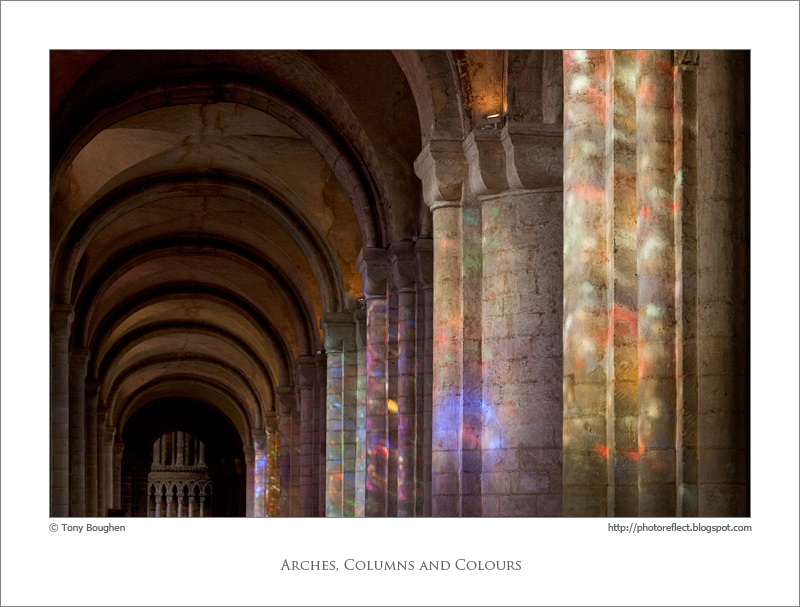
Arches, columns and colours

click photo to enlarge
Most of the interior wall surfaces of England's medieval churches and cathedrals are unadorned stone. Where this isn't the case they are generally painted with a light coloured wash, plastered, or decorated with painted patterns or pictures. In this country we've grown accustomed to the austere looking walls of stone, enlivened only by the occasional memorial tablet, hatchment, British Legion flag or Mothers' Union embroidery. But it wasn't always like this.

England's churches used to be as colourful as any to be found in Spain, Italy or France. In fact these countries were often the model for the painted patterns, figures and architecture that covered many walls. Figures such as St Christopher, Mary, King David with his harp, Adam and Eve; subjects such as the Last Judgement or the symbols of the Four Evangelists, and scenes from the morality tales provided instruction and illustration for the illiterate and decorative surroundings for all. Most of this painting was banished by the Protestant reformation, either physically removed or buried under limewash. Today some relics of these grand schemes can still be seen, examples that have been revealed by the painstaking removal of the covering paint. And, if you look carefully in the carved details of the sculpted figures and plants on column capitals or blind arcades you can often see traces of the original red ochre or blue paint that was quickly applied after the sculptors had finished their work.

We were in Ely Cathedral, Cambridgeshire recently, a building that has fragmentary examples of medieval painting still to be seen. However, as I walked down the south aisle of the nave it was a different kind of colour that was enlivening the unpainted stone of the twelfth century Norman columns and cushion capitals below the groined vaulting. The low November sun was shining through the Victorian stained glass, projecting its colours onto the stonework, temporarily returning long lost colours, but with hues and an intensity that the medieval artists could never match. It was a fine sight, and one that demanded a photograph.

photograph and text © Tony Boughen

Camera: Canon
Mode: Aperture Priority
Focal Length: 84mm
F No: f6.3
Shutter Speed: 1/800
ISO: 1600
Exposure Compensation:  -0.67 EV
Image Stabilisation: On

Sunday, June 10, 2012

Prior's Doorway, Ely Cathedral

click photo to enlarge
Our great churches offer much to delight the eye and mind, more than can be taken in during a single visit, and often contain much that can lie unnoticed even after several visits. On our most recent trip to Ely Cathedral my wife came upon the Prior's doorway. How we had not seen this wonderful example of the Norman sculptor's art before I can't explain, but I'm glad we eventually stumbled upon it.

The doorway dates from the mid-1100s, a time when sculpture exhibited a marvellous mix of linearity, naivety, vigour, drama and stylisation. Doorways, fonts, column capitals and crosses of the twelfth century are an interesting mixture of Byzantine influenced Romanesque with strong elements of Celtic and Norse influence. This example at Ely is busier than most, the columns in particular showing a clear link with the scrollwork, wreaths and knots of the carving and illuminated manuscripts of earlier centuries. Hidden among the swirling lines are medallions, single figures, groups, perhaps labours of the months, zodiac signs and much else. The capitals are similarly carved. An unusual addition is the two corbels in the form of heads that seem to stare at visitors who pass through the portal.

However, interesting though the columns are - and the arches that carry on the decorative themes over the top of the doorway - it is the filled in semi-circle below the arch that draws the eye. This is intentional, and the location above the lintel of a doorway and below the arch, a space known by the architectural term of the "tympanum", was often exploited in this way during the twelfth century. In the Prior's doorway tympanum the sculptors have carved the commonly found subject of the seated Christ (here beardless), one hand raised in a sign of power or blessing, the other holding an open Bible. He sits in a pointed oval shape known as a vesica and is flanked by angels whose bodies are contorted in (possibly) flight or awe, but also to make them fit the semi-circular frame. The treatment of the figure sculpture and clothing is flat and stylised in the way often seen in early two-dimensional frescoes, painted icons and mosaics, characteristics shared with the font at Eardisley, Herefordshire, a subject that I blogged about in 2009.

photograph and text © Tony Boughen

Photo 1
Camera: Canon
Mode: Aperture Priority
Focal Length: 70mm
F No: f4.5
Shutter Speed: 1/80
ISO: 2500
Exposure Compensation:  -0.33 EV
Image Stabilisation: On

Sunday, November 27, 2011

Gotobed East

click photo to enlarge
First names, often called Christian names, originated in a number of ways. Many are simply descriptive. For example, Charles comes from the Germanic for "man", Thomas is the Greek form of the Aramaic word meaning "twin", and Adam derives from the Hebrew for "man" which in turn comes from the word for "ruddy coloured" and links to "earth" (from which, according to the Bible Adam, the first man, came). Names such as Decimus, Septimus and Octavia usually describe the owners position in the family (tenth, seventh or eighth born). Other first names are linked to the circumstances of birth. Boys born over the period of Christmas are often called Noel, and girls are sometimes called Felicity or Prudence in the parents' hope that those qualities will attach to them throughout life. Then there are the invented names such as Pamela (from Samuel Richardson's 1740 novel of  that title) or Wendy, a name that makes its first appearance in J.M. Barrie's 1904 play, "Peter Pan". Some first names are created by pressing surnames into service for that purpose, for example Kingsley, Remington or Wilson. I suspect this may be the case with the very unusual first name featured on the memorial in today's photograph.

A Google search for Gotobed used as a first name turns up only a few references to this particular memorial and the person remembered in it. It looks like Gotobed East may have been unique in the possession of this first name. However, search for the same name as a surname and many sources can be found. Gotobed East's memorial can be found fixed to a wall at Ely Cathedral in Cambridgeshire. This location would only have been open to a wealthy and well-connected individual, and his memorial shows him to have been that as a gentleman and an officer of the Bedford Level drainage body. On his death he "left to the churchwardens of Holy Trinity parish 5 cottages in Newnham, to be occupied by 5 aged widows of the said parish", so he was clearly a benevolent person too.

photograph and text (c) T. Boughen

Main Photo
Camera: Canon
Mode: Aperture Priority
Focal Length: 32mm
F No: f6.3
Shutter Speed: 1/13
ISO: 3200
Exposure Compensation:  -0.33 EV
Image Stabilisation:N/A

Thursday, November 24, 2011

Ely Cathedral

click photo to enlarge
The exterior of Ely Cathedral looks its best, in my opinion, from a distance of several miles as it rises above the small city on a low eminence in the flat Fenland landscape. To someone who is familiar with English cathedrals the exterior of Ely is a decided oddity, and the closer you get to it the odder it looks. A prominent west tower is common in a parish church but rare in a great church such as a cathedral, minster or abbey where the crossing tower usually dominates. The emphasis on embattled turrets rather than pinnacles is even rarer, suggesting a secular castle rather than a religious building. Ely didn't always look like it does today however. It too, like cathedrals across the land, once had a central crossing tower. But, in February 1322, the great Norman structure collapsed, probably due to the inadequacy of its foundations. In its place an octagonal lantern was erected, supported on stone, but constructed of oak, the whole structure making a bristling tower lower than the west tower and very different from the soaring culminations found elsewhere.

You may gather from this that I find the exterior of Ely lacking compared with say,York, Lincoln, Durham, Salisbury or, in fact, most other cathedrals. I do. That's not to say that it lacks interest, but for me the overall form of the building doesn't match the beauty of other major cathedrals. However, the collapse that led to the construction of the octagon produced on the interior one of the finest sights that any English cathedral can offer, one that brings distinction to the building and makes it a place worth going out of your way to see.


Today's main photograph and one of the secondary images show what your eyes behold when you pause below Ely's crossing and look up. At the top left is the painted roof of the very long Norman nave. Opposite, at the bottom right is the elaborate Gothic vaulting of the nave. The other two roofs cover the transepts. Windows fill the spaces between the eight stone piers and from the top of each of the latter spreads a fan of ribs that reach to each of the bottom edges of the octagon itself. This is painted with a ring of angels, has stellar vaulting with Christ on the centre, and the whole is ringed with stained glass that lights the space.

We made the journey to Ely on the back of a weather forecast that promised sun and cloud. The drab photograph of the west tower shows how accurate that was!

photographs and text (c) T. Boughen

Main Photo
Camera: Canon
Mode: Aperture Priority
Focal Length: 17mm
F No: f6.3
Shutter Speed: 1/20
ISO: 2500
Exposure Compensation:  -0.33 EV
Image Stabilisation:N/A