Showing posts with label bicycles. Show all posts

Thursday, June 23, 2016

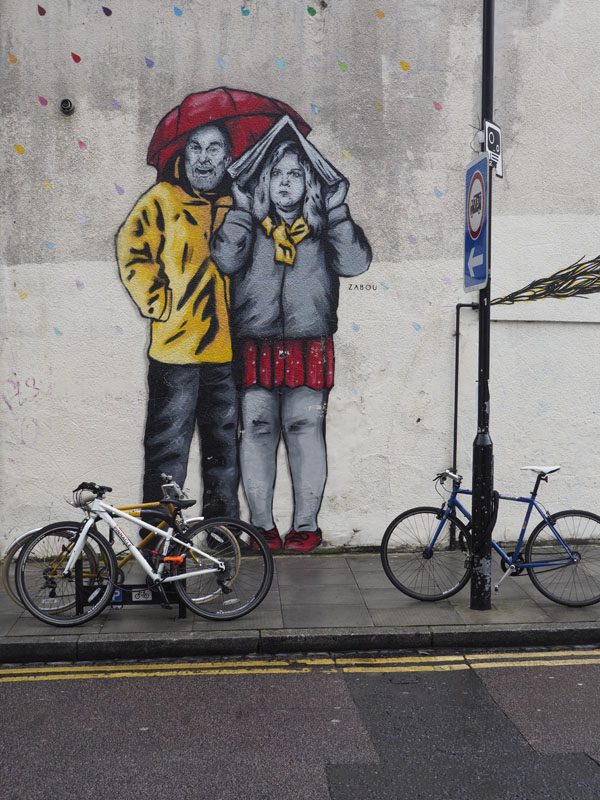
Hackney graffiti

click photo to enlarge
Over the years I've mellowed a little with regard to graffiti. I still dislike "tags" and the graffiti that is piled up one surface on top of another as spraycan-equipped passers-by superimpose their graphic on top of that of earlier "artists". However, I am better disposed towards the considered piece that seeks to add something of beauty, interest or humour to the street-scene.

We came upon today's example in Hackney, London. It isn't particularly accomplished drawing and doesn't seek to make any obvious point, but I like the restricted pallette, it brightened up a street corner and it caused me to wonder why the raindrops were multi-coloured. The piece also causes something of an optical illusion due to the figures being much larger than life-size. This has the effect, at first glance, of making the bicycles appear to be under-sized or children's bikes. As Isay, nothing profound, but nothing offensive either, and on a wet day the subject resonated..

photograph and text © Tony Boughen


Wednesday, February 18, 2009

Incendiary bicycles?

click photo to enlarge
A few decades ago, in my teenage years, I was cycling down a long, steep and winding hill above Langcliffe in the Yorkshire Dales. As the drystone walls and sheep flashed by the smell of burning impinged on my consciousness. Glancing briefly around I could see neither burning man nor flaming beast, but looking down I saw smoke coming from my brake blocks. I suspect I had bought the cheapest available, and they didn't appear to be up to the job. When I stopped, got off and inspected the source of the heat and smoke, I could see that a burnt residue had been smeared around my wheel rims by the friction of rubber on metal. I think I can honestly say that is the only time I have ever considered a bicycle to be anything remotely resembling a fire hazard.

And I suppose that's why I found this sign fixed to a seaside pier in Blackpool, Lancashire, very puzzling, not to say quite bizarre. I tried to imagine the kind of bicycles that the author of the missive might have in mind. I could see that if the clowns from the Blackpool Tower Circus left their car on the pier it might well explode with a flash of flame and a puff of smoke - clowns' cars often do that. But their bicycles? Never! And anyway, most of them have only one wheel so if that was what the sign-writer had in mind he should have prohibited unicycles too! To this day that sign is probably the oddest that I've been motivated to photograph, and the whole point of it, including the spurious "health and safety" justification, puzzles me still.

I came across this image as I was transferring files to my new hard drive after my recent misfortune. It makes a good companion for the image I posted a couple of weeks ago. If you're not keen on this sort of shot, hard luck, I found a third example that will appear soon!

photograph & text (c) T. Boughen

Camera: Olympus E500
Mode: Aperture Priority
Focal Length: 48mm (96mm/35mm equiv.)
F No: f6.3
Shutter Speed: 1/125
ISO: 100
Exposure Compensation: 0 EV
Image Stabilisation: N/A

Wednesday, January 23, 2008

Brayford Pool

click photo to enlarge
Yesterday, as I walked past the city of Lincoln's Brayford Pool, a natural lake formed where the River Witham widens, it was obvious that the recent spell of heavy rain had raised the water level considerably. Boats were floating higher, an island with a tree was submerged, the trunk sticking up through the water, walkways out to the moored pleasure craft were below the surface of the brown, stirred-up flow, and a couple of bicycles locked to posts were semi-submerged.

The Brayford Pool is an interesting location with a long history of commercial use despite being 40 miles from the sea. The Romans used it as a port nearly 2,000 years ago. They journeyed up and down the Witham between Lincoln and The Wash, and also connected the city to the River Trent with the construction of the Fosse Dyke. The Normans, in the C11 and C12, brought stone up to the Pool to construct the castle and cathedral. In the C18 and C19 the wharves were lined with warehouses, and for a brief moment Lincoln was Britain's fourth most important port. But the commercial use of Brayford Pool declined, it decayed and was largely abandoned. In the 1960s there was a scheme to fill it in and create a large car park! Fortunately that idea was dropped. In recent years a regeneration project has brought pleasure craft, shops, eateries, walks, and wildlife to the Pool, and the location lives once more. Unfortunately this rejuvenation has been bought at the expense of the older buildings: too much was swept away, and consequently continuity and character are largely missing from the area.

I took this photograph of a rather wet bicycle from a Pool-edge path. As it's locked to a jetty it must belong to one of the nearby boats. It will need a good service and the application of grease and oil before it can be returned to use! The bicycle, poles, oar(!) and reflection made a strong shape, and I decided to accentuate this by conversion to black and white, and by increasing the contrast of the image.

photograph and text (c) T. Boughen

Camera: Olympus E510
Mode: Aperture Priority
Focal Length: 100mm (200mm/35mm equiv.)
F No: f7.1
Shutter Speed: 1/125
ISO: 100
Exposure Compensation: -0.3 EV
Image Stabilisation: On

Sunday, March 11, 2007

Simple things

click photo to enlarge
"I must go down to the seas again, to the lonely sea and the sky,
And all I ask is a tall ship and a star to steer her by,
And the wheel's kick and the wind's song and the white sail's shaking,
And a grey mist on the sea's face, and a grey dawn breaking", John Masefield (1878-1967), English poet

I find it both a wonder and a delight that, despite the technological progress that mankind makes, people still cling to the simple things in life. Take the bicycle. It is frequently voted the favourite invention of all time, yet it remains, essentially, the same classic, human-powered design that was perfected in the nineteenth century. Sinclair C5s and Segways may come and go, but the humble bicycle rolls on, evolving in small ways, but never forsaking its fundamental features.

So too with sail boats. I suppose paddled canoes came first in evolutionary terms. But it can't have been long before an alert sailor noticed the wind's effect on his upright body, and from there it would have been a small step to rigging up a sail. So, sail-powered boats of one sort or another must have been around for millennia. And they still are. The delight that sailors get from being propelled by the wind, from learning how to sail against it, and from feeling at one with the elements is palpable to anyone who has watched dinghies whizzing over the water. Yes, you can go faster with an outboard, and there is a certain sort of person to whom the motorcycle of the waves - the jet-ski - is the ultimate thrill. But the fun of slapping through the water accompanied by the sound of flapping sails remains a draw to sailors young and old.

The dinghies of the Blackpool & Fleetwood Yacht Club on the tidal River Wyre at Skippool race when the water is high. This area of estuary with its wildlife, mudflats, reedbeds and saltmarsh is a Site of Special Scientific Interest (SSSI). Yet the gentle passage of the dinghies and even the larger yachts create little disturbance, and the plants and animals co-exist happily with their human neighbours. I took this contre jour photograph early one morning as the dinghies were being readied on the slipway prior to launching at high tide. The cloud and vapour trail patterns, the light through the sails, and the silhouettes presented an evocative sight. I recorded it with a wide zoom lens at 22mm (35mm equivalent), with the camera set to Aperture Priority (f8 at 1/2000 second), ISO 100, with -1.0EV.
photograph & text (c) T. Boughen

Monday, March 05, 2007

This bike is rubbish!

click photo to enlarge
The first two-wheeler bicycle that I ever owned was assembled by my father. He took an old steel frame, stripped, it painted it, then fixed all the other components to it. A few parts he bought: some he re-used. There was a time when bicycles were repeatedly recycled! But no more. Today bicycles seem to be "use once" consumer items, much like electronic goods, furniture, and virtually anything else you care to name.

How did this situation come about? Why is a machine that has the potential to last a lifetime, with occasional component replacements, now something to be thrown away after a few years' use? I suppose the fact that western societies are richer is part of the answer. The days when a bicycle was an expensive item are (enthusiast machines excepted) long gone. Manufacture in low-labour cost economies has also had the effect of reducing the price. The use of shorter life alloy components and frames means that they wear out quicker. Furthermore, the increasing complexity of gears, and the introduction of frippery like suspension has made them less user-serviceable. Put all that together, and a scuffed, broken, or otherwise non-functioning machine is thrown away rather than repaired! And that's sad. The bicycle is an environmentally-friendly form of transport that becomes an environmental problem if its life is short. It can also become litter, like this bicycle revealed by the receding tide at Cleveleys, Lancashire.

I took this photograph just as the water had flowed away from the bike, and placed the image in the middle of the frame, knowing that its shape and the background would introduce considerable asymmetry. I used a wide zoom lens at 22mm (35mm equivalent), with the camera set to Aperture Priority (f7.1 at 1/200 second), ISO 100, with -0.3EV.
photograph & text (c) T. Boughen