Friday, April 29, 2016

Fairs ancient and modern

click photo to enlarge
Many of the fairs that take place across the country have their origins in medieval fairs held on "holy days" (holidays). One of the largest to be held annually is the Nottingham Goose Fair. This is thought to have started around 1284 under a charter granted for a fair in the city by Edward 1. Its name arises from the large numbers of geese that were walked to Nottingham from locations in Lincolnshire to be sold at the fair. Inevitably other trades and suppliers set up stalls and sold their wares at the Goose Fair, and entertainers joined in too, also keen to take advantage of the large number of people who congregated in the city for the eight days of the event.

Like most such fairs the one at Nottingham was truncated (to three days) and in time became an event that largely offered entertainment of one kind or another. Today "amusements" (roundabouts, helter-skelters, sideshows, stalls, etc) predominate in what are essentially funfairs. During my lifetime the fairs that I have known best have been the small event that visits Settle in the Yorkshire Dales and the very large fair held annually in Hull that was first held in 1278. Today's photograph was taken at the Boston May Fair in the town of Boston in Lincolnshire. It shows the outside of a large amusement that includes a covered helter-skelter tube. This fair is held in the town's market place where it is reputed to have been staged annually since at least 1152.

photograph and text © Tony Boughen

Camera: Sony RX100
Mode: Aperture Priority
Focal Length: 10.4mm (28mm - 35mm equiv.)
F No: f4
Shutter Speed: 1/320
ISO: 125
Exposure Compensation:  -0.3 EV
Image Stabilisation: On

Monday, April 25, 2016

Miniature traction engine

click photo to enlarge
Each year, in recent years, I've helped some friends with a model engineering and hobby show. My part in the proceedings is based around photography. The event gives me the opportunity to photograph static and moving subjects - usually models of one kind or another - with specific aims in mind. It is a utilitarian kind of photography quite different from my day-to-day work which is entirely based on my interests and whims, and in which I have no one to please but myself. What I appreciate about my annual exercise is the discipline that is needed to produce the photographs that are required. And, it makes me realise how lucky I am to be able to photograph what I want rather than what someone else wants: I'd be a very poor professional photographer.

Today's photograph shows a miniature steam-powered traction engine, a vehicle based on large agricultural machines that were used from the latter part of the nineteenth century through to about the time of the Second World War. They were essentially a moveable source of mechanical power used to power threshing machines, balers, elevators etc. Some large farms would own such a machine, others would use the services of a contractor who might hire out several. These miniature models are sometimes bought from a supplier, ready-made. However, very often they are "scratch-built" i.e. entirely built from by their owner from engineering drawings. My photograph shows the lead vehicle of about a dozen such machines undertaking a "road run" through Springfield Gardens, Spalding in Lincolnshire.

photograph and text © Tony Boughen

Photo Title: Miniature Traction Engine, Springfield Gardens, Spalding, Lincs
Camera: Olympus E-M10
Mode: Aperture Priority
Focal Length: 14mm (28mm - 35mm equiv.) crop
F No: f4
Shutter Speed: 1/500 sec
ISO:200
Exposure Compensation: -0.3 EV
Image Stabilisation: On

Wednesday, April 20, 2016

Magnolia blossom

click photo to enlarge
Magnolia blossom has the power to delight or disappoint. It appears to be one of those plants that is on the edge of its range in the UK because a cold, wet spring results in short-lived blossom that is marked with brown stains. The sight of the large blooms disfigured in this way is particularly woeful because they are potentially one of the most showy early blossoms, and all we see in these circumstances is a hint of what might have been.

The spring of this year in my part of the world seems to have been better suited to magnolias than most because our tree seems to have been in flower for a couple of weeks and has some time yet to go. There have been a few frosts during the time it has been in bloom but they haven't been particularly sharp, and the rain hasn't been especially heavy or persistent. Consequently the blooms have looked magnificent, and though they have acquired some brown staining it isn't as prevalent or strong as it can be.

When I came to photograph the blossom I took some shots against the blue sky because it goes well with the white tinged with pink of the petals. However, as I worked my way around the tree I found that I could frame some low blooms with the darkness of the shadows of a conifer hedge. I much preferred that as a backdrop for the petals. I also liked how it emphasised the branches better than did the sky blue.

photograph and text © Tony Boughen

Photo Title: Magnolia blossom
Camera: Olympus E-M10
Mode: Aperture Priority
Focal Length: 120mm (240mm - 35mm equiv.) crop
F No: f5.6
Shutter Speed: 1/250 sec
ISO:250
Exposure Compensation: 0 EV
Image Stabilisation: On

Monday, April 18, 2016

Lincolnshire potato ridges

click photo to enlarge
Lincolnshire is predominantly an agricultural county with arable farming dominating most areas and particularly the Fens. Where the soil is silt, potatoes are particularly favoured. In April the fields teem with vehicles preparing the soil, planting the seed potatoes and banking up the earth in ridges so perfectly formed that newcomers to the district often marvel at them. Their perfection is the result of machinery that is specifically designed for the work and it is not unusual to see as few as three or four men driving the vehicles that quickly prepare and plant multiple tens of acres in a day.

We came upon the potato ridges in today's photograph as we were walking near the Fenland village of Bicker. They retained most of their sharp edges and perfect curves despite the rain of the past few days and the wet snow of that morning. A couple of dog walkers added the possibility of human interest and scale to the photograph so I waited until they reached the top left of the frame before I pressed the shutter.

photograph and text © Tony Boughen

Photo Title: Potato Ridges near Bicker, Lincolnshire
Camera: Olympus E-M10
Mode: Aperture Priority
Focal Length: 150mm (300mm - 35mm equiv.) crop
F No: f5.6
Shutter Speed: 1/1000 sec
ISO:200
Exposure Compensation: 0 EV
Image Stabilisation: On

Saturday, April 16, 2016

Beautifying hoardings

click photo to enlarge
There must be money to be made from supplying beautified hoardings. Wherever I go I come across boards and fences surrounding building sites that have been elevated by artwork of one kind or another. It wasn't always so. In the past such structures were usually unadorned plywood, chipboard or somesuch material, frequently showing the scuffs, cracks and splinters of re-use. Now, however, developers often use their perimeter fence to provide advertisements or a visual experience for passers-by. I've seen graffiti artists employed to liven them up, photographs linked with the locality displayed on them, abstract paintwork designed to catch the eye etc. On a recent visit to London we came across this example near King's Cross railway station - simplified climbing plants spray painted onto the hoarding providing a leafy backdrop to the bicycle parking stands. It was a simple expedient to brighten up what otherwise would have been an eye-sore in a rapidly improving area.

photograph and text © Tony Boughen

Photo Title: Painted Hoardings and Bicycles, King's Cross, London
Camera: Olympus E-M10
Mode: Aperture Priority
Focal Length: 17mm (34mm - 35mm equiv.) crop
F No: f3.5
Shutter Speed: 1/80 sec
ISO:2500
Exposure Compensation: -0.3 EV
Image Stabilisation: On

Thursday, April 14, 2016

Novelty in architecture

click photo to enlarge
Architecture is no less subject to the search for novelty than any other art, craft or commercial undertaking. Novelty catches the eye of the public and, frequently, the money of the buyer. It can be the entirely legitimate result of new ideas, improved technology etc. But it can also be a deliberate application to an object with the sole purpose of realising a sale, a veneer laid over something that is otherwise unexceptional. To be fair, novelty can enrich the public sphere regardless of its motivation. However, where a form doesn't spring from an underlying need or function too often it fails.

I passed some new flats in Stoke Newington in London recently. The overall form was commonplace - a large block with a grid of windows, some floor to ceiling glass walls, and glazed stairwells. The main feature that distinguished it from other blocks of flats was the decorative treatment of the solid walls. These were painted lemon yellow and overlaid with strips of galvanised mesh arranged in a lattice-work pattern. The metalwork had no purpose that I could deduce except decoration. My first thought on seeing it was, will each of the points where it is fixed to the wall develop a water stain below? This was followed by the thought that the painters will really struggle when it needs painting again. I've commented elsewhere on this blog about the unforeseen consequences of decorative treatments on new architecture. Perhaps an algorithm could be built into architectural software that would identify locations with the potential to develop stains. Perhaps it already exists.

photograph and text © Tony Boughen

Photo Title: Elevation Detail, Newington Court, Stoke Newington, London
Camera: Olympus E-M10
Mode: Aperture Priority
Focal Length: 39mm (78mm - 35mm equiv.) crop
F No: f5.3
Shutter Speed: 1/200 sec
ISO:200
Exposure Compensation: 0 EV
Image Stabilisation: On

Tuesday, April 12, 2016

Boston under leaden skies

click photo to enlarge
A recent walk around Boston, Lincolnshire with my camera coincided with leaden skies and drizzle. But, as someone who believes that there is no such thing as bad weather for photography, we persevered. Today's photograph was taken from the bridge by the Grand Sluice, the point at which the tidal waters of the River Witham are prevented from extending inland. The key feature of the shot is the tall tower of St Botolph piercing the sky and reflecting in the water as it has done for the past several hundred years

This medieval structure - the tallest parish church tower in the country that isn't a spire - looms over the centre of Boston much as it always must have done. No other buildings in the town can compete with its height except for the tall slab that is the Pilgrim Hospital, and that is sufficiently far away that the two can only be seen together from a great distance. It is a a great shame that more of our country's big medieval churches don't enjoy the physical prominence that they once did and that often they are dwarfed by towers of varying quality that have been erected with little thought for their venerable neighbours.

The dark sky and low light levels gave my photograph a quite monochrome appearance, with even the green of the grass, that had been spurred on by recent sun and warmth, not managing to pierce the drabness of the day. It also obscured the details along the river banks that allow the photograph to be dated, and were it not for the "bowstring" bridge in the centre distance, the shot could conceivably been taken any year in the last one hundred and fifty.

photograph and text © Tony Boughen

Photo Title: St Botolph and the River Witham seen from the Grand Sluice Bridge, Boston
Camera: Olympus E-M10
Mode: Aperture Priority
Focal Length: 14mm (28mm - 35mm equiv.)
F No: f6.3
Shutter Speed: 1/640 sec
ISO:200
Exposure Compensation: -0.3 EV
Image Stabilisation: On

Saturday, April 09, 2016

St Pancras before the rain

click photo to enlarge
Today's photograph was taken from in front of King's Cross railway station in London: in fact, from the space in the foreground of yesterday's photograph. We were waiting for a train to take us home and I'd noticed that a stormy sky was gathering above this part of London. Opportunities of that sort are to be seized and so I walked around looking for a shot or two. I missed the zig-zag of lightning that flashed near the clock tower but did get this image of the dark grey clouds as they gathered above the buildings. In the photograph you can see the side of the St Pancras Hotel and on the right of it the glazed train sheds.

One of the things I like about a big city is the pools of light that make evening photography so appealing. It's something that isn't found in a country village and I always relish a visit to London that gives me opportunities to be out and about when the daylight is fading.

photograph and text © Tony Boughen

Photo Title: A Gathering Storm, St Pancras Hotel, London
Camera: Olympus E-M10
Mode: Aperture Priority
Focal Length: 17mm (34mm - 35mm equiv.)
F No: f2.8
Shutter Speed: 1/80 sec
ISO:400
Exposure Compensation: -0.7 EV
Image Stabilisation: On

Thursday, April 07, 2016

Railway stations and cathedrals

click photo to enlarge
The invention of the railways in the nineteenth necessitated the design of a new kind of building - the railway station. In large cities these needed to be large buildings to accommodate the multiple lines, platforms, offices, buffets, waiting rooms etc that were required to cater for the thousands of people who would pass through daily. Moreover, the stations had to protect the users from the weather whilst at the same time allowing sufficient space for the smoke from steam-powered engines to dissipate without inconveniencing people.

Large, glazed train sheds came into being in response to these demands and immediately created a problem for the engineers and architects: what form should the building take that fronts these sheds? Usually a stone or brick facade in one of the established historical styles was erected that contained a main entrance and the necessary offices with, often, a hotel. In London the terminus for the Midland Railway, St Pancras (opened 1868), typifies on the largest scale, this approach. However, the nearby King's Cross railway station (opened 1852) took a radically different approach. Here, George Turnbull and Lewis Cubitt came up with a more utilitarian design in stock brick that won many admirers for its bold simplicity. The large main arches that front the two arched roofs of the Arrival and Departure Halls echo how the big arches of medieval cathedral facades signify the nave and flanking aisles within. The symmetry of the station facade with its central clock tower is still a thrilling sight, and one I enjoy each time I go into and out of London by train.

photograph and text © Tony Boughen

Photo Title: King's Cross Railway Station, London
Camera: Olympus E-M10
Mode: Aperture Priority
Focal Length: 17mm (34mm - 35mm equiv.)
F No: f2.8
Shutter Speed: 1/60 sec
ISO:1000
Exposure Compensation: -0.7 EV
Image Stabilisation: On

Tuesday, April 05, 2016

Tables and chairs

click photo to enlarge
Of all the objects that man designs possibly the most frequently attempted by people who are not trained designers are tables and chairs. These staples of the interior seem to attract the home DIYer, architects, artists and others as well as those qualified in design. Frequently, as I have mentioned elsewhere in this blog, the motivation is appearance rather than utility because tables and chairs make such a strong impact on interior design. And all too often the pieces that look the best perform the worst when it comes to using them for their intended purpose. Tables and chairs that combine great appearance with excellent functional attributes are the mark of a good designer, whether amateur or professional.

Today's photograph shows some tables and chairs that I saw outside a restaurant/cafe near King's Cross and St Pancras railway stations in London the other day. Looking down the line of white table tops I was reminded of the circular ripples that appear on still water when you skim a flat stone across it. The other thing I noticed was that, apart from the colour white, the tables and chairs had no obvious connection: they don't appear to be designed to go with each other. In fact they didn't look too bad together, and even the brown leather seat pads weren't too dissonant, offering a warmer note to the black and white. In fact, the contrasty aesthetic was a factor that prompted me to take the shot, and I knew as I pressed the shutter that I would be converting it to black and white.

photograph and text © Tony Boughen

Photo Title: Cafe Tables and Chairs, King's Cross, London
Camera: Olympus E-M10
Mode: Aperture Priority
Focal Length: 15mm (30mm - 35mm equiv.)
F No: f5.2
Shutter Speed: 1/250 sec
ISO:200
Exposure Compensation: -0.3 EV
Image Stabilisation: On

Sunday, April 03, 2016

The strainer arch

click photo to enlarge
When I first visited Wells Cathedral in Somerset many, many years ago I knew there were two things that I particularly wanted to see. The first was the worn stairs to the Chapter House, the subject of a famous 1903 photograph entitled "Sea of Steps" by the British photographer, Frederick H. Evans (1853-1943). His platinotype image appealed to me because of its purely photographic qualities but also because the subject was an aspect of church architecture, an interest of mine then that continues to this day.

The other thing I searched out that day was the famous strainer arches under the crossing tower. These were inserted as bracing in the arches to the nave and transepts (the choir arch is braced by a screen) by William Joy in 1338. The existing, orthodox arches had begun to show signs of stress after the tower had been heightened, and the "St Andrew's cross" strainer arches were the solution Joy came up with the alleviate the problem. They worked. However, opinion on the aesthetic merits of Joy's arches was divided and remains so. Some see them as an awkward intrusion while others think them an elegant answer that enlivens the interior. I like them and think they are an interesting and beautiful addition to the cathedral.

When I moved to Lincolnshire I came upon a smaller scale copy of the Wells arches in the church of St Denys in Sleaford. Here a strainer arch clearly derived from the Somerset example was inserted at the west end of the north aisle in 1853. Apparently it solves a problem with the original arch that was exhibiting movement due to the weight of the west tower. Though not on the scale of the Wells examples, and introducing a note of asymmetry to the west end of the church, Sleaford's arch is not without its utilitarian beauty.

photograph and text © Tony Boughen

Photo Title: Strainer Arch, St Denys, Sleaford, Lincolnshire
Camera: Olympus E-M10
Mode: Aperture Priority
Focal Length: 17mm (34mm - 35mm equiv.)
F No: f3.2
Shutter Speed: 1/80 sec
ISO:2500
Exposure Compensation: 0 EV
Image Stabilisation: On

Friday, April 01, 2016

The point of focus

click photo to enlarge
Walking by the River Slea in Sleaford, Lincolnshire, the other day I stopped when my wife took a phone call. As she chatted I cast my eye about to see if any photographic subjects offered themselves up to my camera. The freshly growing water weed below the water's surface was making lovely shapes, but it didn't translate into a photograph because it lacked the movement that made the vegetation so appealing. Newly hatched mallard chicks whizzed hither and thither like miniature speed boats, but they didn't look like photographic fodder - too fast, too random in direction. Then my eye was caught (not for the first time) by the public seating nearby. It was metal, had words worked into the backrest and the bench seat was perforated with holes. Underneath were bright yellow celandines glowing in the spring sunshine.

I took two photographs of this subject, each with a different point of focus. What I liked about the result was the way they differed and yet offered something of interest, and the colour combination of the blue seat and the green and yellow of the grass and celandines. As some readers will know I have a jaundiced view of much that passes for contemporary public seating because it too often puts the ability to withstand vandalism well-ahead of any attempt to provide a comfortable perch for a passing posterior. One of the things my photographs show - I think - is that even the most unpromising, inflexible subject is capable of providing something out of which we can fashion a photograph.

photograph and text © Tony Boughen


Photo Title: Bench Seat With Celandines Below
Camera: Olympus E-M10
Mode: Aperture Priority
Focal Length: 150mm (300mm - 35mm equiv.) crop
F No: f5.6
Shutter Speed: 1/250 sec
ISO:400
Exposure Compensation: 0 EV
Image Stabilisation: On

Wednesday, March 30, 2016

Charing Cross escalators

click photo to enlarge
If anyone were to look for favourite formal characteristics in my photographs - compositional themes rather than subjects - I think (hope) they would notice, strong shapes, shadows, reflections and both simple compositions and complex, even confusing, compositions.

Five years ago I came upon a location in London that indulges all those predilections. Charing Cross railway station has escalators that take pedestrian down from the bridge level or up to it from the station below. They are the work of a notable firm of British architects who re-developed the whole station - Terry Farrell and Partners. The big circles, mirror walls reflecting the passing travellers, and the diagonals of the ever-running escalators drew my camera recently for the second time. A late afternoon on a dull day gave more shadow and artificial light to the scene than did the better light of my earlier shot.

photograph and text © Tony Boughen
Photo Title: Charing Cross Station Escalators, London
Camera: Olympus E-M10
Mode: Aperture Priority
Focal Length: 16mm (32mm - 35mm equiv.)
F No: f4.1
Shutter Speed: 1/80 sec
ISO:1600
Exposure Compensation: -0.3 EV
Image Stabilisation: On

Saturday, March 26, 2016

Carbuncles and silly names

click photo to enlarge
The right-most of the two new buildings in today's photograph was a 2015 nominee for the Carbuncle Cup,an architectural prize awarded by the UK's "Building Design" magazine to "the ugliest building in the United Kingdom completed in the last 12 months." It didn't win, and wasn't even short-listed, because last year it faced severe competition. The winner was, in my opinion, the ugliest building erected in the UK so far this century, and probably in the past fifty years - Rafael Vinoly's 20 Fenchurch Street, also known as "The Walkie Talkie".

If there was a prize for the silliest name for a building then the angular monstrosity shown in today's post would surely have won. It is a hotel in the Shoreditch/Hoxton area of London, near "silicon roundabout" and is called, M by Montcalm Hotel. Why do I dislike this building? Well, it defaces the area in which it stands by acknowledging nothing around it, not even the banal new block next door, an essay in what looks like 1930s Moderne-cum-very stripped classical, that matches it for height. The hotel's sharp points, sloping windows and decorative cladding all seem designed to grab the eye, provoke reaction, say "look at me", and nothing else. The absence of right angles in the elevations seems to be worn like a badge of pride, a feature designed to make passers-by feel that either they or the building is falling over. It's a cheap trick that lacks reason, one that quickly becomes tiresome and provokes a "so what" response.

photograph and text © Tony Boughen

Photo Title: M by Montcalm Hotel, Shoreditch, London
Camera: Olympus E-M10
Mode: Aperture Priority
Focal Length: 22mm (44mm - 35mm equiv.) crop
F No: f6.3
Shutter Speed: 1/640 sec
ISO:200
Exposure Compensation: -0.3 EV
Image Stabilisation: On

Thursday, March 24, 2016

Lighting the diagrid roof

click photo to enlarge
One the many areas in which architecture progressed in the twentieth century, and continues to do so in the twenty-first, is lighting. Architects have always built with an eye to light - either the sun to model the building and its details, or artificial light from flame or electricity to illuminate and give atmosphere in the darkness. New technology such as neon, fluorescent tubes, lasers, LEDs etc have widened the role of lighting and today it fulfils all its original roles and some newer ones too. Here are two examples of cinemas using lighting, one in a  traditional way, the other in a much more modern manner.

Today's photograph of the evening lighting of the interior of King's Cross railway station's diagrid roof (see the previous post) is nothing too innovative, but is very effective.

photograph and text © Tony Boughen

Photo Title: Lighting of Diagrid Roof, King's Cross, London
Camera: Olympus E-M10
Mode: Aperture Priority
Focal Length: 42mm (84mm - 35mm equiv.) crop
F No: f5.4
Shutter Speed: 1/100 sec
ISO:640
Exposure Compensation: -0.3 EV
Image Stabilisation: On

Tuesday, March 22, 2016

Diagrid roof, King's Cross, London

click photo to enlarge
The new Western Concourse at King's Cross railway station in London has a striking diagrid roof.It was designed by the architects, John McAsland and Partners in association with the engineers, Arup. The word diagrid comes from "diagonal grid" and describes a construction method that uses diagonal components very efficiently and economically - steel wall supports and roofs can be constructed that use twenty per cent less materials than would a more conventional steel frame.

The Russian engineer/designer/architect, Vladimir Shukhov (1853-1939, who built in the Constructivist style, is credited with the invention of this method of building. Examples can be seen in most major cities today. In London the "Gherkin" (30 St Mary Axe) and the Queen Elizabeth II Great Court at the British Museum feature the system.

Today's photograph was taken in an attempt to improve on an earlier photograph that I took of the King's Cross roof. On this occasion I used a wide angle lens rather than a fish-eye, but stayed with black and white rather than colour.

photograph and text © Tony Boughen

Photo Title: Diagrid Roof, King's Cross, London
Camera: Olympus E-M10
Mode: Aperture Priority
Focal Length: 12mm (24mm - 35mm equiv.) crop
F No: f2.8
Shutter Speed: 1/160 sec
ISO:200
Exposure Compensation: -0.3 EV
Image Stabilisation: On

Sunday, March 20, 2016

Reflecting on stainless steel

click photo to enlarge
No buildings last forever, though some such as Stonehenge, the Sumerian ziggurats, the Pyramids, and the temples of ancient Greece are probably enduring for longer than their builders imagined. There are a number of features that help to make a building last a long time including peace, reverence for the past, and the materials of which it is constructed. War destroys buildings more effectively than anything else, though in Britain the cultural vandalism of national and local politicians in the name of "improvement" runs it a close second. Understanding the importance of the past results in selected old buildings having a long life, though which are chosen for life-support is somewhat arbitrary, and varies with the period in time.

Building materials used to be more important than they are today when buildings are often expected to stand for less than a century, and sometimes only a few decades. Consequently the materials chosen are frequently transient, and where they have the capacity to be long-lived they frequently don't fulfil their potential. In recent years I have despaired of the fashion in Britain for hardwood cladding, a finish that stains badly and warps in our damp climate, that will rot and rarely looks well on a city building. Stainless steel, a material that should last a long time, is one that I have increasing doubts about. It initially looks sleek but requires cleaning because, despite its name it does mark and stain, and isn't always cleaned as often as is required. The Lloyds building in the City of London was completed thirty years ago and still looks fine due to regular maintenance, but it gets much of its force from its complex shape. Will 5 Broadgate (above), a new London building that gets a lot of its power from its contrast of flawless surface with sharply drawn lines, as well as its silky sheen, disappoint in thirty, forty or fifty years when it is dull and stained?

photograph and text © Tony Boughen

Photo Title: 5 Broadgate, London
Camera: Olympus E-M10
Mode: Aperture Priority
Focal Length: 14mm (28mm - 35mm equiv.) crop
F No: f5.6
Shutter Speed: 1/400 sec
ISO:200
Exposure Compensation: -0.3 EV
Image Stabilisation: On

Friday, March 18, 2016

A Ledbury view

click photo to enlarge
The market town of Ledbury in Herefordshire is a place I visit fairly frequently, and over the past few years I've collected quite a few photographs of the place, only a few of which please me. This one was taken in early March on a cold, cloudy day. It attempts to encapsulate the town in a single photograph. That's isn't something that is easy to do, and my image doesn't do it to my satisfaction. However, as a streetscape it isn't a complete failure, with visual interest across the frame.

The photograph shows the main street where it widens to accommodate the weekly market. It shows the unwelcome intrusion of cars and the shoppers and tourists attracted to the visually appealing independent shops that flank the route. The black and white, timber-framed structure is the Market House, the town's most prominent building. It was begun after 1617 and completed after 1655. Herefordshire is an area where timber-framed buildings dating from the 1400s through to the 1700s are relatively common, and Ledbury has several such of which this is the most prominent. The first storey rooms are raised on posts of local Spanish chestnut and the space below was designed to give market traders some shelter. It is still used for its original purpose today.

The other prominent building on the left of the photograph is the Barrett Browning Memorial Institute and Clock Tower. It dates from 1892-6 and is the work of the Brightwen Binyon. Pevsner doesn't pull his punches, describing it as "really terrible", observing that though it acknowledges the local timber-framing it does not harmonise with it. He's right that it isn't a great building but it is a tall, visual punctuation at this part of the town.

photograph and text © Tony Boughen

Photo Title: Market House, Ledbury, Herefordshire
Camera: Olympus E-M10
Mode: Aperture Priority
Focal Length: 18mm (36mm - 35mm equiv.)
F No: f4.2
Shutter Speed: 1/1000 sec
ISO:200
Exposure Compensation: -0.3 EV
Image Stabilisation: On

Wednesday, March 16, 2016

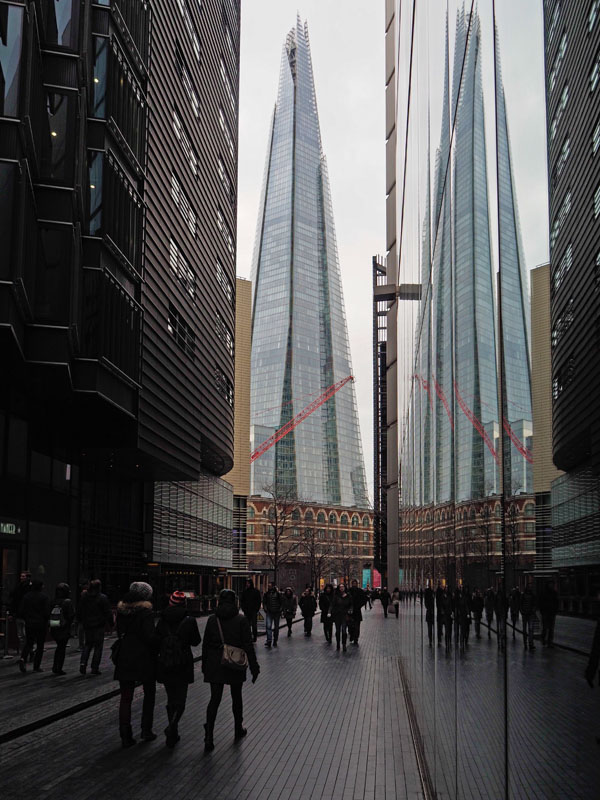
Tall things and The Shard

click photo to enlarge
It was wind turbines that first prompted the realisation that tall things - I mean very tall things - look tallest when seen from afar. There's a wind farm not too far from where I live, and, though I know that the ground to blade tip height is 100m regardless of where I'm standing, they still appear to be bigger when I'm two miles distant, and bigger still when I'm 5 or more miles away. It must be something to do with the fact that at those sorts of distances the real difference between a house or a tree and the turbine is always clear. However, when I'm closer a nearby tree looks relatively tall when viewed with a distant turbine.

The same is true of the the Shard, currently the tallest building in London. When seen from my car on the M11 where it passes over the hills north of London the Shard appears to tower over most of the tall buildings of the city, its distinctive, pointed shape catching the eye. However, from within the city its relative height seems less - at least to my eye. With the Shard I think there is another factor at work: the tapering shape makes it less massive in fact and in appearance when you are nearby. I photographed this building at reasonably regular intervals as it was being built, and took a few shots from the location of today's image (the ludicrously named More London). This recent shot was prompted by the silhouettes of people in the canyon-like cleft that frames the Shard, and also the bright red crane stretched across it. Building in London never stops and a recent news article pointed out that there are currently 436 tall buildings (over 20 storeys) in the pipeline for the capital of which 233 have planning approval.

photograph and text © Tony Boughen

Photo Title:  The Shard Seen From More London, London
Camera: Olympus E-M10
Mode: Aperture Priority
Focal Length: 14mm (28mm - 35mm equiv.)
F No: f5.6
Shutter Speed: 1/250 sec
ISO:200
Exposure Compensation: -0.3 EV
Image Stabilisation: On

Sunday, March 13, 2016

Vespa GTS 300

click photo to enlarge
My interest in scooters began and ended with one that I used to push along with my foot, up and down the hills of my home-town as an eight year old. Even today, if someone says "scooter" I think of the child's plaything rather than the chrome, curves and pop-pop-pop of the sub-motorcycle (or is the step above the bicycle?)

Scooters of the lightweight, folding variety, with skateboard-size wheels, have enjoyed a popularity with children and youths for a number of years. These modern incarnations of the type I knew (in those days by manufacturers such as Triang - today by myriad companies) look like fun. Which is more than I can say about the motorised scooter of today's photograph. I'm sure many would disagree with me on this point, seeing style, convenience and relatively inexpensive transport that can be used wearing work clothes rather than leathers.

So why, you may be wondering, am I photographing something in which I have little interest. The answer lies in the colours, the tactile qualities of the shiny metal, and the way its curves are framed by the yellow, angular lines of the car park. Without its surroundings I wouldn't have photographed this scooter, nor would I have given it a slight vignette to emphasise it in its setting.

photograph and text © Tony Boughen

Photo Title: Vespa GTS 300
Camera: Olympus E-M10
Mode: Aperture Priority
Focal Length: 45mm (90mm - 35mm equiv.)
F No: f5.6
Shutter Speed: 1/320 sec
ISO:200
Exposure Compensation: -0.3 EV
Image Stabilisation: On