Showing posts with label reflection. Show all posts

Tuesday, December 06, 2016

Disused swimming pool

click photo to enlarge
The other day we came across, for the first time, the former outdoor swimming pool in Grantham. This facility in Wyndham Park opened to the public in the 1880s and offered bathing to the residents of the town until the 1970s. Since then it has been used as a skate park, and more recently has been the boating pool for the local model boat club.

On the day we saw it the pool had been drained and it held only leaves and an inch or two of rain water (just enough for a grubby reflection). I read that there are plans to remodel it, a project that includes demolishing some of the Victorian buildings that are on two sides of the water. I hope that the symmetrical block in today's photograph remains; it looks better than some of the others and would be a tangible link with the site's past.

photograph and text © Tony Boughen

Photo Title: Former Outdoor Swimming Pool, Grantham, Lincolnshire
Camera: Olympus E-M10
Mode: Aperture Priority
Focal Length: 36mm (72mm - 35mm equiv.)
F No: f6.3
Shutter Speed: 1/640 sec
ISO:200
Exposure Compensation: -0.3 EV
Image Stabilisation: On

Sunday, June 05, 2016

The tarnished mirror pond

click photo to enlarge
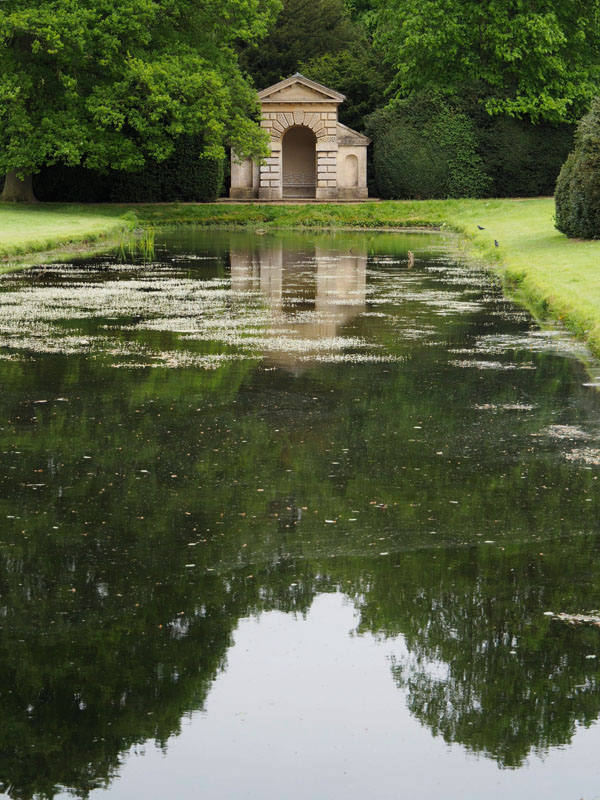
The purpose of a mirror pond is to re-create, usually in a man-made stretch of water, some of the qualities that a natural lake or pond displays on a calm clear day when the surface is completely still. In those circumstances a near perfect reflection of the surroundings, after the manner of a mirror, is possible.

The creators of the English landscape garden sometimes made a mirror pond near to the country house as one of the features to which the owners and their guests could walk and admire. Frequently they also constructed something - a building, statues, a bridge etc - whose purpose was to be the object that was reflected. On a visit to Belton House, near Grantham, we went to look at the example there and were disappointed to find it "broken". Water plants with delicate white flowers that had colonised the mirror pond had broken through the surface, spoiling the reflection of the rusticated stone pavilion that had been placed at the end of the rectangle of water, tarnishing, as it were, the surface. This effect probably worked in winter when the plants were dormant, but the onset of spring had spurred their growth. The diligence of the National Trust staff who care for the grounds at Belton is everywhere apparent, so I will not be surprised to find on a future visit that the "polish" has been restored to the water's surface and a flawless reflection of the pavilion will be mirrored for all to see.

photograph and text © Tony Boughen

Photo Title: Mirror Pond, Belton House, Lincolnshire
Camera: Olympus E-M10
Mode: Aperture Priority
Focal Length: 45mm (90mm - 35mm equiv.) crop
F No: f5.4
Shutter Speed: 1/100 sec
ISO:200
Exposure Compensation: -0.3 EV
Image Stabilisation: On

Wednesday, March 30, 2016

Charing Cross escalators

click photo to enlarge
If anyone were to look for favourite formal characteristics in my photographs - compositional themes rather than subjects - I think (hope) they would notice, strong shapes, shadows, reflections and both simple compositions and complex, even confusing, compositions.

Five years ago I came upon a location in London that indulges all those predilections. Charing Cross railway station has escalators that take pedestrian down from the bridge level or up to it from the station below. They are the work of a notable firm of British architects who re-developed the whole station - Terry Farrell and Partners. The big circles, mirror walls reflecting the passing travellers, and the diagonals of the ever-running escalators drew my camera recently for the second time. A late afternoon on a dull day gave more shadow and artificial light to the scene than did the better light of my earlier shot.

photograph and text © Tony Boughen
Photo Title: Charing Cross Station Escalators, London
Camera: Olympus E-M10
Mode: Aperture Priority
Focal Length: 16mm (32mm - 35mm equiv.)
F No: f4.1
Shutter Speed: 1/80 sec
ISO:1600
Exposure Compensation: -0.3 EV
Image Stabilisation: On

Wednesday, March 16, 2016

Tall things and The Shard

click photo to enlarge
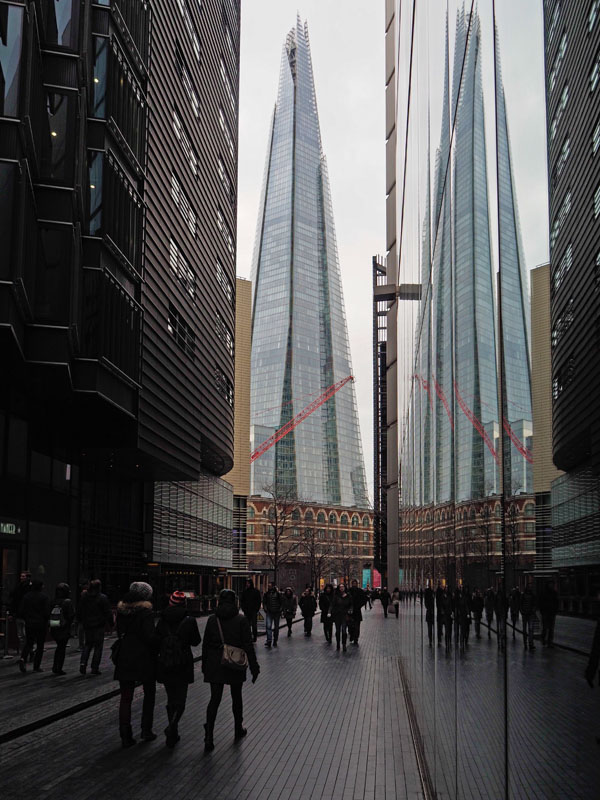
It was wind turbines that first prompted the realisation that tall things - I mean very tall things - look tallest when seen from afar. There's a wind farm not too far from where I live, and, though I know that the ground to blade tip height is 100m regardless of where I'm standing, they still appear to be bigger when I'm two miles distant, and bigger still when I'm 5 or more miles away. It must be something to do with the fact that at those sorts of distances the real difference between a house or a tree and the turbine is always clear. However, when I'm closer a nearby tree looks relatively tall when viewed with a distant turbine.

The same is true of the the Shard, currently the tallest building in London. When seen from my car on the M11 where it passes over the hills north of London the Shard appears to tower over most of the tall buildings of the city, its distinctive, pointed shape catching the eye. However, from within the city its relative height seems less - at least to my eye. With the Shard I think there is another factor at work: the tapering shape makes it less massive in fact and in appearance when you are nearby. I photographed this building at reasonably regular intervals as it was being built, and took a few shots from the location of today's image (the ludicrously named More London). This recent shot was prompted by the silhouettes of people in the canyon-like cleft that frames the Shard, and also the bright red crane stretched across it. Building in London never stops and a recent news article pointed out that there are currently 436 tall buildings (over 20 storeys) in the pipeline for the capital of which 233 have planning approval.

photograph and text © Tony Boughen

Photo Title:  The Shard Seen From More London, London
Camera: Olympus E-M10
Mode: Aperture Priority
Focal Length: 14mm (28mm - 35mm equiv.)
F No: f5.6
Shutter Speed: 1/250 sec
ISO:200
Exposure Compensation: -0.3 EV
Image Stabilisation: On

Sunday, February 14, 2016

Pollarded willows

click photo to enlarge
In the middle of the Lincolnshire town of Bourne is a large, grassed open space with some stretches of water, trees and bushes. It looks like a municipal park and it is - the war memorial is sited there as is a children's playground, benches and tarmac paths. However, there are also a couple of quite old, stone-built buildings - an early C18 farmhouse and barn - and, at the edge of the area a building that was once a working water mill fed by a stream. There are also odd undulations that hint at what was formerly here and accounts for such a large area being undeveloped.

The mounds mark the site of an eleventh century motte and bailey castle that appears to have had two large enclosures. Some of the remaining areas of water must have fed defensive moats. However, the motte has gone and it is hard to discern the parts of the Norman site that must have been built to control the area after the Conquest. Recreational use has led to the planting of plentiful willows, the water-side sites being ideal for this species. However, willows in parks can present problems - they weren't called "crack willows" for nothing - and many have been pollarded to control their spread and remove high, heavy boughs that were seen as potential dangers.

Todays' photograph shows some of these pollarded willows reflected in one of the stretches of water. Immediately after they have been cut such willows look rather ungainly compared with their elegant uncut neighbours. But, as the boughs thicken and the the shape returns they look much better. These, I thought, looked somewhat sinister reflected in the water with a broken sky above.

photograph and text © Tony Boughen

Photo Title: Pollarded Willows, Bourne, Lincolnshire
Camera: Olympus E-M10
Mode: Aperture Priority
Focal Length: 25mm (50mm - 35mm equiv.)
F No: f5
Shutter Speed: 1/1000 sec
ISO:200
Exposure Compensation: -0.3 EV
Image Stabilisation: On

Wednesday, December 23, 2015

10th anniversary of PhotoReflect

click photo to enlarge
It was 10 years ago today - 23rd December 2005 - that I embarked on this blog. I needed a diversion from work, some self-made entertainment, a focus for my photographs, and a place to reflect on photography and other things of interest, importance and inconsequentiality. I thought it might last for a year, maybe two, but I had no idea it would still be going ten years and 2,107 posts later.

As I've said elsewhere here, I like to dabble, to try something and once I've satisfied my interest, to try something else. However, the blog has proved to be more than a dabble; it has kept going. Like many undertakings it has had its ups and downs. There have been periods, though not many, where I've stopped for a while. The most notable was when we moved house. There have also been, for me, lows where my photographic output has waned, and not been as good as I wanted. But, a few better shots, often inspired by the need to "keep feeding the blog", have usually lifted me and re-kindled my enthusiasm.

Earlier this year it was my plan to reach the ten year mark and stop. I intended to draw a line under the blog and try something else. Now I don't think I'll do that. But, the blog is likely to change. I need to reduce the amount of time I devote to it, so I imagine the posts will vary in length. The photographs will probably be presented without their "frames", and I may do one or two more tweaks. Comments are unlikely to re-appear because they take too much time. I deal with most of the emails I get, but apologies if my replies are somewhat perfunctory. So, as things stand at the moment, the blog continues. Not, however, not for the Christmas period. I'm abandoning it in favour of my family, and therefore I wish a Merry Christmas and a prosperous new year to all visitors, whether regular or sporadic.

Today's photograph is, like the first post I made, a reflected self-portrait, though this time seasonal. I used an old Four Thirds f3.5 35mm Macro lens with a Four Thirds to Micro-Four Thirds Adapter. It produced a result that reminds me to keep using my newly acquired fish-eye lens!

photograph and text © Tony Boughen

Camera: Olympus E-M10
Mode: Aperture Priority
Focal Length: 35mm (75mm - 35mm equiv.)
F No: f3.5
Shutter Speed: 1/100 sec
ISO:5000
Exposure Compensation: -0.3 EV
Image Stabilisation: On

Wednesday, August 26, 2015

Under the bridge

click photo to enlarge
It is a children's story that I blame for my fascination with bridges; specifically, "The Three Billy Goats Gruff". When I first heard about them going "trip-trap, trip-trap over the rickety bridge" I began to look at bridges in a new light, as structures with a mysterious underneath as well as a very useful top. The small town where I was raised has a rocky river passing through it so footbridges and road bridges, old and new were well-known to me. I never saw any trolls beneath them but I discovered that the water under a bridge was a good place to spot trout, and the underside of the bridge itself frequently held nooks and crannies where dippers would sometimes build their nests.

This interest in bridges has been life-long and this blog contains many photographs of these interesting structures. Today's photograph shows the underside of a bridge on the River Witham at Boston, Lincolnshire. It is old, rarely used, and supported by both steel and timber, though the latter, as you can see, is somewhat the worse for wear. I liked the bold, semi-abstract shapes that the dark structure and its reflection made against the water - it reminded me of the paintings of Franz Kline.

photograph and text © Tony Boughen

Camera: Olympus E-M10
Mode: Aperture Priority
Focal Length: 63mm (126mm - 35mm equiv.)
F No: f5.5
Shutter Speed: 1/640 sec
ISO:200
Exposure Compensation: 0
Image Stabilisation: On

Saturday, March 07, 2015

Free retinal photography and me

click photo to enlarge
Today's photograph is a variation on one posted a couple of days ago. This time I wanted more emphasis on the eye and my reflection. Hence, no passers-by and a different point of focus. I also quite like to include text in a photograph where the opportunity presents itself, and this example seems more than a little appropriate.

photograph and text © Tony Boughen

Camera: Nikon D5300
Mode: Aperture Priority
Focal Length: 90mm (135mm - 35mm equiv.) - cropped to 4:3 ratio
F No: f8
Shutter Speed: 1/160 sec
ISO:125
Exposure Compensation: -0.33 EV
Image Stabilisation: On

Tuesday, March 03, 2015

Loose end photography

click photo to enlarge
I'm an impatient patient. During my recent bout of illness I found myself unable to settle to any task, frustrated by this, and willing my body to recover. But, of course, these things have to take their course, and no amount of imagining or fortitude or stubbornness will return a person to health until the body is ready. However, I do find that when I'm well enough to get out and about my mind is engaged by matters other than my unwellness and this is all to the good - hence yesterday's photograph - and today's.

The image above came about, as some of mine do, when I was standing about at a loose end. My wife was visiting a couple of shops on Stamford's main shopping street and I'd elected to wander about in the vicinity looking for a few shots. But, I saw not a one. As I waited - for longer than I thought would be the case - I saw an advertisement in an optician's window for "free retinal photography"; a check on the health of the eye as part of the usual optical measurement. I positioned myself so that I was reflected in the window and took several shots making use of my own reflection, the eye in the advert, and passersby. I produced a couple of shots I like. This is one of them. I may post the other if my supply of new images doesn't increase fairly soon.

photograph and text © Tony Boughen

Camera: Nikon D5300
Mode: Aperture Priority
Focal Length: 130mm (195mm - 35mm equiv.) - cropped to 4:3 ratio
F No: f8
Shutter Speed: 1/200 sec
ISO:140
Exposure Compensation: -0.33 EV
Image Stabilisation: On

Friday, January 09, 2015

Self-portraits and Mr Turner

click photo to enlarge
The other evening we went to see Mike Leigh's, "Mr Turner", a film about the great English painter, J. M. W. Turner. It was exquisitely shot, beautifully acted and an interesting take on the artist's life. For me it only suffered by a little too much direct connecting between the artists later, great "impressionistic" works and their sources of inspiration. I do recognise, however, that anyone coming to the film with no knowledge of Turner would value this direct explication.

As we went up to the gallery where our seats were I took a couple of self-portrait photographs in the glazed stairwell windows. This was the best of the bunch with the market place beyond, illuminated bank signs on the right, and a passer-by at bottom right balancing my silhouette on the left. Anyone who has looked at my many self-portraits (for example here, here or here) on this site will know that, with one exception, they can all best be described as "obscured", since they are designed to hide or suggest rather than reveal.

After we'd seen the film mentioned, my wife read me an extract from Wikipedia about Turner's first sale of a work (a seascape, "Staffa, Fingal's Cave", unseen by the buyer) to an American, one James Lenox of New York City. The person who bought it from Turner on behalf of Lenox reported to the artist that the new owner was "greatly disappointed" by what he described as the painting's "indistinctness". Turner is reputed to have replied, "You should tell Mr Lenox that indistinctness is my forte". I think henceforth that will be my reply to those who find my self-portraits unrevealing!

photograph and text © Tony Boughen

Camera: Sony RX100
Mode: Aperture Priority
Focal Length: 12.8mm (34mm - 35mm equiv.)
F No: f2.8 Shutter

Speed: 1/40
ISO: 640
Exposure Compensation:  0 EV
Image Stabilisation: On

Thursday, December 18, 2014

Maud Foster windmill - again

click photo to enlarge
Today's post is my fourth featuring what I have described as my favourite windmill - the Maud Foster Mill at Boston, Lincolnshire. It's the third taken from approximately the same spot - a bridge over the Maud foster Drain. And, given the way it looks in this photograph you may wonder what all the fuss is about. If so, admire its full beauty and interest in this shot.

I took today's photograph during a morning shopping expedition into Boston. The weather was slightly overcast but the forecasters had promised sun and cloud, a combination I like for compositions in flat regions where a big area of sky is often unavoidable in a landscape shot. When I framed this photograph the cloud was starting to break up and some blue sky was peeping through. Its reflection on the surface of the large, canal-like drain was quite striking. So I made that the real subject of my shot with the windmill an eye-catcher point of focus at the top of the frame. Its a photograph that makes use of the windmill without showing it off in any way.

photograph and text © Tony Boughen

Camera: Sony RX100
Mode: Aperture Priority
Focal Length: 14.2mm (38mm - 35mm equiv.)
F No: f5
Shutter Speed: 1/250
ISO: 125
Exposure Compensation:  -0.3 EV
Image Stabilisation: On

Tuesday, September 23, 2014

Reflecting on church brass

click photo to enlarge
It's customary for Anglican churches to have a raised pulpit and a separate reading lectern from which sermons and readings take place. Pulpits have an inclined shelf that traditionally holds The Bible, a prayer book or any other document that the officiating clergy wishes to use. The reading lectern is a humbler (and usually lower) affair, often a simple wooden post with feet surmounted by the inclined shelf. However, in many churches the material is brass rather than wood, and the piece often dates from the Victorian or the Edwardian period. In these cases the shelf is frequently decorated with foliate or cross patterns, and many are pierced. I've photographed such lecterns before because the reflective glow of the brass in the darkness of the church makes an attractive subject for the camera.

The other day we visited a Lincolnshire church, one very near the border with Leicestershire, a building that we'd not been in before. It had a rich and fertile interior for a passing photographer. But, despite the fine tombs, interesting woodwork, unusual font and column capitals and much else, my eye was once again drawn to a brass reading lectern. What caught my attention on this occasion was the reflection of a south aisle stained glass window in the polished surface of the brass. The shelf had a quatrefoil design, each leaf filled with a flower stem with two leaves, and in the centre, a cross. These raised brass shapes were emphasised by black paint or lacquer and the out of focus colours of the window gave the yellow brass a jewel-like glow, inviting the close-up shot that I post today.

photograph and text © Tony Boughen

Camera: Nikon D5300
Mode: Aperture Priority
Focal Length: 52mm (78mm - 35mm equiv.)
F No: f4.8
Shutter Speed: 1/80 sec
ISO:250
Exposure Compensation: 0. EV
Image Stabilisation: On

Monday, June 09, 2014

Self-portrait with pink chair

click photo to enlarge
Walking along a street in Greenwich, London, recently I came upon a shop with goods spilling out on to the pavement in front of its window. It was the sort of shop that sells a wide range of eye-catching items for the home at relatively low prices.

Two items caught my eye. The first was the eye-wateringly pink (and gold) chair. I tried to imagined the rest of the room in which that might stand but immediately gave up under the influence of the waves of nausea that it provoked. Then I saw the glitzy mirror and immediately knew that the owner was trying to sell a collection of items that would complement each other in the room that my mind's eye briefly conjured up.

As I stared at the mirror, transfixed by the glass pimples that bordered it, I saw myself, headless, and decided it was time - in fact, well past the time - for another obscured, reflected, self-portrait. So, positioning myself to create a composition with depth, confusion and anonymity, I pressed the shutter.

© Tony Boughen

Camera: Nikon D5300
Mode: Aperture Priority
Focal Length: 27mm (40mm - 35mm equiv.)
F No: f8
Shutter Speed: 1/125 sec
ISO:100
Exposure Compensation: -0.33 EV
Image Stabilisation: On

Monday, March 24, 2014

Bad habits and serendipity

click photo to enlarge
One of my bad habits when I was working was occasionally eating my lunch at my desk. As bad habits go it's not particularly awful but it did have an unfortunate consequence. My computer keyboard, over time, became sticky and a little grubby from the unintentional spray of juice from my oranges. Now that I am retired I never eat at my desk, I'm almost always at a dining table, and my keyboard remains free of food liquids and solids. However, since my retirement tablet computers have made an appearance and unfortunately I've developed a different bad habit - often reading my tablet as I eat my lunch.

Recently, as I was indulging my predilection, an arc of juice from my orange traced a path through the air and landed on the screen. And, before I wiped it off, I noticed how each drop of juice acted as a convex lens on the pixels and picture displayed beneath it. I made a mental note to reproduce that effect with water and a dropper to see if I could make an interesting photograph of this serendipitous phenomenon. The other day I had a go and, interestingly serendipity extended the range of images that I took from the experiment.

The effect I was initially looking for is exemplified best in the photograph labelled number 2. The grid of pixels is warped by the droplets of water in the way that I saw with the juice from my orange. An interesting additional feature is a bubble in the centre droplet. But, as is often the way, as I moved the camera and re-focused the macro lens, I got a quite different and unexpected view of the droplets. The photograph labelled number 1 was taken from a lower angle with the circle of my light above. I was puzzled by the tripling in the image of each droplet but then realised it must be due to the layers in the screen each reflecting the water slightly differently. A similar effect can be seen in the main photograph (labelled number 3) and here serendipity has intervened once more because this shot is taken with no screen illumination, the power-saving feature having turned it off.

As I looked at my collection of photographs I reflected that they weren't earth shattering but they did have a certain fascination, and that it once again it derived from the macro lens showing what the unaided eye doesn't normally notice or see.


photograph and text © Tony Boughen

Photo 1
Camera: Canon 5DMk2
Mode: Aperture Priority
Focal Length: 100mm Macro
F No: f8
Shutter Speed: 1/80
ISO: 3200
Exposure Compensation:  0
Image Stabilisation: On

Thursday, January 23, 2014

Industrial semi-abstract with reflections

click photo to enlarge
The word "industrial" in the title of today's blog post is something of a  misnomer. The fact is that Lincolnshire, with a few exceptions doesn't feature much of what is usually called industry. It is a predominantly rural and coastal county with no large cities, and few areas of heavy industry - steel making at Scunthorpe and petro-chemical processing near Grimsby is about it. However, it is an agricultural county with a greater proportion of the workforce engaged in growing, processing or packing produce of one sort or another than is to be found in most counties. Consequently there are quite a few sites in the countryside or adjoining villages and towns, that have some of the characteristics of industrial buildings. Large, anonymous steel sheds are commonplace, as are strong perimeter fences.

The other day we walked past such a place, one that from the signs on the building appears to be engaged in distributing flowers. The heavy rain of morning had been followed by afternoon sunshine and its car park was awash with large puddles reflecting the "palisade" security fencing with its viciously pointed tops. The colours, lines, irregular patches of water and tarmac, and the reflected building and sky made an interesting abstract composition. I homed in on a section that seemed to offer something of interest across the viewfinder and took this shot. I used to do more semi-abstract compositions when I lived in a more urban area. I think it's something that I'll have to get back into.

photograph and text © Tony Boughen

Camera: Sony RX100
Mode: Aperture Priority
Focal Length: 37.1mm (100mm - 35mm equiv.)
F No: f6.3
Shutter Speed: 1/200 sec
ISO:125
Exposure Compensation: 0 EV
Image Stabilisation: On

Monday, January 13, 2014

Snapshots, dog walkers and wind turbines

click photo to enlarge
The words "snapshot" and "snap" in connection with photography seem to have pretty much disappeared from use by all but people over the age of, say, fifty. That's a pity because the first word very well describes the act of quickly seeing and taking a photograph without indulging in the lengthy consideration that might be taken with, for example, a landscape. It is a very appropriate word for the sort of shot that is frequently used in street, wildlife or sport photography. "Snap" for a routine or quickly taken photograph is also a useful term. In these days of smart phone cameras and the impromptu shots that they are often employed for, one wonders why the word isn't more widely used.

Snapshot, snapshooting and snaps came to photography from the world of shooting with firearms - rifles, shotguns and pistols. Quickly taken shots at game, targets or even people, were so described in the Victorian era, and are often still described with these words. I'm not the sort of photographer whose output relies heavily on snapshots but I do take photographs rapidly when I want to include people (those who are unknown to me) in my photographs because I usually have a very clear idea where I want them to be in the overall composition. Moreover, for reasons lost in the mists of time, all my digital photographs are in folders that are described with the word "Snaps" followed by the year.

The other day, when walking over the sand and dunes towards the sea at Skegness in Lincolnshire I took a snapshot. A dog walker appeared on a low dune ahead of us. He was silhouetted against the sky, with the sea and wind turbines behind him and a large pool in the foreground. I knew that he would soon be less visible against the sky so I started firing off a series of snapshots having first decided that I wanted a vertical composition with the main interest towards the top of the frame. Today's photograph is the second of four snaps that I took and it came out rather better than I imagined it would. That's another interesting thing about snapshooting: because it's quick you have hits and misses, and the hits, because they are not arranged to the last detail, have a surprise element that often makes them more rewarding than shots where everything turns out as planned.

Incidentally, I often wonder what I'd do without the scale and human interest that dog walkers offer when I'm photographing in the open spaces beside water or on sea-shore grass and dunes.

photograph and text © Tony Boughen

Camera: Sony RX100
Mode: Aperture Priority
Focal Length: 37.1mm (100mm - 35mm equiv.)
F No: f5.6
Shutter Speed: 1/1000 sec
ISO:125
Exposure Compensation: -0.7 EV
Image Stabilisation: On

Friday, December 06, 2013

Getting to know the willow

click photo to enlarge
It wasn't until I had willow trees growing in and adjoining my garden that I really got to know them. One of the first expansions of my knowledge of Salix alba came about when I looked out of my bedroom window one morning and saw that overnight winds had brought down a huge branch. It was flattening a section of ten feet high conifer hedge, had bent a bay tree down to the ground, crushed a shrub border and gouged the lawn. It took four of us most of the day to cut it up with a chainsaw and remove it. Prior to that event I had heard this tree called "crack" willow: now I understood why it had been given the name. The countless small leaves had acted like a sail in the wind that had forced the limb from the tree where it forked. Evidence of the rending crack could be seen on its trunk.

But, the fact is, the willow tree has many endearing habits and I like it. In winter its slender new branches glow reddish-orange in the yellow-tinged light. In March it is one of the earliest trees to come into leaf, a real sign that spring is on the way. The sight of the branches of a willow swaying in the summer breeze, like tresses of long hair, is an arboreal phenomenon that is hard to beat. Birds, large and small love willow trees for the nest sites it offers and the insects that abound in it. As a garden screen the willow tree has few deciduous equals because it carries its leaves for such a long period of time. However, that advantage brings with it some of the tree's disadvantages. It loses leaf through most months of the year so if a tidy garden is your idea of a good garden then it isn't the tree for you. Moreover, the leaf loss is accompanied by long, slender, whippy twigs so composting the gathered leaves becomes more difficult. And then there is that late leaf drop in autumn (or rather early winter). A couple of weeks after you've cleared up most of the deciduous leaves from lawns and flower beds in late November the willow decides its time to shed its leaves too. This is usually in early December. In fact, after completing this blog post collecting up the carpet of willow leaves brought down by yesterday's high winds is my next job!

photograph and text © Tony Boughen

Camera: Sony RX100
Mode: Aperture Priority
Focal Length: 17.8mm (48mm - 35mm equiv.)
F No: f5
Shutter Speed: 1/100 sec
ISO:125
Exposure Compensation: 0 EV
Image Stabilisation: On

Wednesday, November 06, 2013

The organist and the photographer

click photo to enlarge
This is, I think, the third photograph that I've posted showing a church organist. There's something about a dark church, with the silhouette of the musician at the console in a pool of light, that appeals to me. The first, taken at St Wulfram's in Grantham made much of the rather fine, highly ornate, organ case. The second was taken, as I recall, in Holbeach church and was more a study in concentration. It also resulted in a flurry of hits on the blog by people (presumably) looking to book an organist for their wedding. Today's comes from Ledbury church in Herefordshire, and here I took the opportunity to include myself in the shot, reflected in the mirror that the organist uses to take a cue from the officiating vicar.

As I processed the photograph I noticed a couple of copies of "Hymns Old & New". These can often be seen on church organs. As a youngster I was aware of "Hymns Ancient and Modern" and I've always assumed that the current book is an updated version of this old classic. However, I'm told that's not the case; the book "Common Praise" seems to attempt that task. Moreover, as I read a little more about "Hymns Old & New" I discovered that it is a tome that appears to be either loved or reviled. Critics accuse it of re-casting old favourites in different keys, and generally  pitching them for lower voices. "Hark the Herald Angels Sing" is, apparently, in F rather than the usual G (gasp!). They also see the hymns as being subject to "politically correctness" citing the fact that "Onward Christian Soldiers" has become "Onward Christian Pilgrims"! I don't have a view on all of this but in reading the scathing comments about this collection of hymns, and the equally passionate defence of the modernised versions of old favourites, I was reminded that there's often nothing like religion for irreligious argument, vituperation and rancour.

photograph and text © Tony Boughen

Camera: Sony RX100
Mode: Aperture Priority
Focal Length: 14.8mm (40mm - 35mm equiv.)
F No: f2.8
Shutter Speed: 1/40
ISO: 800
Exposure Compensation:  0 EV
Image Stabilisation: On

Friday, September 27, 2013

River Welland and Deeping Gate Bridge

click photo to enlarge
I recently read Peter Ackroyd's fine book, "Thames: Sacred River", a work that examines the river that runs through our capital. I read of its early origins, its course from source to sea, its role in trade and commerce, how it was and is used for pleasure, the way artists and writers have depicted it, even how it was a conduit for the city's effluent and the steps taken to return it to life after being for so long, at least in London, little more than an open sewer, and much else. Through fifteen sections and forty five chapters, each of which almost stand alone, Ackroyd looks at the many facets of the Thames. At a number of places he discusses the sites where the river was bridged and the importance that early peoples assigned to such places. This is a subject that has long interested me, and one that I was thinking about when I took today's photograph.

In the British Isles a relatively high number of archaeological finds are associated with bridges. The weapons - swords, daggers, shields, spear etc - of early peoples have often been discovered in river beds near bridges or in the banks and land surrounding them. This is thought to indicate the high value, reverence even, that was placed on a crossing of of a river, the flow itself being seen as something akin to a life-force. The Romans shared this kind of esteem for flowing water and often placed altars by bridges. Medieval religious orders built bridges with chapels on them for similar reasons, but also as a means of raising funds for the maintenance of the crossing.

Deeping Gate bridge has the year 1651 carefully carved on one of the upstream cutwaters. There are no ribs on the underside of the arches, and these are rounded, not pointed. Both of these suggest that the date signifies when it was actually built rather than rebuilt or restored. Consequently it is very unlikely to be a crossing point that experienced the devotional offerings and activities described above. Today it continues to fulfil its original purpose as a crossing point, and now, as at the time it was built, the narrowness of the road means only one vehicle at a time can pass over it. On the day I photographed it the sky, the sun, the reflective surface of the river and the early autumn tints on the trees made a composition that, apart from the road signs and telegraph poles, could have been seen on and similar day over the past couple of hundred years.

For further information about this bridge and a couple more of my photographs of it see here and here.

photograph and text © Tony Boughen

Camera: Sony RX100
Mode: Aperture Priority
Focal Length: 10.4mm (28mm - 35mm equiv.)
F No: f7.1
Shutter Speed: 1/400
ISO: 125
Exposure Compensation:  -0.3 EV
Image Stabilisation: On
Thursday, August 29, 2013

Price, value and Oscar Wilde

click photo to enlarge
"Nowadays people know the price of everything and the value of nothing." (from "The Picture of Dorian Grey")
Oscar Wilde (1854-1900), Irish writer and poet

The quotation above is delivered by Oscar Wilde's character, Lord Henry, in the course of an apology for lateness - "I went to look after a piece of old brocade in Wardour Street and had to bargain for hours for it. Nowadays people know the price of everything and the value of nothing." However, it seems to me that for many years it has accurately summarised the attitude of British politicians, both national and local. Our coalition government is cutting state spending, particularly that by local government with a barely disguised zeal. Under the pretext of "balancing the books" and "clearing up the mess left by the previous government" they are doing what their political philosophy of "shrinking the state" would have led them to do in any circumstances.

The effect of this in the wider country, particularly where the political complexion is the same as that at national level, is that services are being hacked to pieces. Lincolnshire County Council wants to reduce the spending on its library service by one third, closing many libraries, and hoping that volunteers will step in to fill the void created. In Boston the council is seeking to attract businesses to the town and at the same time is selling off public buildings in order to generate income and reduce outgoings. The glass fronted building in today's photograph used to be an art gallery and community space. For the past few years it has been empty, the only thing on display being a sign advertising its suitability for offices. There have been no takers. What the local council don't seem to realise is that companies looking to locate in an area, and attract workers to their businesses, are influenced by the cultural services available. Many new industries will only establish themselves in a place that offers their workforce theatres, galleries, public parks and facilities that give a buzz to the area. Politicians who close galleries and libraries whilst at the same time working to increase jobs in their area epitomise Wilde's quotation to perfection. It also brings to mind E. M. Forster in "Howard's End" - "Only connect!"

photograph and text © Tony Boughen

Camera: Sony RX100
Mode: Aperture Priority
Focal Length: 10.4mm (28mm - 35mm equiv.)
F No: f5.6
Shutter Speed: 1/200
ISO: 125
Exposure Compensation:  -0.3 EV
Image Stabilisation: On