Showing posts with label hedge. Show all posts

Tuesday, February 04, 2014

Cloud clipped yews

click photo to enlarge
I've posted photographs in the past showing yew trees, often grown as hedges, that are clipped into massive, irregular mounds. It is a style popular in the gardens of English country houses. Audley End has a remarkable example, and I've photographed a fine one at Melbourne, Derbyshire. I've also posted an earlier photograph of those at Ayscoughfee Hall, Spalding, that are shown above, though it wasn't as well lit as when I took this shot. What I didn't have when I took those photographs was a name to attach to this particular type of topiary. But now I do.

Looking up some details about what is surely the biggest such hedge in Britain, the example at Montacute House, Somerset, I found a few references describing it as "cloud clipped" and some others that said it was an example of "cloud pruning". Those are both terms with which I am familiar. However, I assumed they applied to yews (and other conifers) where the branches were clipped so that each had a ball or disc of foliage and the whole tree had several irregular balls - like this or this. But apparently it has a wider application. However, I'm not sure it is the best term to describe this "lumpy" kind of topiary. Though many such hedges could be said to resemble banks of cumulonimbus, they don't resemble clouds as well as the cumulus-like examples that I used to think of as cloud-clipped. But, you live and learn!

photograph and text © Tony Boughen

Camera: Sony RX100
Mode: Aperture Priority
Focal Length: 16mm (43mm - 35mm equiv.)
F No: f5.6
Shutter Speed: 1/60 sec
ISO:125
Exposure Compensation: -0.7 EV
Image Stabilisation: On

Friday, October 14, 2011

Yew hedges and country houses

click photo to enlarge
A couple of weeks ago I was cutting my side of a conifer hedge that separates part of our garden from a neighbour's. It's about 10 feet high and 50 yards or so long. It took me and my wife a morning of hard work to accomplish the task. My relatively light travails came to mind the other day during my visit to Audley End House in Essex as we took a break from our journey down to London. When I got my first glimpse of the Jacobean country house I was impressed - by the size, symmetry and setting of the building - but moreso by the fine yew hedge that stretched diagonally forward from one end of the main facade.

The hedge must be about 15 feet tall, very wide and many yards long. It is cut in the "bumpy", abstract style that is favoured by many country house gardeners. One often sees topiarised yews and geometrically cut yew hedges in such settings, but frequently these cyclopean hedges feature too. Often they act as screens separating areas of garden or block views that offer little of interest or perhaps an eyesore. At Audley End it serves to mask the hotch-potch of service buildings - kitchen, dairy, laundry etc - from visitors as they approach the front of the house. The hedge, unusually, isn't wholly yew, a few other evergreen shrubs have been allowed to intermingle.

As yew hedges go it's one of the biggest I've come across. Not as big though as this example at Montacute House in Somerset that takes 4 gardeners three months to cut! For a couple more examples of this kind of hedge see this Spalding, Lincolnshire example and this one at Melbourne, Derbyshire.

click photo to enlarge

Camera: Canon
Mode: Aperture Priority
Focal Length: 50mm
F No: f7.1
Shutter Speed: 1/200
ISO: 100
Exposure Compensation:  -0.67 EV
Image Stabilisation: On

Friday, June 25, 2010

England's patchwork quilt

click photo to enlarge
Visitors to England, and particularly to the lowland areas of these islands, frequently comment on the way much of the landscape is parcelled up into fields bounded by hedges. Natives returning from faraway places often only really notice the contribution that the patchwork of fields makes to our environment when they have been absent for some time and have the opportunity to see English farmland with fresh eyes. And in the minds of many - natives and non-natives alike - there is a feeling that this quintessentially English scene is one of long standing: that it has always been thus.

In fact, the hedges and the fields that they enclose are, for the most part (and especially those of the English Midlands) the product of planning and planting that took place only two hundred years ago. At that time, under a legal process known as "enclosure", the common fields shared by multiple farmers were parcelled out to individual landowners who then enclosed them with hedges. In a few areas of the country, such as the South West, small fields with hedges had long been used, but elsewhere they were imposed in the interests of agricultural efficiency. Many saw the enclosure process as a usurping of ancient rights and a re-distribution of land from the poor to the rich: hedges were disliked because they were part of that process. It is somewhat ironic, therefore, that the disappearance over the past fifty years (in the interests of agricultural efficiency!) of more than half our hedgerows, is widely lamented.

Today's photograph shows the patchwork effect of the fields near Breedon-on-the-Hill in Leicestershire. Each field is a slightly different colour depending on whether it grows wheat, barley, pasture, hay, oilseed rape etc. The dividing hedges are either neatly cut to a uniform width and height, or left to grow in a more natural way, depending on the owners' predelictions, and may or may not contain trees for similar reasons. The best view of this effect is from an aeroplane, but a prominence that rises above the general area, such as Breedon Hill from where I stood to take this shot, serves almost as well. The distant power station with its cooling tower plumes and man-made cloud is at Ratcliffe-on-Soar in nearby Nottinghamshire, and the large buildings in front of it (and actually some distance away), is East Midlands Airport.

photograph and text (c) T. Boughen

Camera: Olympus E510
Mode: Aperture Priority
Focal Length: 34mm (68mm/35mm equiv.)
F No: f5.6
Shutter Speed: 1/640
ISO: 100
Exposure Compensation: -0.7 EV
Image Stabilisation: On

Tuesday, June 22, 2010

Yew hedges, dioramas and blue skies

click photo to enlarge
I'm sure the curators would disagree, but I think quite a few museums have lost their way when it comes to displaying their contents. Increasingly I find buildings where the displays are pared down in a minimalist way, the "educational" is promoted very heavily, and there seems to be an emphasis on style rather than exhibits.

The Victorians got a lot right with their approach: pile in as much as you can, label everything, add a few panels to give background information and an overview, and leave the rest to the visitor. One of my favourite London collections is the Sir John Soane Museum. It holds the artefacts amassed by the neo-classical architect, and though it was put together just before the Victorian period, it follows their approach to display.

In my youth I visited York reasonably regularly, and in that city the Yorkshire Museum was a magnet for me because of its collection of stuffed birds. Courtesy of Victorian "collectors" (whose methods of shoot and stuff I deplored) I got to see many species that I would otherwise never have set eyes on. Not only extinct birds such as the Great Auk, but also the extreme rarities that pass your way only occasionally or never. These were usually presented singly or in groups in glass cases. There seemed to be room after room of such exhibits, broken up with the odd diorama showing a bird, such as the black grouse, against a painted backdrop of its habitat, with a few plants and rocks scattered about. In fact, that was my introduction to the word "diorama", and its a word I only occasionally came across in subsequent years. Today, in museums, the diorama as a method of presentation seems to be viewed as old hat.

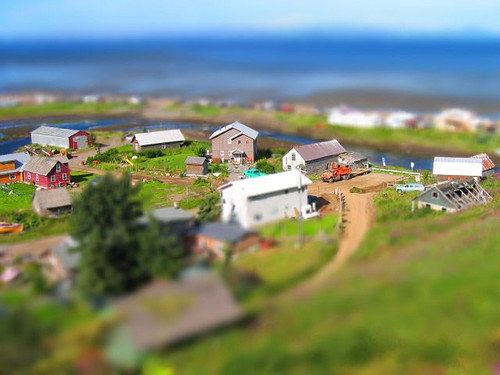
However, the word has made a comeback courtesy of photography. By a trick of lenses and software, people have devised a way of giving a real scene the appearance of a diorama. By adding foreground and background blur the impression of a shallow depth of field such as is found in close-up photography is achieved. This tricks the brain into, on first viewing, seeing the photograph as a set with models: see examples here and here. I understand that the Olympus PEN range of cameras have the facility to create these built into them as an effect. The only question I have is, "Why?" I can see that it's a trick that is easily done, but what is its purpose? I can't think of a use to which I would put it, so its reason is lost on me.

What has my photograph of the top of a yew hedge* against a blue sky with white clouds got to do with dioramas? Well, it occurred to me that the photograph could be mistaken for a view of the jungle-covered hills of somewhere such as New Guinea. Which would make the image something akin to a "reverse photographic diorama"!

* See another of my images of a yew hedge cut in this traditional manner here.

photograph and text (c) T. Boughen

Camera: Olympus E510
Mode: Aperture Priority
Focal Length: 28mm (56mm/35mm equiv.)
F No: f5.6
Shutter Speed: 1/1000
ISO: 100
Exposure Compensation: -0.7 EV
Image Stabilisation: On

Saturday, February 20, 2010

Foggy day photography

click photo to enlarge
I like to convert colour photographs to black and white. I'm not one who does it all the time, nor can I say that I do it with the majority of my images. But, when I have a subject that I think suits the treatment, I have no hesitation about going monochrome. People, buildings, some landscapes, shots with shadows or large areas of darkness and occasional highlights, are the subjects I favour. The Black and White gallery in my "Best of PhotoReflect 5" features many such images.

However, there is one subject that, I think, particularly lends itself to a black and white treatment and that is fog. Many photographs that are taken in fog (as opposed to above it from a hill) have very muted colour. Consequently the step to monochrome is smaller than it would otherwise be. Furthermore, the gentle gradations that foggy images feature are emphasised when they are in shades of a single colour rather than broken up by the complication of several. In addition, black and white often has the effect of giving a foggy image a more sombre or mysterious mood; something that can be very appropriate for the right subject.

Today's photograph is, to my mind, the best of the three foggy photographs that I'm posting following my recent morning expedition. The simplicity in terms of composition and subject make it for me. The road, hedge, two areas of grass, sky and the pair of pine trees would be complicated by a backdrop of more trees and a distant farm in clearer weather, and the image would be much busier. When I composed it I also liked the way the trees were near, but not at the intersection of the converging lines. It's probably not a shot that will have particularly wide appeal, but I do think it's one of my better recent photographs.

photograph & text (c) T. Boughen

Camera: Olympus E510
Mode: Aperture Priority
Focal Length: 12mm (24mm/35mm equiv.)
F No: f5.6
Shutter Speed: 1/125
ISO: 100
Exposure Compensation: 0 EV
Image Stabilisation: On

Saturday, March 29, 2008

Big hedge

click photo to enlarge
"Love thy neighbour, yet pull not down thy hedge", Old English Proverb

The saying above has a French version: "Hedges between keep friendships green", and both echo the oft-quoted, "Good fences make good neighbours". That being the case, what are we to make of the hedge shown in today's photograph? Its function doesn't appear to be to encourage a proper neighbourliness, so much as banish everyone and everything from sight. Looking at its height and undulations, "hedge" seems be a misnomer for this edifice constructed out of rows of yew trees grown closely together, and clipped as one structure when their foliage met.

It can be found in the grounds of Ayscoughee Hall, Spalding, Lincolnshire. This building, erected as a house in the early 1400s, and given to the town in the early 1900s, is now a museum with public gardens. However, the hedge must date from its time as a private residence. Research shows the yew trees date from successive plantings, the oldest probably being eighteenth century. It is cut in a way that is fairly common in the grounds of large English country houses (and churchyards), and fulfils the purpose of dividing up the gardens, screening one section from another, acting as a wind-break, and providing a mountainous backdrop against which plants can be displayed. Oh, and it offers gardeners a scary few weeks teetering thirty feet up on ladders as they give it the annual cut!

Impressed by the oddness of this living barrier I decided to show something of its scale by including two people sitting on one of the nearby benches.

photograph & text (c) T. Boughen

Camera: Olympus E510
Mode: Aperture Priority
Focal Length: 108mm (216mm/35mm equiv.)
F No: f8.0
Shutter Speed: 1/160
ISO: 100
Exposure Compensation: -0.3 EV
Image Stabilisation: On