Showing posts with label diorama. Show all posts

Wednesday, September 01, 2010

Wisbech & Fenland Museum

click photos to enlarge
The Victorians got museums right - pack them to the rafters with a wide variety of interesting stuff, add labels and brief explanatory texts, and leave the rest to the visitor. Many of today's museums have departed drastically from this idea, and seem to have taken the photographs of living rooms and kitchens in Homes and Gardens as their inspiration. All the clutter is removed and a few objets d'art are carefully placed amongst the seating. The "less is more" philosophy prevails. But the fact is, as far as museums go, less is a bore.

Sometimes today the emphasis is on "interpretation". In museums that favour this approach a visit is akin to going to church, with curators and historians in the role of the priesthood handing down to the laity the one and undivided truth about the past. Gone is any idea that a museum displays artefacts that prompt wonder and interest in the visitor such that they are inspired to go off and learn more for themselves. Other museums succumb to the audio-visual or "interactive" approach, with video presentations, historical games and puzzles, buttons to press and flashing lights for the correct answer. The idea behind this is the patronising thought that today's generation can only be attracted to what a museum offers by giving them something of what they already consume through TV and computers. Lincolnshire has a number of museums that feature some or all of these principles.

Consequently, it was with a sense of increasing delight that, a few weeks ago, I explored the museum at Wisbech in Cambridgeshire. As I passed beyond the entrance foyer it immediately became apparent that not only in the range of its content, but in presentation too, it was still a Victorian museum. The building opened in 1847, its initial collection having come from the town's Literary and Museum Societies. Since then it has, in the words of its website, "continued to grow, but the essence of the Museum remains virtually unchanged." It is, to quote again from its own publicity, "a treasure house of rare and unusual artefacts, illuminating history, both local and worldwide, recent and ancient." In other words, a wonderful Victorian museum from which a more recent small room with white walls, very little content and a couple of new "historical games" for children couldn't detract.

The display cases with stuffed birds took me back to my childhood visits to the Yorkshire Museum in York. The very large collection there, many displayed in diorama settings as at Wisbech, was a source of endless fascination for me. I didn't, at that young age, think about the Victorian collectors and the hundreds of rarities that were shot for display purposes. The young birdwatcher in me simply gazed with fascination at species that I'd never seen, and couldn't imagine ever seeing.

photograph and text (c) T. Boughen

Camera: Lumix LX3
Mode: Aperture Priority
Focal Length: 5.1mm (24mm/35mm equiv.)
F No: f2
Shutter Speed: 1/30
ISO: 125
Exposure Compensation: -0.66 EV
Image Stabilisation: On

Tuesday, June 22, 2010

Yew hedges, dioramas and blue skies

click photo to enlarge
I'm sure the curators would disagree, but I think quite a few museums have lost their way when it comes to displaying their contents. Increasingly I find buildings where the displays are pared down in a minimalist way, the "educational" is promoted very heavily, and there seems to be an emphasis on style rather than exhibits.

The Victorians got a lot right with their approach: pile in as much as you can, label everything, add a few panels to give background information and an overview, and leave the rest to the visitor. One of my favourite London collections is the Sir John Soane Museum. It holds the artefacts amassed by the neo-classical architect, and though it was put together just before the Victorian period, it follows their approach to display.

In my youth I visited York reasonably regularly, and in that city the Yorkshire Museum was a magnet for me because of its collection of stuffed birds. Courtesy of Victorian "collectors" (whose methods of shoot and stuff I deplored) I got to see many species that I would otherwise never have set eyes on. Not only extinct birds such as the Great Auk, but also the extreme rarities that pass your way only occasionally or never. These were usually presented singly or in groups in glass cases. There seemed to be room after room of such exhibits, broken up with the odd diorama showing a bird, such as the black grouse, against a painted backdrop of its habitat, with a few plants and rocks scattered about. In fact, that was my introduction to the word "diorama", and its a word I only occasionally came across in subsequent years. Today, in museums, the diorama as a method of presentation seems to be viewed as old hat.

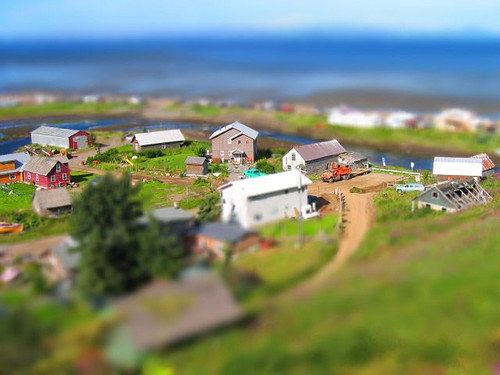
However, the word has made a comeback courtesy of photography. By a trick of lenses and software, people have devised a way of giving a real scene the appearance of a diorama. By adding foreground and background blur the impression of a shallow depth of field such as is found in close-up photography is achieved. This tricks the brain into, on first viewing, seeing the photograph as a set with models: see examples here and here. I understand that the Olympus PEN range of cameras have the facility to create these built into them as an effect. The only question I have is, "Why?" I can see that it's a trick that is easily done, but what is its purpose? I can't think of a use to which I would put it, so its reason is lost on me.

What has my photograph of the top of a yew hedge* against a blue sky with white clouds got to do with dioramas? Well, it occurred to me that the photograph could be mistaken for a view of the jungle-covered hills of somewhere such as New Guinea. Which would make the image something akin to a "reverse photographic diorama"!

* See another of my images of a yew hedge cut in this traditional manner here.

photograph and text (c) T. Boughen

Camera: Olympus E510
Mode: Aperture Priority
Focal Length: 28mm (56mm/35mm equiv.)
F No: f5.6
Shutter Speed: 1/1000
ISO: 100
Exposure Compensation: -0.7 EV
Image Stabilisation: On