Showing posts with label More London. Show all posts

Wednesday, March 16, 2016

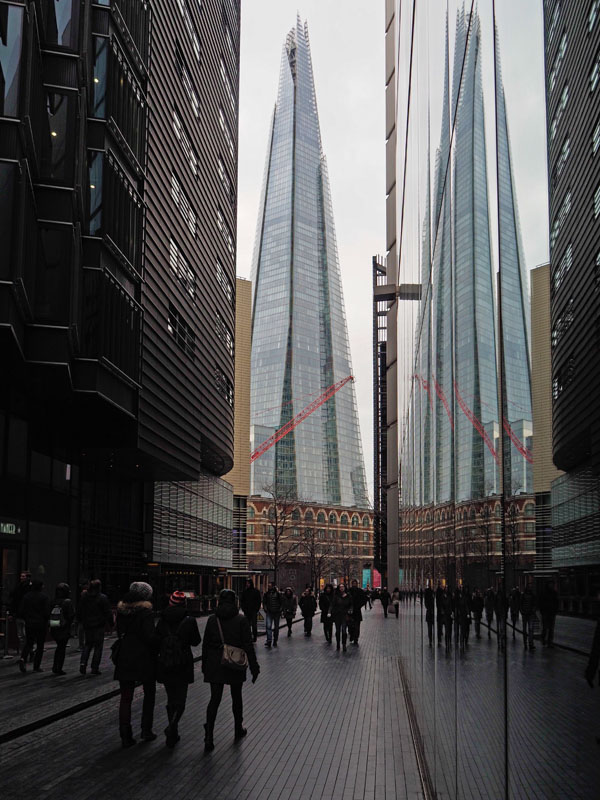
Tall things and The Shard

click photo to enlarge
It was wind turbines that first prompted the realisation that tall things - I mean very tall things - look tallest when seen from afar. There's a wind farm not too far from where I live, and, though I know that the ground to blade tip height is 100m regardless of where I'm standing, they still appear to be bigger when I'm two miles distant, and bigger still when I'm 5 or more miles away. It must be something to do with the fact that at those sorts of distances the real difference between a house or a tree and the turbine is always clear. However, when I'm closer a nearby tree looks relatively tall when viewed with a distant turbine.

The same is true of the the Shard, currently the tallest building in London. When seen from my car on the M11 where it passes over the hills north of London the Shard appears to tower over most of the tall buildings of the city, its distinctive, pointed shape catching the eye. However, from within the city its relative height seems less - at least to my eye. With the Shard I think there is another factor at work: the tapering shape makes it less massive in fact and in appearance when you are nearby. I photographed this building at reasonably regular intervals as it was being built, and took a few shots from the location of today's image (the ludicrously named More London). This recent shot was prompted by the silhouettes of people in the canyon-like cleft that frames the Shard, and also the bright red crane stretched across it. Building in London never stops and a recent news article pointed out that there are currently 436 tall buildings (over 20 storeys) in the pipeline for the capital of which 233 have planning approval.

photograph and text © Tony Boughen

Photo Title:  The Shard Seen From More London, London
Camera: Olympus E-M10
Mode: Aperture Priority
Focal Length: 14mm (28mm - 35mm equiv.)
F No: f5.6
Shutter Speed: 1/250 sec
ISO:200
Exposure Compensation: -0.3 EV
Image Stabilisation: On

Monday, May 06, 2013

Trees and louvres, More London

click photo to enlarge
When photographers use the word "contrast" they usually mean a marked difference between dark and light areas in a photograph. In black and white photography this can be achieved by seeking out compositions that naturally feature areas that are white or almost so as well as very dark or black areas. Another means of increasing contrast in this type of photography is to use a red, orange or yellow filter. In wet photography, of course, it can also be introduced during enlarging and developing too by techniques such as "burning" and "dodging". Contrast in the light/dark sense of is clearly possible in colour photography too, not least by shooting against the light.

However, the word contrast can be used in a different way, to mean a clear and visible difference of character (rather than tone) between one part of the image and another. This photograph of two adjacent shrubs shows that sort of contrast, as do aspects of this shot of Southwold Pier, particularly where the name sits against the clear sky and the dark shadows of the railings overlay the concrete and wooden decking. Architects often make use of contrast (or counterpoint) particularly when they use the soft, irregular lines and textures of natural vegetation against the hard, sharp surfaces of their buildings. This photograph of the City of London Information Centre (near St Paul's cathedral) exemplifies what I mean. So too does today's photograph.

The shot shown above has little contrast in the light/dark sense, but plenty as a result of the ragged lines of the tree branches against the hard, straight lines of the  external louvre screening. The latter is used to moderate the solar gain affecting these buildings on the edge of More London. I've photographed details of these particular buildings before, but on a recent visit I stepped further back to capture the contrast that the architects had introduced into the composition.

photograph and text © Tony Boughen

Camera: Sony RX100
Mode: Aperture Priority
Focal Length: 10.4mm (28mm - 35mm equiv.)
F No: f6.3
Shutter Speed: 1/640
ISO: 125
Exposure Compensation:  -0.3 EV
Image Stabilisation: On

Tuesday, February 12, 2013

Posing, fashion and photography

click photo to enlarge
Fashion photography  too often isn't. By that I mean it is photography, but it isn't about fashion. This branch of photography seem to attract those who see it as an opportunity to create "art", and so they produce images that do everything except show off the clothing that is being promoted. Thus, models adopt contorted poses, or are photographed in harsh or dim light, or are placed in locations that overwhelm or hide the main subject, or - well I think you'll have seen what I mean.

And even when a straight forward shot of a model is taken from face-on the photographers seem to crave an awkward element such as the feet in a strange position, the eyes deliberately closed, the hand raised to shield the face etc. Or the model is asked to adopt what I think of as the "gormless pose". I think you'll have seen this one too. It involves the model standing upright,  staring straight at the camera, mouth dropped open, no hint of emotion evident, arms hanging limply with the back of the hands turned forwards. I suppose it's a reaction against the poses of the middle of the twentieth century where models sat in the sunlight, relaxed, on scooters, on garden seats, or leaning nonchalantly against a tree, all the while beaming their best smile. On balance I think I prefer the latter! There was a time when fashion photographers managed to create art (of a sort) that also showed off the fashions being sold - Norman Parkinson frequently managed it producing wonderful images. These days many aim for one or other of these goals but few achieve both.

Today's photograph shows a wall of windows at the London Tower Bridge Hilton next to More London. It's an interesting wall  for the way colour is used. Standing on a thick wooden trunk nearby is a wooden sculpture of a woman (there's also a man nearby, out of shot). She is one of the "Couple", a commissioned work by the German artist, Stephan Balkenhol, completed in 2003. It was only after I'd seen the woman a couple of times that I realised her "wooden" pose reminded me of the "gormless" poses favoured by some fashion photographers. Now, it has to be said that this lady really can't help but look wooden: even if she was contorted like an Olympic gymnast she'd still be completely wooden. But why do we have to suffer it in the living models in the Sunday supplements? Incidentally, on past experience you may have expected me to say something about the quality of the sculpture. I see them as WYSIATI (what you see is all there is) pieces, so there's not much to add, and I certain won't be describing them as totemic or poles.

photograph and text © Tony Boughen

Camera: Canon
Mode: Aperture Priority
Focal Length: 85mm
F No: f7.1
Shutter Speed: 1/100
ISO: 125
Exposure Compensation:  -0.67 EV
Image Stabilisation: On

Sunday, April 08, 2012

Revisiting photographic subjects

click photos to enlarge
Our modern world, it seems, craves novelty. Manufacturers constantly update their cars, phones, televisions, bathrooms, clothing and much else in the hope and expectation that through change they will prompt desire and trigger another purchase to replace whatever it is that they now deem to be old and consequently worthless. Camera makers are past masters at this, offering a few more megapixels, slightly faster burst rates, a touch more dynamic range and further tweaks in their new models that appear for sale with frightening rapidity. And yet as these products change they also, in many ways, remain the same, because the fact is, manufacturers and consumers enjoy familiarity just as much as they do novelty. So, digital SLR cameras look very much like film SLR cameras though they don't have to do so, and today's shiny new car isn't radically different in appearance from that of ten years ago, or from the current competitor manufacturers' offerings (to the extent that I frequently confuse marques). In the realm of fast food outlets you are successful if you can give the customer the same product from the same menu - EXACTLY the same product, EXACTLY the same menu - wherever they happen to be in the country.

This love of both novelty and familiarity affects photographers too. Many enthusiastic amateurs and professionals like to go to new and different places to photograph new and different subjects. But those same photographers also enjoy taking "just one more" shot of a favourite or familiar subject, using the different light, weather, season, lens, etc. to try and improve on their earlier efforts. I'm no different from most photographers in this respect, and will quite happily shoot the same subject over and over again in the quest for a better outcome. I've discussed this previously in this post about Quadring church, and this post about Sleaford church, both in Lincolnshire.

I've posted shots of the subjects in today's post before too. One Humber Quays is a new office building in Hull that I've passed and photographed a few times, and the semi-abstract architectural detail is one that I frequently walk near when I'm in London, and each time try to come away from it with a better image. Familiarity with a subject often allows you take a better photograph of it because you have a fuller understanding of what it offers. Of course there's no guarantee that this will happen, and occasionally the freshness of discovery prompts a shot that trumps one bred of close acquaintance. You can be the judge of which of these forces is at work in the examples I post today.

photographs and text (c) T. Boughen

Main Photo
Camera: Canon
Mode: Aperture Priority
Focal Length: 28mm
F No: f7.1
Shutter Speed: 1/125
ISO: 320
Exposure Compensation: -0.33 EV
Image Stabilisation: On

Sunday, June 12, 2011

You can't take photographs of this building

click photo to enlarge
So, there I was with a family member, walking through More London in the early evening light, snapping away with my LX3 at subjects such as City Hall and "The Shard" (already the UK's tallest office block and still growing), on my way to the Marks and Spencer store located there. Our quest was for something for the evening meal, but I'd taken the small camera along for some shots as I always do on such occasions. I took a few more images of the buildings, the entrance to the food store, and, after completing our purchases, we left. As I walked through the street shown in today's photograph I stopped, raised my camera to take a photograph of the lights, the reflected sky and the patterns on the upper part of the exterior of one of the glass buildings, when it happened: someone approached me from behind and said, " You can't take photographs of this building."

The speaker was clearly someone employed on the foyer desk of the building, and who had been out somewhere (probably to Marks and Spencer) and was returning to his place of work. I won't bore you with the ensuing conversation which was polite but querying and exasperated on my part, and of the "I'm only following instructions" sort on his. Suffice to say that we went our separate ways, me to dinner and a discussion about what had happened and who I needed to write to about it, him to his desk and keeping his employers safe from the depredations of ageing amateur photographers and sundry tourists with cameras.

My first missive has gone to the owners of the private land on which the offices stand. More London is one of those hybrid spaces that are increasingly common in our cities - places where not only the buildings but the streets and the circulation spaces are private. Notices that are discreet almost to the point of invisibility tell the public this at More London. A few more prominent signs ban cycling, roller blades, skateboards and the like. No sign anywhere, to my knowledge, suggests that there is a ban on photography, and the thousands of tourists who visit the area each day merrily snap away at Tower Bridge, City Hall, HMS Belfast, the fountains, the buildings and anything else that takes their fancy. I have done so many times in the presence of the blue jacketed and overalled More London staff, with never a word spoken, and I assume they have no problem with people taking pictures. So my basic query of the landowners is whether they have a policy on photography, or do they leave such matters to the occupants of the buildings, and do they give any guidance on the matter to them. Depending on their reply (assuming I get one) I'll write to the occupiers of the building whose staff stopped me, asking what they hope to achieve through such action, suggesting why it is both counterproductive and futile, and asking them to change their policy. My third letter will be to the Mayor of London asking him to take whatever steps he can to stop the harrassment of photographers in outdoor areas of London where the public have free access, reminding him that successive Home Secretaries and the Association of Chief Police Officers have issued such instructions to police officers, and that private security staff should follow the same guidance in privately owned outdoor areas that are freely accessible to the public.

Will I achieve anything? Maybe. Maybe not. But, as ever, if you do nothing, nothing changes: if you do something, something might change. And the fact is, something needs to change.

A Google search reveals that I'm not the only person to have been accosted in this way. Interestingly, a Google image search on "More London Place" returns 34,600,000 photographs! Those security guards and their employers are fighting a battle that was lost long ago.

photograph and text (c) T. Boughen

Camera: Lumix LX3
Mode: Aperture Priority
Focal Length: 7.9mm (37mm/35mm equiv.)
F No: f2.8
Shutter Speed: 1/200
ISO:125
Exposure Compensation: -0.33 EV
Image Stabilisation: On
Monday, November 08, 2010

Privatising public space

click photo to enlarge
The insidious spread of private space into what was formerly, or should be, public space continues. Whether it be shopping malls, new developer-created streets, gated communities, or public-private partnerships that trade space for council-owned facilities, the result is the same: areas that would, in the past, have been publicly owned and would have offered unfettered access to everyone, are now often places in which we have restricted rights, and what we can or cannot do is limited in order that the owners can sell more effectively to the public or to their tenants. So, watch out if you're taking photographs, collecting for charity, skateboarding, or doing anything that offends the delicate sensibilities of the owners or their private security guards: if they don't like it they have the power to tell you to "clear off".

On a recent visit to London it was pointed out to me that one of the largest redevelopments of the river front is privately owned. The area upstream of Tower Bridge on the South Bank, a location that has a riverside path, green space, benches, multiple office blocks, open-air amphitheatre and is known by the ridiculous name of "More London" is not the public space that it seems to be. If one looks carefully you can see discreet metal plates fixed to walls that proclaim its private status. This is all the more remarkable because the space includes the new City Hall from where the London Assembly governs the metropolis. One of the architectural features of this Norman Foster-designed building is its openness, designed to bring transparency to the democratic process. Yet it is located in a privately owned part of the city. As they say in the United States - "go figure".

All that being so, I did wonder whether I might be stopped as I pointed my new camera at the orange coloured acers in front of the offices with their blue-tinted glass. However, anyone trying to restrict my photography would, in fairness, have to do the same with the thousands of tourists snapping away at Tower Bridge, HMS Belfast, the city skyline and the "Glass Gonad" itself, so I felt fairly safe.

photograph and text (c) T. Boughen

Camera: Canon
Mode: Aperture Priority
Focal Length: 27mm
F No: f6.3
Shutter Speed: 1/60
ISO: 100
Exposure Compensation: -0.33 EV
Image Stabilisation: On