Showing posts with label The Shard. Show all posts

Wednesday, March 16, 2016

Tall things and The Shard

click photo to enlarge
It was wind turbines that first prompted the realisation that tall things - I mean very tall things - look tallest when seen from afar. There's a wind farm not too far from where I live, and, though I know that the ground to blade tip height is 100m regardless of where I'm standing, they still appear to be bigger when I'm two miles distant, and bigger still when I'm 5 or more miles away. It must be something to do with the fact that at those sorts of distances the real difference between a house or a tree and the turbine is always clear. However, when I'm closer a nearby tree looks relatively tall when viewed with a distant turbine.

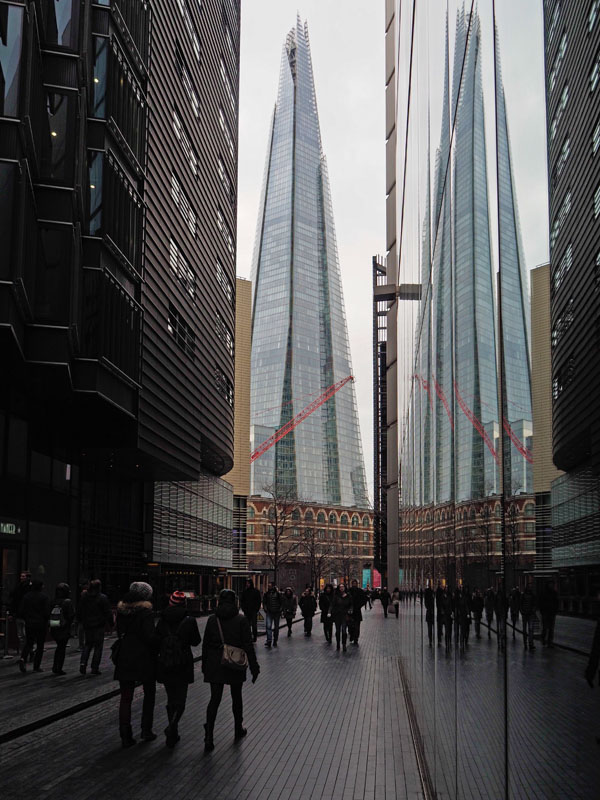
The same is true of the the Shard, currently the tallest building in London. When seen from my car on the M11 where it passes over the hills north of London the Shard appears to tower over most of the tall buildings of the city, its distinctive, pointed shape catching the eye. However, from within the city its relative height seems less - at least to my eye. With the Shard I think there is another factor at work: the tapering shape makes it less massive in fact and in appearance when you are nearby. I photographed this building at reasonably regular intervals as it was being built, and took a few shots from the location of today's image (the ludicrously named More London). This recent shot was prompted by the silhouettes of people in the canyon-like cleft that frames the Shard, and also the bright red crane stretched across it. Building in London never stops and a recent news article pointed out that there are currently 436 tall buildings (over 20 storeys) in the pipeline for the capital of which 233 have planning approval.

photograph and text © Tony Boughen

Photo Title:  The Shard Seen From More London, London
Camera: Olympus E-M10
Mode: Aperture Priority
Focal Length: 14mm (28mm - 35mm equiv.)
F No: f5.6
Shutter Speed: 1/250 sec
ISO:200
Exposure Compensation: -0.3 EV
Image Stabilisation: On

Monday, November 05, 2012

The Shard, viewed and eclipsed

click photo to enlarge
If I take my camera with the 70-300mm lens mounted on it, lean out from the balcony in Rotherhithe where I often stay, brace myself against the metal work and point it upstream towards the centre of London, I can take this photograph of The Shard. I've taken quite a few shots in this way during the construction of the building, some of which I've posted on the blog.

As well as showing the glass spike itself this view also features Guy's and St Thomas' Hospital - the tall building on the left. This utilitarian, concrete structure has sprouted what looks like scaffolding, an indication, perhaps, that it is being spruced up to be a more presentable neighbour for the new tower. A segment of the big wheel that is called the London Eye can be seen immediately to the right of The Shard. To the right of that is one of the pointed roofs of Tower Bridge visible between the two cranes. The buildings in the lower half of the photograph are the converted warehouses and new-build riverside flats along the Thames. The river itself is in the foreground.

The Shard's moment of fame as Europe's tallest building was brief. Apparently its height of 1,016 feet (310 metres) was recently eclipsed by Mercury City Tower in Moscow. It is though, by a big margin, the tallest building in the United Kingdom, though not the tallest structure. That honour belongs to the Emley Moor transmitting station, a telecommunications mast at 1,084 feet (330 metres) that was built in 1969-71 in Yorkshire. I mentioned in a recent post that I must buy a ticket to access the viewing gallery near the top of The Shard and in writing this piece I came across the fact that tickets are already on sale for the opening in February. I think I'll wait for the rush to die down before I buy one. If, that is, it does ever die down.

photograph and text © Tony Boughen

Camera: Canon
Mode: Aperture Priority
Focal Length: 228mm
F No: f5.6
Shutter Speed: 1/60
ISO: 3200
Exposure Compensation:  -0.33 EV
Image Stabilisation: On

Thursday, November 01, 2012

Changing London

click photo to enlarge

"London is a splendid place to live in for those who can get out of it."
George John Gordon Bruce (1883-1967), English banker and peer

"I've been walking about London for the last thirty years, and I find something fresh in it every day." Walter Besant (1836-1901), English novelist and historian (words said on his death bed)

English people have differing views of their capital city. There are those who see it as the centre of the world, a place where anything and everything can and does happen, somewhere that shines brighter and more intensely than anywhere else. But there are also those for whom London is a place to avoid, a large, crowded, noisy, tumultuous place bent on making money or extracting it from the unwary visitor.

My view of London leads me to find sympathy with both of the above quotations. I really enjoy visiting London, but I wouldn't want to live there on a permanent basis. I've said elsewhere in this blog that a few years would suit me nicely, but then a yearning for the country, for the sea, for villages and small towns, for wide open spaces and wildlife would be so engulf me that I'd have to move out. So yes, a splendid place to live if you can regularly go elsewhere. As a photographer I'm always overwhelmed by the choice of photographic subjects that London offers. Like anywhere else it changes with the light, time of day and season. But it also changes because infrastructure development is an ongoing process to a much greater extent than anywhere else in the country. Buildings change use, old ones come down and new ones go up. The view up the Thames to the city from where I stay in London changes every year. A rather odd shaped building that flares out towards the top is currently under construction, a feature that has already earned it the name, "The Walkie Talkie". Then there is the view of the completed splinter of glass called "The Shard" that can be seen on the right of today's photograph (memo to self: must visit the viewing gallery when it opens to the public). For someone like me who is interested in architecture such buildings offer something fresh everyday at which I can point my camera.

Today's image, though it has a backdrop of the River Thames and the southern edge of the centre of the city is in fact a family photograph. I took it as my eldest son, his daughter, my wife and I were having a short walk. The sharp silhouettes and almost monochrome qualities softened by the clouds that threatened a further downpour suggested a contre jour shot would work, so I framed my photograph and pressed the shutter.

photograph and text © Tony Boughen

Camera: Canon
Mode: Aperture Priority
Focal Length: 45mm
F No: f7.1
Shutter Speed: 1/400
ISO: 100
Exposure Compensation:  -1.00 EV
Image Stabilisation: On

Tuesday, March 20, 2012

Shard March update

click photo to enlarge
A couple of days in a cloudy, rain-swept London allowed me to have two walks into and through the city and the opportunity to gather a clutch of photographs including today's showing the current progress of The Shard. In December this building passed the height of 1 Canada Square in Canary Wharf, becoming the tallest in the UK and the European Union, and the second tallest free-standing structure in the UK (after the Emley Moor TV transmitter). It is currently near its projected maximum height of 1,012 feet (308.5 metres). Superlatives in the world of tall buildings are, of course, transitory, and The Shard will doubtless soon be removed from its current pinnacle.

Speaking of pinnacles, he said, segueing into the next topic like a radio DJ on autopilot, the next tall London tower to reach for the skies has made a strong appearance since I was last there in November. Bishopsgate Tower in Leadenhall, now to be called The Pinnacle, was to have been about the same height as the Shard, but after concerns from the Civil Aviation Authority it is losing just under twenty metres. This is another deliberately "different" shape for a city tower, resembling to my eye, a loosely coiled tube of paper. The very ugly concrete service core is already quite high, and when it gets its curved glass curtain walls that sweep up to its summit it will be another distinctive addition to the London skyline. At the moment I'm holding my judgement on whether the quality of being distinctive will be paired with being distinguished. It's certainly no Shard, but perhaps I'll warm to the real thing more than I do to the architect's illustration. Incidentally, it will be interesting to see if the more populist, "The Pinnacle", is adopted by Londoners or whether, as is their habit, they confer a more appropriate and less respectful soubriquet. Indeed, I wonder whether the new name was a calculated attempt to forestall such an eventuality!

Today's photograph, like a couple of others I've posted of The Shard, was taken by resting my camera on a balcony rail by the Thames in Rotherhithe, downstream from the City.

photograph and text (c) T. Boughen

Camera: Canon
Mode: Aperture Priority
Focal Length: 168mm
F No: f5
Shutter Speed: 1/20 sec
ISO: 3200
Exposure Compensation:  -0.33 EV
Image Stabilisation: On

Friday, November 18, 2011

Cleaning the Shard's windows

click photo to enlarge
"A window cleaner you would be,
If you can see what I can see,
When I'm cleanin' windows."
from the song, "When I'm Cleaning Windows sung by George Formby (1904-1961), British songwriter, comedian and actor

When I lived in Lancashire I could look out of my upstairs windows and, across the fields, see a house that once belonged to George Formby. It was called the Illawalla. Formby did a lot of work in the Blackpool area so I suppose a rural retreat a few miles inland was a good base for him.

It was his best-known song, "When I'm Cleaning Windows" that came to mind when I saw these workmen doing just that hundreds of feet above me on the Shard. Not that the subjects mentioned in his ribald lyrics would be likely to be seen at this location. However, the London sights they do see from their various vantage points around the building must be amazing. It takes a particular kind of person to do the kind of work seen in today's photograph, and I can say that it most definitely wouldn't suit me.

If you look carefully at yesterday's photograph with the closer view of the Shard you can just make out the crane, cradle and the bright orange jackets seen in the picture above.

photograph and text (c) T. Boughen

Camera: Canon
Mode: Aperture Priority
Focal Length: 300mm
F No: f6.3
Shutter Speed: 1/320
ISO: 320
Exposure Compensation:  -0.33 EV
Image Stabilisation: On

Thursday, November 17, 2011

Shard November update

click photo to enlarge
It's probably a bit rich to describe this as an update on the progress of the Shard - the low cloud hid the "working" section at the top for much of the time I was in a position to get a shot. However, I did manage to incorporate into my main image some of a lower building that shares the same address as the Shard and together with the taller building comprises "The London Bridge Quarter". The hunk of concrete surrounded by cranes will become "The Place", a name that the workings already carry as it slowly rises above its neighours. It too will be a glass faced structure as its website shows.

It strikes me that "The Place" is an incredibly uninspiring name. It reminds me of "the hub" that is now "nccd" in Sleaford, Lincolnshire. It's a generic name, in some ways redolent of the 1960s (it conjures up a hang-out such as a coffee bar or small music venue), and is one which is unlikely to last very long.

The River Thames view is equally unrevealing of the Shard, and much less so than my earlier photograph from downstream taken in August. Even the night time shots that I took on my last visit show the building partially obscured by cloud. I suppose this is something the workers, visitors and residents of the Shard will have to get used to. Mind you, I bet the view is amazing when there's a temperature inversion.

photograph and text (c) T. Boughen

Camera: Canon
Mode: Aperture Priority
Focal Length: 28mm
F No: f6.3
Shutter Speed: 1/160
ISO: 100
Exposure Compensation:  -0.33 EV
Image Stabilisation: On

Saturday, October 15, 2011

Shard October update

click photo to enlarge
Perhaps the above encounter between a barge, a Port of London Authority launch, a Fire Rescue boat and a Police launch (departing background right) wasn't an incident as such, more a planned coming together of vessels. However, the flashing blue lights on the Police launch and the speed at which it arrived on the scene suggested otherwise and drew the attention of this passing photographer as he trudged towards the centre of London under a leaden sky hoping for a shot or two to present themselves.

My most recent photographs of the construction of the Shard were posted on 29th and 30th August. I post today's images as my latest update on the progress of this tall and very visible building. Flipping back and forth between the two river views I can see that the glass reaches somewhat higher than it did in August. The concrete core has now reached its final height. There has always been a crane at the tallest point during construction. However, the crane that is now at the top of the Shard, which was put up on September 24th, is the tallest ever erected in Britain. It will be used to complete the "spire" that forms the uppermost part of the building.

The projected completion date for the Shard is May 2012.

photograph and text (c) T. Boughen

Main Photo
Camera: Canon
Mode: Aperture Priority
Focal Length: 95mm
F No: f7.1
Shutter Speed: 1/100
ISO: 100
Exposure Compensation:  0 EV
Image Stabilisation: On

Tuesday, August 30, 2011

London riverscape and National Trails

click photo to enlarge
My walk from Rotherhithe into the centre of London follows a section of a route called the Thames Path. This is a 184 miles long National Trail that follows the river from its source in the Cotswolds, through the heart of London, to the Thames Barrier at Greenwich. Though that title sounds rather impressive, the section that I use is simply a collection of riverside paths, public footpaths and roads that are collectively waymarked with this grand title.

I've always enjoyed walking, and have walked in many parts of Britain. Yet, perhaps surprisingly, I have an aversion to the whole concept of "National Trails" and long-distance footpaths. I first gave voice to it in the 1960s when I lived in the Yorkshire Dales and saw what the creation of the Pennine Way was doing to the country through which it runs: in particular the way that the track up the "nose" of Penyghent grew from a narrow path to a disfiguring scar 50 yards wide, visible for miles, that ultimately required boarding and steps to stabilise it. The creation of other such trails across sections of the country have done nothing to change my view of these footpaths. I've seen similar erosion associated with the creation of the long distance path along the length of Hadrian's Wall, and find it deplorable.

But it's not just the environmental damage that the designation of National Trails brings that I find objectionable, there are two other major problems. Firstly, they encourage endurance and competitive walking in the countryside. In a small, heavily populated island like Britain, where open country is a precious resource, people should be encouraged to walk in our natural areas and farmland with a much wider focus than the selfish sense of achievement that comes from completing a route. There are those who will say that this is possible, even on such a trail, to which I answer: talk to those who walk them! Secondly, the focus on these long-distance trails inevitably reduces the much more valuable work that needs to be done to maintain and, importantly, extend our historic network of footpaths and bridleways, a task which, if done properly, enriches the lives of many more people by giving access to local walking. And, if that were not sufficient reason for disliking the idea and execution of National Trails, there is the commercialisation of the concept that is evident in the opening sentence of the National Trails website: "We welcome innovative approaches from all sectors of business and are keen to explore opportunities for joint ventures with the private sector to develop new products and services." I cringe when I read such language in connection with countryside access.

Today's photograph, taken from the Thames Path, gives some context to my earlier photographs of The Shard.

photograph and text (c) T. Boughen

Mode: Aperture Priority
Focal Length: 58mm
F No: f7.1
Shutter Speed: 1/320
ISO: 100
Exposure Compensation:  0 EV
Image Stabilisation: On
Filter: Graduated ND8

Monday, August 29, 2011

Shard update

click photos to enlarge
On my recent visit to London I took a few more shots of The Shard, the tall, tapering, glass splinter-like tower that is rising above London on the south bank of the Thames. I usually manage to get photographs of the building from my Rotherhithe balcony and from the More London district of the South Bank, and I did so again. However, during our visit we also needed to visit the hospitals next door to The Shard and so I was able to get a shot looking up at the rapidly growing structure.

Two red lifts were scuttling up and down their ladder-like track that is fixed to the side of the building, transporting men and materials to wherever they were needed. As I gazed up at the gleaming building it struck me that a tapering tower not only is lighter in terms of mass than the usual cuboid, it looks much lighter and doesn't dominate the area as a more conventional shape would.
The observant visitor will notice, in the bottom right of the frame of the main image, the wire mesh cladding of the combined heat and power unit that is the subject of yesterday's blog post, and above it the grim, stained concrete of the hospital tower. Incidentally, the photograph of The Shard taken from Rotherhithe dates from the same evening as the wonderful sunset photograph that I posted a couple of days ago. And, further to that marvellous sight, the Daily Telegraph newspaper noted the sunset as one of the best in London in recent years and featured a photograph of it on their website.


photographs and text (c) T. Boughen

Camera: Canon
Mode: Aperture Priority
Focal Length: 24mm
F No: f7.1
Shutter Speed: 1/500
ISO: 100
Exposure Compensation:  -0.33 EV
Image Stabilisation: On

Sunday, July 03, 2011

Kindles, dashes and the Shard

click photo to enlarge
In recent months I've been giving some thought to buying an e-book reader, possibly a Kindle. I have no special affection for Amazon. In fact, the built-in proprietary format of their device along with the widely reported case of the remote removal of a book from people's Kindles that the company undertook a while ago makes me think another manufacturer might be preferable. However, their reader does support most (though not all) common formats, has a good quality display, and is relatively inexpensive. The latter would be a particular consideration if I didn't like the experience.

However, looking at a full page advertisement for the Kindle on the back page of the Guardian newspaper's Review section has put the thought right out of my head for the time being. Why? Well, the advert features a large photograph of the Kindle with the first page of a novel, "Ordinary Thunderstorms" by William Boyd, showing on the screen, and I read the first sentence of this three times before I understood its meaning! The reason was that where a dash should have been, indicating a break in the flow of the sentence for an interjection, there was what looked like a hyphen (i.e. there was no space before and after the character), and where the sentence continued after this aside, there was a further hyphen. So, on my first reading I was left wondering what a "river-all" and a "doubt-but" were.  The second sentence was perfectly clear, but then it got worse. The third sentence, that begins the second paragraph, starts, "There he is - look - stepping hesitantly down..." But on the Kindle I read, "There he is-look-stepping hesitantly down... And, once again I was re-reading to extract meaning. The irony is, this same Kindle page has two correctly hyphenated words. Why, I wondered, couldn't the correct typography that usually features spaces before and after a dash, that was presumably in the paper novel, be transferred to the e-book reader? Is this common to all these devices? Anyway, it was enough to put me off and I don't think that was the intention of Amazon's expensive advertisement.

It was only after I'd puzzled over this for a while and sent a query off to Amazon that I noticed the characters were (quite correctly) longer when they indicated dashes, and shorter when being used as hyphens.* However, they were not so different that I noticed this until I began forensically examining what was going on. So, even that distinction isn't enough to prevent the understanding of a passage being a potential chore and, frankly, difficulties of that sort are not what I want from my reading.

* Further clarification for the technically minded. Skip if you don't care!
  • The dash ( — ) used for a pause in thought or where parentheses might be used is sometimes called an em dash. It usually has a space before and after, and can only be produced on a computer keyboard by using the key combination Alt and 0151 (on the Num pad). Computer writers usually use the hyphen with a space before and after in place of a proper dash, but publishers invariably observe the distinction in character length and place spaces before and afterwards.
  • The hyphen (-) is used for hyphenated words e.g. full-length or re-entered, and is available directly from the keyboard. When used it has no space before and after except where listing hyphenated words e.g. pre- and post- war.
  • An intermediate length line (–) called an en dash, sometimes used when showing a range of numbers e.g. 180–360, can be produced using the key combination Alt and 0150. It also has no space before and after.
What I suspect is happening with this Kindle example is that the spaces before and after the dash are being lost during the translation from paper to e-book format.

Addendum - Curiouser and Curiouser
The day after I wrote the above my wife noticed a Tesco advertisement for the Amazon Kindle on the back of the Guardian newspaper's magazine. It showed the same first page of the same novel on its screen held by the very same hand. But guess what - on this Kindle the dashes were fine, with a space before and a space after! More detailed analysis of the screenshot showed this page had several differences from the earlier one. The page displayed two fewer lines even though each line was slightly longer, the title bar was different, "Chapter 1" had been replaced by "ONE", and there was more data on the bottom of the screen. The most important, and perhaps the crucial difference was that the symbol "3G" was displayed on the screen. On the basis of these advertisements am I to assume that the more expensive 3G+WiFi Kindle displays better than the basic WiFi model? And if that is the case why isn't it made clear? Or is it simply that the Kindles in the advertisements are displaying different versions of the William Boyd novel. This begs another question, of course - if I buy a typographically "crippled" version of a book can I get it exchanged for one that reads correctly? This is all very curious and none of it makes me inclined to purchase Amazon's e-book reader. Moreover it shows the company failing in the two key areas of advertising - information and persuasion.

And now back to our regular programming. Today's photograph is an update on the progress of the Shard taken on a recent visit to London. It was taken from downstream by the Thames at Rotherhithe. Image stabilisation, the selection of a high ISO, and bracing the camera against the balcony door was enough to secure a fairly sharp shot.  The image also includes parts of the tops of the towers of Tower Bridge and a segment of the London Eye. My last photographs of this new London building were taken on 9th June - see here and here.

photograph and text (c) T. Boughen

Camera: Canon
Mode: Aperture Priority
Focal Length: 238mm
F No: f5.6
Shutter Speed: 1/20
ISO: 3600
Exposure Compensation:  -0.67 EV
Image Stabilisation: On
Monday, June 20, 2011

The Shard

click photo to enlarge
The Shard looks set to be one of the most interesting buildings to have been erected in London in recent years. Not only will it be the tallest in the capital (and in the UK and Europe) at 1,017 feet (310m), it will also be a mixed use building, something that is not common in the UK. Floors 2-28 will be offices, 31-33 will be restaurants, 34-52 will be a hotel, 53-65 are reserved for residences, and floors 68-72 are to form an observatory. The designer of the tower, Renzo Piano, likened his creation to a shard of glass and the name has stuck. This glittering, angular, tapered shape will be a dramatic addition to the skyline, a building that is designed to change its appearance in different weathers.

There was some opposition to the construction of such a tall building so close to the centre of London, even one located on the south bank of the Thames. However, the last Labour government gave the planning go-ahead, and I am glad that they did. It seems to me that the height of a new building is an important consideration if it is very near a large, significant older building. But, a big new tower should not be rejected on size alone where this consideration does not come into play. The crucial factor is the quality of what is proposed, and the Shard, it seems to me, is a high quality design that will add something to the London skyline rather than detract from what is already there. Yes, its shape is a little "odd", but it is very appealing: to my mind more so than London's other "oddity", the Gherkin.

I've photographically recorded the Shard as it has been under construction over the past two years, and have meant to post a blog entry with several of the shots. However, I probably won't do this as the Shard's Wikipedia page has done it better (bottom of page). Instead I will post photographs of the building as and when I secure one that I like. This shot was taken during a recent early evening walk where, even without lights, the glass of the building glowed against the dark, sunlit cloud.

Incidentally, the Shard has a very good website that not only explains more about what it will become, but also charts the progress of its construction. I particulary recommend the Gallery and the panoramic views.

photograph and text (c) T. Boughen

Camera: Lumix LX3
Mode: Aperture Priority
Focal Length: 12.8mm (60mm/35mm equiv.)
F No: f3.2
Shutter Speed: 1/500
ISO:125
Exposure Compensation: 0 EV
Image Stabilisation: On

Sunday, June 12, 2011

You can't take photographs of this building

click photo to enlarge
So, there I was with a family member, walking through More London in the early evening light, snapping away with my LX3 at subjects such as City Hall and "The Shard" (already the UK's tallest office block and still growing), on my way to the Marks and Spencer store located there. Our quest was for something for the evening meal, but I'd taken the small camera along for some shots as I always do on such occasions. I took a few more images of the buildings, the entrance to the food store, and, after completing our purchases, we left. As I walked through the street shown in today's photograph I stopped, raised my camera to take a photograph of the lights, the reflected sky and the patterns on the upper part of the exterior of one of the glass buildings, when it happened: someone approached me from behind and said, " You can't take photographs of this building."

The speaker was clearly someone employed on the foyer desk of the building, and who had been out somewhere (probably to Marks and Spencer) and was returning to his place of work. I won't bore you with the ensuing conversation which was polite but querying and exasperated on my part, and of the "I'm only following instructions" sort on his. Suffice to say that we went our separate ways, me to dinner and a discussion about what had happened and who I needed to write to about it, him to his desk and keeping his employers safe from the depredations of ageing amateur photographers and sundry tourists with cameras.

My first missive has gone to the owners of the private land on which the offices stand. More London is one of those hybrid spaces that are increasingly common in our cities - places where not only the buildings but the streets and the circulation spaces are private. Notices that are discreet almost to the point of invisibility tell the public this at More London. A few more prominent signs ban cycling, roller blades, skateboards and the like. No sign anywhere, to my knowledge, suggests that there is a ban on photography, and the thousands of tourists who visit the area each day merrily snap away at Tower Bridge, City Hall, HMS Belfast, the fountains, the buildings and anything else that takes their fancy. I have done so many times in the presence of the blue jacketed and overalled More London staff, with never a word spoken, and I assume they have no problem with people taking pictures. So my basic query of the landowners is whether they have a policy on photography, or do they leave such matters to the occupants of the buildings, and do they give any guidance on the matter to them. Depending on their reply (assuming I get one) I'll write to the occupiers of the building whose staff stopped me, asking what they hope to achieve through such action, suggesting why it is both counterproductive and futile, and asking them to change their policy. My third letter will be to the Mayor of London asking him to take whatever steps he can to stop the harrassment of photographers in outdoor areas of London where the public have free access, reminding him that successive Home Secretaries and the Association of Chief Police Officers have issued such instructions to police officers, and that private security staff should follow the same guidance in privately owned outdoor areas that are freely accessible to the public.

Will I achieve anything? Maybe. Maybe not. But, as ever, if you do nothing, nothing changes: if you do something, something might change. And the fact is, something needs to change.

A Google search reveals that I'm not the only person to have been accosted in this way. Interestingly, a Google image search on "More London Place" returns 34,600,000 photographs! Those security guards and their employers are fighting a battle that was lost long ago.

photograph and text (c) T. Boughen

Camera: Lumix LX3
Mode: Aperture Priority
Focal Length: 7.9mm (37mm/35mm equiv.)
F No: f2.8
Shutter Speed: 1/200
ISO:125
Exposure Compensation: -0.33 EV
Image Stabilisation: On