click photo to enlarge
In everyday usage the word "lent" is often confused with "borrowed". There should be no problem - "he lent me...", "I borrowed..." - where is the problem. But problem there is because the error persists. It's perhaps fortunate that the word Lent (with a capital "L") is no longer part of everyday usage; it might add another layer of confusion.
Of course, for Christians Lent is a word used annually because it describes a roughly six week period in the liturgical calendar that stretches from Ash Wednesday to Easter Sunday. The Latin name for this period is Quadragesima which ties in with the approximately 40 days of this period in the church year.
In Roman Catholic churches and countries it is not uncommon for religious objects, particularly crucifixes and statues , to be covered during this period. In Protestant churches, including the UK's Anglican buildings this is much less common. However, some churches do veil objects, particularly on the altar, and frequently the three statues of the rood screen - Christ on the Cross (or just a Cross), St John and the Virgin Mary. In the UK the material that is used as a covering is often purple. We came across the example above in Tewkesbury Abbey, Gloucestershire, a couple of weeks ago.
photograph and text © Tony Boughen
Camera: Nikon D5300
Mode: Aperture Priority
Focal Length: 56mm (84mm - 35mm equiv.)
F No: f5
Shutter Speed: 1/50 sec
ISO:6400
Exposure Compensation: -0.33 EV
Image Stabilisation: On
Showing posts with label Gloucestershire. Show all posts
Monday, April 13, 2015
Thursday, September 25, 2014
Tewkesbury Abbey choir vault
click photo to enlarge
I visit a lot of churches, both great and small. And, if the truth be known, I prefer the modest buildings to the great abbeys, minsters and cathedrals. However, if it's awe and wonder you are in search of then one of the best man-made spectacles is to be found in the large churches of the medieval and later periods. More specifically, in the elaborate, often beautiful vaulting that supports their great ceilings.
In England there are many examples that take your breath away, and some that offer a variety of examples of the mason's art. Peterborough Cathedral has fine work from the twelfth century and beautiful fan vaults of the 1400s and early 1500s while Gloucester Cathedral cloister can claim the earliest example of this peculiarly English style. Beverley Minster has vaulting to compete with any church, and Ely Cathedral's vaults in and surrounding the famous octagonal lantern are unparalleled anywhere else. Even lesser known buildings, such as Pershore Abbey, can thrill when we stop, look up and reflect on the stonework above our heads.
Today's photograph shows the lierne vaulting of the 1330s above the choir of Tewkesbury Abbey. It is pretty much as built, though in the fifteenth century the Yorkist badges of the "Sun in Splendour" were added. And, of course, the paintwork has been renewed down the centuries. The two features that make this vaulting so different from any other, and so spectacular, are the extent and colours of the paint, as well as the unusual complexity of the ribs and bosses. When I visit this abbey I never fail to stop and look up at this beautiful spider's web that keeps the roof from falling on my head.
photograph and text © Tony Boughen
Camera: Nikon D5300
Mode: Aperture Priority
Focal Length: 18mm (27mm - 35mm equiv.)
F No: f5.6
Shutter Speed: 1/30 sec
ISO:1100
Exposure Compensation: 0 EV
Image Stabilisation: On
I visit a lot of churches, both great and small. And, if the truth be known, I prefer the modest buildings to the great abbeys, minsters and cathedrals. However, if it's awe and wonder you are in search of then one of the best man-made spectacles is to be found in the large churches of the medieval and later periods. More specifically, in the elaborate, often beautiful vaulting that supports their great ceilings.
In England there are many examples that take your breath away, and some that offer a variety of examples of the mason's art. Peterborough Cathedral has fine work from the twelfth century and beautiful fan vaults of the 1400s and early 1500s while Gloucester Cathedral cloister can claim the earliest example of this peculiarly English style. Beverley Minster has vaulting to compete with any church, and Ely Cathedral's vaults in and surrounding the famous octagonal lantern are unparalleled anywhere else. Even lesser known buildings, such as Pershore Abbey, can thrill when we stop, look up and reflect on the stonework above our heads.
Today's photograph shows the lierne vaulting of the 1330s above the choir of Tewkesbury Abbey. It is pretty much as built, though in the fifteenth century the Yorkist badges of the "Sun in Splendour" were added. And, of course, the paintwork has been renewed down the centuries. The two features that make this vaulting so different from any other, and so spectacular, are the extent and colours of the paint, as well as the unusual complexity of the ribs and bosses. When I visit this abbey I never fail to stop and look up at this beautiful spider's web that keeps the roof from falling on my head.
photograph and text © Tony Boughen
Camera: Nikon D5300
Mode: Aperture Priority
Focal Length: 18mm (27mm - 35mm equiv.)
F No: f5.6
Shutter Speed: 1/30 sec
ISO:1100
Exposure Compensation: 0 EV
Image Stabilisation: On
Labels:
bosses,
church,
Gloucestershire,
medieval,
ribs,
Tewkesbury Abbey,
vaulting
Tuesday, July 22, 2014
Tewkesbury Abbey stylistic juxtapositions
click photo to enlarge
I've heard it argued that Gothic architecture i.e. the medieval style that features pointed arches, was the first stone-built style of Northern Europe. During the so-called "Battle of the Styles" in the nineteenth century, when the design of large public buildings in Britain was often decided in competition, Gothic was frequently chosen because it was seen as a native style in contrast to the Classical style which was deemed, rightly, to be Mediterranean in origin.
The Romanesque style with its rounded arches, that preceded Gothic, can be viewed as a debased version of classical architecture, though that is not the whole story by any means; the timber building traditions of the Anglo-Saxons and the decorative sculpture of the Norse peoples are two stylistic threads that are also very evident. Something that I always found interesting was that the Romanesque style merged into Gothic rather than becoming a purer version of the styles of Ancient Greece and Rome. That had to to wait until the Renaissance.
Today's photograph shows part of the nave and more distant crossing and chancel at Tewkesbury Abbey in Gloucestershire. What always strikes me when I enter this building is the contrast between the plain, solid columns and rounded arches of Romanesque period, surmounted by the lighter, ornate vaulting of the later Gothic period. It is not uncommon in many English cathedrals, but at Tewkesbury the dissonance the pairing produces seems more pronounced than elsewhere.
photograph and text © Tony Boughen
Camera: Nikon D5300
Mode: Aperture Priority
Focal Length: 18mm (27mm - 35mm equiv.)
F No: f5.6
Shutter Speed: 1/30 sec
ISO:2000
Exposure Compensation: 0 EV
Image Stabilisation: On
I've heard it argued that Gothic architecture i.e. the medieval style that features pointed arches, was the first stone-built style of Northern Europe. During the so-called "Battle of the Styles" in the nineteenth century, when the design of large public buildings in Britain was often decided in competition, Gothic was frequently chosen because it was seen as a native style in contrast to the Classical style which was deemed, rightly, to be Mediterranean in origin.
The Romanesque style with its rounded arches, that preceded Gothic, can be viewed as a debased version of classical architecture, though that is not the whole story by any means; the timber building traditions of the Anglo-Saxons and the decorative sculpture of the Norse peoples are two stylistic threads that are also very evident. Something that I always found interesting was that the Romanesque style merged into Gothic rather than becoming a purer version of the styles of Ancient Greece and Rome. That had to to wait until the Renaissance.
Today's photograph shows part of the nave and more distant crossing and chancel at Tewkesbury Abbey in Gloucestershire. What always strikes me when I enter this building is the contrast between the plain, solid columns and rounded arches of Romanesque period, surmounted by the lighter, ornate vaulting of the later Gothic period. It is not uncommon in many English cathedrals, but at Tewkesbury the dissonance the pairing produces seems more pronounced than elsewhere.
photograph and text © Tony Boughen
Camera: Nikon D5300
Mode: Aperture Priority
Focal Length: 18mm (27mm - 35mm equiv.)
F No: f5.6
Shutter Speed: 1/30 sec
ISO:2000
Exposure Compensation: 0 EV
Image Stabilisation: On
Friday, July 18, 2014
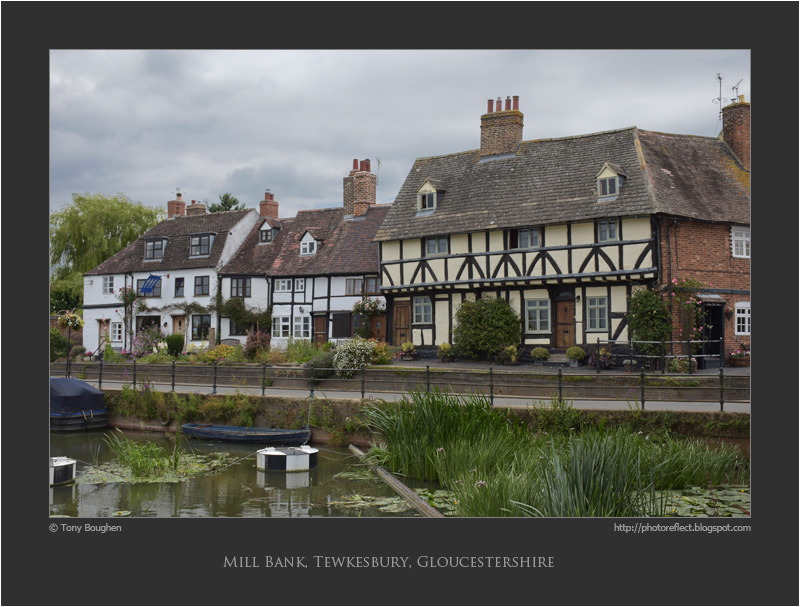
Mill Bank, Tewkesbury
click photo to enlarge
It was an overcast day when we stopped off at Tewkesbury, Gloucestershire, on our way to Herefordshire. We walked around the abbey, the town and by the riverside, and in the course of our perambulation I took this photograph of these houses, raised above the water near the weir and the Abbey Mill. It's a picturesque row that to many people shouts out "Merrie England". The warm, orange brick, painted render, plain tile roofs, heavy chimney stacks, timber-framing with jettied first floor, and the pleasing individuality of the houses, each determinedly different from its neighbour, make a picturesque and pleasing scene. They are the sort of houses that many would wish to live in, residences with history, presence and character.
However, all is not quite so "chocolate box" quaint or jigsaw perfect as it seems. Living in houses by the rivers that flow through Tewkesbury requires a certain fortitude because flooding is no stranger to the town. In recent years there have been times when the area around the abbey has appeared to be an island or a peninsula in a large, irregular lake, and at the fringes of the island, and beyond, houses have their feet and sometimes their knees in water. Yet, despite this inconvenience and disruption, a feature that afflicts the area periodically, and has done for centuries, people still vie to buy the old houses that grace the streets. And consequently they continue to make a fine sight for visitors such as me and my camera.
photograph and text © Tony Boughen
Camera: Nikon D5300
Mode: Aperture Priority
Focal Length: 30mm (99mm - 45mm equiv.)
F No: f8
Shutter Speed: 1/250 sec
ISO:100
Exposure Compensation: 0 EV
Image Stabilisation: On
It was an overcast day when we stopped off at Tewkesbury, Gloucestershire, on our way to Herefordshire. We walked around the abbey, the town and by the riverside, and in the course of our perambulation I took this photograph of these houses, raised above the water near the weir and the Abbey Mill. It's a picturesque row that to many people shouts out "Merrie England". The warm, orange brick, painted render, plain tile roofs, heavy chimney stacks, timber-framing with jettied first floor, and the pleasing individuality of the houses, each determinedly different from its neighbour, make a picturesque and pleasing scene. They are the sort of houses that many would wish to live in, residences with history, presence and character.
However, all is not quite so "chocolate box" quaint or jigsaw perfect as it seems. Living in houses by the rivers that flow through Tewkesbury requires a certain fortitude because flooding is no stranger to the town. In recent years there have been times when the area around the abbey has appeared to be an island or a peninsula in a large, irregular lake, and at the fringes of the island, and beyond, houses have their feet and sometimes their knees in water. Yet, despite this inconvenience and disruption, a feature that afflicts the area periodically, and has done for centuries, people still vie to buy the old houses that grace the streets. And consequently they continue to make a fine sight for visitors such as me and my camera.
photograph and text © Tony Boughen
Camera: Nikon D5300
Mode: Aperture Priority
Focal Length: 30mm (99mm - 45mm equiv.)
F No: f8
Shutter Speed: 1/250 sec
ISO:100
Exposure Compensation: 0 EV
Image Stabilisation: On
Labels:
Gloucestershire,
medieval house,
Mill Bank,
Tewkesbury,
timber-framed
Monday, July 22, 2013
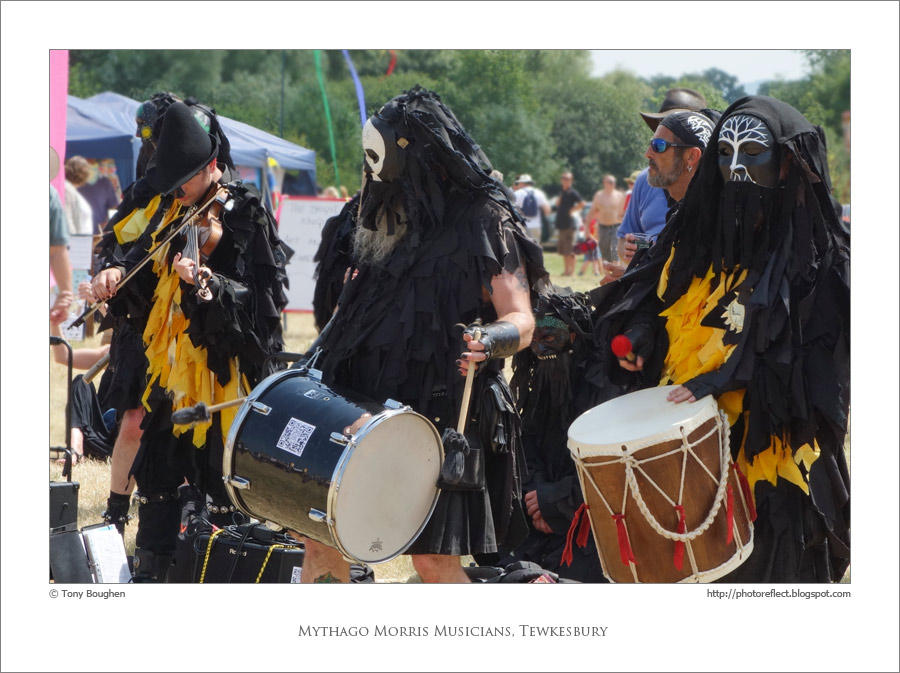
Morris dancers of Mordor?
click photo to enlarge
Morris dancers seem to be like buses: you don't see a troupe for ages then along they come in a bunch, one after the other. At least that's how it's been with us in recent years. After a long period when we saw none of these traditional English dancers, lately we've seen them everywhere. I don't think it's to do with a sudden surge in the popularity of this old style of dancing so much as the places and events that we've happened to visit.
When we were in Herefordshire recently our son suggested we go to a "medieval fayre" that was taking place over a weekend at Tewkesbury. It sounded like somewhere I might gather a few photographs. So, in temperatures approaching 30 degrees Celsius, we set off. I've never attended such an event before so I had only a hazy idea of what to expect. There were jugglers, people in medieval garb, musicians playing old instruments and singing gentle folk songs, various olde worlde games, stalls with appropriate food and clothing, weapons and armour for sale and many more "new age" style offerings. All reasonably predictable with the exception of the new-old military equipment (of which more later).
As we walked among the tents and pavilions, from the distant edge of the site came the sound of thundering drums and electric instruments playing music in a style that I can only describe as "heavy folk-rock"; imagine Fairport Convention meets Black Sabbath. As we got closer I noticed dancers clad in what appeared to be black rags, ghoulish masks and Goth boots. Then it struck me that what I was seeing and hearing was clearly the morris dancers of Mordor, a troupe more usually associated with Sauron's hordes, perhaps entertainers of the orc armies having a day off at Tewkesbury. It's usual for English morris dancers to wear neat white shirts or blouses, jackets, waiscoats, orthodox hats, feathers, neckerchiefs, ribbons and bells, and the often black and white theme to be enlivened by plentiful dashes of primary colours: see examples here and here. The contrast with the dancers shown above couldn't be more stark. Those providing the music were equally "different". The usual array of acoustic instruments was augmented by a recorder, an electric bass, amplified acoustic guitar and a number of assorted, large drums. The whole effect was decidedly rhythm heavy. I loved it! Though it was hard to see through the masks I got the impression that this morris attracted a wider age range with more younger members than is usual. I could see why. As the morris men (and women) took a break from their exertions my wife went to ask who they were and was given their card. They styled themselves Mythago Morris and hailed from the village of Ashurst, West Sussex, not too far from Brighton. In fact, nowhere near Mordor!
I took my photographs in what can only be described as difficult conditions - the sun high in the sky, the grass turned brown and light coloured against which I sought to capture detail of the the dancers' black costumes. It took a few shots and some post-processing to extract these fairly ordinary record shots.
photograph and text © Tony Boughen
Photo 1
Camera: Sony RX100Mode: Aperture Priority
Focal Length: 22.7mm (61mm - 35mm equiv.)
F No: f8
Shutter Speed: 1/400
ISO: 125
Exposure Compensation: -1.0 EV
Image Stabilisation: On
Morris dancers seem to be like buses: you don't see a troupe for ages then along they come in a bunch, one after the other. At least that's how it's been with us in recent years. After a long period when we saw none of these traditional English dancers, lately we've seen them everywhere. I don't think it's to do with a sudden surge in the popularity of this old style of dancing so much as the places and events that we've happened to visit.
When we were in Herefordshire recently our son suggested we go to a "medieval fayre" that was taking place over a weekend at Tewkesbury. It sounded like somewhere I might gather a few photographs. So, in temperatures approaching 30 degrees Celsius, we set off. I've never attended such an event before so I had only a hazy idea of what to expect. There were jugglers, people in medieval garb, musicians playing old instruments and singing gentle folk songs, various olde worlde games, stalls with appropriate food and clothing, weapons and armour for sale and many more "new age" style offerings. All reasonably predictable with the exception of the new-old military equipment (of which more later).
As we walked among the tents and pavilions, from the distant edge of the site came the sound of thundering drums and electric instruments playing music in a style that I can only describe as "heavy folk-rock"; imagine Fairport Convention meets Black Sabbath. As we got closer I noticed dancers clad in what appeared to be black rags, ghoulish masks and Goth boots. Then it struck me that what I was seeing and hearing was clearly the morris dancers of Mordor, a troupe more usually associated with Sauron's hordes, perhaps entertainers of the orc armies having a day off at Tewkesbury. It's usual for English morris dancers to wear neat white shirts or blouses, jackets, waiscoats, orthodox hats, feathers, neckerchiefs, ribbons and bells, and the often black and white theme to be enlivened by plentiful dashes of primary colours: see examples here and here. The contrast with the dancers shown above couldn't be more stark. Those providing the music were equally "different". The usual array of acoustic instruments was augmented by a recorder, an electric bass, amplified acoustic guitar and a number of assorted, large drums. The whole effect was decidedly rhythm heavy. I loved it! Though it was hard to see through the masks I got the impression that this morris attracted a wider age range with more younger members than is usual. I could see why. As the morris men (and women) took a break from their exertions my wife went to ask who they were and was given their card. They styled themselves Mythago Morris and hailed from the village of Ashurst, West Sussex, not too far from Brighton. In fact, nowhere near Mordor!
I took my photographs in what can only be described as difficult conditions - the sun high in the sky, the grass turned brown and light coloured against which I sought to capture detail of the the dancers' black costumes. It took a few shots and some post-processing to extract these fairly ordinary record shots.
photograph and text © Tony Boughen
Photo 1
Camera: Sony RX100Mode: Aperture Priority
Focal Length: 22.7mm (61mm - 35mm equiv.)
F No: f8
Shutter Speed: 1/400
ISO: 125
Exposure Compensation: -1.0 EV
Image Stabilisation: On
Tuesday, July 31, 2012
Kempley's unique wall paintings
click photo to enlarge
The village of Kempley in Gloucestershire is fortunate to have two wonderful churches. One dates from 1902-3 and is in a fine "modern Gothic" style, the work of the Arts and Crafts architect, Albert Randall-Wells (1877-1942), perhaps the subject of a future blog post. The other, redundant since 1976, is a Norman building of around 1130 that has some of the best early wall paintings to be found in Britain.Schemes like the one in the chancel, shown above, are not unusual in the churches of Mediterranean countries. However, in Britain, for such work to remain, it had to withstand not only the ravages of a damp climate but also the condemnatory hand of the religious iconoclast. The Reformation denounced such painting as "popish", idolatrous and unfitting for the newly independent, national and puritanical church. Consequently they were either plastered over, scrubbed or scraped from the walls, or painted over with whitewash. Of these three methods of removal the one most likely to result in some kind of later salvage of the paintings was the latter. And, in fact, during restoration work in 1871-2, whitewash was removed from the old walls to reveal the work of Romanesque artists.
The Victorians sought to preserved them by applying various clear coatings, all of which made the original colours darker. More sensitive conservation work was done in the 1950s and the figures and patterns in reds, ochres, blues and whites were better revealed. The centre of the ceiling has Christ in a triple mandorla giving benediction, the night sky, candles and the Evangelists surround him. Also represented are the Virgin and St Peter with the Apostles sitting under arcades on the north and south walls. The scheme continues in the nave, with interruptions due to damage, where it is joined by fourteenth century work and seventeenth century texts. Evidence of medieval wall paintings can be seen in many churches. In some, for example Pickering in North Yorkshire, it is reasonably extensive. Elsewhere it is often in the form of a "Doom" above a chancel arch. However, for the most part we are left with the odd figure, part figure, pattern or text, and splendours of the kind to be seen at Kempley are to be treasured.
photograph and text (c) T. Boughen
Camera: Canon
Mode: Aperture Priority
Focal Length: 17mm
F No: f7.1
Shutter Speed: 1/20
ISO: 1250
Exposure Compensation: 0 EV
Image Stabilisation: On
Sunday, May 27, 2012
River Avon and Abbey Mill, Tewkesbury
Today's photograph of Abbey Mill in Tewkesbury, Gloucestershire, is quite different from my previous shots (in fact my first) of the subject taken in October of last year. On that occasion I managed to get photographs under a threatening sky, and again when the weather appeared much calmer. My recent shots, of which this is the best, were taken on a pleasantly warm, bright afternoon in May. There was an absence of drama in the sky so I gained a little by positioning myself downstream of the weir and used the froth-filled water of the River Avon (known here, for obvious reasons, as the Mill Avon) as the foreground against which I positioned the mill and the distant crossing tower of Tewkesbury Abbey. One of the purposes of photography is to describe a scene; to tell the viewer about the subject. When I took my earlier shots I was aware that I hadn't shown the mill's position by a weir - in that photograph it couldn't be discerned below the footbridge. So, my aim in this shot was to complement the previous images and give the viewer a fuller picture of this fascinating old building and its context.
photograph and text (c) T. Boughen
Camera: Canon
Mode: Aperture Priority
Focal Length: 24mm
F No: f8
Shutter Speed: 1/320
ISO: 100
Exposure Compensation: -0.67 EV
Image Stabilisation: On
Labels:
Abbey Mill,
Gloucestershire,
River Avon,
Tewkesbury,
Tewkesbury Abbey,
weir
Tuesday, December 13, 2011
Stained glass knights
click photo to enlarge
There is not as much medieval stained glass in England as might be expected. Many continental European countries that saw land warfare in WW1 and WW2 suffered great losses. Similarly, those that were the subject of heavy and systematic aerial bombing lost much in the major cities. England experienced no ground warfare, but was heavily bombed. However, though these major wars did destroy some of our remaining old stained glass they were not the main cause of its disappearance. That had happened much earlier in the sixteenth and seventeenth centuries.The Protestant Reformation produced national protestant churches that either replaced or complemented the existing Roman Catholic religion. Its clergy and congregations often saw stained glass as idolatrous. It did not fit with the new churches' ideas of what should be found in a building dedicated to worship. Consequently much was broken and disposed of, and much was sold. In England the Dissolution of the Monasteries following Henry VIII's assumption of the role of head of the church of England saw the deliberate destruction of monastic abbeys, priories, convents, friaries etc, with their wealth being seized by the crown and their property sold. In the following years zealots and iconoclasts before and during the English Civil War smashed yet more ancient glass in cathedrals and parish churches. But, this wanton destruction notwithstanding, today it is not unusual to come across re-assembled fragments, some whole windows and a few quite complete schemes.
Today's photograph shows part of a window, one of seven of the fourteenth century, in the chancel clerestory at Tewkesbury Abbey in Gloucestershire. The heraldry of the knights' surcoats suggests a date of around 1340. The families represented are, from left to right, Fitzroy, de Clare, le Despenser and Fitzhamon. It is thought that the donor was Eleanor de Clare (d.1337) and the scheme was supervised by her son, Hugh le Despenser. Most of this glass is original. Some re-assembled fragments can be seen in the shields of the four shapes across the bottom of the image. The windows were restored to their present beauty by Kempe & Co. in 1923-4.
photograph and text (c) T. Boughen
Camera: Canon
Mode: Aperture Priority
Focal Length: 161mm
F No: f7.1
Shutter Speed: 1/125
ISO: 1600
Exposure Compensation: -0.67 EV
Image Stabilisation: On
Saturday, October 22, 2011
Romanesque and Gothic at Tewkesbury
click photo to enlarge
Today's photograph shows the interior of the nave of Tewkesbury Abbey, Gloucestershire. A Saxon abbey founded c.715AD was the first building on this site, but nothing of it remains today. The present church is a Norman foundation of the eleventh century with most of the structure dating from the 1100s, a little from the 1200s, the ambulatory chapels and vaulting the 1300s, and small areas elsewhere of more recent dates.Looking at the photograph we can see that the drum piers (columns), the rounded arches and the triforium (dark passage with light shining from it) are of the Norman (or Romanesque) period. They were complete by the time of the abbey's consecration in the 1120s and are characteristically heavy compared with the lighter appearance of the later Gothic style. For the student of architectural history there are two particular points of interest in this photograph. Firstly, the piers are relatively tall and plain, a regional characteristic of the Norman style whilst the triforium is quite small, almost insignificant compared with most similar buildings of the period (compare with this example at Peterborough Cathedral). The second thing to note is that the vaulting of both the aisles and the nave dates from 1330-1350, what is stylistically called the Decorated period of Gothic architecture.
The rounded arches of the Norman period were poor at spanning spaces as wide as a nave and consequently most Norman naves had flat timber ceilings, rather than stone vaulting. However, the narrower aisles were often covered with tunnel or groin vaulting. Here at Tewkesbury the Norman nave had no clerestory so the present one was inserted in the fourteenth century when the lierne vaulting of the nave and the quadripartite with ridge ribs vaulting of the aisles was built. To anyone who visits large churches regularly the Gothic vaulting on Romanesque piers looks odd. It also accounts for the half-hidden and relatively ineffectiveness of the clerestory which was squeezed in and then partly obscured by the springing of the vaulting. However, in the middle ages, as today, architects were keen to build in a contemporary way, and the idea of building vaulting or a clerestory in 1340 in a style from over one hundred years earlier was thought ridiculous, just as building today in the manner of the late Victorians would be. It would, wouldn't it?
photograph and text (c) T. Boughen
Camera: Canon
Mode: Aperture Priority
Focal Length: 24mm
F No: f7.1
Shutter Speed: 1/20
ISO: 2500
Exposure Compensation: -0.33 EV
Image Stabilisation: On
Wednesday, October 19, 2011
Abbey Mill, Tewkesbury
click photo to enlarge
We recently stayed for a few days near Ledbury, Herefordshire, and during our time in the area took a short trip to Tewkesbury. We've visited the town a couple of times before to see the abbey, and we viewed it again, but on this occasion we also had a walk by the river. Tewkesbury stands at the confluence of the River Avon and the River Severn, and as well as being known for its fine medieval abbey and its delightful buildings of all periods, especially the black and white half-timbered Tudor houses and pubs, it is recognized as a place that is prone to flooding. Mention the town today and many will recall a famous photograph from 2007 which shows the abbey seeming to stand on an island surrounded by water.
Autumn weather has started to make its presence felt in the the UK in the form of stronger winds, lower temperatures and rain, and on our visit to Tewkesbury it looked like we might get a little precipitation. Fortunately the dark clouds passed and the sun made an appearance. But not before I'd taken a photograph under those clouds of a building with which I wasn't familiar - Abbey Mill on the River Avon.This water mill is an attractive and complex three-storey building with an attic level. It has three mill-races to undershot wheels and a weir alongside. A bridge connects the two banks of the river, running under part of the mill buildings (small photograph). Abbey Mill was erected in 1793 and has nineteenth and twentieth century additions. It is built mainly of brick and weatherboarding with cast iron columns, some with spreader plates. Flour was milled here until 1933 but now the building comprises a number of desirable apartments.
photograph and text (c) T. Boughen
Camera: Canon
Mode: Aperture Priority
Focal Length: 24mm
F No: f7.1
Shutter Speed: 1/250
ISO: 100
Exposure Compensation: -1.0 EV
Image Stabilisation: On
Labels:
Abbey Mill,
Gloucestershire,
River Avon,
Tewkesbury,
water mill
Subscribe to:
Posts (Atom)