click photo to enlarge
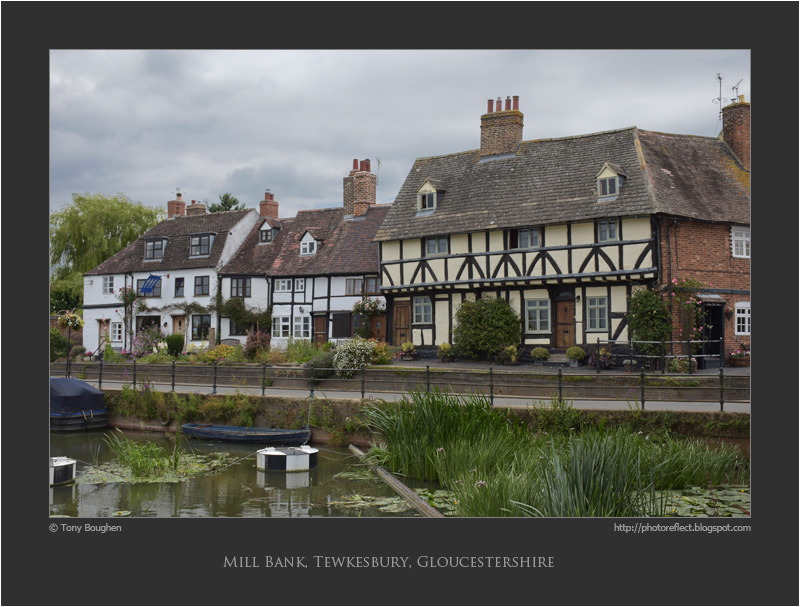
It was an overcast day when we stopped off at Tewkesbury, Gloucestershire, on our way to Herefordshire. We walked around the abbey, the town and by the riverside, and in the course of our perambulation I took this photograph of these houses, raised above the water near the weir and the Abbey Mill. It's a picturesque row that to many people shouts out "Merrie England". The warm, orange brick, painted render, plain tile roofs, heavy chimney stacks, timber-framing with jettied first floor, and the pleasing individuality of the houses, each determinedly different from its neighbour, make a picturesque and pleasing scene. They are the sort of houses that many would wish to live in, residences with history, presence and character.
However, all is not quite so "chocolate box" quaint or jigsaw perfect as it seems. Living in houses by the rivers that flow through Tewkesbury requires a certain fortitude because flooding is no stranger to the town. In recent years there have been times when the area around the abbey has appeared to be an island or a peninsula in a large, irregular lake, and at the fringes of the island, and beyond, houses have their feet and sometimes their knees in water. Yet, despite this inconvenience and disruption, a feature that afflicts the area periodically, and has done for centuries, people still vie to buy the old houses that grace the streets. And consequently they continue to make a fine sight for visitors such as me and my camera.
photograph and text © Tony Boughen
Camera: Nikon D5300
Mode: Aperture Priority
Focal Length: 30mm (99mm - 45mm equiv.)
F No: f8
Shutter Speed: 1/250 sec
ISO:100
Exposure Compensation: 0 EV
Image Stabilisation: On
Showing posts with label Tewkesbury. Show all posts
Friday, July 18, 2014
Sunday, July 28, 2013
Arms, armour and weekend warriors
click photo to enlarge
I've never given a great deal of thought to where people who stage military re-enactments get their props from but during my recent visit to a medieval fayre in Tewkesbury I remedied that deficiency. Why? Well, there was not one but several tents selling all manner of clothing, domestic objects, armour and weaponry for the would-be knight, page, damsel, archer, pikeman, etc. Need a pair of authentic medieval-style shoes? Multiple vendors could supply any size that was wanted. How about a quilted jacket to wear under your armour plate? Name your colour (though red and blue seemed favoured). What about plate armour? Everything from a full suit to all the individual components - breastplate, greave, hemet, gauntlet, you name it - was on offer. The impecunious would-be knight could buy his suit a piece at a time! Battle axes, maces, pikes, swords, daggers, long bows and cross bows without which no self-respecting medieval warrior could feel properly attired were available in invasion-sized quantities. Clearly, unknown to me, there is a thriving cottage industry beavering away, right across Europe from the accents I heard, supplying the wherewithall of weekend warriors.Looking closely at the weaponry it was obvious that it wasn't made to the fighting standard required in, say, the Wars of the Roses or by Henry V's troops at Agincourt. However, it looked sufficiently durable and sharp; more than capable of doing significant damage if not wielded with care. I took several photographs of the wares being offered and show a few here. The armadillo-like gauntlets particularly caught my eye. They looked like they were holding on to their display shelf and might, at any moment, flex their fingers, get up and scurry off.
photographs and text © Tony Boughen
Photo 1
Camera: Sony RX100
Mode: Aperture Priority
Focal Length: 22.7mm (61mm - 35mm equiv.)
F No: f8
Shutter Speed: 1/400
ISO: 125
Exposure Compensation: -1.0 EV
Image Stabilisation: On
Labels:
armour,
gauntlets,
medieval fayre,
swords,
Tewkesbury
Monday, July 22, 2013
Morris dancers of Mordor?
click photo to enlarge
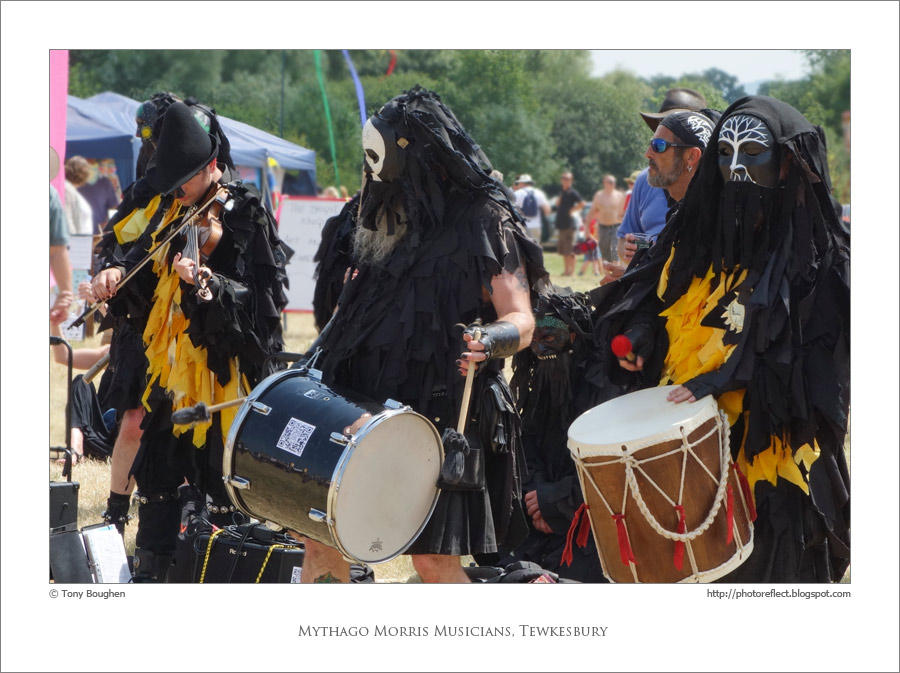
Morris dancers seem to be like buses: you don't see a troupe for ages then along they come in a bunch, one after the other. At least that's how it's been with us in recent years. After a long period when we saw none of these traditional English dancers, lately we've seen them everywhere. I don't think it's to do with a sudden surge in the popularity of this old style of dancing so much as the places and events that we've happened to visit.
When we were in Herefordshire recently our son suggested we go to a "medieval fayre" that was taking place over a weekend at Tewkesbury. It sounded like somewhere I might gather a few photographs. So, in temperatures approaching 30 degrees Celsius, we set off. I've never attended such an event before so I had only a hazy idea of what to expect. There were jugglers, people in medieval garb, musicians playing old instruments and singing gentle folk songs, various olde worlde games, stalls with appropriate food and clothing, weapons and armour for sale and many more "new age" style offerings. All reasonably predictable with the exception of the new-old military equipment (of which more later).
As we walked among the tents and pavilions, from the distant edge of the site came the sound of thundering drums and electric instruments playing music in a style that I can only describe as "heavy folk-rock"; imagine Fairport Convention meets Black Sabbath. As we got closer I noticed dancers clad in what appeared to be black rags, ghoulish masks and Goth boots. Then it struck me that what I was seeing and hearing was clearly the morris dancers of Mordor, a troupe more usually associated with Sauron's hordes, perhaps entertainers of the orc armies having a day off at Tewkesbury. It's usual for English morris dancers to wear neat white shirts or blouses, jackets, waiscoats, orthodox hats, feathers, neckerchiefs, ribbons and bells, and the often black and white theme to be enlivened by plentiful dashes of primary colours: see examples here and here. The contrast with the dancers shown above couldn't be more stark. Those providing the music were equally "different". The usual array of acoustic instruments was augmented by a recorder, an electric bass, amplified acoustic guitar and a number of assorted, large drums. The whole effect was decidedly rhythm heavy. I loved it! Though it was hard to see through the masks I got the impression that this morris attracted a wider age range with more younger members than is usual. I could see why. As the morris men (and women) took a break from their exertions my wife went to ask who they were and was given their card. They styled themselves Mythago Morris and hailed from the village of Ashurst, West Sussex, not too far from Brighton. In fact, nowhere near Mordor!
I took my photographs in what can only be described as difficult conditions - the sun high in the sky, the grass turned brown and light coloured against which I sought to capture detail of the the dancers' black costumes. It took a few shots and some post-processing to extract these fairly ordinary record shots.
photograph and text © Tony Boughen
Photo 1
Camera: Sony RX100Mode: Aperture Priority
Focal Length: 22.7mm (61mm - 35mm equiv.)
F No: f8
Shutter Speed: 1/400
ISO: 125
Exposure Compensation: -1.0 EV
Image Stabilisation: On
Morris dancers seem to be like buses: you don't see a troupe for ages then along they come in a bunch, one after the other. At least that's how it's been with us in recent years. After a long period when we saw none of these traditional English dancers, lately we've seen them everywhere. I don't think it's to do with a sudden surge in the popularity of this old style of dancing so much as the places and events that we've happened to visit.
When we were in Herefordshire recently our son suggested we go to a "medieval fayre" that was taking place over a weekend at Tewkesbury. It sounded like somewhere I might gather a few photographs. So, in temperatures approaching 30 degrees Celsius, we set off. I've never attended such an event before so I had only a hazy idea of what to expect. There were jugglers, people in medieval garb, musicians playing old instruments and singing gentle folk songs, various olde worlde games, stalls with appropriate food and clothing, weapons and armour for sale and many more "new age" style offerings. All reasonably predictable with the exception of the new-old military equipment (of which more later).
As we walked among the tents and pavilions, from the distant edge of the site came the sound of thundering drums and electric instruments playing music in a style that I can only describe as "heavy folk-rock"; imagine Fairport Convention meets Black Sabbath. As we got closer I noticed dancers clad in what appeared to be black rags, ghoulish masks and Goth boots. Then it struck me that what I was seeing and hearing was clearly the morris dancers of Mordor, a troupe more usually associated with Sauron's hordes, perhaps entertainers of the orc armies having a day off at Tewkesbury. It's usual for English morris dancers to wear neat white shirts or blouses, jackets, waiscoats, orthodox hats, feathers, neckerchiefs, ribbons and bells, and the often black and white theme to be enlivened by plentiful dashes of primary colours: see examples here and here. The contrast with the dancers shown above couldn't be more stark. Those providing the music were equally "different". The usual array of acoustic instruments was augmented by a recorder, an electric bass, amplified acoustic guitar and a number of assorted, large drums. The whole effect was decidedly rhythm heavy. I loved it! Though it was hard to see through the masks I got the impression that this morris attracted a wider age range with more younger members than is usual. I could see why. As the morris men (and women) took a break from their exertions my wife went to ask who they were and was given their card. They styled themselves Mythago Morris and hailed from the village of Ashurst, West Sussex, not too far from Brighton. In fact, nowhere near Mordor!
I took my photographs in what can only be described as difficult conditions - the sun high in the sky, the grass turned brown and light coloured against which I sought to capture detail of the the dancers' black costumes. It took a few shots and some post-processing to extract these fairly ordinary record shots.
photograph and text © Tony Boughen
Photo 1
Camera: Sony RX100Mode: Aperture Priority
Focal Length: 22.7mm (61mm - 35mm equiv.)
F No: f8
Shutter Speed: 1/400
ISO: 125
Exposure Compensation: -1.0 EV
Image Stabilisation: On
Sunday, May 27, 2012
River Avon and Abbey Mill, Tewkesbury
Today's photograph of Abbey Mill in Tewkesbury, Gloucestershire, is quite different from my previous shots (in fact my first) of the subject taken in October of last year. On that occasion I managed to get photographs under a threatening sky, and again when the weather appeared much calmer. My recent shots, of which this is the best, were taken on a pleasantly warm, bright afternoon in May. There was an absence of drama in the sky so I gained a little by positioning myself downstream of the weir and used the froth-filled water of the River Avon (known here, for obvious reasons, as the Mill Avon) as the foreground against which I positioned the mill and the distant crossing tower of Tewkesbury Abbey. One of the purposes of photography is to describe a scene; to tell the viewer about the subject. When I took my earlier shots I was aware that I hadn't shown the mill's position by a weir - in that photograph it couldn't be discerned below the footbridge. So, my aim in this shot was to complement the previous images and give the viewer a fuller picture of this fascinating old building and its context.
photograph and text (c) T. Boughen
Camera: Canon
Mode: Aperture Priority
Focal Length: 24mm
F No: f8
Shutter Speed: 1/320
ISO: 100
Exposure Compensation: -0.67 EV
Image Stabilisation: On
Labels:
Abbey Mill,
Gloucestershire,
River Avon,
Tewkesbury,
Tewkesbury Abbey,
weir
Tuesday, May 22, 2012
The Olympics, money and kayaking
click photo to enlarge
It seems impossible to express indifference or opposition to the Olympic Games without having opprobrium heaped upon you, such is the fervour with which the alliance of sporting organisations, politicians, sponsors and the self-serving bureaucrats of the International Olympics Committee (IOC) stir up support for the nationalistic jamboree. For years I've been of the opinion that the Games has moved so far from its original and modern ideals that it has forfeited the right to use the word "Olympic" and should embrace the inevitable and sell the naming rights to a sponsor.The absurd sums of money that host nations are required to spend mounting the Olympic Games invites ridicule. As do the demands of the IOC for facilities for their delegates: the designated traffic lanes for official cars and the rest of their gratis benefits are megalomaniacal and no country should concede them. Then there is the idea that new facilities should be built for a Games - for a fortnight's utilisation - and the wishful thinking that they will find "legacy" uses for decades afterwards. The record shows that this is rarely the case. Moreover, you have to question enormous public subsidies for sports that, day to day, find it difficult to find an audience and exist only through sponsorship, state handouts and the recognition that comes from being part of the Olympics. Now don't get me wrong, I have no objection to people indulging in or watching minority sports or in the principle of subsidies. However, I can see many more worthy recipients of public money, and in straitened times I object to the state supporting people's hobbies.
I think it is time for the Olympics to be returned whence it came, to a purpose built sports complex in Greece, one that could also be used in the periods between Games. Moreover, I'd like to see the number of sports reduced to an agreed and traditional range (probably a few more than the modern Games' original nine). This would have so many obvious benefits that I'll only mention one - it would provide much needed visitor and TV income for Greece on a continuing basis! Under my proposals kayaking, the subject of today's photograph, wouldn't feature in the Olympic Games. Nor would synchronised swimming, trampolining, mountain biking, taekwondo, table tennis etc etc etc.
photograph and text (c) T. Boughen
Camera: Canon
Mode: Aperture Priority
Focal Length: 67mm
F No: f8
Shutter Speed: 1/200
ISO: 100
Exposure Compensation: -0.33 EV
Image Stabilisation: On
Labels:
kayak,
Olympic Games,
river,
Tewkesbury
Wednesday, October 19, 2011
Abbey Mill, Tewkesbury
click photo to enlarge
We recently stayed for a few days near Ledbury, Herefordshire, and during our time in the area took a short trip to Tewkesbury. We've visited the town a couple of times before to see the abbey, and we viewed it again, but on this occasion we also had a walk by the river. Tewkesbury stands at the confluence of the River Avon and the River Severn, and as well as being known for its fine medieval abbey and its delightful buildings of all periods, especially the black and white half-timbered Tudor houses and pubs, it is recognized as a place that is prone to flooding. Mention the town today and many will recall a famous photograph from 2007 which shows the abbey seeming to stand on an island surrounded by water.
Autumn weather has started to make its presence felt in the the UK in the form of stronger winds, lower temperatures and rain, and on our visit to Tewkesbury it looked like we might get a little precipitation. Fortunately the dark clouds passed and the sun made an appearance. But not before I'd taken a photograph under those clouds of a building with which I wasn't familiar - Abbey Mill on the River Avon.This water mill is an attractive and complex three-storey building with an attic level. It has three mill-races to undershot wheels and a weir alongside. A bridge connects the two banks of the river, running under part of the mill buildings (small photograph). Abbey Mill was erected in 1793 and has nineteenth and twentieth century additions. It is built mainly of brick and weatherboarding with cast iron columns, some with spreader plates. Flour was milled here until 1933 but now the building comprises a number of desirable apartments.
photograph and text (c) T. Boughen
Camera: Canon
Mode: Aperture Priority
Focal Length: 24mm
F No: f7.1
Shutter Speed: 1/250
ISO: 100
Exposure Compensation: -1.0 EV
Image Stabilisation: On
Labels:
Abbey Mill,
Gloucestershire,
River Avon,
Tewkesbury,
water mill
Subscribe to:
Posts (Atom)