Saturday, July 30, 2016

Improbable photographic colours

click photo to enlarge
Sometimes it's the depth of the blue in the sky, other times its the lurid green of the fresh grass, and frequently it's the improbable reds and oranges of the sunset (or sunrise). The other day, on a visit to the Yorkshire city of Hull (Kingston upon Hull to give it its full title) it was the blackness of the clouds. I'm referring, of course, to the way that reality sometimes looks unreal. In each of the instances cited above the observant viewer or photographer might well think that the saturation slider has been applied with a heavy hand, although there is a school of photography where this kind of embellishment has become pretty much the norm (see 500px.com).

We visited Hull on a day when heavy showers  and brighter spells alternated, and the clouds produced by this weather were striking. We were walking near the pier where the River Hull meets the River Humber, passing the end of Queen Street, when we both noticed the smoke-like clouds drifting past the tower of Holy Trinity church. My wife remarked that they wouldn't look real in a photograph and I know just what she means.We have reached a point in the development of digital photography when the manipulation of the relatively faithful images produced by cameras are routinely "enhanced", either straight away and automatically by software (e.g. Google's "auto awesome"), or later by the user's deliberate choice. I really wish it would stop. Our world is awesome enough without making it look otherworldly.

photograph and text © Tony Boughen

Photo Title: Queen Street and Holy Trinity, Hull
Camera: Olympus E-M10
Mode: Aperture Priority
Focal Length: 39mm (78mm - 35mm equiv.)
F No: f5.3
Shutter Speed: 1/2000 sec
ISO:200
Exposure Compensation: -0.3 EV
Image Stabilisation: On

Thursday, July 28, 2016

Cogglesford Mill, Sleaford

click photo to enlarge
Watermills - the use of water to drive a wheel whose energy is then harnessed - are thought to predate windmills, devices that do the same but with wind power. The 1086AD Domesday survey of England recorded 5,624 watermills. Many of these sites still had working watermills in the eighteenth, nineteenth and even twentieth centuries. They were widely used to grind corn, but in later centuries water power was turned to a wider range of activities such as fulling, tanning and even forging iron. In some parts of the country they were very numerous. The River Wylye in Wiltshire had thirty mills on a ten mile stretch!

The current, preserved, Cogglesford Mill in Sleaford dates from around 1750 but a watermill is believed to have been on the site for a thousand years, grinding corn as the present mill still does today on its open days. The name derives from Coggle Ford nearby where a prehistoric trackway and subsequent Roman road crossed the River Slea.

My photograph shows the orange brickwork of the watermill glimpsed through the willows and other trees that surround the mill pond.

photograph and text © Tony Boughen

Photo Title: Cogglesford Mill, Sleaford, Lincolnshire
Camera: Olympus E-M10
Mode: Aperture Priority
Focal Length: 15mm (30mm - 35mm equiv.)
F No: f4.1
Shutter Speed: 1/250 sec
ISO:200
Exposure Compensation: 0 EV
Image Stabilisation: On

Monday, July 25, 2016

St Pancras Hotel, London

click photo to enlarge
George Gilbert Scott was one of the most prolific and able of Britain's Victorian architects. He came from an architectural dynasty and is sometimes referred to as "the middle Scott" to distinguish him from his similarly named father and son. In the 1860s he had many projects underway including three of national importance - the Foreign Office, the Albert Memorial and St Pancras railway station and hotel. Scott's office trained many architects who went on to achieve fame in their own right but he kept close control of all that passed through the firm, and ensured that the high standards that characterised his work was maintained.

St Pancras railway station on Euston Road was the London terminus for the Midland Railway. Scott's Gothic-based design incorporated the engine sheds and platforms (the latter designed by William Henry Barlow) as well as the rooms needed for the station and the Midland Hotel that fronted the building. The functional engine sheds and the elaborate Gothic brickwork, towers and spires admirably convey the Victorian fascination with and ambivalence about buildings as art as well as the allure of new technology and engineering. My photograph shows a large part of the main elevation facing Euston road, but doesn't include the curved wing out of view on the left of the frame.

I've tried for a photograph of this elevation before but haven't produced anything that satisfies me. On a recent visit I decided that the ornate lamp post might be a suitable "anchor" for an asymmetrical composition, and so it proved.

photograph and text © Tony Boughen

Photo Title: St Pancras Hotel, London
Camera: Olympus E-M10
Mode: Aperture Priority
Focal Length: 15mm (108mm - 30mm equiv.)
F No: f5
Shutter Speed: 1/320 sec
ISO:200
Exposure Compensation: -0.3 EV
Image Stabilisation: On

Saturday, July 23, 2016

Flags, Upton-upon-Severn

click photo to enlarge
We popped into Upton-upon Severn in Worcestershire recently and found the small, riverside town had been taken over by flags and flowers. The flags, I suppose, were still flying in honour of Queen Elizabeth's 90th birthday - at least the dominance of the Union flag and a flag with the royal coat of arms suggested that was the case. Anyone who has kept up with this blog will know that I'm not a royalist so it is conceivable that some other day or date of royal significance has occurred but passed me by.

The flowers were mainly - as far as I could see - in the vicinity of the streets by the River Severn, though they were in significant numbers elsewhere too as the photo above shows. Volunteers were setting out large tubs of begonias and other brightly coloured blooms. I noticed a poster proclaiming that the town was a Britain in Bloom 2016 Finalist so I imagine that they were preparing for the arrival of some of the judges.

The combination of flags and flowers certainly made the town much more colourful than the brick and plaster of the old buildings usually achieve alone and for this architecture enthusiast they made it difficult to capture the photographs that I had in mind. However, the flags and people on this street made for a shot that gives a flavour of a small English town displaying both its patriotism and its pride.

photograph and text © Tony Boughen

Photo Title: Flags, Upton-upon-Severn, Worcestershire
Camera: Olympus E-M10
Mode: Aperture Priority
Focal Length: 36mm (72mm - 35mm equiv.) crop
F No: f7.1
Shutter Speed: 1/800 sec
ISO:200
Exposure Compensation: -0.3 EV
Image Stabilisation: On

Wednesday, July 20, 2016

Ghost sign, Bardney, Lincolnshire

click photo to enlarge
The name "ghost sign" has been given to old advertising signs and writing on buildings. Often these have been protected from greater deterioration by new signs being fixed over them. Others have been preserved by the building having been painted, the removal of that layer revealing what was underneath.

In many cases the ghost writing is preserved intact as an interesting artefact of earlier days, something that indicates the history of the building. Quite often the the signs are sympathetically restored, with matching paint carefully tracing the letters, ornament and pictures to show the work as it was when first put in place.

That looks to be what has happened with the florid writing and ornament on the small building in Bardney, Lincolnshire.It was made to fit the gable end of the modest building and proclaims the main and subsidiary business of this, presumably long-gone company. Reading the sign I was somewhat surprised to find appended to the list of flour, cake and corn "All Kinds of Offals". If "offal" then meant what offal means now it doesn't seem to be a terribly good fit with the rest of the business. Rather like the new uPVC door and window that have replaced the originals on the facade.

photograph and text © Tony Boughen

Photo Title: Ghost Sign, Bardney, Lincolnshire
Camera: Sony RX10
Mode: Aperture Priority
Focal Length: 10.4mm (28mm - 35mm equiv.) crop
F No: f5
Shutter Speed: 1/1250 sec
ISO:125
Exposure Compensation: -0.7 EV
Image Stabilisation: On

Monday, July 18, 2016

Milton Ferry Bridge

click photo to enlarge
The Ordnance Survey maps of Britain are full of references to ferries. Near where I live there is Ferry Farm marking the location of a long-gone ferry across the canal-like South Forty Foot Drain. Not too distant, by the River Slea, is another Ferry Farm with, close by, Ferry Wood and Ferry Bridge - the latter presumably the structure that put paid to the actual ferry. A similar situation can be found at Langrick Bridge, a place where there is yet another Ferry Farm.

On a recent cycle ride near Peterborough we chanced upon Milton Ferry Bridge, a crossing built in 1716 to replace the earlier ferry. Interestingly it retains the record of the previous means of crossing the River Nene in its name, though chooses not to make use of its full title of Gunwade Ferry.

This bridge was, until I believe, some time in the 1960s, a toll bridge. You can still see, on the right of the photograph above, the gate that barred the crossing to anyone not paying the required fee. Just visible below is a door leading to two small rooms lit by port-hole style openings. Perhaps they were used by the crossing keeper, though not, I think, when the river was high. Around the year 1724 Daniel Defoe, undertaking his "Tour Through The Whole Island Of Great Britain" paid the very high toll fee of 2s 6d to cross the bridge and remarked, "I think 'tis the only half crown toll in Britain". I'm pleased we paid nothing: I shudder to think what the inflation-adjusted price would be today.

photograph and text © Tony Boughen

Photo Title: Milton Ferry Bridge, near Castor, Cambridgeshire
Camera: Sony RX10
Mode: Aperture Priority
Focal Length: 10.4mm (28mm - 35mm equiv.) crop
F No: f4
Shutter Speed: 1/2000 sec
ISO:125
Exposure Compensation: -0.3 EV
Image Stabilisation: On

Saturday, July 16, 2016

Neighbours of 1902 and 1970

click photo to enlarge
A mere sixty eight years separates the completion of the two buildings shown in today's photograph yet it might be centuries and they might be from different planets. However, both are on Euston Road in London.

On the left is the London County Council (LCC)Fire Brigade Station of 1902, built with flats above the two-bay engine house. It is the work of an in-house architect of the LCC, H. F. T. Cooper. The materials are red brick, Portland stone and slate on the roofs. Yellow stock bricks are used in the basement. The style is Arts and Crafts and it is notably asymmetrical.

The building on the right, now called Evergreen House, was conceived in 1965 and completed in 1970.It is built of steel and glass in the International Style, one of many towers across the world that owe a massive debt to Mies van der Rohe.

There are those who abhor such juxtapositions, usually favouring one style over the other, and wishing that there was greater consonance between adjacent buildings. I can see the place for that kind of planning. However, I can also see the visual delight in seeing the contrast of two completely different styles side-by-side. And as a photographer I revel in it as this blog frequently testifies. See here, here and here for example.

photograph and text © Tony Boughen

Photo Title: 1902 LCC Fire Brigade Station and 1970 Evergreen House, Euston Road, London
Camera: Olympus E-M10
Mode: Aperture Priority
Focal Length: 54mm (108mm - 35mm equiv.) crop
F No: f5.6
Shutter Speed: 1/320 sec
ISO:200
Exposure Compensation: -0.3 EV
Image Stabilisation: On

Tuesday, July 12, 2016

Rain, King's Cross Square

click photo to enlarge
It has been an unusual summer with rain actual, and rain metaphorical being unleashed upon our islands. I could say so much about "Brexit" rain but will restrict my remarks to the collective national folly of allowing the person who has been quite the worst prime minister of my lifetime to put party unity before country and leave us, through his ill-advised referendum, in a place not of our collective choosing. That is the polite version!

Now for the the wet stuff. It hasn't actually rained every day this summer, but it feels like it has because we've had more wet days than usual. Moreover, I say this as someone who for the past nine years has lived in the drier east of England. But here too rain has followed more rain. As we've travelled about the country we've experienced rain wherever we've gone, with one exception. Very unusually our week in Settle in the Yorkshire Dales was dry. However, as we left - we were five minutes down the A65 on the way to Skipton - when a phone call told us that the town was experiencing a torrential downpour! All we saw of it was a beautiful rainbow over the Ribble valley.

A couple of recent London visits have coincided with rain, mainly showers, though some very heavy. As we waited at King's Cross for our train recently the heavens opened and people ill-prepared for precipitation had to sprint for cover. Today's photograph shows the equipped and the unequipped making bee-lines for the cover of the concourse. I took my photograph from under a large canopy!

photograph and text © Tony Boughen

Photo Title: Rain, King's Cross Square, London
Camera: Olympus E-M10
Mode: Aperture Priority
Focal Length: 80mm (160mm - 35mm equiv.) crop
F No: f5.5
Shutter Speed: 1/160 sec
ISO:640
Exposure Compensation: 0 EV
Image Stabilisation: On

Sunday, July 10, 2016

Giggleswick, a north country church

click photo to enlarge
The medieval stone-built churches of the Pennines are often characterised by a long, low shape, rather like the medieval farm houses of the northern uplands. But, whereas the latter came about by the living accommodation and barns being side by side and in one building, in the case of churches it was due to technological and, perhaps, stylistic reasons.

If you look at medieval churches across England, and especially in the north country, you will soon begin to notice a triangular shape on the east wall of the tower above the nave roof. You can see such a shape on St Alkelda in Giggleswick, North Yorkshire (above - below the clock). It is a drip mould designed to stop water flowing the down that face of the tower and penetrating the roof. Instead it is made to flow onto the slates, tiles or thatch of the nave roof and thence to gutters and gargoyle spouts. The moulding is revealed for all to see because, of course, the roof that it was designed to serve is no longer there. The availability, in the fifteenth and sixteenth centuries, of cheaper lead in large sheets prompted a widespread migration from steeply pitched church roofs that didn't always work as well as they should, and which needed frequent maintenance, to lower pitched lead-covered roofs. These were frequently so low as to be invisible behind the parapets of the naves and chancels, and sometimes those of the aisles too.

One has to believe that the builders and church authorities who sanctioned the widespread introduction of low, lead-covered roofs decided that the advantages outweighed the less attractive appearance of the building. Certainly that wasn't the case when the Victorian restorers set to work on these churches. Quite a few lamented the lead roofs and in more than a few instances the pitched roofs were reinstated. This didn't happen at Giggleswick. We were there on an overcast evening after a bright day when the view from the side of the churchyard that is allowed to produce hay and grow a little wild offered an interesting image. It reminded me of how many such places looked in the 1960s and 1970s before powered mowers came into widespread use and memorial-strewn lawns replaced long grasses blowing in the wind.

photograph and text © Tony Boughen

Photo Title: St Alkelda, Giggleswick, North Yorkshire
Camera: Olympus E-M10
Mode: Aperture Priority
Focal Length: 14mm (28mm - 35mm equiv.) crop
F No: f6.3
Shutter Speed: 1/500 sec
ISO:200
Exposure Compensation: -0.3 EV
Image Stabilisation: On

Friday, July 08, 2016

Gravestones, Langcliffe church

click photo to enlarge
After a long walk from Settle taking in Watery lane, Lodge Lane, Lambert Lane, Stockdale Lane, Attermire, Clay Pits Plantation and Langcliffe Brow we stopped off at Langcliffe church, as we often do, and sat on a bench in the churchyard to eat our packed lunch. A couple of motorcyclists were doing the same on the green near the church, but apart from them our only companion was a young rabbit that showed far less fear of humans than was good for it. If it should meet anyone less benignly disposed towards rabbits than us it may not reach old age.

After we had finished eating my wife went to look at the books for sale in the church and I walked round the churchyard to look at the gravestones. Having been brought up in the area I recognised quite a few surnames carved on them. This churchyard is well kept, with areas nicely mowed and planted and other areas deliberately left wilder. The pair of brown gravestones above are near the path that leads to the south porch, and both their distinctive shapes and the leafy surroundings of ferns, ivy and hostas lit by the dappled light piercing the trees above, made for a nice contrast between the man-made and the natural.

As I processed the photograph I noticed, for the first time, the low wire round the flowers in front of the right-most gravestone and reflected that those responsible for maintaining the churchyard must be very familiar with our rabbit.

photograph and text © Tony Boughen

Photo Title: Gravestones, Langcliffe Church, North Yorkshire
Camera: Olympus E-M10
Mode: Aperture Priority
Focal Length: 47mm (94mm - 35mm equiv.) crop
F No: f6.3
Shutter Speed: 1/100 sec
ISO:1000
Exposure Compensation: -0.3 EV
Image Stabilisation: On

Wednesday, July 06, 2016

Staircase, The Hub, Regent's Park

click photo to enlarge
Wherever I go I come across Hubs. By that I mean buildings that have been given that name, presumably to, in some way, describe how they are the focal point of one kind of activity or another. In recent years I've been to Hubs in Lancashire, Yorkshire, Lincolnshire and London, and I know of others. Some have been training venues, one was a gallery, one a medical facility, another an educational establishment. Clearly this name has attractions for organisations but one can't help but wonder how much confusion is caused by its popularity. Most recently I visited a Hub that was a new building built into a mound, topped by a cafe, that serves as the focal point of a number of sports facilities in Regent's Park, London.

This particular Hub was a quite utilitarian building, designed of materials that could cope with muddy, sweaty, athletic people who were using the lockers, toilets, cafe etc. Fortunately the architects had an eye that went beyond utility and the building incorporated a particularly interesting central staircase that connected the ground level (actually below ground level) with the cafe at the top of the mound. Glass, steel, concrete and plywood combined with the well-lit top of the building to create sinuous lines between the two floors - an attractive subject for a photograph.

photograph and text © Tony Boughen

Photo Title: Staircase, The Hub, Regent's Park, London
Camera: Olympus E-M10
Mode: Aperture Priority
Focal Length: 15mm (30mm - 35mm equiv.) crop
F No: f5.6
Shutter Speed: 1/60 sec
ISO:200
Exposure Compensation: -0.3 EV
Image Stabilisation: On

Monday, July 04, 2016

Stocks Reservoir

click photo to enlarge
When I was a teenager living in Settle (then in the West Riding of Yorkshire, now in North Yorkshire) I reasonably frequently cycled the several miles to Stocks Reservoir (then in the West Riding of Yorkshire, now in Lancashire), a large area of water in the Forest of Bowland. The purpose of my journey, up hill and down dale, was bird watching. This had to be done from the road that cuts across a narrow arm of the reservoir and from the few public footpaths that allowed a view of the water and its margins. Elsewhere were signs saying "Keep Out", others warning against the risk of fire (many square miles of forest surround the reservoir) and yet more reminding people that the man-made lake was their drinking water.The tone of all this was decidedly unwelcoming.

How times change. Today, though the risk of fire is no less and it is still a water supply, the area around the reservoir features cyclepaths, visitor attractions, bird hides, footpaths of varying lengths and a general welcoming atmosphere greets the visitor. Moreover, fishermen are to be seen on boats, criss-crossing the water in search of their prey. Look carefully at today's photograph and you'll see a pair in their boat, an insignificant dot in the big landscape under a even bigger sky.

photograph and text © Tony Boughen

Photo Title: Fishermen on Stocks Reservoir, Lancashire
Mode: Aperture Priority
Focal Length: 42mm (84mm - 35mm equiv.) crop
F No: f6.3
Shutter Speed: 1/2000 sec
ISO:200
Exposure Compensation: -0.3 EV
Image Stabilisation: On

Saturday, July 02, 2016

The Trough of Bowland

click photo to enlarge
The Trough of Bowland is a valley and pass in the Forest of Bowland, an area of mainly heather moor in Lancashire that is a designated Area of Outstanding Natural Beauty* (AONB). In wider British terms and certainly in world terms it is not a very significant feature. However, when you are in this area of rolling upland it comes as something of a surprise to find the road winding its way up to the watershed by a stream, and then the same road falling away as it snakes down a valley on the other side of the summit.

We drove over it recently on a day when sun alternated with cloud and the flourishing bilberry leaves were glistening among the heather. This combination of blue sky, cloud, greenery and the sinuous road prompted me to pull over and take a photograph looking up the Trough. A conveniently coloured car - red - passed and added a point of dissonant colour and scale to the composition.

* Quite how heather moor can be described as "natural" I don't know. Were this landscape to be as nature intended there would be significantly less heather and bilberry, a lot more scrub, and underfoot would be significantly wetter. The whole area would be much more species friendly.

photograph and text © Tony Boughen

Photo Title: Trough of Bowland, Lancashire
Mode: Aperture Priority
Focal Length: 18mm (36mm - 35mm equiv.)
F No: f7.1
Shutter Speed: 1/500 sec
ISO:200
Exposure Compensation: 0 EV
Image Stabilisation: On

Thursday, June 30, 2016

Love in a mist and the Meike MK320 flash

click photo to enlarge
There's something about the Love in a mist (Nigella damascena), sometimes known as simply Nigella, that makes me want to photograph it. I think it's the fact that it is quite different from most garden flowers. The flower head is fairly orthodox except for the prominent centre. The leaves are exceptionally thin and spiky and when seen in a group of many flowers give the misty appearance that prompted one of its common names.

The example in today's photograph has a blue flower and is the variant "Miss Jekyll". However, you can't see that because another feature of this flower is that it makes me want to photograph it in black and white. Against a black background the spikes become very prominent and give the plant a more threatening appearance than it actually possesses. The plant's seed pod is nothing short of remarkable and could easily be used by a sci fi film-maker as the basis for some alien life form. I made one of these the subject of a photograph in 2013 (also in black and white).

I took today's photograph with a 60mm macro lens and a newly acquired flash - the Meike Speedlite MK320, a small M43 compatible flash that performs much better and has more features and options than its cost of just over £50 might suggest. The guide number is 32, fine for my requirements - plant photography, family portraiture and indoor architectural detail shots. The fact that it comes supplied with a diffuser, a stand for off-camera triggering (the EM-10 works with it), has a metal foot (the plastic one on my Olympus flash soon broke!), three built-in LEDs, and it can be charged with a USB cable if you use rechargeable batteries, will I hope, encourage me to do more flash photography than hitherto. Time will tell.

photograph and text © Tony Boughen

Photo Title: Nigella Flower
Mode: Manual
Focal Length: 60mm macro (120mm - 35mm equiv.)
F No: f5.6
Shutter Speed: 1/125 sec
ISO:200
Exposure Compensation: -0.3 EV
Image Stabilisation: On

Monday, June 27, 2016

Penyghent's moods and drystone walls

click photo to enlarge
Elsewhere in this blog I have posted photographs of Penyghent, my favourite among Yorkshire's "Three Peaks", a small group of mountains in the Pennine range that forms the central backbone of the north of England. Those photographs show the varying moods that time of day, weather and season can bestow on this whaleback that looms over the upper Ribble valley near Horton-in-Ribblesdale.

Today's photograph shows Penyghent in a benign mood, the afternoon June sunshine that falls on its slopes lessening the effect of the dark clouds above. Anyone wondering at the perversity of a person who would build a drystone wall running up the steep slope of the mountain's "nose" should know that such walls were usually a result of the legal enclosure of common land and were required to mark the boundary of the landowner's holding.

photograph and text © Tony Boughen

Photo Title: Penyghent Seen From Near Swarth Moor
Mode: Aperture Priority
Focal Length: 47mm (94mm - 35mm equiv.) crop
F No: f6.3
Shutter Speed: 1/1250 sec
ISO:200
Exposure Compensation: -0.3 EV
Image Stabilisation: On

Saturday, June 25, 2016

Narrow boat, Regent's Canal, Islington

click photo to enlarge
For many years our visits to London involved staying in Rotherhithe by the River Thames. That great artery formed the subject of many of my photographs of the city during that time. Recently our stays in the city have centred on Islington and a different, much smaller waterway has received the attention of my camera. The Regent's Canal runs through the borough and we have come to know the stretch that passes east from Angel towards Hackney.

The canal remains a route for narrow boats and other pleasure craft and the tow path is a combined footpath and cyclepath, much used as a commuter route by pedestrians and cyclists as well as a pleasant place for a walk away from the noise and fumes of traffic. Today's photograph was taken not too far into our walk from Angel and appropriately, and not coincidentally, features a narrow boat called "Angel". I took the photograph using a bridge as a frame and also tried to capture some of the greenery that makes this part of the canal particularly pleasurable.

photograph and text © Tony Boughen

Photo Title: Narrow Boat, "Angel", on Regent's Canal, Islington
Mode: Aperture Priority
Focal Length: 49mm (98mm - 35mm equiv.) crop
F No: f7.1
Shutter Speed: 1/160 sec
ISO:200
Exposure Compensation: -0.3 EV
Image Stabilisation: On

Thursday, June 23, 2016

Hackney graffiti

click photo to enlarge
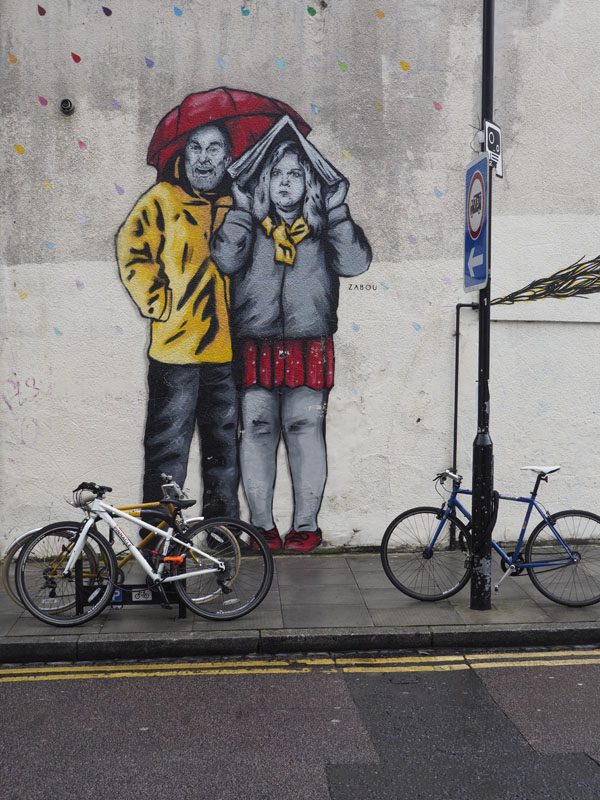
Over the years I've mellowed a little with regard to graffiti. I still dislike "tags" and the graffiti that is piled up one surface on top of another as spraycan-equipped passers-by superimpose their graphic on top of that of earlier "artists". However, I am better disposed towards the considered piece that seeks to add something of beauty, interest or humour to the street-scene.

We came upon today's example in Hackney, London. It isn't particularly accomplished drawing and doesn't seek to make any obvious point, but I like the restricted pallette, it brightened up a street corner and it caused me to wonder why the raindrops were multi-coloured. The piece also causes something of an optical illusion due to the figures being much larger than life-size. This has the effect, at first glance, of making the bicycles appear to be under-sized or children's bikes. As Isay, nothing profound, but nothing offensive either, and on a wet day the subject resonated..

photograph and text © Tony Boughen


Tuesday, June 21, 2016

Café cutlery, Broadway Market, London

click photo to enlarge
As its name suggests Broadway Market is a market street that has grown up on an old drove route, a track or road on which cattle and other animals would be driven into London to slaughter houses and markets. Such roads are characterised by broadness due to the quantity of animals that would be involved and the fact that a broad way gave a better chance of the route being passable because the animals and other travellers were not all concentrated in a narrow way and could choose the better ground for their passage.Today this street in Hackney hosts a mainly food market that fills the street and the shops on either side have a high proportion of eating establishments.

We stopped off at one on a recent visit to London and secured this photograph of cutlery. On a rainy but warm day we were eating inside with the whole of the side of the restaurant thrown open to the pavement. My son noticed the containers of knives, forks, etc ready and waiting for customers and he suggested the shot.

photograph and text © Tony Boughen

Photo Title: Café Cutlery, Broadway Market, London
Camera: Olympus E-M10
Mode: Aperture Priority
Focal Length: 60mm (120mm - 35mm equiv.) crop
F No: f5.5
Shutter Speed: 1/125 sec
ISO:1250
Exposure Compensation: -0.3 EV
Image Stabilisation: On

Sunday, June 19, 2016

Orangery, Belton House

click photo to enlarge
We tend to think of the conservatory as an adjunct to Victorian and Edwardian houses, and they were certainly popular in during those periods. However, the glasshouse and orangery pre-date the nineteenth century and rose to popularity in the seventeenth and eighteenth centuries.

English country houses built orangeries in their kitchen gardens or elsewhere near the residence for the cultivation of not just oranges, but peaches, grapes and other fruits. They were primarily hot-houses, heated by fuel in winter, for the production of fruits that could not be grown easily or at all outdoors in our country, and were secondarily ornamental additions to the grounds.

The orangery at Belton House in Lincolnshire is less ornate than many - a large rectangular building, glass fronted with stone piers and Coade stone balustrade. Inside are statuary niches and water features. It is currently home to a variety of climbing plants, palms and shrubs. It was designed in 1811 by Geoffrey Wyattville but not built until 1820, and then with a slightly revised plan. As with many orangeries the light, plants and warmth give quite sub-tropical feel to the interior and the favourable growing conditions encourage luxuriant foliage of the type seen in my photograph.

photograph and text © Tony Boughen

Photo Title: Statues, Orangery, Belton House, Lincolnshire
Camera: Olympus E-M10
Mode: Aperture Priority
Focal Length: 20mm (40mm - 35mm equiv.) crop
F No: f4.3
Shutter Speed: 1/60 sec
ISO:400
Exposure Compensation: -0.3 EV
Image Stabilisation: On

Friday, June 17, 2016

The north face of the O2

click photo to enlarge
The O2 Dome entertainment complex on the Greenwich peninsula in London was initially known as the Millennium Dome since it was built to celebrate and coincide with the year 2000. It was initially seen as something of a vanity project of the politicians who supported its construction, was reviled by many Londoners as the wrong building in the wrong place, and seen by the regions as yet another enormous sum spent on the capital at the expense of the provinces. However, over time it has come to have something of a purpose as a large arena for music concerts and other events, and the subsidiary buildings and subsequent construction nearby have made it seem less of a stranded white elephant. The scale of the building and the method of construction has ensured it is a visible structure that people look at and visit.

I was recently looking at the dome from near the Isle of Dogs on the north bank of the Thames. We were exploring a part of London by the river with which we are not very familiar. I took a few shots from the arts centre that is Trinity Buoy Wharf and while doing so saw some people undertaking the walk on the roof of the dome. I've seen people doing this before. However, on this occasion, from this vantage point, I got a very good impression of the size of the dome as the ant-like people carefully made their way down the structure. They appear to have been clipped on to the wire alongside which they were making their way - a wise precaution on a wet and intermittently windy day.

photograph and text © Tony Boughen

Photo Title: Walking On the O2 Dome, London Camera: Olympus E-M10
Mode: Aperture Priority
Focal Length: 150mm (300mm - 35mm equiv.) crop
F No: f6.3
Shutter Speed: 1/500 sec
ISO:200
Exposure Compensation: 0 EV
Image Stabilisation: On