click photo to enlarge
I'm sure that there are many photographers who have wonderful digital archives that can be searched by every conceivable parameter including subject, geographical location and photographic data, allowing them to easily locate an image. I am not one of those people. Like, I suspect, the majority of photographers, I have an archival system that is better than nothing, but not good enough to allow images to be retrieved without the expenditure of time and effort. However, the occasions on which I need to retrieve an image quickly are relatively few, so I'm never motivated to expend the energy to improve matters.
Today I searched for a photograph of a wooden screen in a Norfolk church on which were painted, in the 1400s, various saints, one of whom wore spectacles (glasses). These aids to vision were invented much earlier than many people realise. The earliest pictorial representation of spectacles with converging lenses for the long-sighted dates from c.1286, as I was reminded in a book about the medieval industrial revolution that I'm currently reading. Consequently it should come as no surprise to see them represented in a painting of the fifteenth century. However, it did jolt me. In the light of what I wrote above you won't be surprised to hear that I was unable to find my photograph after ten minutes search.
Perhaps it was reading my book that caused me to notice my rimless spectacles that I'd put down on a cupboard in my darkened study. I liked the glowing colour, the way the light of the lamp illuminated them, emphasising the delicate metalwork, and I liked the contrast of the light and dark areas. The simple subject called for a shallow depth of field and so I used a long lens in my relatively small room.
photograph and text © Tony Boughen
Photo Title: Rimless Spectacles
Camera: Olympus E-M10
Mode: Aperture Priority
Focal Length: 150mm (300mm - 35mm equiv.)
F No: f5.6
Shutter Speed: 1/200 sec
ISO:6400
Exposure Compensation: -0.3 EV
Image Stabilisation: On
Showing posts with label technology. Show all posts
Wednesday, January 20, 2016
Saturday, December 05, 2015
I was dumb, but now I'm smart
click photo to enlarge
I have an ambivalent view of technological advancement. So many new products seem to have so little reason for existence or worrisome potential liabilities attached - internet connected heating system or fridge anyone? That said, I've used computers since the early 1980s and I do have my share of hi-tech gadgets.
One device that I have managed to avoid has been the smart phone. I'm not a great fan of phones of any kind; I spent too much time using them in my work. But we do, of course, have a landline and I also had a dumb phone. You may recall dumb phones. They're the tiny ones that you could carry around that allow you to speak to people beyond shouting range and even send them little written messages, but do very little else. The disadvantage of even a dumb phone from my point of view is that you can be the recipient of these calls and messages too. I say I "had" one because it is no more and has been replaced, at my wife's insistence, by a smart phone. They're the bigger ones that don't easily fit in your pocket and cause people to bump into you on the street as they walk along watching the latest episode of heaven knows what (I don't watch much TV either). She's had one for quite a while and felt it would be useful for her and our extended family, if I had one too. So I bought a cheap one. I say "cheap" because, compared with my wife's, it is. However, it was more than I wanted, or wanted to pay. But I know when to go with the flow and so I'm no longer dumb but smart, and can do lots of things with my phone (but won't).
I noticed the thing has a camera so I took a shot of possibly the most reviled building in Spalding Lincolnshire, when we were out shopping. It's also one of the biggest buildings in this quite small town. The concrete frame and cladding used to be stained so I guess that put some people off. But, a few years ago, it had a new paint job and it looks fine now - not great, but O.K. That describes my photograph too - not great, but O.K. In fact it's a bit better than I expected. I guess the bright light helps. The shot was something of an experiment and it will probably be the only smart phone shot I post on this blog.
photograph and text © Tony Boughen
Camera: No-Name Android Phone
Mode: Auto
Focal Length: Does it matter
F No: See above
Shutter Speed: Presumably
ISO: Ditto
Exposure Compensation: Didn't bother
Image Stabilisation: Perhaps. Or maybe not
I have an ambivalent view of technological advancement. So many new products seem to have so little reason for existence or worrisome potential liabilities attached - internet connected heating system or fridge anyone? That said, I've used computers since the early 1980s and I do have my share of hi-tech gadgets.
One device that I have managed to avoid has been the smart phone. I'm not a great fan of phones of any kind; I spent too much time using them in my work. But we do, of course, have a landline and I also had a dumb phone. You may recall dumb phones. They're the tiny ones that you could carry around that allow you to speak to people beyond shouting range and even send them little written messages, but do very little else. The disadvantage of even a dumb phone from my point of view is that you can be the recipient of these calls and messages too. I say I "had" one because it is no more and has been replaced, at my wife's insistence, by a smart phone. They're the bigger ones that don't easily fit in your pocket and cause people to bump into you on the street as they walk along watching the latest episode of heaven knows what (I don't watch much TV either). She's had one for quite a while and felt it would be useful for her and our extended family, if I had one too. So I bought a cheap one. I say "cheap" because, compared with my wife's, it is. However, it was more than I wanted, or wanted to pay. But I know when to go with the flow and so I'm no longer dumb but smart, and can do lots of things with my phone (but won't).
I noticed the thing has a camera so I took a shot of possibly the most reviled building in Spalding Lincolnshire, when we were out shopping. It's also one of the biggest buildings in this quite small town. The concrete frame and cladding used to be stained so I guess that put some people off. But, a few years ago, it had a new paint job and it looks fine now - not great, but O.K. That describes my photograph too - not great, but O.K. In fact it's a bit better than I expected. I guess the bright light helps. The shot was something of an experiment and it will probably be the only smart phone shot I post on this blog.
photograph and text © Tony Boughen
Camera: No-Name Android Phone
Mode: Auto
Focal Length: Does it matter
F No: See above
Shutter Speed: Presumably
ISO: Ditto
Exposure Compensation: Didn't bother
Image Stabilisation: Perhaps. Or maybe not
Labels:
Android phone,
BT Building,
humour,
Lincolnshire,
smart phone,
Spalding,
technology
Tuesday, December 01, 2015
Tower Bridge seen from London Bridge
click photo to enlarge
One recent cold and windy night we found ourselves in London Bridge station waiting for someone. We had about forty minutes to kill so we walked out onto nearby London Bridge. After photographing the big blocky office building on the nearby south bank we walked out onto the bridge itself. It was freezing! Definitely not the weather you'd choose for photography.
The temperature was low and the wind speed high making it colder and harder to hold a camera steady. And yet, there on the bridge, besides the usual tourists taking photographs with their phones, were a few hardy photography enthusiasts, some with tripods, some without. I joined their ranks, tripodless, and started to take a few shots of the illuminated Tower Bridge, nearby HMS Belfast and the lit buildings along the shore. It quickly became apparent that a bright lens and a reasonable focal length were required. I happened to have my current portrait lens with me, the Olympus 45mm 1.8, since I'd been photographing my grand-daughter earlier in the day. It proved ideal for the job. Reasonably sharp wide open and image stabilised by the camera body.
As I took my photographs I reflected on the time when I used Four Thirds cameras without stabilisation, and without the high ISO performance of current cameras. The quality that was possible today simply with my unsupported camera body and lens was impossible only a few short years ago. The metering too has improved in leaps and bounds and it took minimal effort to achieve what I consider to be the very satisfactory result in today's photograph.
photograph and text © Tony Boughen
Camera: Olympus E-M10
Mode: Aperture Priority
Focal Length: 45mm (90mm - 35mm equiv.)
F No: f1.8
Shutter Speed: 1/100 sec
ISO:5000
Exposure Compensation: -0.3 EV
Image Stabilisation: On
One recent cold and windy night we found ourselves in London Bridge station waiting for someone. We had about forty minutes to kill so we walked out onto nearby London Bridge. After photographing the big blocky office building on the nearby south bank we walked out onto the bridge itself. It was freezing! Definitely not the weather you'd choose for photography.
The temperature was low and the wind speed high making it colder and harder to hold a camera steady. And yet, there on the bridge, besides the usual tourists taking photographs with their phones, were a few hardy photography enthusiasts, some with tripods, some without. I joined their ranks, tripodless, and started to take a few shots of the illuminated Tower Bridge, nearby HMS Belfast and the lit buildings along the shore. It quickly became apparent that a bright lens and a reasonable focal length were required. I happened to have my current portrait lens with me, the Olympus 45mm 1.8, since I'd been photographing my grand-daughter earlier in the day. It proved ideal for the job. Reasonably sharp wide open and image stabilised by the camera body.
As I took my photographs I reflected on the time when I used Four Thirds cameras without stabilisation, and without the high ISO performance of current cameras. The quality that was possible today simply with my unsupported camera body and lens was impossible only a few short years ago. The metering too has improved in leaps and bounds and it took minimal effort to achieve what I consider to be the very satisfactory result in today's photograph.
photograph and text © Tony Boughen
Camera: Olympus E-M10
Mode: Aperture Priority
Focal Length: 45mm (90mm - 35mm equiv.)
F No: f1.8
Shutter Speed: 1/100 sec
ISO:5000
Exposure Compensation: -0.3 EV
Image Stabilisation: On
Labels:
London,
London Bridge,
night,
photography,
technology,
Tower Bridge
Thursday, September 03, 2015
Walkie Not Talkie
click photo to enlarge
I've never been a fan of the telephone. There's something about talking to a disembodied voice that doesn't appeal to me. Moreover, I spent too much time speaking to people on the phone during my working life. That's not to say I don't appreciate their utility, and of course, I do use phones. With that in mind you might think that the rise of the smartphone would be something I'd welcome because it offers communication without the necessity for speaking. In fact, I wonder if these days such devices aren't more used for texting (SMS), email, social media communication etc, than simply speaking to people. But the fact is, though I recognise their multiple uses, and though I use my wife's smartphone, I haven't succumbed to one myself because I have enough computers of one kind or another and the idea of having one to use on a regular basis when I'm out and about is simply too much to contemplate.
I sometimes wonder what smartphone users would do if they had their device surgically removed. What would they do with their hands, their eyes, their ears and their brains? Would they have to look about them, make their own entertainment, fret because they don't know what their friends and acquaintances are doing, organise their time and social interactions better because there was no phone to make last-minute adjustments? I do wonder whether smartphones will turn us into lobster people who carry massive smartphones as evolution causes us to develop massively over-sized thumbs from countless keypresses.
I recognise that my relative antipathy to smartphones isn't widely held. On reflection it probably comes from the deep enjoyment I get from looking at our world, finding out about it and reflecting on what I see. A smartphone would get in the way of that - and it would encourage me to use an inferior camera!
photograph and text © Tony Boughen
Camera: Olympus E-M10
Mode: Aperture Priority
Focal Length: 63mm (126mm - 35mm equiv.)
F No: f6.3
Shutter Speed: 1/400 sec
ISO:200
Exposure Compensation: 0
Image Stabilisation: On
I've never been a fan of the telephone. There's something about talking to a disembodied voice that doesn't appeal to me. Moreover, I spent too much time speaking to people on the phone during my working life. That's not to say I don't appreciate their utility, and of course, I do use phones. With that in mind you might think that the rise of the smartphone would be something I'd welcome because it offers communication without the necessity for speaking. In fact, I wonder if these days such devices aren't more used for texting (SMS), email, social media communication etc, than simply speaking to people. But the fact is, though I recognise their multiple uses, and though I use my wife's smartphone, I haven't succumbed to one myself because I have enough computers of one kind or another and the idea of having one to use on a regular basis when I'm out and about is simply too much to contemplate.
I sometimes wonder what smartphone users would do if they had their device surgically removed. What would they do with their hands, their eyes, their ears and their brains? Would they have to look about them, make their own entertainment, fret because they don't know what their friends and acquaintances are doing, organise their time and social interactions better because there was no phone to make last-minute adjustments? I do wonder whether smartphones will turn us into lobster people who carry massive smartphones as evolution causes us to develop massively over-sized thumbs from countless keypresses.
I recognise that my relative antipathy to smartphones isn't widely held. On reflection it probably comes from the deep enjoyment I get from looking at our world, finding out about it and reflecting on what I see. A smartphone would get in the way of that - and it would encourage me to use an inferior camera!
photograph and text © Tony Boughen
Camera: Olympus E-M10
Mode: Aperture Priority
Focal Length: 63mm (126mm - 35mm equiv.)
F No: f6.3
Shutter Speed: 1/400 sec
ISO:200
Exposure Compensation: 0
Image Stabilisation: On
Labels:
footbridge,
Lincolnshire,
Sleaford,
smartphone,
technology,
telephone
Monday, June 10, 2013
Tiger Moths, preservation and technology
click photo to enlarge
I get pleasure and interest from seeing old forms of transport still being used for their original purpose. There's a certain satisfaction that comes from knowing that something constructed decades ago still works. Perhaps that feeling comes partly from the fact that many of the vehicles that we buy, use and discard today are so obviously manufactured for a limited life and in a way that precludes them working fifty or more years down the line. Modern computerised engine management systems, LCD displays etc with their purpose-made chips linked to software that will soon be obsolete mean that today's cars will be difficult for enthusiasts to run in the future. The sophisticated metals that aircraft manufacturers began using in the 1950s and 1960s are limiting the flying time of preserved aircraft such as the Avro Vulcan; the sole airworthy example's engines' flying hours have almost expired. Heaven knows how the aviation preservation enthusiasts of the year 2100 will keep today's aircraft with their head-up displays, circuit boards and the rest of their technological gizmos in the air.
The problems that face someone today who aims to keep an aircraft from the 1930s flying are of a lesser order. The technology involved in most aircraft of this era is much more basic, and components can be relatively easily manufactured if they can't be sourced from elsewhere. I was discussing this with one of my sons the other day as we watched an assortment of old aircraft - Tiger Moths, Dragon Rapides, a Harvard, a Chipmunk, a Boeing B17 bomber and others - taking off and landing at the Imperial War Museum site at Duxford, Cambridgeshire. Today's photograph shows one of the Tiger Moths, an aircraft first manufactured in 1932. This example was built during WW2 as a training aircraft and after a long career in aerobatics, private ownership and storage is now used for pleasure flying.
I'm no specialist aircraft photographer: I have neither the lenses nor the inclination to pursue planes to the exclusion of much else. However, I'm not averse to pointing my camera at them when they come my way. I took a few shots of this particular Tiger Moth on the ground and several more when it was aloft. The main photograph is the one I liked best of the latter group. The aircraft's smallness against the dark, heavy cloud cover appealed to me more than shots where it better filled the frame.
photograph and text © Tony Boughen
Camera: Canon
Mode: Aperture Priority
Focal Length: 300mm
F No: f5.6
Shutter Speed: 1/1000 sec
ISO: 100
Exposure Compensation: -0.33 EV
Image Stabilisation: On
I get pleasure and interest from seeing old forms of transport still being used for their original purpose. There's a certain satisfaction that comes from knowing that something constructed decades ago still works. Perhaps that feeling comes partly from the fact that many of the vehicles that we buy, use and discard today are so obviously manufactured for a limited life and in a way that precludes them working fifty or more years down the line. Modern computerised engine management systems, LCD displays etc with their purpose-made chips linked to software that will soon be obsolete mean that today's cars will be difficult for enthusiasts to run in the future. The sophisticated metals that aircraft manufacturers began using in the 1950s and 1960s are limiting the flying time of preserved aircraft such as the Avro Vulcan; the sole airworthy example's engines' flying hours have almost expired. Heaven knows how the aviation preservation enthusiasts of the year 2100 will keep today's aircraft with their head-up displays, circuit boards and the rest of their technological gizmos in the air.
The problems that face someone today who aims to keep an aircraft from the 1930s flying are of a lesser order. The technology involved in most aircraft of this era is much more basic, and components can be relatively easily manufactured if they can't be sourced from elsewhere. I was discussing this with one of my sons the other day as we watched an assortment of old aircraft - Tiger Moths, Dragon Rapides, a Harvard, a Chipmunk, a Boeing B17 bomber and others - taking off and landing at the Imperial War Museum site at Duxford, Cambridgeshire. Today's photograph shows one of the Tiger Moths, an aircraft first manufactured in 1932. This example was built during WW2 as a training aircraft and after a long career in aerobatics, private ownership and storage is now used for pleasure flying.
I'm no specialist aircraft photographer: I have neither the lenses nor the inclination to pursue planes to the exclusion of much else. However, I'm not averse to pointing my camera at them when they come my way. I took a few shots of this particular Tiger Moth on the ground and several more when it was aloft. The main photograph is the one I liked best of the latter group. The aircraft's smallness against the dark, heavy cloud cover appealed to me more than shots where it better filled the frame.
photograph and text © Tony Boughen
Camera: Canon
Mode: Aperture Priority
Focal Length: 300mm
F No: f5.6
Shutter Speed: 1/1000 sec
ISO: 100
Exposure Compensation: -0.33 EV
Image Stabilisation: On
Labels:
aircraft,
aircraft preservation,
biplane,
IWM Duxford,
technology,
Tiger Moth
Wednesday, April 25, 2012
Lister Blackstone No 1 Digger (Take 2)
click photo to enlarge
Sometimes, in the rush and routine of photography, I ignore my own advice. I've long known that it is best to look at and think about a photograph for a while before coming to an opinion about its merits. That's something I've advocated before on this blog. However, when I took my photographs of the old potato harvester that I posted yesterday, due to a dearth of acceptable fresh photographs, I didn't take this elementary step, and posted what I thought at the time was the best of my images. I got it wrong.Not by a big margin, but wrong nonetheless. Moreover, I was wrong for a second reason that goes beyond making myself more familiar with the shots. Elsewhere in this blog I've proclaimed the virtues of different aspect ratios. I was a long-time user of Four Thirds cameras with their 4:3 aspect ratio. My current Canon camera outputs images at 3:2. The compact camera I use, a Panasonic LX3, offers both of those plus 16:9 and 1:1. After thirty years using a 35mm film SLR (3:2) I found the change to 4:3 interesting but not problematic. Moreover, after a while I found that I preferred it. I still do, though I find 3:2 is perfectly acceptable. The aspect ratios of 16:9 and 1:1 have their attractions for the right subject and composition. So, when I'd spent more time with my collection of shots of the potato harvester, I decided that, perhaps, one of the others was compositionally better than the one I posted. And, when I'd placed a 4:3 selection outline over the image to improve the composition further, I wondered how, after all these years, I could still make such an elementary error.
The answer to that question, I think, lies in photoblogging. Overall this blog has been something that has improved my photography considerably, giving me a focus, urgency and a widened range that has resulted in a keener eye and better shots. But a downside is that periodically my relatively high frequency of posting results in a dearth of shots and a posting date that is too close to the date I took the photograph. Hence, sometimes I haven't reflected sufficiently on the shot, quality control slips, and I post a photograph that, with hindsight, I could have bettered. So, today I post what I think is the better photograph as well as a detail showing the maker's name. Of course, that's only my point of view: yours may differ.
photograph and text (c) T. Boughen
Camera: Canon
Mode: Aperture Priority
Focal Length: 50mm
F No: f11
Shutter Speed: 1/40 sec
ISO: 125
Exposure Compensation: 0 EV
Image Stabilisation: On
Tuesday, April 24, 2012
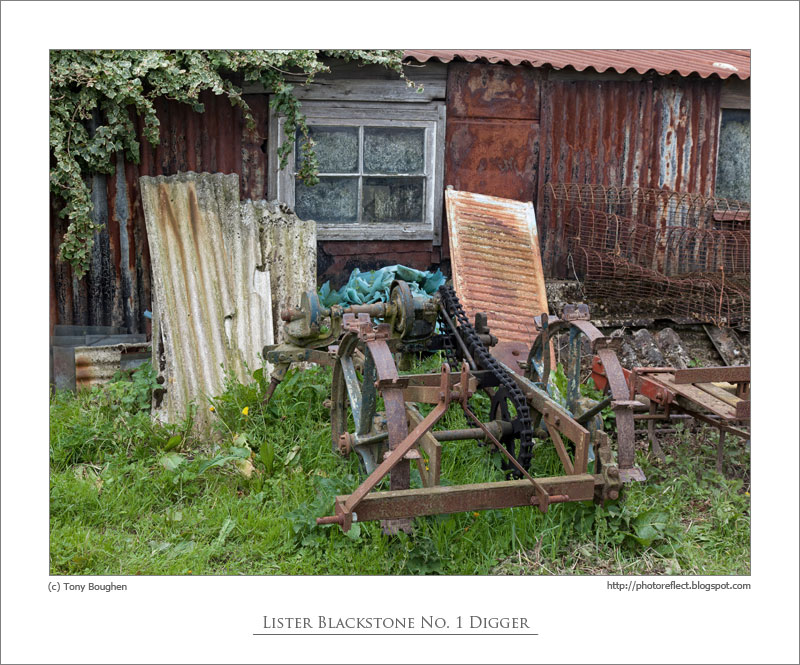
Lister Blackstone No 1 Digger
click photo to enlarge
Yesterday the Sinclair Spectrum home computer celebrated the thirtieth anniversary of its appearance on the market in the UK. I owned one of these machines and enjoyed the affordable introduction to computing that it provided. I can't remember precisely how long I used the Spectrum before I replaced it with a newer and more capable computer, but it can only have been a matter of a few years, such is the lifespan of this kind of technology-based hardware.I was recently looking at a few pieces of rather older technology associated with vegetable growing, simple machines and tools owned by someone we know, which have had a much longer life than the Spectrum and have been used every year since they were first acquired. The photograph above shows one of them, the Lister Blackstone No 1 Digger, an implement used for harvesting potatoes. I'm no authority on such things, but from what I can gather, it must date from shortly after the takeover of the Stamford-based farm implement maker, Blackstone* & Co, by R.A.Lister & Company of Dursley, Gloucestershire, in 1936. Consequently it is about 75 years old. This particular example was the version designed to be pulled by a horse: a model for fitting to a tractor was also offered. However, the Digger shown above has a blacksmith-made bracket that allows it to be pulled by a small Ferguson tractor, something that happens annually when the potatoes are harvested from the smallholding where it resides.
As we discussed the machine I expressed reservations about it being pulled along a tarmac road to the place where it would be used - those notched lugs on the steel wheels would make for a slow, noisy and potentially damaging journey. However, I was informed that the manufacturer supplied steel rims that fitted round the wheels, locating in each notch on the lugs. One of the pleasures of quite a lot of older technology is the way that simplicity of design and durability of construction combine to create something with a life that can be measured in decades rather than a few short years. I took my photograph of the venerable machine at rest behind an old shed alongside other equipment and cast-off remnants that gave a suitably time-worn backdrop.
* The name "Blackstone" rang a bell for me, and I remembered a blog entry of an engine nameplate that I posted some years ago. It is the same company.
photograph and text (c) T. Boughen
Camera: Canon
Mode: Aperture Priority
Focal Length: 73mm
F No: f11
Shutter Speed: 1/60 sec
ISO: 200
Exposure Compensation: 0 EV
Image Stabilisation: On
Subscribe to:
Posts (Atom)