Showing posts with label cemetery. Show all posts

Wednesday, October 23, 2013

Cemeteries and red oaks

click photo to enlarge
A new crematorium is currently being built near Surfleet in Lincolnshire. Its purpose is to supplement the existing crematoria in the area and reduce the journey times for funerals in the south of the county. One of the first things that the contractors did, after a service road had been built, was to plant two hundred trees and a kilometre of hedging on the ten acre site. As with most such facilities the aim is to surround the main building withattractive parkland. Reading a newspaper report about progress on the development I noted that hornbeam has been chosen as the tree to form an avenue from the main road to the crematorium building and chapel. Cemeteries and crematoria are good places to go in search of interesting trees. The desire to beautify the place where people are laid to rest leads to careful consideration of the disposition and type of trees that feature in the grounds. Boston cemetery has a big avenue of mixed trees featuring both pines and limes. Long Sutton cemetery is reached by an avenue of lime trees. The much smaller cemetery in the village of Bicker has a couple of noteworthy silver birches.

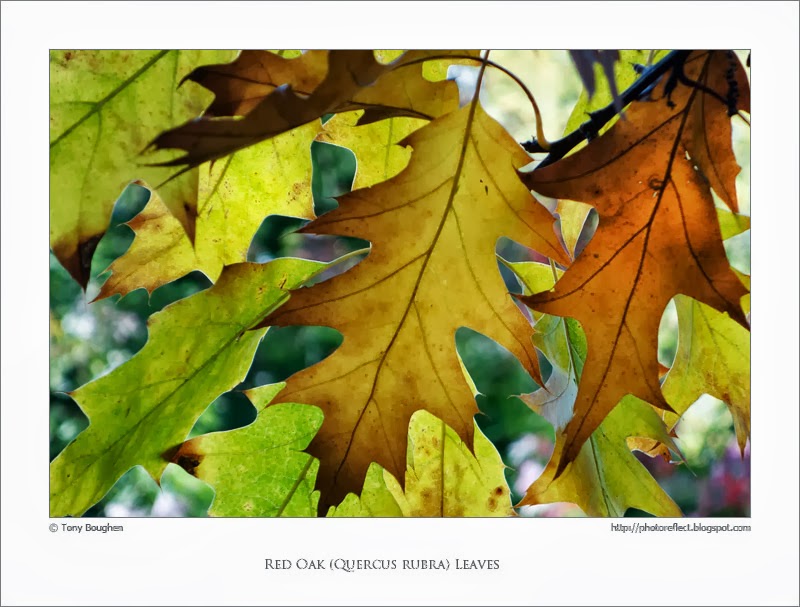
I was in Boston cemetery the other day having a look at the architecture. However, I also took some time to see the kinds of trees that were planted there. The older part of the site is something of a wildlife haven, and here the trees have, for the most part, reached maturity. It was in this section that I came across the red oak (a tree of North American origin) shown in the main photograph. It's deeply cut and pointed leaves were begining to show the hues of autumn. These are appearing a little later than usual due to the recent mild weather. In an area that seemed to have closely packed graves of the 1930s and 1940s I came upon a copper leaved tree that I foolishly didn't take the time to identify - is it a beech? Perhaps its something else entirely. I'll check if I visit there again.

photograph and text © Tony Boughen

Photo 1
Camera: Sony RX100
Mode: Aperture Priority
Focal Length: 37.1mm (100mm - 35mm equiv.)
F No: f4.9
Shutter Speed: 1/125
ISO: 200
Exposure Compensation:  -0.3 EV
Image Stabilisation: On

Friday, January 18, 2013

Cemetery gatehouse, Boston, Lincolnshire

click photo to enlarge
The increase in Britain's population during the eighteenth century led to the graveyards around churches becoming overcrowded, bodies being buried above bodies, and some graves being a matter of only two feet below the surface. By the nineteenth century it was clear that churchyard burial was no longer tenable in many places, particularly in the rapidly expanding cities and towns, and that some alternative measures for dealing with the dead must be found. The answer was the cemetery.

Pere Lachaise Cemetery in Paris was opened in 1804 and influenced British cemetery design. Early examples such as the Rosary Cemetery, Norwich (1819) and Chorlton Row Cemetery, Manchester (1821) drew on its example. Private companies saw profit in the burial of the dead and examples of their work  include Key Hill, Birmingham (1834) and York Cemetery (1836). The first cholera epidemic of 1831-2 also spurred cemetery building and J.P. Loudon's book, "On the Laying Out, Planting and Managing of Cemeteries: And on the Improvement of Churchyards"(1843) offered an architect's views on their better design and construction. The second cholera epidemic of 1848-9 prompted a series of public health Acts, one of which gave newly appointed boards of health powers concerning the burial of the dead. However, it was not until a series of Acts, the first of which was passed in 1852, and which were consolidated in 1857 (becoming known as the Burial Acts), that a nation-wide structure of public cemeteries was established. Many town and city cemeteries were laid out during this time and in the following decades.

Today's photograph shows part of an entrance gatehouse to the cemetery in Boston, Lincolnshire, a facility that dates from this period having been opened in 1855. Today it is almost three times the size of that first cemetery. The original plot is now a designated wildlife area though it retains its distinctive memorials, chapel and entrance avenue, as well as the gatehouse. The newer extensions have graves more closely spaced, and today a crematorium is sited there too.

I took my photograph of the rear of the gatehouse, as the late afternoon light was fading, after doing some shopping in Boston. The old building retains most of its original features including the ornate bargeboards, and it was these that I decided to make the focus of my image.

photograph and text © Tony Boughen

Camera: LX3
Mode: Aperture Priority
Focal Length: 5.9mm (28mm - 35mm equiv.)
F No: f2.1
Shutter Speed: 1/125
ISO: 80
Exposure Compensation:  0 EV
Image Stabilisation: On 

Monday, October 29, 2012

Avenues

click photo to enlarge
The word "avenue" in English originally comes from the French avenir and Latin advenire, to come to or to approach. In the sixteenth and seventeenth centuries the word was often spelt, "advenue", and in the eighteenth century "a'venue" was used. The Oxford English Dictionary (OED) records the first use of "avenue" meaning "approach" in a piece dating from 1639. However, by the eighteenth century the definition of the word that we use today - an approach or road lined with trees - was widely accepted. The United States seems to have modified its usage of the word to mean any fine, wide street, but in Britain trees are usually implied by "avenue".

The habit of lining a street, road or entrance driveway with trees to give it an enhanced status is a practise of long standing. It is a feature seen in the grounds of most large English country houses. Towns and cities with streets of eighteenth and and nineteenth century foundation often have such trees and feature the word "avenue" in their name. Municipal parks of the Victorian and Edwardian period usually have avenues, and the rare park of eighteenth century date, such as that at King's Lynn, frequently have them too. Go to the municipal cemetery- usually a nineteenth century creation - and here too you will find a tree lined road leading from the main entrance or to the chapel.

We recently, for the first time, walked into the cemetery at Boston, Lincolnshire, and found here a fine, imposing avenue leading from the entrance gatehouse to the chapel. Unusually it had a mixture of trees rather than being restricted to one or two species. Pines stood alongside beech and lime, with the deciduous trees shedding their leaves on the tarmac and gravestones below. we didn't venture far into the cemetery - that exploration can wait for a later date - but I lingered long enough to see two men come into view at the bottom of the avenue, figures to give some scale to my symmetrical shot down the roadway.

photograph and text © Tony Boughen

Camera: Canon
Mode: Aperture Priority
Focal Length: 105mm
F No: f7.1
Shutter Speed: 1/100
ISO: 1000
Exposure Compensation:  0 EV
Image Stabilisation: On

Saturday, February 11, 2012

Hoar frost and forecasters

click photo to enlarge
After the cold winter of 2009-2010 people expected that the winter of 2010-2011 would be milder. When those hopes were dashed and the January proved to be every bit as cold, the expectation then became that, after two successive harsh winters, the winter of 2011-2012 was almost bound to be better. And, for a while it looked as though it might be. However, late January and February have put paid to that theory, with last night being the coldest of the year, and Lincolnshire recording the lowest temperature (-16 Celsius) anywhere in the country.

In fact, there is no rational reason to suppose that a bad winter presages the next being milder, nor that a succession of cold winters increases the likelihood of the subsequent one being more equable. What we can expect, however, is that if the weather forecasters suggest that the minimum overnight temperature will be -5 Celsius, then we have no reason to suppose it will be anywhere near -16 Celsius. Last night the Meteorological Office got their predictions drastically wrong. For many that can be a major problem because they wouldn't necessarily have taken the precautions that they otherwise might. From my perspective as a photographer it was O.K. Why? Because we had a wonderful, unexpected hoar frost on top of the previous night's fall of snow!

We had a few of these frosts in the cold weather at the end of December 2010 and in early January 2011. I was thrilled to see another one this year and made a couple of morning forays with the camera to gather a few shots of the dramatic trees. Today's photograph was taken in the village cemetery. The white covering of the hoar frost combined with a shot against the light made a rather banal subject into something a little more interesting.

photograph and text (c) T. Boughen

Camera: Canon
Mode: Aperture Priority
Focal Length: 17mm
F No: f8
Shutter Speed: 1/500
ISO: 100
Exposure Compensation: 0 EV
Image Stabilisation: N/A

Friday, August 05, 2011

The lime tree avenue

click photo to enlarge

A title or caption to a photograph works very much like the title of a poem - it influences the way you see what follows. A photograph I took in Swineshead, Lincolnshire, illustrates this quite well. The old brick building with the pointed door and shadows from nearby trees looks interesting. However, with the title, "The Gravedigger's Door", it takes on an entirely different character. You wonder what's behind the door, your mind begins to wander into darker places, and the shadows, perhaps, take on the appearance of fingers!

Today's photograph shows an elderly lady walking her dog along a fine lime tree avenue at Long Sutton, Lincolnshire. The character of the image is fairly neutral. However, if I tell you that the gates at the end of the avenue open on to the cemetery a different mood may well start to pervade the shot. The age of the person can become more significant, and there is the temptation to to fabricate little storylines in your head. Why is she alone? Is she going to visit a grave? Whose grave?

Of course none of this may have been in the mind of the person who took the shot because any appreciation or reaction to an image is a consequence of what the photographer offers and what the viewer brings. In fact, I took the shot, very quickly, solely for the composition down the path with its rows of trees. The figure added foreground interest and by being off-centre broke the symmetry quite well.

photograph and text (c) T. Boughen

Camera: Canon
Mode: Aperture Priority
Focal Length: 90mm
F No: f7.1
Shutter Speed: 1/80
ISO: 1250
Exposure Compensation:  0 EV
Image Stabilisation: On 

Friday, December 24, 2010

Merry Christmas

click photo to enlarge
Anyone who knows me well knows that I am lukewarm about Christmas. I don't especially look forward to the arrival of the festivities, and do tend to be glad when the calendar says January 1st. It wasn't always so. As a child I couldn't wait for it to be upon me - the special food, presents, and events all being something to relish. When my children were small I enjoyed it enormously through them, and always strove to make it something special. But, as I've got older it has palled somewhat for me. I really dislike seeing the arrival of Christmas merchandise in the shops during early October, the conspicuous consumption doesn't appeal, and the frenzied shopping in December is something to be avoided or endured rather than enjoyed. I continue to like some of the traditions, and the carols have an enduring attraction for me, but on the whole it's not my favourite time of year.

What also impacts negatively on my feelings at this time is the period between Christmas and the start of the new year, a sort of hiatus when the country has ground to a halt apart from "The Sales". That particular week is the only one in the year that I'm glad to see the back of. During those days I'm ready for January to start, ready for the chance to look forward and to plan rather than to look back, and I'm ready for the daylight hours to start to lengthen. If, after reading that, you think I must be pretty miserable at Christmas, let me say that I'm not. I don't ask much of Christmas - time with my family and friends, a few good films on television, and weather that lets me get out and about, walking with my camera, - that's all I require to be entirely happy.

So why, I imagine you may be thinking, does today's photograph show a lonely, frost covered bench in the unused corner of a frozen cemetery rather than colourful holly against a blue sky (last year's Christmas shot), a festive bauble (2008), or Christmas coffee (2006)? Does it reflect an end of year gloom that has descended on the Boughen household? The answer to that is a resounding no. The fact is I've simply been too busy to shoot anything more suitable, and this was the next image in the queue for posting!

So, as I take a break from blogging for a few days, let me say to everyone who visits on a regular or a sporadic basis, Merry Christmas to you and to your nearest and dearest, and I hope you have a splendid new year! Now I'm off to see when the 1951 film version of Charles Dickens', "A Christmas Carol", is on TV. Alastair Sim is the definitive Scrooge - my hero!

photograph and text (c) T. Boughen

Camera: Canon
Mode: Aperture Priority
Focal Length: 45mm
F No: f9
Shutter Speed: 1/50
ISO: 1000
Exposure Compensation: -0.33 EV
Image Stabilisation: On