Showing posts with label agriculture. Show all posts

Wednesday, April 09, 2014

Old farm silos and the Nikon D5300

click photo to enlarge
For the past few years my photography has involved the use of a Canon 5D Mk2 and a Sony RX100. The Canon I chose for its reliability and versatility and it has given me that, courtesy of a very capable body and four high quality lenses. However, it's heavy. And I'm not getting any younger. Hence, I bought the Sony for its mixture of compact form and pretty good quality to use as the "always with me" camera, the one to be taken when we're shopping or out and about without photography specifically in mind. I also thought it would be useful when we do long walks or visit cities such as London. For the latter purpose it is excellent; it's unobtrusive and the 28-100mm (35mm equiv.) focal length lens suits my photography fine in the streets and parks of the city. However, when it comes to walking in the countryside of, say, the Yorkshire Dales or the Lincolnshire Wolds, on the Fens or even by the sea, its maximum focal length has proved somewhat limiting.

Consequently, at the end of last year I bought what I thought would be a reasonably small and light,  "in-between" camera with a versatile lens - the Panasonic G6 with the 14-140mm (28-280mm 35mm equiv.) lens. I got it at a good price and began to use it. Within a couple of days I realised this was not the camera for me. Why? Well, at quite commonly used focal lengths and shutter speeds it would not produce sharp images when using the mechanical shutter. It has an electronic shutter too and that always produced sharp images but at the cost of restricted usability. The problem was "shutter shock", an issue that has affected a number of mirrorless cameras. It is caused by the way a camera without a flip-up mirror cocks the shutter and introduces vibrations just before the shutter fires and makes the exposure. This seems to be a particular issue with this specific body and lens, though my letter to Panasonic resulted in no acknowledgement of the issue; this despite the fact that quite a number of photographers have reported the same problem. The fact that the body was so small and designed with quite a few buttons that I kept inadvertently hitting was also a problem, but one I would have persevered with. Blurred shots I wouldn't countenance, and so the camera was returned to the seller.

My response to this was to buy a Nikon D5300 with the 18-140mm lens (27-210mm 35mm equiv.). The size of this camera is approximately the same as the Olympus E510, the camera that I've had most pleasure out of in the past ten years. It's heavier than the Panasonic (and much heavier than the Sony), but quite a bit lighter than the Canon. You might wonder why an enthusiast wouldn't choose the Nikon D7100 or a mid-priced Canon to make use of my existing lenses. The answer is - weight, and a curiosity to try another brand. Moreover, I intend to restrict this camera to one lens only, so if I had chosen a Canon I'd still have to buy a lighter EF-S lens and so there would be no real saving.

Today's photograph is an example of the output of the Nikon. I'm quite happy with the camera which, incidentally, seems to have the same sensor as all Nikon's newer APS-C DSLRs regardless of price.

photograph and text © Tony Boughen

Camera: Nikon D5300
Mode: Aperture Priority
Focal Length: 38mm (57mm - 35mm equiv.)
F No: f8
Shutter Speed: 1/320 sec
ISO:100
Exposure Compensation: 0 EV
Image Stabilisation: On

Monday, October 07, 2013

Tractor work

click photo to enlarge
The other day I watched a tractor as it began to break up the surface of a field that had given up its wheat crop a few weeks ago. As the driver began his work I watched with incredulity as the vehicle reared up, stallion-like, on its large rear wheels, the front pair resting on nothing but several feet of fresh air. Clearly the weight that had been fixed to the front of the tractor was insufficient for the job in hand. After a few moments the tractor set off again and once more its front wheels went high in the air. The driver's tinkering with the front counter-balance weight was followed by a couple more less spectacular "take offs", and then, after a final adjustment that seemed to bring it under control, it settled down to slowly working up and down the field. As it got nearer to me I noticed that the weight had been moved well forward from the front wheels so that it offered a greater counter-force. Presumably the driver had miscalculated when making his original setting.

As I returned to my own work I reflected that it was only a few days ago that the Agricultural Wages Board (AWB) was abolished by our incompetent and divisive coalition government. This organisation had the power to set the minimum pay rate and conditions for agricultural workers. It had done so successfully for many years, but this was not good enough for our deregulating government. From 1st October 2013 the national minimum wage and general employment law applies to agricultural work. The AWB was originally established because of the distinctive conditions of employment that apply to agricultural workers - for example, tied housing, the need for irregular hours and seasonal work. Watching the tractor driver I was reminded that statistics usually show agricultural employment (after fishing) at the top of any list of the most hazardous areas of work. Part of the reason for this is that people are often working alone with big, powerful machinery - such as tractors - or managing large, unco-operative animals. In many of the occupations that are placed lower on these lists, such as policing, the rate of remuneration reflects the danger of the job. As of this month that's very unlikely to be the case for farm workers, if indeed it ever was.

The tractor in today's photograph is resting after its days work. Presumably it wouldn't fit in the barn and the farmer seems to be using it as a barrier to prevent the theft of whatever else he's got in there.

photograph and text © Tony Boughen

Camera: Sony RX100
Mode: Aperture Priority
Focal Length: 14.2mm (38mm - 35mm equiv.)
F No: f2.8
Shutter Speed: 1/4
ISO: 3200
Exposure Compensation:  0 EV
Image Stabilisation: On

Wednesday, April 25, 2012

Lister Blackstone No 1 Digger (Take 2)

click photo to enlarge
Sometimes, in the rush and routine of photography, I ignore my own advice. I've long known that it is best to look at and think about a photograph for a while before coming to an opinion about its merits. That's something I've advocated before on this blog. However, when I took my photographs of the old potato harvester that I posted yesterday, due to a dearth of acceptable fresh photographs, I didn't take this elementary step, and posted what I thought at the time was the best of my images. I got it wrong.

Not by a big margin, but wrong nonetheless. Moreover, I was wrong for a second reason that goes beyond making myself more familiar with the shots. Elsewhere in this blog I've proclaimed the virtues of different aspect ratios. I was a long-time user of Four Thirds cameras with their 4:3 aspect ratio. My current Canon camera outputs images at 3:2. The compact camera I use, a Panasonic LX3, offers both of those plus 16:9 and 1:1. After thirty years using a 35mm film SLR (3:2) I found the change to 4:3 interesting but not problematic. Moreover, after a while I found that I preferred it. I still do, though I find 3:2 is perfectly acceptable. The aspect ratios of 16:9 and 1:1 have their attractions for the right subject and composition. So, when I'd spent more time with my collection of shots of the potato harvester, I decided that, perhaps, one of the others was compositionally better than the one I posted. And, when I'd placed a 4:3 selection outline over the image to improve the composition further, I wondered how, after all these years, I could still make such an elementary error.

The answer to that question, I think, lies in photoblogging. Overall this blog has been something that has improved my photography considerably, giving me a focus, urgency and a widened range that has resulted in a keener eye and better shots. But a downside is that periodically my relatively high frequency of posting results in a dearth of shots and a posting date that is too close to the date I took the photograph. Hence, sometimes I haven't reflected sufficiently on the shot, quality control slips, and I post a photograph that, with hindsight, I could have bettered. So, today I post what I think is the better photograph as well as a detail showing the maker's name. Of course, that's only my point of view: yours may differ.

photograph and text (c) T. Boughen

Camera: Canon
Mode: Aperture Priority
Focal Length: 50mm
 F No: f11
Shutter Speed: 1/40 sec
ISO: 125
Exposure Compensation:  0 EV
Image Stabilisation: On
Tuesday, April 24, 2012

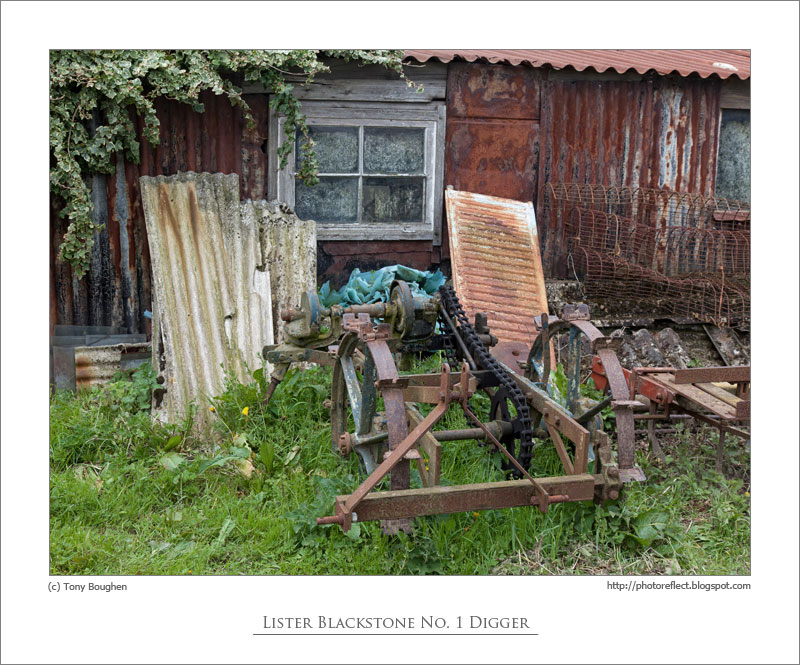
Lister Blackstone No 1 Digger

click photo to enlarge
Yesterday the Sinclair Spectrum home computer celebrated the thirtieth anniversary of its appearance on the market in the UK. I owned one of these machines and enjoyed the affordable introduction to computing that it provided. I can't remember precisely how long I used the Spectrum before I replaced it with a newer and more capable computer, but it can only have been a matter of a few years, such is the lifespan of this kind of technology-based hardware.

I was recently looking at a few pieces of rather older technology associated with vegetable growing, simple machines and tools owned by someone we know, which have had a much longer life than the Spectrum and have been used every year since they were first acquired. The photograph above shows one of them, the Lister Blackstone No 1 Digger, an implement used for harvesting potatoes. I'm no authority on such things, but from what I can gather, it must date from shortly after the takeover of the Stamford-based farm implement maker, Blackstone* & Co, by R.A.Lister & Company of Dursley, Gloucestershire, in 1936. Consequently it is about 75 years old. This particular example was the version designed to be pulled by a horse: a model for fitting to a tractor was also offered. However, the Digger shown above has a blacksmith-made bracket that allows it to be pulled by a small Ferguson tractor, something that happens annually when the potatoes are harvested from the smallholding where it resides.

As we discussed the machine I expressed reservations about it being pulled along a tarmac road to the place where it would be used - those notched lugs on the steel wheels would make for a slow, noisy and potentially damaging journey. However, I was informed that the manufacturer supplied steel rims that fitted round the wheels, locating in each notch on the lugs. One of the pleasures of quite a lot of older technology is the way that simplicity of design and durability of construction combine to create something with a life that can be measured in decades rather than a few short years. I took my photograph of the venerable machine at rest behind an old shed alongside other equipment and cast-off remnants that gave a suitably time-worn backdrop.

 * The name "Blackstone" rang a bell for me, and I remembered a blog entry of an engine nameplate that I posted some years ago. It is the same company.

photograph and text (c) T. Boughen

Camera: Canon
Mode: Aperture Priority
Focal Length: 73mm
 F No: f11
Shutter Speed: 1/60 sec
ISO: 200
Exposure Compensation:  0 EV
Image Stabilisation: On

Sunday, September 18, 2011

Giving the wrong impression

click photo to enlarge
I've said elswhere in this blog that I think "the camera ALWAYS lies" is a truer statement than "the camera NEVER lies." I've also come to realise, over the years, that photographs often deceive unwittingly. In fact, "lies" is frequently too strong a word: "give a false impression" sums it up rather better.

This misleading comes about through the way that we compose images. Photographers are usually selective of the view before them, deciding what will be included in the shot and what will be left out. Sometimes they are less careful than that and are so fixed on what they want in the photograph they simply don't care or notice what is omitted. And, when this happens, the image can give a viewer who doesn't know the subject that we are presenting, a false impression.

Today's image is an example of this. It shows a tractor hauling a couple of disc harrows, one with tines, over a field that has been cleared of wheat. The scene is in Lincolnshire, a county that is considered by many English people to be sparsely populated, flat (or flattish), treeless, with few hedges, and devoted exclusively to arable agriculture. This photograph reinforces every one of those ideas which are, in fact, misconceptions. It was taken in a part of Lincolnshire where the Fens give way to low rolling hills (there are also higher rolling hills - the Lincolnshire Wolds). If I had not wanted the sparse composition that I did and had shown a wider view it would have included more of these hills and trees and hedges (just out of shot). Had I panned left I'd have photographed an old manor house surrounded by trees with adjacent pasture, paddocks for horses and small copses, with further away, some cattle. The stereotypical image that I have produced gives a false impression of the area in which it was taken.

For another (compositionally similar) example of this, and similar comments (in the last paragraph), see here.

photograph and text (c) T. Boughen

Camera: Canon
Mode: Aperture Priority
Focal Length: 104mm
F No: f6.3
Shutter Speed: 1/800
ISO: 100
Exposure Compensation:  -0.33 EV
Image Stabilisation: On

Sunday, March 01, 2009

The daffodil pickers

click photo to enlarge
I was raised in the Yorkshire Dales of the north-west of England, an area of hills, mountains and valleys. On these uplands the agriculture consisted mainly of sheep, hay and a few beef or milk cattle. In the valleys the mix was similar, but cattle were more numerous. During the last few decades of the twentieth century, in response to market prices and, perhaps, global warming, some intrepid farmers with better land tried root crops, maize and cereals. However, for the most part, the farming of recent years in that area of Yorkshire hasn't been drastically different from what it was a hundred years earlier. With one exception - the number of agricultural workers was significantly fewer, and those that remained were, on average, much older. Many farms were worked by one, two or at most, three people - often a husband and wife with one of their offspring.

When I moved to Lincolnshire, I found the situation as far as manpower is concerned, to be very similar. A couple of people often run quite large cereal farms. Where vegetables are grown, there may be three or four permanent workers with contract labour brought in as required. In the Dales the number of agricultural workers you see in fields is few all year round, but in Lincolnshire higher numbers are evident when vegetables are planted and harvested. In both areas it is mechanisation that has made the difference: Dales farmers can travel the uplands and transport animals much quicker than formerly, whilst the soil preparation, planting, tending and harvesting in eastern England is now done, to a very great extent, by machine. However, some tasks have remained resistant to mechanisation, and I came across one of them yesterday as I drove along the road at Cowbit near Spalding, Lincolnshire.

Rounding a bend I came upon a field with about seventy people bent double, harvesting daffodils. The regular rows of flowers didn't have a single bloom showing, but many carried buds that would soon open. The workers were selecting suitable stalks, bundling them in tens with elastic bands, and boxing them ready for collection, distribution and sale. I stopped and took a few shots of the activity, and reflected that scenes like this, that have continued down the decades, may one day also succumb to the machine - a device that can judge which flowers to pick, which to leave, that knows how to bundle them, and that doesn't get a bad back in the process or lament the seasonal nature of the work or the level of remuneration.

photograph & text (c) T. Boughen


Camera: Olympus E510
Mode: Aperture Priority
Focal Length: 150mm (300mm/35mm equiv.)
F No: f7.1
Shutter Speed: 1/160 seconds
ISO: 100
Exposure Compensation: -0.3 EV
Image Stabilisation: On

Monday, August 04, 2008

The staff of life

click photo to enlarge
Britain's farming population is in long-term decline. In 1996 there were 616,000 people employed in agriculture. By 2007 this had gone down to 526,000, the result of increasing mechanization, the amalgamation of farms into ever larger units, and the declining profitability of the sector. Over the same period the age profile of those employed in agriculture increased.

Changes in wheat farming are fairly typical of the sector as a whole. Over the same period the area devoted to cultivation declined from 1976,000 hectares to 1816,000 hectares, and the volume produced also went down.The income generated by milling wheat and feed wheat slumped, and the amount of wheat produced as a percentage of UK use fell from 125% to 106%. There was, and is, money to be made by producing wheat, but of the 60,000 cereal farmers in the UK it is principally the large landowners and corporate bodies who can benefit from larger subsidies who are making it. The smaller, independent farmers have seen incomes fall drastically, then rally slightly recently. A consequence of this is that a significant number of cereal farms, with hundreds of acres under cultivation, are now worked by the farmer alone, assisted by no permanently employed farm hands. Family members, friends, and occasionally some bought-in contract hours, are the only additional help. It's true to say that the main ingredient of the "staff of life" is grown and harvested with virtually no staff at all! Not surprisingly, since as much of the work as possible is mechanized, the land (and landscape) where these crops are grown is tailored to be managed by farm machinery.

I gleaned this information some time ago from the Statistics pages of UK Agriculture, and from Corporate Watch, and it came to mind as I was looking at this photograph of a combine harvester. I took it a while ago on the Yorkshire Wolds near Weaverthorpe. The solitary driver, alone in his cab in the large, regimented, rolling fields of this cereal growing upland area, seemed to encapsulate the predicament of today's wheat farmer in Britain.

photograph & text (c) T. Boughen

Camera: Olympus E500
Mode: Aperture Priority
Focal Length: 134mm (268mm/35mm equiv.)
F No: f6.3
Shutter Speed: 1/160
ISO: 100
Exposure Compensation: -0.3 EV
Image Stabilisation: N/A

Wednesday, January 30, 2008

Working the land

click photo to enlarge
From the front window of my friends' house on the Lincolnshire Fens it's possible to see Brussels. Which, considering that, as the crow flies, it's about 230 miles away, is remarkable! But when you realise that they can also see cabbages, wheat, broccoli, and a host of other vegetables and cereals, perhaps the sight of sprouts isn't so impressive!

Since I moved to Lincolnshire I've noticed a number of things. The drier weather I expected, but it's been pleasant to experience it after living on the wetter west coast for many years. The quieter roads and the easier parking has been very welcome. I've also been mightily impressed by the way the farmers make the land work. It seems that no sooner has a crop been harvested than the soil is ploughed, prepared, and in go the seedlings or seeds. And in their work the farmers call on, not just migrant labour, but a whole host of weird and wonderful machinery. In Lincolnshire the tractors are bigger than any I've ever seen. So too are the ploughs. The combine harvesters, of course, are large, but they are dwarfed by the beet harvester. Tractors with conveyor belts and mini-veg packers roam the roads and fields all year round, harvesting, to keep the flow of food to the country's tables. This is a landscape that doesn't appear to sleep, and you have to worry about the longer-term consequences of that, for the quality of the soil, and for the wildlife whose home it represents.

These tractors were resting towards the end of the day on an almost fully harvested field of brussel sprouts. I took this shot to see if I could make a picture out of this simple subject, and found a spot where I could make a composition that included a near and distant machine.

photograph & text (c) T. Boughen

Camera: Olympus E510
Mode: Aperture Priority
Focal Length: 19mm (38mm/35mm equiv.)
F No: f7.1
Shutter Speed: 1/1000
ISO: 100
Exposure Compensation: -0.7 EV
Image Stabilisation: Off