Showing posts with label tools. Show all posts

Wednesday, April 25, 2012

Lister Blackstone No 1 Digger (Take 2)

click photo to enlarge
Sometimes, in the rush and routine of photography, I ignore my own advice. I've long known that it is best to look at and think about a photograph for a while before coming to an opinion about its merits. That's something I've advocated before on this blog. However, when I took my photographs of the old potato harvester that I posted yesterday, due to a dearth of acceptable fresh photographs, I didn't take this elementary step, and posted what I thought at the time was the best of my images. I got it wrong.

Not by a big margin, but wrong nonetheless. Moreover, I was wrong for a second reason that goes beyond making myself more familiar with the shots. Elsewhere in this blog I've proclaimed the virtues of different aspect ratios. I was a long-time user of Four Thirds cameras with their 4:3 aspect ratio. My current Canon camera outputs images at 3:2. The compact camera I use, a Panasonic LX3, offers both of those plus 16:9 and 1:1. After thirty years using a 35mm film SLR (3:2) I found the change to 4:3 interesting but not problematic. Moreover, after a while I found that I preferred it. I still do, though I find 3:2 is perfectly acceptable. The aspect ratios of 16:9 and 1:1 have their attractions for the right subject and composition. So, when I'd spent more time with my collection of shots of the potato harvester, I decided that, perhaps, one of the others was compositionally better than the one I posted. And, when I'd placed a 4:3 selection outline over the image to improve the composition further, I wondered how, after all these years, I could still make such an elementary error.

The answer to that question, I think, lies in photoblogging. Overall this blog has been something that has improved my photography considerably, giving me a focus, urgency and a widened range that has resulted in a keener eye and better shots. But a downside is that periodically my relatively high frequency of posting results in a dearth of shots and a posting date that is too close to the date I took the photograph. Hence, sometimes I haven't reflected sufficiently on the shot, quality control slips, and I post a photograph that, with hindsight, I could have bettered. So, today I post what I think is the better photograph as well as a detail showing the maker's name. Of course, that's only my point of view: yours may differ.

photograph and text (c) T. Boughen

Camera: Canon
Mode: Aperture Priority
Focal Length: 50mm
 F No: f11
Shutter Speed: 1/40 sec
ISO: 125
Exposure Compensation:  0 EV
Image Stabilisation: On

Tuesday, April 24, 2012

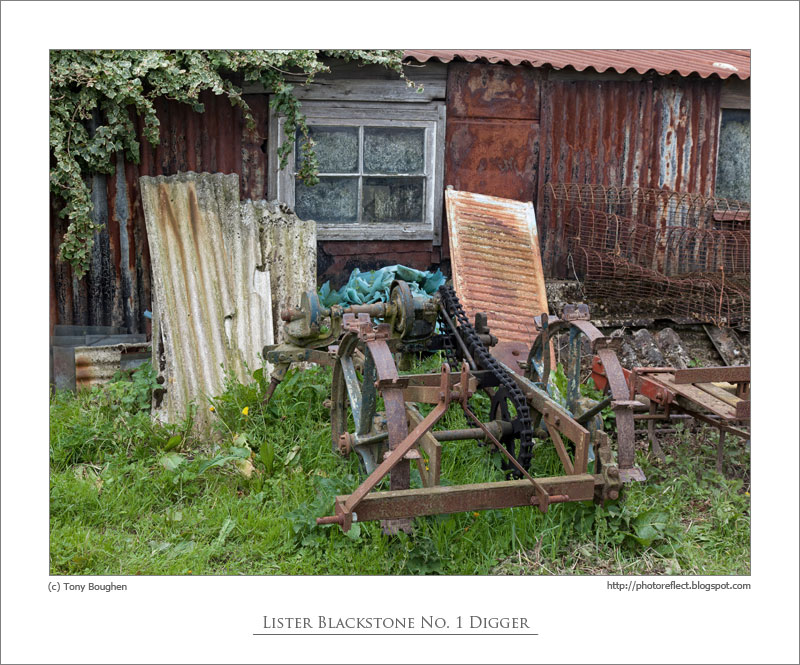
Lister Blackstone No 1 Digger

click photo to enlarge
Yesterday the Sinclair Spectrum home computer celebrated the thirtieth anniversary of its appearance on the market in the UK. I owned one of these machines and enjoyed the affordable introduction to computing that it provided. I can't remember precisely how long I used the Spectrum before I replaced it with a newer and more capable computer, but it can only have been a matter of a few years, such is the lifespan of this kind of technology-based hardware.

I was recently looking at a few pieces of rather older technology associated with vegetable growing, simple machines and tools owned by someone we know, which have had a much longer life than the Spectrum and have been used every year since they were first acquired. The photograph above shows one of them, the Lister Blackstone No 1 Digger, an implement used for harvesting potatoes. I'm no authority on such things, but from what I can gather, it must date from shortly after the takeover of the Stamford-based farm implement maker, Blackstone* & Co, by R.A.Lister & Company of Dursley, Gloucestershire, in 1936. Consequently it is about 75 years old. This particular example was the version designed to be pulled by a horse: a model for fitting to a tractor was also offered. However, the Digger shown above has a blacksmith-made bracket that allows it to be pulled by a small Ferguson tractor, something that happens annually when the potatoes are harvested from the smallholding where it resides.

As we discussed the machine I expressed reservations about it being pulled along a tarmac road to the place where it would be used - those notched lugs on the steel wheels would make for a slow, noisy and potentially damaging journey. However, I was informed that the manufacturer supplied steel rims that fitted round the wheels, locating in each notch on the lugs. One of the pleasures of quite a lot of older technology is the way that simplicity of design and durability of construction combine to create something with a life that can be measured in decades rather than a few short years. I took my photograph of the venerable machine at rest behind an old shed alongside other equipment and cast-off remnants that gave a suitably time-worn backdrop.

 * The name "Blackstone" rang a bell for me, and I remembered a blog entry of an engine nameplate that I posted some years ago. It is the same company.

photograph and text (c) T. Boughen

Camera: Canon
Mode: Aperture Priority
Focal Length: 73mm
 F No: f11
Shutter Speed: 1/60 sec
ISO: 200
Exposure Compensation:  0 EV
Image Stabilisation: On

Tuesday, August 03, 2010

Dobson's Mill, Burgh le Marsh

click photo to enlarge
In recent years I've taken an interest in the half-machine/half-building that is the windmill. In my journeys around Britain I come across them reasonably regularly. They aren't evenly spread through these windy islands: in the hills and mountains of the north and west the water-powered mill located on a stream or river was more often favoured, though on the Fylde Plain of west Lancashire they were found (and still are found) in sufficient numbers that it was known as "windmill land". In the main, however, the east and south of England was the domain of the windmill and it is here that the majority of those that remain can be seen. Many windmills have lost their sails and remain as forlorn, tapering towers, sometimes with, but more often without, their original cap. A significant number of these have been turned into desirable residences. Those with sails are usually in the hands of local authorities, charitable trusts established for the purpose of maintaining the structure, or are the property of private owners. A while ago I visited Moulton windmill in south Lincolnshire: the other day I had a look at Dobson's Mill at Burgh le Marsh near Skegness, also in Lincolnshire.

This windmill is owned by the local council and looked after by a small group of enthusiastic volunteers. It is a tarred, brick-built, five storey structure erected in 1813 by Sam Oxley of Alford. One of the features that distinguishes it from most other tower windmills is the fact that its five sails are left-handed, which means they rotate clockwise. I had a tour of the inside, and found that quite a bit of the original, early nineteenth century fittings and machinery are still in place. My main photograph shows two of the millstones, the top one partly encased in wood of Georgian-period manufacture. Resting on it are a variety of old tools, including some that are used in re-cutting the heavy stones after they have become worn through the regular grinding of corn. The sight of these haphazardly assembled old implements seemed a good subject for a sepia-toned image, and that is how I present it.The smaller image shows the windmill in context with its attendant corrugated steel sheds.


photograph and text (c) T. Boughen

Photo 1 (Photo 2)
Camera: Lumix LX3 (Olympus E510)
Mode: Aperture Priority
Focal Length: 5.1mm (24mm/35mm equiv.) (15mm (30mm/35mm equiv.)
F No: f2 (6.3)
Shutter Speed: 1/30 (400)
ISO: 200 (100)
Exposure Compensation: 0 EV (-0.3 EV)
Image Stabilisation: On