click photo to enlarge
I favour compositions that feature the whole of something - a building a flower, a tree, etc. It may be asymmetrically placed, sometimes it's centrally located, it may be small, or it can just about fill the frame. But, nine times out of ten I include a complete and recognisable subject in my compositions. On the other occasions I deliberately don't! Moreover, when I photograph a fragment, or multiple fragments of several objects I'm fighting my natural predilection.
Take today's photograph. I took a couple of shots of all of this ornamental fountain in Queen's Gardens, Hull, with its wind-blown jets of water partly obscuring Christopher Wray's magnificent Dock Offices of 1867-71. However, the compositions didn't satisfy me; there was too much in the frame and no definite visual focus. So I tried a composition featuring part of the fountains and just two of the three domes in a composition that has a strong diagonal element running from the top left to the bottom right. It proved much better. And, with a fairly contrasty black and white conversion that made the best of the dull day I produced a monochrome shot that pleases me more than most of my recent efforts.
photograph and text © Tony Boughen
Camera: Nikon D5300
Mode: Aperture Priority
Focal Length: 35mm (52mm - 35mm equiv.)
F No: f8
Shutter Speed: 1/320 sec
ISO:100
Exposure Compensation: -0.33 EV
Image Stabilisation: On
Showing posts with label fountain. Show all posts
Sunday, September 14, 2014
Sunday, August 31, 2014
Towers of the winds
click photo to enlarge
Many years ago I visited Athens to look at the architecture of Classical (and later) Greece. One of the many buildings that I viewed was the Tower of the Winds, a 12 metre tall octagonal structure in the Roman agora, that was built in the period between 50BC and 200BC. It features the eight deities associated with wind and has a sundial on each of its faces. It was, essentially, a clock tower.
The other day I was standing in a public space at Canary Wharf in London where there are several clocks indicating time at different locations. We were debating where to sit to eat the lunch that we were carrying. That question was important because, though the sun was shining and the temperature was generally quite pleasant, it was windy and we knew that sitting in the wind would soon result in us feeling cold and uncomfortable. However, it was difficult to find such a place because the tall towers that dominate the location cause the wind to swirl in many directions. We eventually settled on a bench in a well planted area by some water features.
As I ate my sandwich I recalled an article I read recently about a tall tower in Leeds that caused the wind to increase in speed at its base to the point where it often knocked people off their feet, and caused a death when a lorry blew onto a pedestrian. The piece described how structures were being erected at ground level as baffles to reduce the wind velocity. It occurred to me that Canary Wharf's towers were "towers of the wind" too: the gusts definitely seemed to be stronger among them that in the open space by the river. But, the people who work there seemed to know the best places to sit at lunchtime and enjoy food and a break, so I took the opportunity to photograph the be-suited people enjoying their moments of mid-day leisure.
photograph and text © Tony Boughen
Camera: Nikon D5300
Mode: Aperture Priority
Focal Length: 140mm (210mm - 35mm equiv.)
F No: f8
Shutter Speed: 1/500 sec
ISO:100
Exposure Compensation: -0.33 EV
Image Stabilisation: On
Labels:
Canary Wharf,
fountain,
London,
office blocks,
workers
Thursday, June 26, 2014
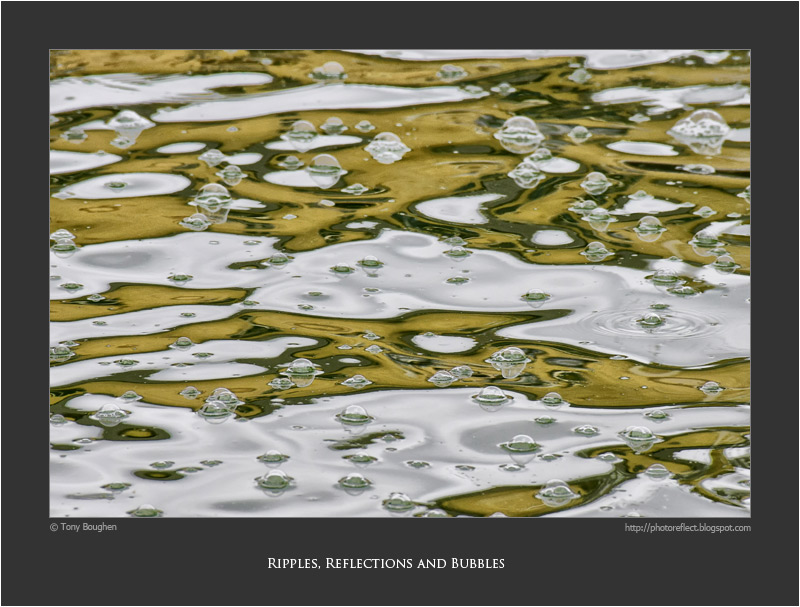
Ripples, reflections and bubbles
click photo to enlarge
I've been doing less photography than is usual for me in recent months - other activities and interests have been consuming more of my time. And, as a consequence, I think my photographic eye has become somewhat dulled. The fact is, with photography as with many other undertakings, pursuing the act on a regular basis is the only way of maintaining an acceptable level of performance. Just as the soccer player or musician loses their touch without regular training, matches or performances, so too does a photographer find it harder to see subjects once he or she begins taking fewer shots.
I've experienced troughs of this kind before. The way I dealt with it then was to keep on snapping or - and this works for me but may not for others - by giving more attention to seeking out semi-abstract subjects. I don't know why this should be effective, but it has been in the past and it may help again. My shot with the out of focus barbed wire was an example of my endeavours in this direction, and so too is today's photograph. I'd been photographing the large, formal fountain in Queen's Gardens, Hull, and producing nothing of interest. So, in pursuit of my short-term aim I concentrated on the reflections and bubbles produced by the falling drops of water. Not the best example of this genre that I've produced, but better than most of what I've been producing lately.
photograph and text © Tony Boughen
Camera: Nikon D5300
Mode: Aperture Priority
Focal Length: 140mm (210mm - 35mm equiv.)
F No: f8
Shutter Speed: 1/250 sec
ISO:280
Exposure Compensation: 0 EV
Image Stabilisation: On
Labels:
bubbles,
fountain,
Hull,
reflections,
semi-abstract,
water
Thursday, November 14, 2013
No budget for photographs
click photo to enlarge
When I changed my contact and enquiries page in February 2012 (modified in April) I had an email from a regular visitor suggesting that my wording was, perhaps, a touch off-putting to people interested in using my photographs. I explained that it was meant to be because I was getting fed up of people contacting me and asking to use an image commercially, but unwilling to pay for doing so. The last straw, and the prompt for my somewhat brusque re-write, was a communication from a company working in the field of Combined Heat and Power units. They explained that my photograph of the undulating, rather artistic cladding that surrounds one of the CHP units at Guy's and St Thomas' Hospitals in London, would be perfect for a publication they were putting together. They explained that they were a "non-profit" company and regretted that they had no budget for photography so couldn't pay for the image. However, should I consent to them using my photograph, they explained, I could be sure that they would give me full written credit.
My response was polite, curt and in the negative. When I re-wrote my contact information I wrote my reasons for this approach in a blog post called "Something for nothing". I was reminded of it the other day when browsing a photography website. One of the posts was a copy of a letter from a musician who had been approached by a TV production company seeking music and regretting that they had "no budget for music" to pay for it. His eloquent and heartfelt response to the solicitation (originally posted on music websites) chimed with a lot of professional and enthusiast photographers who are regularly asked for their work without the offer of recompense and consequently it has been widely circulated on photography websites too. It's well worth reading.
All of which has nothing to do with today's photograph of the upturned, broken top of a Victorian cast iron fountain basin. Except, I've discovered that you never know just what kind of photograph is going to be attractive to a company. Who would have thought the hospital CHP unit would be attractive to anyone? Is this broken fountain? It makes me glad that photography is my interest rather than my job.
photograph and text © Tony Boughen
Camera: Canon
Mode: Aperture Priority
Focal Length: 88mm
F No: f7.1
Shutter Speed: 1/100
ISO: 100
Exposure Compensation: -0.33 EV
Image Stabilisation: On
When I changed my contact and enquiries page in February 2012 (modified in April) I had an email from a regular visitor suggesting that my wording was, perhaps, a touch off-putting to people interested in using my photographs. I explained that it was meant to be because I was getting fed up of people contacting me and asking to use an image commercially, but unwilling to pay for doing so. The last straw, and the prompt for my somewhat brusque re-write, was a communication from a company working in the field of Combined Heat and Power units. They explained that my photograph of the undulating, rather artistic cladding that surrounds one of the CHP units at Guy's and St Thomas' Hospitals in London, would be perfect for a publication they were putting together. They explained that they were a "non-profit" company and regretted that they had no budget for photography so couldn't pay for the image. However, should I consent to them using my photograph, they explained, I could be sure that they would give me full written credit.
My response was polite, curt and in the negative. When I re-wrote my contact information I wrote my reasons for this approach in a blog post called "Something for nothing". I was reminded of it the other day when browsing a photography website. One of the posts was a copy of a letter from a musician who had been approached by a TV production company seeking music and regretting that they had "no budget for music" to pay for it. His eloquent and heartfelt response to the solicitation (originally posted on music websites) chimed with a lot of professional and enthusiast photographers who are regularly asked for their work without the offer of recompense and consequently it has been widely circulated on photography websites too. It's well worth reading.
All of which has nothing to do with today's photograph of the upturned, broken top of a Victorian cast iron fountain basin. Except, I've discovered that you never know just what kind of photograph is going to be attractive to a company. Who would have thought the hospital CHP unit would be attractive to anyone? Is this broken fountain? It makes me glad that photography is my interest rather than my job.
photograph and text © Tony Boughen
Camera: Canon
Mode: Aperture Priority
Focal Length: 88mm
F No: f7.1
Shutter Speed: 1/100
ISO: 100
Exposure Compensation: -0.33 EV
Image Stabilisation: On
Thursday, April 19, 2012
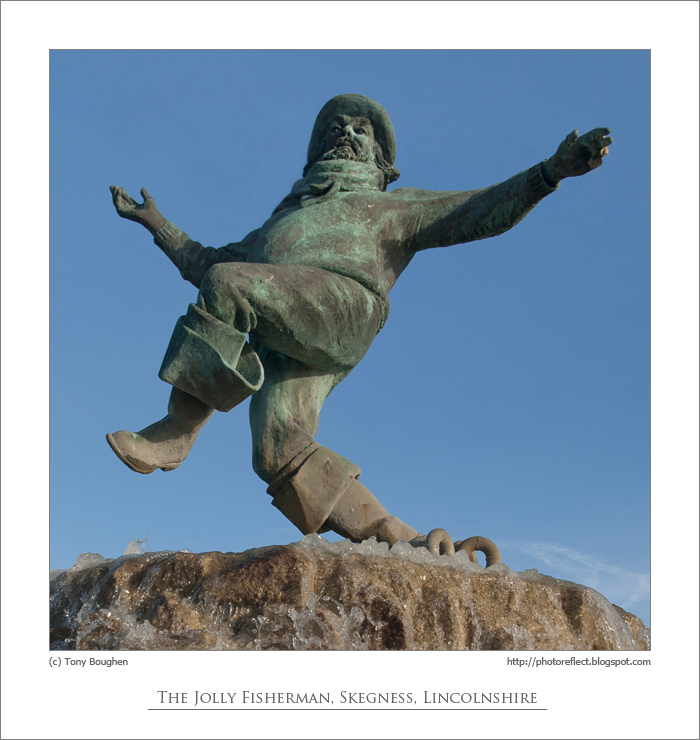
The Jolly Fisherman, Skegness
click photo to enlarge
In the middle ages the Lincolnshire town of Skegness suffered from the depredations of the sea. Buildings were lost, and its continuance was precarious. But, it survived and its medieval church can still be seen. In the early nineteenth century the town gained some standing as a desirable resort for the well-to-do. However, most of Skegness's growth came after the arrival of the railway in 1876 when a conscious decision was made to develop the town as a seaside resort.Under the direction of the major landowner, the Earl of Scarborough, the expansion of Skegness was planned on a grid and developed quite slowly, with wide avenues, tree planting and monuments. Only when the area fronting the sea was bought by the town council in 1921 did the brash resort that we see today begin to appear. Not that there hadn't been a concerted effort in the earlier years of the twentieth century to attract visitors.
In 1908 the London and North Eastern Railway company commissioned the illustrator, John Hassall, to produce a poster to advertise Skegness. His creation, for which he was paid twelve guineas, has become one of the best known seaside advertising posters in Britain. The "jolly fisherman" character that it features, as well as the slogan, "Skegness is so bracing", became so closely associated with the town they that have been used in the original form and in several updated-versions almost without interruption over the past century. Hassall's first, hand-painted poster is now displayed in Skegness Town Hall. The jolly fisherman continues to be used on many souvenirs and advertisements for the town, and in recent years has been made the centrepiece of a fountain in one of the sea-front gardens.I took this contre-jour photograph of the prancing figure on top of the cascading water, positioning myself so that the aircraft vapour trails framed the silhouetted fisherman like Hollywood searchlights. It's hard to predict the outcome with photographs that include the sun in the frame, but I've shot enough of this kind of image to know that even the big white orb and lens flare don't detract from the impact and drama that can be achieved by photographing against the light.
photograph and text (c) T. Boughen
Photo 1
Camera: Canon
Mode: Aperture Priority
Focal Length: 38mm
F No: f7.1
Shutter Speed: 1/2000 sec
ISO: 100
Exposure Compensation: 0 EV
Image Stabilisation: On
Labels:
contre jour,
fountain,
Jolly Fisherman,
Lincolnshire,
Skegness,
vapour trails
Friday, July 02, 2010
Cast iron and fountains
click photo to enlarge
Every now and then I get a flier through my letter-box soliciting unwanted metal items. They are delivered by a scrap metal dealer who collects anything that people want to throw away. These items go to UK recycling centres, or increasingly, for export to China which has an insatiable appetite for metal. When I lived in North-West England I often saw ships at Glasson Dock near Lancaster loading shredded waste metal for export. On a recent visit to Great Yarmouth in Norfolk I saw this again.The Industrial Revolution brought a great increase in the amount of metal that Britain manufactured and used. It also saw the invention of different kinds of metal for specialist purposes, and iron and steel, in particular, started to usurp more traditional materials. Buildings started to employ structural steel in place of wood, stone and brick. In ship-building wood became confined to smaller craft as first iron, then steel took over. Even in everyday objects metal became the material of choice. Take ornamental and drinking fountains. These were traditionally made of stone, had very functional designs (except where marble was used) and lasted for centuries with regular, but basic, maintenance. However, the spread of cast-iron manufacture eventually changed this market, and every city and town, and many villages installed ornate fountains made of this relatively inexpensive and very malleable material. They continued being produced well into the twentieth century (see my earlier blog post about the Coronation Fountain at March, Cambridgeshire).
I recently came across another cast-iron fountain in The Circle garden at Wisbech, Cambridgeshire. It is, very typically, located at the center of an axial path, an eyecatcher and a thing of beauty at a focal point. The bowl has very attractive leaves, serpentine tendrils and paterae embellishing its surface. Regrettably, however, it is currently detached (broken) from its stem. It lays at the base of some bushes, rusting and gathering the odd shrivelled leaf that falls on it during our present dry spell. I hope the bowl is only temporarily parted from its stem, and is awaiting a suitably skilled craftsman who will make the fountain whole again: its quality, age and location demand no less. It would be a small tragedy if the pieces were shipped off to China to be returned in pieces of inexpensive, ephemeral junk.
photograph and text (c) T. Boughen
Camera: Olympus E510
Mode: Aperture Priority
Focal Length: 22mm (44mm/35mm equiv.)
F No: f7.1
Shutter Speed: 1/80
ISO: 100
Exposure Compensation: -0.3 EV
Image Stabilisation: On
Labels:
Cambridgeshire,
cast iron,
fountain,
The Crescent,
Victorian,
Wisbech
Subscribe to:
Posts (Atom)