click photo to enlarge
I grew up in a valley on one side of which were, nearby, high, rugged hills and on the other lower hills with a more distant prospect. As a child I called the very tops of the higher side of the valley the "skyline" and summits of the most distant part of lower hills the "horizon". Nobody told me to make this kind of distinction - it simply seemed natural that the skyline was near and clearly above you whereas the horizon was the distant point where earth and sky appear to meet. I still feel that is a reasonable viewpoint.
Perhaps it was growing up in a valley that gave me an interest in the horizon - observing its peculiarities, noting how it changed as I moved, wondering what was beyond it. Quite a few of my photographs feature the horizon (or skyline) and in some, as is the case with today's photograph, most of the detail is clustered there. What I like about scenes and photographs like this one is the way that man's massive achievements - cooling towers, cranes, chimneys, ferries become as nothing when seen against a great river and the vastness of the sky.
photograph and text © Tony Boughen
Photo Title: River Humber Seen From Hull Pier
Camera: Olympus E-M10
Mode: Aperture Priority
Focal Length: 42mm (84mm - 35mm equiv.)
F No: f8
Shutter Speed: 1/320 sec
ISO:200
Exposure Compensation: 0 EV
Image Stabilisation: On
Showing posts with label clouds. Show all posts
Wednesday, August 03, 2016
Saturday, July 30, 2016
Improbable photographic colours
click photo to enlarge
Sometimes it's the depth of the blue in the sky, other times its the lurid green of the fresh grass, and frequently it's the improbable reds and oranges of the sunset (or sunrise). The other day, on a visit to the Yorkshire city of Hull (Kingston upon Hull to give it its full title) it was the blackness of the clouds. I'm referring, of course, to the way that reality sometimes looks unreal. In each of the instances cited above the observant viewer or photographer might well think that the saturation slider has been applied with a heavy hand, although there is a school of photography where this kind of embellishment has become pretty much the norm (see 500px.com).
We visited Hull on a day when heavy showers and brighter spells alternated, and the clouds produced by this weather were striking. We were walking near the pier where the River Hull meets the River Humber, passing the end of Queen Street, when we both noticed the smoke-like clouds drifting past the tower of Holy Trinity church. My wife remarked that they wouldn't look real in a photograph and I know just what she means.We have reached a point in the development of digital photography when the manipulation of the relatively faithful images produced by cameras are routinely "enhanced", either straight away and automatically by software (e.g. Google's "auto awesome"), or later by the user's deliberate choice. I really wish it would stop. Our world is awesome enough without making it look otherworldly.
photograph and text © Tony Boughen
Photo Title: Queen Street and Holy Trinity, Hull
Camera: Olympus E-M10
Mode: Aperture Priority
Focal Length: 39mm (78mm - 35mm equiv.)
F No: f5.3
Shutter Speed: 1/2000 sec
ISO:200
Exposure Compensation: -0.3 EV
Image Stabilisation: On
Sometimes it's the depth of the blue in the sky, other times its the lurid green of the fresh grass, and frequently it's the improbable reds and oranges of the sunset (or sunrise). The other day, on a visit to the Yorkshire city of Hull (Kingston upon Hull to give it its full title) it was the blackness of the clouds. I'm referring, of course, to the way that reality sometimes looks unreal. In each of the instances cited above the observant viewer or photographer might well think that the saturation slider has been applied with a heavy hand, although there is a school of photography where this kind of embellishment has become pretty much the norm (see 500px.com).
We visited Hull on a day when heavy showers and brighter spells alternated, and the clouds produced by this weather were striking. We were walking near the pier where the River Hull meets the River Humber, passing the end of Queen Street, when we both noticed the smoke-like clouds drifting past the tower of Holy Trinity church. My wife remarked that they wouldn't look real in a photograph and I know just what she means.We have reached a point in the development of digital photography when the manipulation of the relatively faithful images produced by cameras are routinely "enhanced", either straight away and automatically by software (e.g. Google's "auto awesome"), or later by the user's deliberate choice. I really wish it would stop. Our world is awesome enough without making it look otherworldly.
photograph and text © Tony Boughen
Photo Title: Queen Street and Holy Trinity, Hull
Camera: Olympus E-M10
Mode: Aperture Priority
Focal Length: 39mm (78mm - 35mm equiv.)
F No: f5.3
Shutter Speed: 1/2000 sec
ISO:200
Exposure Compensation: -0.3 EV
Image Stabilisation: On
Labels:
church,
clouds,
colour saturation,
Holy Trinity,
Hull,
photographic manipulation,
Queen Street,
street
Monday, July 04, 2016
Stocks Reservoir
click photo to enlarge
When I was a teenager living in Settle (then in the West Riding of Yorkshire, now in North Yorkshire) I reasonably frequently cycled the several miles to Stocks Reservoir (then in the West Riding of Yorkshire, now in Lancashire), a large area of water in the Forest of Bowland. The purpose of my journey, up hill and down dale, was bird watching. This had to be done from the road that cuts across a narrow arm of the reservoir and from the few public footpaths that allowed a view of the water and its margins. Elsewhere were signs saying "Keep Out", others warning against the risk of fire (many square miles of forest surround the reservoir) and yet more reminding people that the man-made lake was their drinking water.The tone of all this was decidedly unwelcoming.
How times change. Today, though the risk of fire is no less and it is still a water supply, the area around the reservoir features cyclepaths, visitor attractions, bird hides, footpaths of varying lengths and a general welcoming atmosphere greets the visitor. Moreover, fishermen are to be seen on boats, criss-crossing the water in search of their prey. Look carefully at today's photograph and you'll see a pair in their boat, an insignificant dot in the big landscape under a even bigger sky.
photograph and text © Tony Boughen
Photo Title: Fishermen on Stocks Reservoir, Lancashire
Mode: Aperture Priority
Focal Length: 42mm (84mm - 35mm equiv.) crop
F No: f6.3
Shutter Speed: 1/2000 sec
ISO:200
Exposure Compensation: -0.3 EV
Image Stabilisation: On
When I was a teenager living in Settle (then in the West Riding of Yorkshire, now in North Yorkshire) I reasonably frequently cycled the several miles to Stocks Reservoir (then in the West Riding of Yorkshire, now in Lancashire), a large area of water in the Forest of Bowland. The purpose of my journey, up hill and down dale, was bird watching. This had to be done from the road that cuts across a narrow arm of the reservoir and from the few public footpaths that allowed a view of the water and its margins. Elsewhere were signs saying "Keep Out", others warning against the risk of fire (many square miles of forest surround the reservoir) and yet more reminding people that the man-made lake was their drinking water.The tone of all this was decidedly unwelcoming.
How times change. Today, though the risk of fire is no less and it is still a water supply, the area around the reservoir features cyclepaths, visitor attractions, bird hides, footpaths of varying lengths and a general welcoming atmosphere greets the visitor. Moreover, fishermen are to be seen on boats, criss-crossing the water in search of their prey. Look carefully at today's photograph and you'll see a pair in their boat, an insignificant dot in the big landscape under a even bigger sky.
photograph and text © Tony Boughen
Photo Title: Fishermen on Stocks Reservoir, Lancashire
Mode: Aperture Priority
Focal Length: 42mm (84mm - 35mm equiv.) crop
F No: f6.3
Shutter Speed: 1/2000 sec
ISO:200
Exposure Compensation: -0.3 EV
Image Stabilisation: On
Labels:
clouds,
fishermen,
Forest of Bowland,
landscape,
Stocks Reservoir
Sunday, November 29, 2015
Rose-coloured clouds
click photo to enlarge
"What is the good of your stars and trees, your sunrise and the wind, if they do not enter into our daily lives."
E. M. Forster (1879-1970), English novelist
Some people find it hard to look forward to retiring from work because for them it signifies the beginning of the end of their lives, something they don't want reminding about. It can be just that if you let it, if you are one of the many people for whom the three stages of life are childhood and education, work, and lastly retirement. However, retirement can also be seen as a distinct, fulfilling, exciting time, one where each day offers experiences and opportunities that work in particular, often reduced to brief episodes, but more usually denied.
The quotation by E. M. Forster (above) is one that I like because it emphasises the importance and beauty of everyday experiences, phenomena that are too often overlooked because they are common. Moreover, the things that he itemises are those that work can relegate to the infrequent and the snatched, to the periphery of life. Retirement can, if you so wish it, bring them (and many other everyday pleasures) back to the centre of your existence and the joys that they offer can be life enriching.
In my working life I rose quite early and returned home quite late; I had long days. Getting up in the morning I would often speed through ablutions and breakfast and be gone. There was no time to do what I do daily in retirement: namely, open the curtains and look at the day and reflect on how I might fill it. Or admire the frosted grass, the autumnal leaves, the light fall of snow or the rose-coloured clouds of a fine sunrise. The sky in today's photograph appeared for only five or so minutes before I sat down for breakfast. Had I been working I probably wouldn't have noticed it. But, in retirement I got my camera and took a few shots of the beautiful sight.
photograph and text © Tony Boughen
Camera: Olympus E-M10
Mode: Aperture Priority
Focal Length: 22mm (44mm - 35mm equiv.)
F No: f4.5
Shutter Speed: 1/80 sec
ISO:200
Exposure Compensation: -0.3EV
Image Stabilisation: On
"What is the good of your stars and trees, your sunrise and the wind, if they do not enter into our daily lives."
E. M. Forster (1879-1970), English novelist
Some people find it hard to look forward to retiring from work because for them it signifies the beginning of the end of their lives, something they don't want reminding about. It can be just that if you let it, if you are one of the many people for whom the three stages of life are childhood and education, work, and lastly retirement. However, retirement can also be seen as a distinct, fulfilling, exciting time, one where each day offers experiences and opportunities that work in particular, often reduced to brief episodes, but more usually denied.
The quotation by E. M. Forster (above) is one that I like because it emphasises the importance and beauty of everyday experiences, phenomena that are too often overlooked because they are common. Moreover, the things that he itemises are those that work can relegate to the infrequent and the snatched, to the periphery of life. Retirement can, if you so wish it, bring them (and many other everyday pleasures) back to the centre of your existence and the joys that they offer can be life enriching.
In my working life I rose quite early and returned home quite late; I had long days. Getting up in the morning I would often speed through ablutions and breakfast and be gone. There was no time to do what I do daily in retirement: namely, open the curtains and look at the day and reflect on how I might fill it. Or admire the frosted grass, the autumnal leaves, the light fall of snow or the rose-coloured clouds of a fine sunrise. The sky in today's photograph appeared for only five or so minutes before I sat down for breakfast. Had I been working I probably wouldn't have noticed it. But, in retirement I got my camera and took a few shots of the beautiful sight.
photograph and text © Tony Boughen
Camera: Olympus E-M10
Mode: Aperture Priority
Focal Length: 22mm (44mm - 35mm equiv.)
F No: f4.5
Shutter Speed: 1/80 sec
ISO:200
Exposure Compensation: -0.3EV
Image Stabilisation: On
Labels:
clouds,
E. M. Forster,
Fens,
retirement,
sky,
sunrise,
trees,
winter,
work
Friday, November 20, 2015
Delusions from on high
click photo to enlarge
When it was suggested that Tony Blair should have a prime ministerial jet for international travel - popularly dubbed at the time "Blairforce One" - his chancellor, Gordon Brown, wisely scotched the idea. He judged, quite correctly, that it wouldn't play well with the British people. George Osborne, quite typically, doesn't appear to be showing the same good judgement, and I read that an RAF Airbus is to be converted for travel by senior ministers. The justification for the expenditure is that it will cost less than chartering aircraft or using scheduled flights, which is, again, quite typical of a government that knows the price of everything but the value of nothing.
It seems to me that it is salutary for a government composed largely of millionaires from wealthy families, who are privately educated and do not have to use many of the public services that those they govern must use, to use a more humble form of air travel, to know something of what the electorate experiences. However, I've come to expect double standards from people who can agree to their their own public sector salaries increasing by 10% while holding down those of lesser mortals in the the public sector to 1%. I'm sure that as they jet off on important business, by-passing the herds of plebeians shuffling through security checks and squeezing into their economy class seats, ministers will delude themselves that their luxury in saving the country money is the only motivation for their cossetted travel. And I'm sure we'll all agree that it is. Not.
Today's photograph shows a view of the Bay of Biscay from 37,000 feet. It includes four ships, the largest of which, a container vessel, is near the bottom right of the frame.
photograph and text © Tony Boughen
Camera: Sony RX100
Mode: Aperture Priority
Focal Length: 12.2mm (33mm - 35mm equiv.)
F No: f3.5
Shutter Speed: 1/1000
ISO: 125
Exposure Compensation: 0 EV
Image Stabilisation: On
When it was suggested that Tony Blair should have a prime ministerial jet for international travel - popularly dubbed at the time "Blairforce One" - his chancellor, Gordon Brown, wisely scotched the idea. He judged, quite correctly, that it wouldn't play well with the British people. George Osborne, quite typically, doesn't appear to be showing the same good judgement, and I read that an RAF Airbus is to be converted for travel by senior ministers. The justification for the expenditure is that it will cost less than chartering aircraft or using scheduled flights, which is, again, quite typical of a government that knows the price of everything but the value of nothing.
It seems to me that it is salutary for a government composed largely of millionaires from wealthy families, who are privately educated and do not have to use many of the public services that those they govern must use, to use a more humble form of air travel, to know something of what the electorate experiences. However, I've come to expect double standards from people who can agree to their their own public sector salaries increasing by 10% while holding down those of lesser mortals in the the public sector to 1%. I'm sure that as they jet off on important business, by-passing the herds of plebeians shuffling through security checks and squeezing into their economy class seats, ministers will delude themselves that their luxury in saving the country money is the only motivation for their cossetted travel. And I'm sure we'll all agree that it is. Not.
Today's photograph shows a view of the Bay of Biscay from 37,000 feet. It includes four ships, the largest of which, a container vessel, is near the bottom right of the frame.
photograph and text © Tony Boughen
Camera: Sony RX100
Mode: Aperture Priority
Focal Length: 12.2mm (33mm - 35mm equiv.)
F No: f3.5
Shutter Speed: 1/1000
ISO: 125
Exposure Compensation: 0 EV
Image Stabilisation: On
Labels:
air travel,
aircraft,
Bay of Biscay,
clouds,
government,
politics,
sea
Tuesday, May 21, 2013
Double the value
click photo to enlarge
In one of my early posts - in March 2006 as it happens - I extolled the advantages of a west-facing coast. I happened to live near the west-facing Fylde coast at the time and during my years in Lancashire I frequently photographed during the evening by the sea. Such a coast has a singular advantage at this time of day because, if the sun goes down and produces a blazing sunset, one with fiery skies of red, orange and yellow, the reflection on the sea below doubles the magical effect. I now live in Lincolnshire, a county with a coast that faces east and my nearest west facing coast is round on the other side of The Wash in Norfolk, in the area of Hunstanton. In fact, that is the only piece of coast in the east of east of England that faces west (a good quiz question there I think).
Fortunately the sea is not the only reflective surface that doubles the value of a sunset: ponds, lakes and rivers do as well. So too do the glass curtain walls of modern high-rise buildings. This particular sunset shows the same glass wall that features in today's photograph. It is in Southwark, London. On the day in question it wasn't evening as I passed but early morning and looking up I saw that the sky was being reflected in a rather fine manner. Such reflections regularly attract my eye and feature fairly strongly in this blog. I wonder if the extra value that they add to the subject they reflect appeals to my Yorkshire upbringing?
photograph and text © Tony Boughen
Camera: Sony RX100
Mode: Aperture Priority
Focal Length: 10.4mm (28mm - 35mm equiv.)
F No: f6.3
Shutter Speed: 1/500
ISO: 125
Exposure Compensation: -0.3 EV
Image Stabilisation: On
In one of my early posts - in March 2006 as it happens - I extolled the advantages of a west-facing coast. I happened to live near the west-facing Fylde coast at the time and during my years in Lancashire I frequently photographed during the evening by the sea. Such a coast has a singular advantage at this time of day because, if the sun goes down and produces a blazing sunset, one with fiery skies of red, orange and yellow, the reflection on the sea below doubles the magical effect. I now live in Lincolnshire, a county with a coast that faces east and my nearest west facing coast is round on the other side of The Wash in Norfolk, in the area of Hunstanton. In fact, that is the only piece of coast in the east of east of England that faces west (a good quiz question there I think).
Fortunately the sea is not the only reflective surface that doubles the value of a sunset: ponds, lakes and rivers do as well. So too do the glass curtain walls of modern high-rise buildings. This particular sunset shows the same glass wall that features in today's photograph. It is in Southwark, London. On the day in question it wasn't evening as I passed but early morning and looking up I saw that the sky was being reflected in a rather fine manner. Such reflections regularly attract my eye and feature fairly strongly in this blog. I wonder if the extra value that they add to the subject they reflect appeals to my Yorkshire upbringing?
photograph and text © Tony Boughen
Camera: Sony RX100
Mode: Aperture Priority
Focal Length: 10.4mm (28mm - 35mm equiv.)
F No: f6.3
Shutter Speed: 1/500
ISO: 125
Exposure Compensation: -0.3 EV
Image Stabilisation: On
Labels:
clouds,
curtain wall,
glass,
London,
reflection,
sky,
Southwark,
sunset
Wednesday, December 26, 2012
Photographic decisions
click photo to enlarge
Every time we take a photograph we make decisions. If we assume that we've already decided the nature of the subject then the first one concerns what part of our field of view we will use as the composition or whether we will we use it all. Having decided that we have to consider what we want to say through the photograph - what it's about. Is it representational reportage where the subject is all important and we are saying, "look at this", to the viewer? Is the way we show the subject, the viewpoint we adopt, the way we use light, composition, colour etc. important, so that the image us as much about the photographers vision as it is the subject, and we are inviting the viewer to look at the subject in our particular way? Or is there an intention to introduce an element of abstraction, to make the viewer wonder what they are looking at and why the image was conceived in that way? There are other decisions to be made, of course, but these three interest me because I deliberately exploit them all at various times in my photography.
Today's photograph falls into the last of these three categories. I took it one evening in London as I looked up at the darkening sky with its pink-tinged clouds and their reflection on the glass of the office buildings. I wanted to make a photograph with very little in it, that concentrated on just a few elements arranged in a simple composition. Moreover, I was keen to produce an image where the component parts would be appreciated for their intrinsic graphic qualities rather than because they were part of the recognisable, real world. The shot I came up with is divided into two halves by a diagonal line, sky and clouds on one side, glass, glazing bars and cladding on the other. It contrasts softness and irregularity with hardness and regular linearity, the colours o the sky and their reflections uniting the two halves, with an element of abstraction to complete the mix.
photograph and text © Tony Boughen
Camera: LX3
Mode: Aperture Priority
Focal Length: 12.8mm (60mm - 35mm equiv.)
F No: 2.8
Shutter Speed: 1/125
ISO: 400
Exposure Compensation: 0 EV
Image Stabilisation: On
Every time we take a photograph we make decisions. If we assume that we've already decided the nature of the subject then the first one concerns what part of our field of view we will use as the composition or whether we will we use it all. Having decided that we have to consider what we want to say through the photograph - what it's about. Is it representational reportage where the subject is all important and we are saying, "look at this", to the viewer? Is the way we show the subject, the viewpoint we adopt, the way we use light, composition, colour etc. important, so that the image us as much about the photographers vision as it is the subject, and we are inviting the viewer to look at the subject in our particular way? Or is there an intention to introduce an element of abstraction, to make the viewer wonder what they are looking at and why the image was conceived in that way? There are other decisions to be made, of course, but these three interest me because I deliberately exploit them all at various times in my photography.
Today's photograph falls into the last of these three categories. I took it one evening in London as I looked up at the darkening sky with its pink-tinged clouds and their reflection on the glass of the office buildings. I wanted to make a photograph with very little in it, that concentrated on just a few elements arranged in a simple composition. Moreover, I was keen to produce an image where the component parts would be appreciated for their intrinsic graphic qualities rather than because they were part of the recognisable, real world. The shot I came up with is divided into two halves by a diagonal line, sky and clouds on one side, glass, glazing bars and cladding on the other. It contrasts softness and irregularity with hardness and regular linearity, the colours o the sky and their reflections uniting the two halves, with an element of abstraction to complete the mix.
photograph and text © Tony Boughen
Camera: LX3
Mode: Aperture Priority
Focal Length: 12.8mm (60mm - 35mm equiv.)
F No: 2.8
Shutter Speed: 1/125
ISO: 400
Exposure Compensation: 0 EV
Image Stabilisation: On
Labels:
architecture,
clouds,
composition,
evening,
London,
offices,
photography,
semi-abstract,
sky
Sunday, October 14, 2012
More of the fence
click photo to enlarge
In a recent post I mentioned how, in common with most photographic enthusiasts, I make multiple exposures of a subject that I feel is going to produce a good photograph. But I also observed that, in the great majority of instances, the first or second shot that I take usually proves to be the best, and that the subsequent ones rarely improve on them in any way.
But, a subject that can produce one good photograph can often produce a couple more slightly different photographs, and I frequently find myself "working over" a subject, trying to find in it everything that it has to offer photographically speaking. In the past I've likened this to mining a photographic seam in the way that miners try to extract every last piece of coal before moving their machinery on to the next location. The fence I encountered the other day offered that kind of opportunity and today I've posted a couple of the other photographs I took of it.
The main one has a semi-abstract look that appeals to me, and I was pleased that the newly planted, alder trees still had enough leaves on them to add some shadows to the bottom of the image. The idea of the smaller photograph appealed for the same reasons that yesterday's did - the ambiguity of real sky juxtaposed with a photograph of sky. I was tempted to include the graffiti that was at the bottom of the sky photograph but it was just too coarse for family viewing! However, the scratch and and the odd mark add just enough to make it clear what is being viewed.
The other photographs on the fence were old, black and white shots of Wisbech. They were the work of Lilian Ream who ran a photographic studio in the town from 1909 to 1949. She did any work that came her way including portraits, events and news. I didn't manage to make a satisfactory image that included any of her displayed work, but I did buy a book of her photographs from the local museum.
photograph and text © Tony Boughen
Photo 1
Camera: Canon
Mode: Aperture Priority
Focal Length: 47mm
F No: f7.1
Shutter Speed: 1/800
ISO: 100
Exposure Compensation: 0 EV
Image Stabilisation: On
In a recent post I mentioned how, in common with most photographic enthusiasts, I make multiple exposures of a subject that I feel is going to produce a good photograph. But I also observed that, in the great majority of instances, the first or second shot that I take usually proves to be the best, and that the subsequent ones rarely improve on them in any way.
But, a subject that can produce one good photograph can often produce a couple more slightly different photographs, and I frequently find myself "working over" a subject, trying to find in it everything that it has to offer photographically speaking. In the past I've likened this to mining a photographic seam in the way that miners try to extract every last piece of coal before moving their machinery on to the next location. The fence I encountered the other day offered that kind of opportunity and today I've posted a couple of the other photographs I took of it.
The main one has a semi-abstract look that appeals to me, and I was pleased that the newly planted, alder trees still had enough leaves on them to add some shadows to the bottom of the image. The idea of the smaller photograph appealed for the same reasons that yesterday's did - the ambiguity of real sky juxtaposed with a photograph of sky. I was tempted to include the graffiti that was at the bottom of the sky photograph but it was just too coarse for family viewing! However, the scratch and and the odd mark add just enough to make it clear what is being viewed.
The other photographs on the fence were old, black and white shots of Wisbech. They were the work of Lilian Ream who ran a photographic studio in the town from 1909 to 1949. She did any work that came her way including portraits, events and news. I didn't manage to make a satisfactory image that included any of her displayed work, but I did buy a book of her photographs from the local museum.
photograph and text © Tony Boughen
Photo 1
Camera: Canon
Mode: Aperture Priority
Focal Length: 47mm
F No: f7.1
Shutter Speed: 1/800
ISO: 100
Exposure Compensation: 0 EV
Image Stabilisation: On
Labels:
Cambridgeshire,
clouds,
fence,
Lilian Ream,
semi-abstract,
Wisbech
Tuesday, August 07, 2012
Southwold and the weather
click photo to enlarge
"The English winter - ending in July, to recommence in August"Lord Byron (1788-1824), English poet
Given that he devoted so much of his life to his poetry, his love affairs, travel in the Mediterranean region and revolutionary activities, it's a wonder that Byron noticed the English weather. Perhaps the poet in him drew his attention to it and his experience of hot, sunny climes caused him to lament its relative coolness. As a summary of England's weather, however, he was woefully inaccurate, though today's photograph might seem to suggest otherwise.
It shows the Suffolk coastal town of Southwold, renowned as a watering hole of the English middle classes. I took the shot on August 2nd on a day that was dull, cool, windy, showery, warm (in spells) and sunny. English days often involve multiple kinds of weather and this early August day was one such. What it wasn't was wintry. In fact, I don't imagine that Byron's words were meant to be taken literally. Rather, the intention would have been humorous, making a joke of England's weather as so many do. It reminds me of the remark by Michael Flanders, the late English actor and singer: "It's spring in England. I missed it last year. I was in the bathroom."Many have seen the weather as an influence on the character of the English. The Victorian writer, Charles Kingsley, said in his poem "Ode to the North-East Wind" (1858), " 'Tis the hard grey weather breeds hard English men." Whether that be true or not, shortly after I'd taken this photograph I noted several men and women swimming in the dark grey sea, to be joined by quite a few more as the clouds were whisked away on the wind to be be replaced by more prolonged sun.
I took my shot from Southwold's pier. This is one of the few around our coast that are not Victorian or Edwardian constructions. Consequently it has less of the ornate, decorative metal work characteristic of the older structures, little by way of brash colour, and is altogether a more tasteful, sedate sort of pier, eminently suitable for its location. Some of the town's beach huts can be seen lining the promenade. The uniformly white and blue row to the right are available for hire: The multicoloured collection nearer the centre are some of the many privately owned examples, each loudly (though sometimes subtly) asserting its individuality
photograph and text © Tony Boughen
Camera: Canon
Mode: Aperture Priority
Focal Length: 100mm
F No: f8
Shutter Speed: 1/1000 sec
ISO: 100
Exposure Compensation: -0.33 EV
Image Stabilisation: On
Wednesday, July 18, 2012
Clouds, letters and imagination
click photo to enlarge
"Clouds That Look Like Things" is the very accurate title of book available from the Cloud Appreciation Society*. The photographs for the publication were supplied by Society members and come from all over the world. Flying saucers, fish, dragons, people - you name it and someone, somewhere has probably photographed a cloud that, with a little imagination, looks like it. When you think about it, it's quite an obvious subject for a book. Who, as a child, hasn't stared at the clouds and seen the profile of a face, the outline of a castle, a bird or some other shape momentarily formed then slowly dissipating into an amorphous, cotton wool-like mass? If you're like me you see such things still.But, as I discovered the other day, sometimes clouds, like people, feel the need to break the chains of their everyday existence and venture into situations new and challenging. I was photographing the "Water's Edge" visitor centre in Barton upon Humber, Lincolnshire. I'd taken shots inside the building, and I was looking for some of the exterior. One end of the building has a very prow-like canopy that reaches out to an area of tarmac where cars can be parked. I walked away from the building, turned round, put on my wide-angle lens and raised the camera to my eye. Immediately, what hadn't been apparent in my unencumbered field of view, suddenly became very obvious within the confines of the viewfinder. Clouds were forming the letter "Z" in the sky. More than that, they were making it right next to what, with a little imagination, was the letter "A". What a fortuitous conjunction - A to Z! What are the chances? Why have I never seen anything like it before? Perhaps, I thought, these were rogue clouds, clouds that wanted to extend their aerial art by combining it with earthly shapes. Perhaps the "letters" in my photograph are forerunners, the avant garde, the shape of things to come.
*I am a proud member with a certificate, number and badge to prove it!
photograph and text © Tony Boughen
Camera: Canon
Mode: Aperture Priority
Focal Length: 17mm
F No: f7.1
Shutter Speed: 1/500 sec
ISO: 100
Exposure Compensation: -0.67 EV
Image Stabilisation: On
Friday, July 06, 2012
Simple pleasures
click photo to enlarge
Simple pleasures are always, without exception, the best pleasures. Watching your children's first encounters with what we take for granted
is an experience that's hard to beat. I remember my first-born sitting in
his pushchair and laughing uncontrollably at a donkey, the first he'd ever seen, that put its head
through a fence to look at him. Simpler still, isn't a cool glass of water on a hot day a drink unsurpassed by any man-made mixture? Or what about the view at the end of a strenuous climb to the summit of a mountain? Isn't it just the perfect reward for your effort?And then there's clouds. I take almost daily pleasure in looking at clouds. Formations that I've seen countless times still attract my eye and instill the same awe that I must have felt the first time I saw them. New and different takes on common configurations also draw my attention. The other evening I was out and about looking for a few "lines in the landscape" to add to my collection. The tracks left by farm vehicles as they traverse crops have a fascination for me, and when I saw the examples in the photograph above I was pleased to see the clouds overhead. Those straight flicks of cirrus looked like they were painted on to the blue sky with a lightly laden brush. The effect of the wide angle lens at 17mm was to make them converge towards a vanishing point and introduced a linear quality that echoed the lines below. It was enough to make me take a shot that gives the sky more emphasis than the land below.
photograph and text © Tony Boughen
Camera: Canon
Mode: Aperture Priority
Focal Length: 17mm
F No: f7.1
Shutter Speed: 1/250 sec
ISO: 100
Exposure Compensation: 0 EV
Image Stabilisation: On
Labels:
Aunsby,
clouds,
fields,
landscape,
Lincolnshire,
sky,
tractor lines,
wheat
Thursday, May 03, 2012
Radiatus clouds over the Fens
click photo to enlarge
As a paid up member of The Cloud Appreciation Society and the proud owner of "The Cloudspotter's Guide" you'd think that I'd have no difficulty in naming the type of cloud shown in today's photograph. But I do. I had no trouble identifying it as something relatively unusual in my part of the world, and perhaps a suitable subject for a photograph, or a background to a shot. And I had no hesitation in making the effort to find some foreground interest in a quite open and flat area of the Fens. But as for a name for this cloud formation, well, that required a bit of research that I still haven't completed.From earlier reading I did remember that some of the basic clouds have what is described as a "radiatus" form. That is to say, they form lines more or less parallel with the wind direction and the perspective effect makes them seem to converge towards the horizon. I've seen cumulus clouds do this, and very striking they were too. I've also seen it in high-level cirrus clouds. The clouds in the photograph, however, weren't the former that are fluffy cotton-wool balls, nor did they seem particularly high and white as is characteristic of cirrus. They don't look like stratocumulus, and probably they aren't altocumulus either. Are they altostratus? They certainly have a greyness about them that is prevalent in that form of cloud. I just don't know. Perhaps someone can enlighten me.
When I searched for a composition for my photograph it occurred to me that I should try and include an element that worked with the lines of cloud, so I positioned myself next to a section of road that curved round towards the "vanishing point" and waited for a container lorry to pass by. Fortunately this quite colourful one quickly appeared on the scene.
photograph and text (c) T. Boughen
Camera: Canon
Mode: Aperture Priority
Focal Length: 24mm
F No: f7.1
Shutter Speed: 1/320
ISO: 100
Exposure Compensation: -0.33 EV
Image Stabilisation: On
Friday, April 13, 2012
Drought and fickle nature
click photo to enlarge
A casual observer might wonder how parts of the UK could be in a state of drought and suffering from such a shortage of water that the use of hose-pipes has been banned. After all, haven't these offshore islands been famous for millennia for their clouds, all-enveloping mists, regular rainfall and verdant pastures? But, much of eastern and south-eastern England is in that situation after two years when rainfall has been significantly less than usual. The fact is, of course, that the prevailing south-westerly winds bring water-laden air off the Atlantic which then falls as rain mainly on the west side of Britain and on the adjacent hills and mountains. By the time the rain does get to the east side of the island precipitation is often much reduced or non-existent. The natural dryness of the east is not helped by the fact that it is flatter and water storage in the form of lakes and reservoirs is much less practical than farther west.However, sometimes nature is fickle and there are times when it seems to be having a laugh at man's expense. The very day the hose-pipe ban came into force it rained, and it has rained on most days since. It isn't enough to compensate for the many months of dryness, nor will it significantly impact on ground-water levels, but as gardeners we have been pleased to see it, and as a photographer I've welcomed the fine, cloudy skies that accompany the associated changeable weather. On a Fenland walk I framed a few landscape compositions that wouldn't have worked without the towering clouds drifting by overhead. Today's photograph shows a Georgian farmhouse that I've photographed before in winter. On this early spring day it looked quite different with leaves starting to appear on the trees that surround the building, onion shoots in the nearby field, winter wheat thriving beyond, and those billowing, mountainous clouds and blue skies above.
photograph and text (c) T. Boughen
Camera: Canon
Mode: Aperture Priority
Focal Length: 82mm
F No: f7.1
Shutter Speed: 1/800 sec
ISO: 100
Exposure Compensation: -0.33 EV
Image Stabilisation: On
Labels:
clouds,
drought,
farmland,
Fenland,
Fens,
Georgian farmhouse,
Lincolnshire
Thursday, April 05, 2012
One from the vaults
Today's was taken in February last year in the Wellhead Gardens at Bourne, Lincolnshire. It shows willow branches and their reflections in one of the stretches of water that run through the small public park. It's a shot that I like for the semi-abstract effect produced by the soft, water-colour, cloud reflections overlaid with the veil of dark, delicate, almost ink-like lines of the slender willow branches. The subtle range of colours and the difficulty of working out what is real and what is reflected also appeals to me. Reflections in water are a recurring theme in my photographs, one I never tire of, but which I suppose is an acquired taste.
If you do like this photograph you may wonder how it got overlooked or left behind. There are a few reasons. Sometimes the rate of my photography is such that I move on to the most recent crop of images before I've exhausted the previous one. On other occasions the time of year changes, and I do like to reflect the seasons in the shots I post. I also like to ring the changes over the course of a week or so, so sometimes I forsake a shot because it has too many characteristics of one I've recently used. And finally, I'm sometimes just plain careless and don't properly notice an image that I think is good enough to be posted. Today's falls into the latter category.
photograph and text (c) T. Boughen
Camera: Canon
Mode: Aperture Priority
Focal Length: 32mm
F No: f8
Shutter Speed: 1/100 sec
ISO: 200
Exposure Compensation: -0.66 EV
Image Stabilisation: On
Labels:
Bourne,
branches,
choice,
clouds,
Lincolnshire,
reflections,
semi-abstract,
water,
willow
Thursday, August 25, 2011
Getting the best photograph
click photo to enlarge
One of the joys of digital photography is the ease and lack of extra expense involved in taking multiple shots of the same subject with the intention of securing the best possible image. Today's photograph, like yesterday's, is one of six that I took the other day of clouds reflected in the glass curtain wall of some London offices.Here are the main advantages that I see in taking more than one shot of your subject. Firstly, if conditions dictate a low shutter speed that is hand-held, multiple exposures increase the chance of you getting a shot that is sharp. Secondly, you can experiment with the composition by either zooming, changing your position, adjusting the elements that you include in the frame, changing the depth of field etc. Thirdly, you can adjust your camera settings to, for example, control highlights or modify colour saturation. Fourthly, through taking more than one exposure of a subject you inevitably think more about it and that often results in a better outcome. There is a downside with multiple exposures (and indeed the general ease of digital) and that is the amount of storage space required for images if you don't ruthlessly cull the "duds". But, that notwithstanding, multiple exposures make a lot of sense.
However, here's the paradox. When I take multiple shots of the same subject I usually find - about nine times out of ten - that my first shot is the best! Is this because I'm an instinctive or intuitive photographer rather than one who thinks long and hard about each shot? Perhaps. And if that's the case why do I still take multiple shots? Well the answer lies in those approximate statistics: every now and again the first shot isn't the one I prefer, or something went wrong with it, and then I'm very grateful for the "duplicates".
From the above you'll gather that I like yesterday's shot over this one. But, I've been taking photographs long enough to know that many people will prefer the one above.
photograph and text (c) T. Boughen
Camera: Lumix LX3
Mode: Aperture Priority
Focal Length: 12.8mm (60mm/35mm equiv.)
F No: f2.8
Shutter Speed: 1/125
ISO:125
Exposure Compensation: 0 EV
Image Stabilisation: On
Labels:
clouds,
curtain wall,
glass,
offices,
photography,
reflections,
sunset,
windows
Monday, July 11, 2011
Dark skies and photography
click photo to enlarge
After a very dry, sunny spring and early summer, with plenty of warm weather - at least in my part of the world - things have changed and we've had quite a bit of welcome rain. At the time of writing this blog post thunder is booming around us and heavy showers are queuing up to drench the fields and gardens. All this is very welcome to someone who likes to cultivate his patch, and the result of the precipitation can be seen in the increased growth rate of the grass on the lawns, the blooming of the annual and perennial flowers, the heavy crops of strawberries and raspberries that we've gathered in, and the bountiful lushness of the vegetable garden. But it's not just the gardener in me that has been pleased by the rain and changeable skies, my photographic side has welcomed them too.On a recent day in the East Yorkshire countryside sunshine fought for supremacy with fleeting showers and dark skies. The result of the conflict was a draw, but for me personally it was, as they say these days, a "win-win" situation, with the sky with sun and clouds lending itself to photographic compositions just as much as as the dark, glowering skies. The main photograph, showing the beach at Hornsea with a groyne and the high water groyne marker, would have been less of an image without the black clouds that were above my head and heading out over the sea. They change the tonal values and the mood of the photograph. Interestingly no rain fell from them onto our heads, but rain was around, and distant showers can be seen on the horizon.
On one of the days of my recent visit to London the sky was behaving in a similar way, and it gave me an opportunity to get a different kind of shot of Canary Wharf. The grey blanket above subdued the colours and brightness of the gleaming towers, and perhaps more clearly reflected the mood that much of the financial community has experienced over the past few years. By the way, on this occasion we did get caught in a light shower and had to beat a hasty retreat for cover.
photograph and text (c) T. Boughen
Photo 1
Camera: Canon
Mode: Aperture Priority
Focal Length: 28mm
F No: f6.3
Shutter Speed: 1/1000
ISO: 100
Exposure Compensation: -0.33 EV
Image Stabilisation: On
Labels:
beach,
clouds,
East Yorkshire,
groyne,
Hornsea,
reflections,
weather
Friday, June 17, 2011
In praise of clouds
click photo to enlarge
I sometimes feel sorry for people who are condemned to live their lives in a place where the sky is invariably unbroken blue and clouds are infrequent visitors. I'm not usually of this state of mind in, say, February when a dense blanket of stratus covers the land and the only variation from day to day is wondering whether I'll wake up to fog or to mist. But for much of the year, when clouds cause the skies to change daily, from morning to afternoon, even hour to hour, then I'm glad I live where we have this life-enriching beauty and I don't rise to the same, all-pervasive, boring blue.I was thinking about this when I was looking across the Thames during my recent stay in London. This view of the city from the balcony changes with the time of day, the weather, and particularly the type of clouds that drift across the metropolis. I've photographed it a number of times, and on each occasion it hasn't been the buildings that have prompted me (though they add significant interest), but rather the quality of the sky. In fact, what the clouds have offered has often been the main point of my image.
The sky in today's photograph was part of one of the dry spells between a succession of squally showers that were crossing London. The sun kept fighting to make its presence felt, but on this day the clouds and the rain were definitely in the ascendant. "Turbulent" was the best word I could find to describe the clouds, and their magnificent disorder above the man-made order below seemed a good enough reason for a photograph.
photograph and text (c) T. Boughen
Camera: Canon
Mode: Aperture Priority
Focal Length: 105mm
F No: f8
Shutter Speed: 1/500
ISO: 100
Exposure Compensation: -1.0 EV
Image Stabilisation: On
Labels:
City of London,
clouds,
London,
River Thames,
sky
Saturday, September 18, 2010
Soft sky at Aldeburgh
click photo to enlarge
When, many years ago, I first started to take a deeper interest in photography I began to think more about the weather, and particularly about the sky. Until I put more thought and effort into my pictures the importance of these two things hadn't really struck me. I'd read about light being the key to good images, and had seen how light can transform the mundane into something special. But, in every example that illustrated this point in magazines and books (no web then) it was either sunlight or flash that was the light source working its magic. Contre jour lighting, a low sun, flash pointed at the camera, deliberate flare, deep shadows contrasted with illuminated areas, and other techniques were very alluring, and fixed in my mind the value of a bright light source as a way of achieving drama.What was never said, or at least I never read, was that soft, natural light, the sort of light that is spread evenly across a scene by a thick covering of cloud, can also lend a scene a delightful quality that has an appealing, understated beauty. But, over the years, I came to appreciate this kind of light and the weather that produces it. However, not just any old clouds will do. Low, uniform, stratus offers little to the photographer: the clouds have to have shape and shadows or include thinner, brighter areas. When this happens the colours on the land below are muted and highlights are few; the landscape can appear to have been drawn on dark paper with pastel crayons. A couple of days ago I had one of these skies as I was photographing on the beach at Aldeburgh in Suffolk. The shot I secured could never be described as dramatic, but it does have that calm, subdued softness that I like.
photograph and text (c) T. Boughen
Camera: Olympus E510
Mode: Aperture Priority
Focal Length: 19mm (38mm/35mm equiv.)
F No: f5
Shutter Speed: 1/800
ISO: 100
Exposure Compensation: -0.3 EV
Image Stabilisation: On
Labels:
Aldeburgh,
beach,
boats,
clouds,
landscape,
natural light,
photography,
Suffolk
Tuesday, June 22, 2010
Yew hedges, dioramas and blue skies
click photo to enlarge
I'm sure the curators would disagree, but I think quite a few museums have lost their way when it comes to displaying their contents. Increasingly I find buildings where the displays are pared down in a minimalist way, the "educational" is promoted very heavily, and there seems to be an emphasis on style rather than exhibits.
The Victorians got a lot right with their approach: pile in as much as you can, label everything, add a few panels to give background information and an overview, and leave the rest to the visitor. One of my favourite London collections is the Sir John Soane Museum. It holds the artefacts amassed by the neo-classical architect, and though it was put together just before the Victorian period, it follows their approach to display.
In my youth I visited York reasonably regularly, and in that city the Yorkshire Museum was a magnet for me because of its collection of stuffed birds. Courtesy of Victorian "collectors" (whose methods of shoot and stuff I deplored) I got to see many species that I would otherwise never have set eyes on. Not only extinct birds such as the Great Auk, but also the extreme rarities that pass your way only occasionally or never. These were usually presented singly or in groups in glass cases. There seemed to be room after room of such exhibits, broken up with the odd diorama showing a bird, such as the black grouse, against a painted backdrop of its habitat, with a few plants and rocks scattered about. In fact, that was my introduction to the word "diorama", and its a word I only occasionally came across in subsequent years. Today, in museums, the diorama as a method of presentation seems to be viewed as old hat.
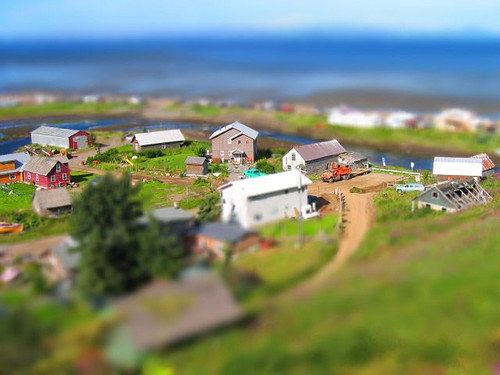
However, the word has made a comeback courtesy of photography. By a trick of lenses and software, people have devised a way of giving a real scene the appearance of a diorama. By adding foreground and background blur the impression of a shallow depth of field such as is found in close-up photography is achieved. This tricks the brain into, on first viewing, seeing the photograph as a set with models: see examples here and here. I understand that the Olympus PEN range of cameras have the facility to create these built into them as an effect. The only question I have is, "Why?" I can see that it's a trick that is easily done, but what is its purpose? I can't think of a use to which I would put it, so its reason is lost on me.
What has my photograph of the top of a yew hedge* against a blue sky with white clouds got to do with dioramas? Well, it occurred to me that the photograph could be mistaken for a view of the jungle-covered hills of somewhere such as New Guinea. Which would make the image something akin to a "reverse photographic diorama"!
* See another of my images of a yew hedge cut in this traditional manner here.
Camera: Olympus E510
Mode: Aperture Priority
Focal Length: 28mm (56mm/35mm equiv.)
F No: f5.6
Shutter Speed: 1/1000
ISO: 100
Exposure Compensation: -0.7 EV
Image Stabilisation: On
I'm sure the curators would disagree, but I think quite a few museums have lost their way when it comes to displaying their contents. Increasingly I find buildings where the displays are pared down in a minimalist way, the "educational" is promoted very heavily, and there seems to be an emphasis on style rather than exhibits.
The Victorians got a lot right with their approach: pile in as much as you can, label everything, add a few panels to give background information and an overview, and leave the rest to the visitor. One of my favourite London collections is the Sir John Soane Museum. It holds the artefacts amassed by the neo-classical architect, and though it was put together just before the Victorian period, it follows their approach to display.
In my youth I visited York reasonably regularly, and in that city the Yorkshire Museum was a magnet for me because of its collection of stuffed birds. Courtesy of Victorian "collectors" (whose methods of shoot and stuff I deplored) I got to see many species that I would otherwise never have set eyes on. Not only extinct birds such as the Great Auk, but also the extreme rarities that pass your way only occasionally or never. These were usually presented singly or in groups in glass cases. There seemed to be room after room of such exhibits, broken up with the odd diorama showing a bird, such as the black grouse, against a painted backdrop of its habitat, with a few plants and rocks scattered about. In fact, that was my introduction to the word "diorama", and its a word I only occasionally came across in subsequent years. Today, in museums, the diorama as a method of presentation seems to be viewed as old hat.
However, the word has made a comeback courtesy of photography. By a trick of lenses and software, people have devised a way of giving a real scene the appearance of a diorama. By adding foreground and background blur the impression of a shallow depth of field such as is found in close-up photography is achieved. This tricks the brain into, on first viewing, seeing the photograph as a set with models: see examples here and here. I understand that the Olympus PEN range of cameras have the facility to create these built into them as an effect. The only question I have is, "Why?" I can see that it's a trick that is easily done, but what is its purpose? I can't think of a use to which I would put it, so its reason is lost on me.
What has my photograph of the top of a yew hedge* against a blue sky with white clouds got to do with dioramas? Well, it occurred to me that the photograph could be mistaken for a view of the jungle-covered hills of somewhere such as New Guinea. Which would make the image something akin to a "reverse photographic diorama"!
* See another of my images of a yew hedge cut in this traditional manner here.
photograph and text (c) T. Boughen
Camera: Olympus E510
Mode: Aperture Priority
Focal Length: 28mm (56mm/35mm equiv.)
F No: f5.6
Shutter Speed: 1/1000
ISO: 100
Exposure Compensation: -0.7 EV
Image Stabilisation: On
Tuesday, November 03, 2009
Clouds over Sutterton
click photo to enlargeIf you were to invent a "Forces of Nature Scale", somewhat analagous to the Beaufort Scale of wind speed, where 0 equals Calm and 12 equals Hurricane, with ever rising numbers and speed between, what would you place at 12? A volcano? An earthquake? A tsunami? It would probably be one of those, though if we extended the scale beyond 12 (as the Beaufort Scale has been in China and elsewhere to take account of tropical cyclones), then a meteor impact on earth would probably equate to the highest number.
In between would be blizzard, flood, lightning and various other manifestations of the power of nature. Somewhere near the bottom of the list would be clouds. These can, of course, bring precipitation, but often they just blank out the sun, or fill the sky with wonderful, fleeting shapes like an invasion of benign, diaphanous alien craft. A few days ago, as we walked in the vicinity of the Lincolnshire villages of Algarkirk and Sutterton, the bright, sunny afternoon gave way to the onset of evening rather quicker than might have been expected with the appearance of a bank of grey cloud. It rolled in across the flat Fenland landscape with a malevolent look in its eye. But it proved to be a sheep in wolf's clothing, and produced no rain to mar our enjoyment of a walk in the autumn countryside.
photograph & text (c ) T. Boughen
Camera: Olympus E510
Mode: Aperture Priority
Focal Length: 58mm (116mm/35mm equiv.)
F No: f6.3
Shutter Speed: 1/250
ISO: 100
Exposure Compensation: -1.0 EV
Image Stabilisation: On
Labels:
clouds,
landscape,
Lincolnshire,
nature,
Sutterton
Subscribe to:
Posts (Atom)