Thursday, November 23, 2006

Gullibility and advertising

click photo to enlarge
If someone knocked on my door and said they'd like to fix an advertising hoarding to the side of my house I'd tell them to get lost. But, if I needed some additional income, my first question would be, "How much are you prepared to pay?" Undoubtedly they would make me an offer: no one would expect to use a building for advertising without paying for the privilege. It would then be up to me to decide whether the sum proffered was enough.

That being the case, why is it, when it comes to companies advertising themselves on clothing, the general public is asked to pay a premium to the company to allow this to happen? Moreover, what makes shoppers actively seek out merchandise with the favoured names prominently displayed, and agree to this extortion? Surely if someone wants to sell me a T-shirt with a brand name or advertising slogan emblazoned across the front, or even placed discreetly on the chest, I should be offered the garment for less than a comparable T-shirt with no advertising? That seems only fair because I'm acting as part of the company's advertising arm - and doing it for free! The only conclusion to be drawn from this amazing state of affairs is that we, the general public, are gullible saps! And that retailers and advertisers are very clever people who should be employing their undoubted talents in more socially useful ways.

That train of thought, which I've puzzled over for many years, came to me as I processed this shot of a lonely can, on a wet table amid cafe furniture, at Lytham, Lancashire. The prominent name is one of those to be found on many items, from drinks to clothing to clocks, and which are sold at a premium because of the cache of the brand. The flash of red amid a silver and grey background drew my eye. I framed the shot with the can in the top right corner. It was one of those wet one minute, dry the next days. Consequently I had the camera ISO at 200 and set to Program, so that I could snatch shots quickly. That produced f4.5 at 1/250 sec: quite appropriate for a long zoom at 148mm (35mm equivalent).
photograph & text (c) T. Boughen

Wednesday, November 22, 2006

Glass bricks

click photo to enlarge
The first time I saw glass bricks I was about 12 years old and it was the 1960s. As soon as I set eyes on them I knew I liked them. They were in a section of wall in the porch of a police station. The building would have been quite new - a post-war construction of the 1950s - and the architect must have wanted to show his modernity. In retrospect I realise that the purpose of the glass bricks (sometimes called glass blocks) was to let light into the public area, let the policeman at the desk see anyone approaching, and provide a strong wall. Those three factors are the reason for anyone using glass bricks. I'm only sorry they aren't used more often.

Architects employ them reasonably frequently in high-cost private housing, but in the UK they are more commonly found in utilitarian private buildings, or in the functional parts of public buildings. Consequently garages and multi-storey car parks often have them, as do toilets, washrooms, and municipal swimming baths. They are used less on exterior walls than formerly because vandals have discovered that the right tool can puncture the outside of the two glass membranes, revealing the internal void and making the inner layer of glass vulnerable. But, despite this disadvantage, I still feel that our built environment would be better if internal walls featured more glass bricks. Wonderful effects can be achieved with lighting near these bricks, and some come with lights actually inside. However, the changing daylight, combined with the colouring that can be applied to the glass, is often what works best.

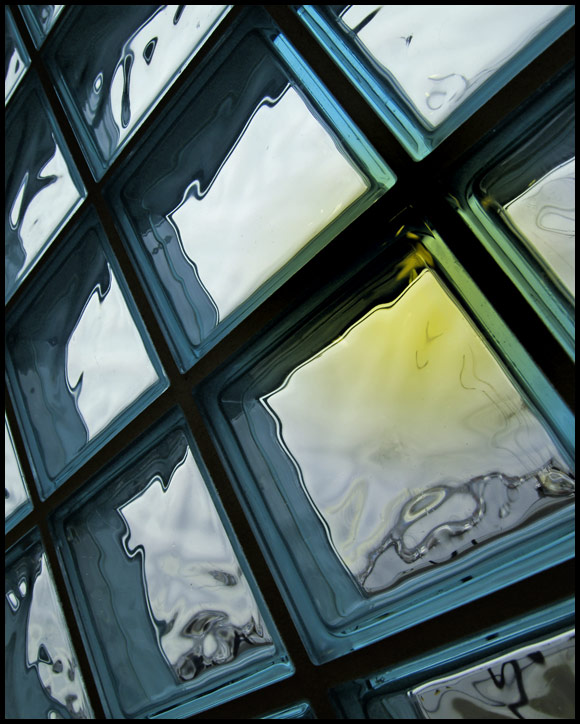
I took this photograph from inside the porch of a washroom. The glass bricks were part of the exterior wall and tinted blue. They created a grid, and from inside picked up the colours of anything that was outside or passing by. This shot was taken in the late afternoon with a wide zoom lens. A small light had come on, adding a yellow patch to the grid. I tilted the camera to create a more dynamic composition, and placed the light effect near an intersection of the bricks. The combination of colours, along with the glass distortions and the regular grid, makes, I think, an interesting composition.
photograph & text (c) T. Boughen

Tuesday, November 21, 2006

Cobble puddle tree

click photo to enlarge
A while ago I indulged in a tirade against block paving. In that blog piece I expressed concern at the ubiquity of this form of ground covering, the crassness of many of the designs that private contractors and housing developers produced, and pointed out the usually much better standards produced by those working to a landscape architect's brief. The photograph in that piece was held up as a good example.

I've been thinking more about this subject recently, and I think the rise of block paving, particularly around houses, is motivated by three factors. Firstly the increasing number of motor vehicles - many people see it as a surface on which to park a number of vehicles, and it's certainly useful for that. Secondly, it's seen as a low maintenance, "lay and forget" surface. Now that's questionable, particularly in the UK. Block paving has been down long enough for everyone to see that weeds, lichen and moss love it, and oil drips are absorbed by it. There's a lot of grubby looking surfaces around that, I think, will not last as long as tarmac, gravel or paving slabs! The final factor driving the use of block paving (and its close cousin, pattern-impressed concrete) is a desire for a "traditional", "olde worlde" look. I wouldn't deny that when it's used well block paving can complement an older building. However, pattern-impressed concrete never can! And around new "old looking" buildings it simply looks as false as the artificially distressed bricks, stuck on half-timbering, herring-bone brick infill and terracotta pinnacles that accompany it. In the past road surfaces designed to last were often made of cobbles. In Kingston upon Hull, blocks of pitch-impregnated wood were used! If the better materials that superceded them had been available at the time people would have used them. That's what we should be doing today.

I saw this puddle in some cobbles that had been revealed by traffic that had worn through the tarmac covering. I was at the end of a fruitless day of photography, where driving rain, dark skies and strong wind had stopped play. The wind was stirring the surface of the puddle and a sudden bright patch in the clouds gave some contrast to this piece of ground. I used a wide angle zoom lens, switched the camera to Program for speed and convenience, and quickly framed and took the shot. I like it for its colour and the interest that exists in such a prosaic subect.
photograph & text (c) T. Boughen

Monday, November 20, 2006

A Victorian church

click photo to enlarge
Anyone with an interest in church architecture, asked to name the fifty best medieval parish churches in England, would undoubtedly come up with a list that would be similar to that of other enthusiasts. Patrington, Beverley, Long Melford, Fotheringhay, Boston, Louth and Heckington would certainly feature.

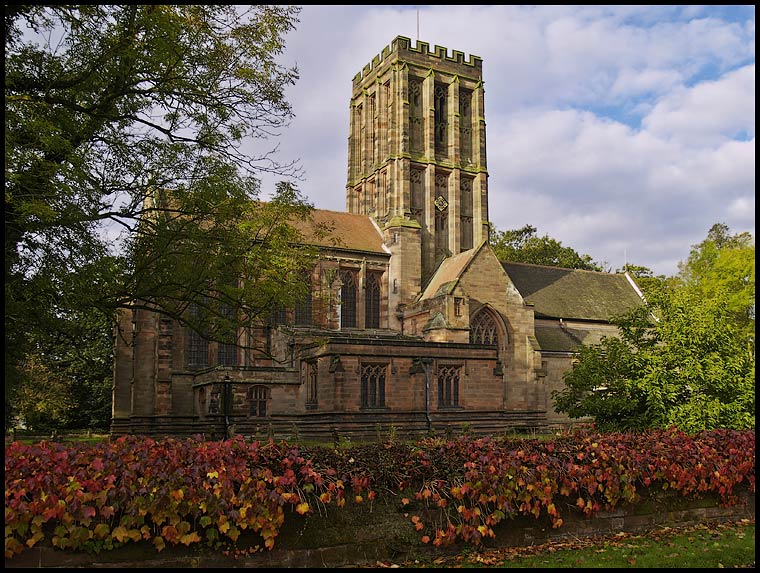
However, were you to ask those same people to name the fifty best Victorian churches the lists would, I suspect, show much greater variation. Pearson's South Dalton and Paddington buildings would surely be included by all, as would Pugin's St Giles at Cheadle. Butterfield's All Saints, Margaret Street, London, would probably be included for its significance rather than any affection it might inspire. But elsewhere individual preferences would prevail. This church - Holy Angels, at Hoar Cross in Staffordshire, built 1872-1876 by the architect G.F. Bodley -would feature in some lists, but probably not all. Many would favour his church at Pendlebury for its greater originality.

However, to my mind this is one of the finest Victorian churches that our country produced. I would go so far as to say that it is a church that stands comparison with the very best built in the medieval period. It draws its inspiration from the Decorated style of the fourteenth century, and re-works those motifs in an original way. The whole structure locks together in a very satisfying manner, and the external decoration - tracery, string courses, buttress niches, etc. - don't overpower the excellence of the smooth dressed stone. The crowning feature is the beautiful crossing tower with its recessed panels, a design that combines solidity with soaring elegance. Inside the church it is quite dark, but as the visitor's eyes become accustomed to the gloom, the magnificence of the High Victorian decoration - all screens, ballflowers, statuary, richly coloured glass and deeply polished wood - overwhelms with its richness, and invites exploration of every surface and feature. A visit to this building is a reminder of the best that Victorian church architecture could achieve, and a welcome antidote to the banal examples that so often litter our towns and cities.

I took this photograph in the late afternoon, and benefitted from the modelling that the low sun produced. However, the shadows were more extensive than I would have wished, and most of my post processing involved bringing out the necessary details. That and correcting the converging verticals produced by the 28mm lens (35mm equivalent).
photograph & text (c) T. Boughen
Sunday, November 19, 2006

What to photograph?

click photo to enlarge
Question - what's a suitable subject for a photograph? Answer - virtually anything! Yet, for an amateur photographer there is a great danger of slipping into a photographic rut. Friends, family and holiday shots are undoubtedly the most common subjects. But how does the amateur move beyond these and not end up producing yet another sunset?

Often photography supports a hobby. I see many enthusiasts photographing trams in Blackpool, Lancashire. And any time a steam train runs up the Settle-Carlisle line, vantage points along the route are manned by train buffs with cameras. Many birdwatchers (birders in the modern parlance) "digiscope" i.e. photograph birds using a digital camera connected to their telescope.

But to move beyond these narrow confines is harder. Books, magazines, and internet photography forums are a good starting point for ideas for subjects, approaches and techniques. But one strategy that I have found useful is to name a subject to yourself and work at it until you get an image that satisfies you. The subject can be as prosaic as some vertical blinds. I took this as a starting point, and over a few days produced two shots (out of about thirty) that satisfied me. They are here and here. I've recently been trying to produce a shot using a local 1930s hall as the subject. On the face of it this building is photogenic, but it is big, painted cream, and is very long. Here's the first image that I am reasonably pleased with. A shaft of light had pierced the clouds and lit the dome and the nearby beach, whilst the sea behind was being hit by a squall. A ferry came into view, battling through the rain, and the contrast between the bright building and the dark ship seemed a possibility. A couple of gulls helped out with the composition. I used a long zoom at 300mm (35mm equivalence) and boosted the ISO to hand hold the camera in the strong wind. The post processing is minimal.
photograph & text (c) T. Boughen

Saturday, November 18, 2006

Walking in the Dales

click photo to enlarge
Is there a better landscape for winter walking than upland limestone? The classic "karst" scenery is well-drained, has few surface streams, and, apart from the odd muddy "shake hole", or gateway churned up by the feet of cattle and sheep as they funnel through, the walker can bound along the springy turf almost as well as in summer. I find that, in a given time, I can walk half as far again on limestone compared with, say, a heather moor on gritstone or granite. So, a walk in the the Yorkshire Dales is often a long one!

And so it proved to be on the day we did a walk on the Craven uplands that flank the River Ribble. The low sun on a bright November day lit up the grass and grey stone, and moulded the landscape for us. Dark shadows tracked every drystone wall, and each sheep was followed by its doppelganger. As we passed over stiles and through gates, we came upon distant views of Penyghent and Pendle, and congratulated ourselves that we weren't churning through the wet reeds and bogs of those dark peaks.

I took this photograph early in the walk from a point on Giggleswick Scars near Stackhouse, a small hamlet where I lived at the age of three. Across the valley the village of Langcliffe could be seen nestled on the hillside, above the river and below the higher woods and limestone cliffs, its walled fields enclosing the improved pastures nearer to the settlement. The low sun was throwing long shadows and delineating every feature, emphasising that the buildings, trees and walls were insubstantial and temporary additions to this ancient landscape. Without the effect that these shadows produced I doubt whether I would have taken this photograph. To my mind they make the shot, which I took with a zoom lems at 225mm (35mm equivalent).
photograph & text (c) T. Boughen

Friday, November 17, 2006

Casino Royale?

click photo to enlarge
Fans of 007 films will want to know what Daniel Craig, the new James Bond, makes of the role. The early reviews are favourable, saying he brings something to the part that hasn't been seen before, and that he matches Sean Connery (usually the critics' favourite) at his best. I suppose the reason for the continuing box office success of this franchise is largely down to the "updating" both of the lead actor and the way the stories are developed. I'm not really qualified to talk about this however, not being a fan of the films.

Nor am I qualified to talk about casinos and gambling. I've never visited a casino and I don't engage in betting. However, that doesn't prevent me from having a view on the plans of the present UK government to introduce a number of "super-casinos" at selected locations across the country. Quite why an allegedly social democratic government would want to do this is beyond my imagining. Fortunately the views of the executive are not shared by many MPs and party supporters, and so the plans have been watered down. Nonetheless a number of locations are vying to be a site for one of those that is licensed. Blackpool wants one because it fits with its leisure-focussed industries, and the local council believes it will boost the town's economy. I don't want any further casinos, because of the social problems that they inevitably produce, and I have major doubts about any "trickle down" benefits. Such places are likely to be mainly patronised by people who can ill-afford to lose what money they have, and one thing is sure - they certainly won't be full of debonair James Bond look-alikes!

My photograph today is a reflection of the fanciful detailing of Blackpool's first casino, a 1935-1939 building, by the architect Joseph Emberton, that was the subject of an earlier post. The sun had pierced early morning cloud, and I glimpsed this image in the orange and blue tinted glass of a nearby swimming pool (also the subject of a previous post). A long zoom isolated the interesting part of the reflection, including the word "CASINO" fixed to the spiral turret. However, buffeting from a gale force wind meant I had to up the ISO to 200 and shoot at 1/1000 second to prevent blurring. I corrected verticals in post processing and brought out some of the details in the image.
photograph & text (c) T. Boughen

Thursday, November 16, 2006

On the prom

click photo to enlarge
English is a promiscuous language. It will get into bed with anyone it fancies! But for all that it shows a touching constancy. Appropriated words are rarely used then callously discarded. They usually snuggle down in the language and enjoy a long-lasting relationship.

Take the word "beck". Now to some people this word denotes a popular Kansas-born singer and sometime collaborator with Jack White. But to people in rural north-west England the word means a stream. And it has done so for centuries. The word comes from the Old Norse "bekkr" meaning stream, and was introduced by Scandinavian invaders, probably in the late 700s AD. Or how about "bungalow", a (usually) single storey house, found throughout the land, and much favoured by retired people. It was originally a Hindi word, "bangla", meaning "of Bengal", but also describing a single storey dwelling, and was brought to this country by early travellers and colonists. It was first noted in the seventeenth century. The word "promenade" is known to the French, and to anyone who has learnt that language, as the word for "walk". But in England it commonly uses a French variation meaning "to take the air", and is applied to the wide, purpose-made path overlooking the sea.

My photograph shows the promenade and sea-wall at Cleveleys, Lancashire. The tide is out, the rain has stopped, and the weak November sun is drying the concrete. In the hazy distance is Blackpool. The serpentine curves of the sea-wall was the feature that drew me into this shot, and I used a long focal length lens to emphasise them. I waited for a few people to appear in the frame on the "prom". Their silhouettes seemed to add necessary dark points to which the eye is led by both the curve and stepping of the wall. The image looked best in black and white because it stressed the strong lines in the composition. But more than that, it got ride of the green lichen and weed covering the wall!
photograph & text (c) T. Boughen

Wednesday, November 15, 2006

Anyone for coffee?

click photo to enlarge
"I intend to live for ever - so far so good!", Steven Wright (1955- ), US comedian, writer and actor

I've lost track of what's good for me and what isn't! When I was a child I knew that it was dairy products and lots of red meat. I also knew to "Drink a pinta milk a day" to be healthy, because the Milk Marketing Board told me so. And the Egg Marketing Board urged me to "Go to work on an egg". So, if I had a full "English breakfast" of eggs, bacon, and sausages, with cheese sandwiches for lunch, followed by Ye Roast Beef of Olde England with roast potatoes, Yorkshire Pudding and all the trimmings in the evening, I knew I wasn't going far wrong. If that was my diet today my doctor would have me plugged into a heart monitor before I could say "muesli"!

As the UK became more sophisticated we were introduced to the delights of healthier foods. Like rye crispbread - a type of gastronomic chipboard. This epicurean delight broke with a crack, showering anyone within 5 feet with sharp shards, and when you ate it you lacerated the inside of your mouth - but it was good for us! As was bran. Thousands of pet rabbits and guinea pigs must have gone hungry when bran and muesli invaded the English dining table - I can't think where else it all came from. And as the years have rolled on other wonder foods, promised to make us live long and healthy lives, have been brought to the market - like macrobiotic yoghurt, a sort of sweetened wallpaper paste. Moreover, foods that were once frowned upon have been rehabilitated. Dark chocolate - ugh, all that harmful sugar - is suddenly good for your heart because of its action on "platelets". And coffee. I was never a fan of coffee, always preferring a cup of tea. But now, I find I have a taste for it, and I don't know whether it's in favour or out. I think it was at one point, but now? Can anyone tell me? Please!!!

My increased liking for coffee pre-dates my acquisition of the cafetiere, a gift from my youngest son, in today's photograph. I'm particularly fond of this jug, and not just for the family association - it's a good design. Moreover, in black and white it featured in the first blog post I ever made, also showing my face in its polished lid. On a dull and rainy day I thought I'd re-work that shot, and see what I could achieve in colour. This time I played down the portrait, positioning myself away from the light. I used a 70mm (35mm equivalent) macro lens opened up to f16 and a background of black vinyl.

From what I've written above you might worry about my diet. Have no fear. I eat enough vegetables and fruit to make a chimpanzee jealous, I'm not a big fan of meat, and I'm guided by my wife who knows all the latest recommendations on healthy eating. Cheers!
photograph & text (c) T. Boughen

Tuesday, November 14, 2006

Cyclopean architecture

click photo to enlarge
Thirty years ago I visited Mycenae, the ruined second millennium BC city in southern Greece. It was there that I was introduced to the term "cyclopean architecture", a style of building that uses massive components such as might have been arranged by the mythical giant, Cyclops (he of the single eye). At Mycenae the walls of the city, and more architectural features such as the famous "Lion Gate", are made of overwhelmingly large blocks of stone. They dwarf people, and make the usual size of building stone look puny.

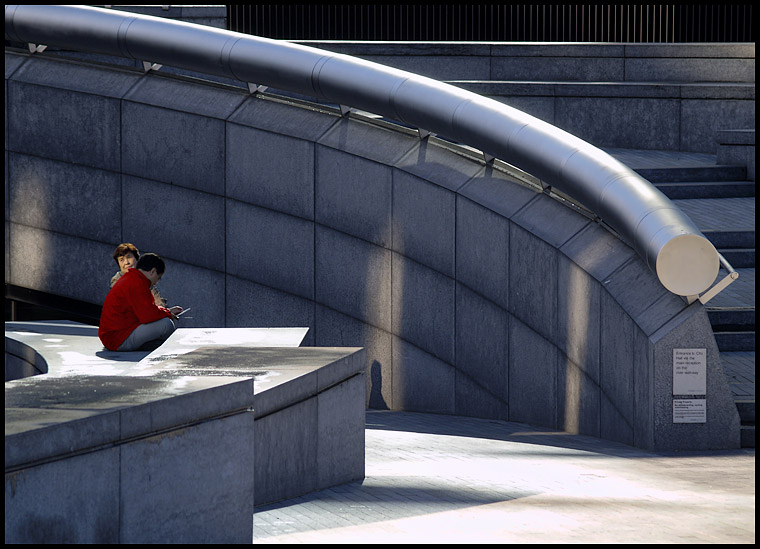
I was reminded of this when I visited the amphitheatre, known as The Scoop, next to the new London City Hall. An impersonal monotone experience in grey stone, it features very large blocks and a massive, stainless steel bannister rail. Presumably this curved tube is both a railing and an architectural "pointer" that says "walk this way to the seating." But its scale is cyclopean. It makes the people in its presence seem smaller - not the image that the Greater London Authority is trying to project with its democratically open Assembly building.

I think my photograph, with two people looking small against these large features, illustrates the point I make above. The dull red coat against the grey background attracted my attention. I used a long zoom to isolate part of the scene, and tried to balance the composition by placing the two tourists on the opposite side of the frame from the end of the steel tube. The shot was enlivened by the residue of recent rain and the reflected light from surrounding glass buildings. The blown highlights that this produced on the ground seems to me to add to the image, by increasing the tonal range, rather than detract from it.
photograph & text (c) T. Boughen

Monday, November 13, 2006

Thunderbirds are G...G...Guernica!

click photo to enlarge
"Guernica 3" is a 50 feet high model of the rocket, Thunderbird 3, that many will remember from the puppet-based TV programme (and later film), "Thunderbirds". However, the original bright red of the model has been almost completely replaced by selections from Picasso's most famous painting, "Guernica", a work that commented on the bombing of the town of that name in the Spanish Civil War. As an "installation" it's certainly different, but is it art? Given that it's one of a number of populist and popular art works along Blackpool's miles of promenade we can only assume that Graham Ogden, Shouichi Yasuda, Collette Halstead and Sarah Myerscough had that in mind. But, on this occasion I'll leave that question to one side and simply say it's definitely fun! And, furthermore, it immediately suggests other unlikely pairings of toys and art works!

Here are 5 ideas that the team of artists might like to consider for future projects:

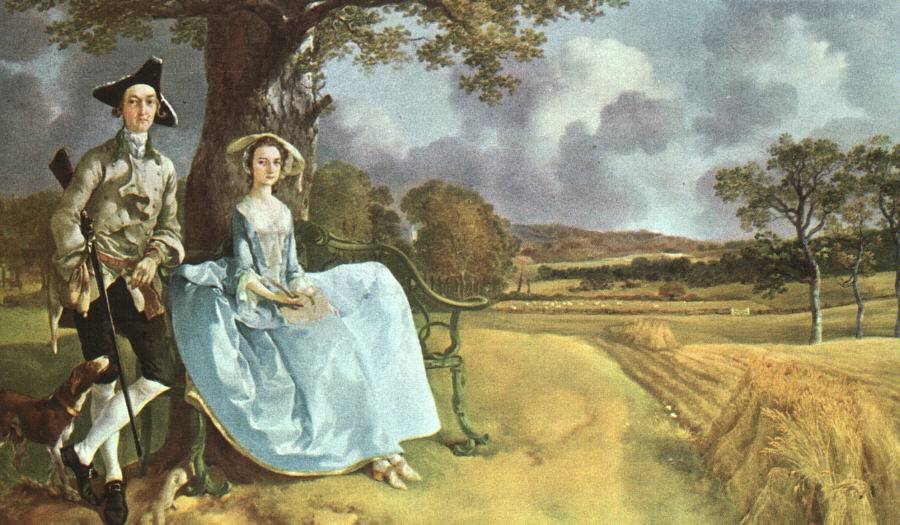
1 "Fab Mr & Mrs Andrews" - Lady Penelope's Fab 1 futuristic pink Rolls Royce (also from Thunderbirds) adorned with Thomas Gainsborough's "Mr & Mrs Andrews". This would look wonderful: a sort of filthy rich meets the country squire and his missus.

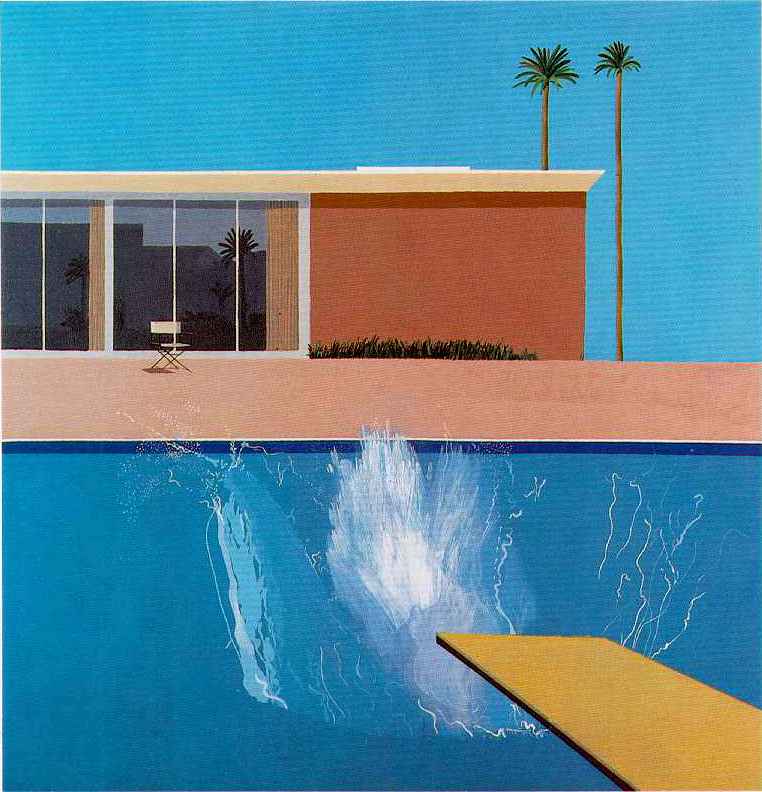
2 "A Bigger Splashmobile" - This livens up the boring black of Batman's Batmobile car with the bright colours and Californian sunlight of David Hockney's swimmng pool scene, "A Bigger Splash". After that paint job the dynamic duo would be heard singing Beach Boys songs as they sped off to save Gotham City.

3 "Swinging Darth" - Darth Vader thinks he's the epitome of bad, in his shiny black mask, armour and cape. But he'd be a pussy cat, a complete pushover, who no one could take seriously, sporting the coy figures and boudoir colours of Jean-Honore Fragnard's "The Swing".

4 "Boardwalk Noddy" - Most people would agree that Noddy's car has a futuristic engine design (putting a penny in the engine is still something that mainstream manufacturers haven't cottoned on to), and is the unsurpassed highpoint of automotive styling. So imposing an angular aesthetic on those sensuous curves might seem sacrilegious. However, Piet Mondrian's "Boardwalk" would wrap around it nicely, and bring a heightened sophistication to a colour scheme that many think of as a classic!

5 "Superchintz" - The red, blue and yellow of Superman's outfit is so last-millennium. He should swap it for a material that's a timeless classic, something that never goes out of date, like William Morris's "Chrysanthemum" fabric design. An added bonus would be that when he got changed in the shrubbery there'd be very little chance of anyone spotting him!

No doubt this has got you thinking about other possible pairings of toys and paintings. Well here's my advice. Keep them to yourself, or people will think you're as weird as I am. Or possibly something far worse - an artist! Ah, I almost forgot - the photograph. I pointed the camera and clicked the shutter.

photograph & text (c) T. Boughen

Sunday, November 12, 2006

Remembrance Sunday

click photo to enlarge
An unpleasant brouhaha has blown up in the UK over the refusal of a prominent TV newsreader to wear a British Legion poppy. These small paper and plastic flowers, available in the fortnight or so before Remembrance Sunday (the first Sunday after 11th November), are given to individuals in return for a monetary donation. Schools, groups, workplaces, shops, and organisations associated with the armed forces sell the poppies on behalf of the British Legion who use the money to help ex-service people and their dependants.

The newsreader in question, patiently and properly, and then, under pressure, tetchily, explained that he was assailed by many organisations asking him to wear their badge, ribbon, sticker, etc, and, as a matter of principle, declined all requests. Consequently he didn't wear a poppy on air. However, he explained, he did wear one in his private life, and did pay his tribute on Remembrance Day. Interestingly, none of the the many adverse, hectoring, even bitter and vindictive comments he received, came from the British Legion. Their dignified response was to say that wearing a poppy was an entirely voluntary gesture, and the newsreader was entitled to his opinion. In that statement - a defence of freedom of thought and action - they eloquently and pointedly reminded us of the purpose of our armed forces, and why we should value and support them.

I took this photograph of St James' church, Haslingden, on Remembrance Sunday 2005. As I approached the building the morning service had just ended and the brass band was spilling out of the south porch, a scarlet, black and silver ribbon, streaming down the churchyard path, heading off to lead a procession through the town. I quickly framed the shot, pressed the shutter, and the camera did the rest. However, the zoom at 28mm (35 mm equivalent) produced massively converging verticals, and correction of these was necessary to bring the image back to what I saw. Though it was a grabbed shot, I'm quite pleased with the composition.

Oh, and for anyone who is wondering, yes, every year I do buy and wear a poppy, and remember all those - in the armed forces and civilian life - who made the ultimate sacrifice.
photograph & text (c) T. Boughen
Saturday, November 11, 2006

Drystone walls

click photo to enlarge
"As old as the hills" is a saying that many think applies to the drystone walls that characterise the Yorkshire Dales. In one sense they are, being mainly made of the native carboniferous limestone laid down under a warm sea over 300 million years ago. But, the oldest remnant walls are probably no earlier than Iron Age (probably 1000 BC), and are associated with hill forts. Some later examples have medieval farming or monastic origins. However, most that we see today were erected in the late eighteenth and early nineteenth centuries, the result of the Enclosure Acts that encouraged landowners to enclose the common lands.

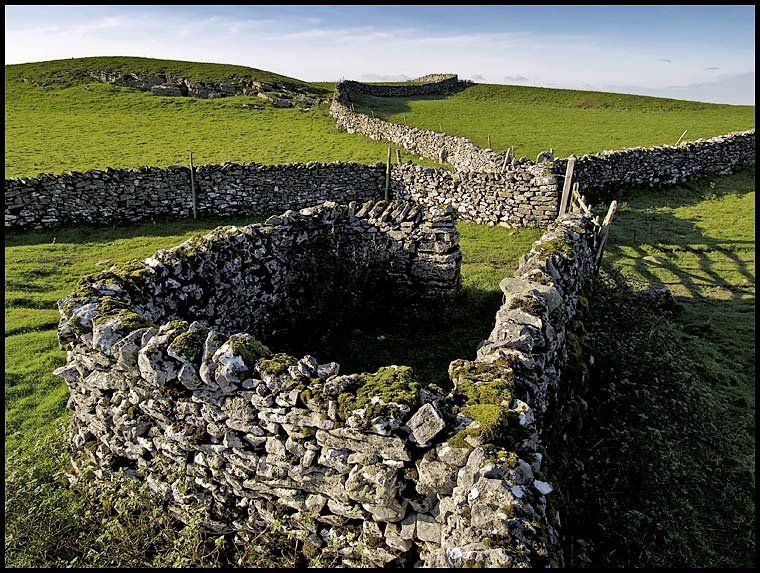
A well-built limestone wall is capable of lasting for centuries. The basic structure of good heavy footings, well chosen face stones, rubble heart stones, "through" stones spanning the width of the wall, and copestones (or topstones) to finish it off, mean that the heave of frost/thaw action and the inconsiderate rambler, who climbs over the wall rather than using a stile, are the two main reasons for one to fall down. Over time these walls developed features to accommodate the sheep that they enclose. The sheep-hole (or "creep") through the wall allows shepherds to move animals or give them access to adjoining fields. Small "folds", like the one shown in the photograph, ease the gathering in of sheep. And stiles with steps built into the wall aids the passage of those walking the footpaths that criss-cross these attractive uplands. The increasing cost of maintenance and the changing pattern of land use has resulted in walls being less well maintained than formerly. However, grants have been available to farmers to maintain the appearance of this unique landscape.

I took my photograph near the hamlet of Feizor whilst standing on a stile. The angular curl of the nearby wall, and the way it linked with the other walls snaking across the fields was only apparent from height, and these qualities combined with the deeper shadows suggested a photograph might work. I used a wide zoom lens at 26mm (35mm equivalent), and emphasised the detail of the scene by using a contrast mask in post processing.
photograph & text (c) T. Boughen

Friday, November 10, 2006

Iconic walls?

click photo to enlarge
There's nothing intrin- sically wrong with compiling a list of 100 icons that represent England. It's a harmless pursuit. My list will both overlap, and differ from, your list. But that's part of the fun of the exercise. However, it does strike me as slightly ridiculous for the government's Department for Culture, Media and Sport to be doing it. And particularly pointless for them to be inviting the public to both suggest the icons and to vote for them.

I suppose having embarked on a list they felt that it would have greater validity if it represented the views of the people as a whole. They couldn't be more wrong! That thinking is analagous to believing that the pop songs in the Top Ten are the best songs currently available because that's what people are buying!

The list hasn't been completed yet, but some icons have already been chosen, and many more offered. Who could argue with Stonehenge, the map of the London Underground, the red telephone box (the few left that haven't been destroyed), Sgt Pepper's Lonely Hearts Club Band, or even (possibly the most original item suggested) the "V" sign? But the River Thames? The rose? English weather? The stiff upper lip? Or, Winnie the Pooh, now, thanks to Disney, known to millions of English children as a bear with an American accent?! The developing list can be seen here.

Well, having said all that, I suppose I must offer a suggestion, and here it is - the drystone wall! Yes, it isn't representative of much of the south of England, but so what! The photograph above shows some of these walls, so-called because no mortar is used in their construction, near Giggleswick (yes really!) in the Yorkshire Dales. I took the shot with a long zoom lens from high limestone cliffs overlooking the fields. The arrangement of the walls with their strong shadows, leading to the rougher land with the barn and small trees, seemed a good, bold, composition. The closely cropped grass, illuminated by the low morning sun was as green/yellow as shown, and gave the image an unexpected vibrancy - perhaps the farmer's hand had slipped when applying the fertilizer!
photograph & text (c) T. Boughen

Wednesday, November 08, 2006

Evening by the creek

click photo to enlarge
When the early photographers - Daguerre, Fox Talbot, Niepce, etc - composed their first images it was inevitable that they often drew on the conventions of painting. Images of people would be posed, often with props and carefully balanced backgrounds. Views would be composed like the landscape paintings that they knew so well. It was only when photographers became comfortable with their cameras, and the technology developed, that photography expanded its repertoire into candid shots, reportage, etc., and developed compositional styles of its own.

This much is fairly well known, but what is appreciated less is the extent to which traditional painting fed off the upstart art of photography. In his illuminating book, "Art and Photography", the writer Aaron Scharf, discusses some of the artists who made use of photography. Edouard Manet's painting of the "Execution of Emperor Maximilian (?1867), for example, makes use of photographs to give portrait realism to several figures. Edgar Degas referred to photographs extensively in his portrait work - see "Portrait of the Princess de Metternich" - and even for his famous ballerinas. His paintings with people entering and exiting the frame, or cut off at the waist also echo the type of composition common in photography, but rarely found in the traditional arts. Even the Pre-Raphaelites and John Ruskin, a group dedicated to resurrecting the methods of the past, were not above basing paintings on photographs. Art historians are still making connections between individual photographs and particular paintings and artists.

I am not aware that any such link has been made with reference to the English artist, John Atkinson-Grimshaw (1836-1893), who painted some particularly impressive evening and night scenes. However, the skeletal trees and the hint of yellow in the cold, water-laden, evening sky of my photograph reminded me of this artist whose paintings I admired recently at the Harris Art Gallery in Preston. I took this photograph in fading light at Skippool Creek, Lancashire, for the atmospheric qualities I saw that evening. The camera ISO was increased to 200, the aperture opened up to f4.5, and the long zoom at 240mm (35mm equivalent) was rested on a post to ensure a sharp image. This image has been sharpened, as usual, for presentation on the web, but the unsharpened version has much more of the painting about it.
photograph & text (c) T. Boughen
Tuesday, November 07, 2006

Communal facilities

click photo to enlarge
Looking at this amphitheatre focussed on the bandstand at Stanley Park, Blackpool, one is reminded of a time when people came together in parks for shared enjoyment of a free event. This happens less today, largely due to the increased wealth of individuals and the charged events that now take precedence.

It seems that the richer a society becomes the more leisure becomes a paid for, individual pursuit. Once we are in a position to afford the price of admission, have a car to transport us, and have bought the consumer durables to entertain us at home, the need for shared, free, communal facilities declines. There is a debate in the UK at the moment about the proper purpose of public libraries, with many saying that they must widen their brief into computers, cafes, and other attractions - or die. Communal washing, even in the form of the launderette, has disappeared from many communities as people have equipped their home with the necessary machinery. The UK's "community centres", village halls and other public rooms, are similarly in decline, and where they aren't it's usually down to the energy of a few individuals who make the centre a focus for shared activities. The glue that holds a society together is made to a complex formula, but it includes experiences in common, provided by and enjoyed alongside, the people where we live. We forget this at our peril.

I took today's photograph on an early November afternoon with long shadows as the sun was low in the sky. A wide zoom lens allowed me to place the freshly painted, domed bandstand at the top left, in the embracing curve of the tiered concrete. The light coloured lines in the steps helped to draw the eye to the focal point, and I made sure I stood at the end of one. I think the photograph works best in black and white due to the light colour of the bandstand. A red filter was used to increase the contrast of the scene.
photograph & text (c) T. Boughen

Monday, November 06, 2006

Return of Best of PhotoReflect!

Best of PhotoReflect II

The link to what I consider the best of my photographs has not worked for a few weeks. I got rid of the webspace that held the album, and the demise of the original archive seemed a good time to update it.

The first incarnation of the album had 77 images: there are now 120. Anyone who looked at and remembers the first album may like to start at image 78.

For reasons that aren't clear to me yet, it seems a bit slow to load, but you can start looking before all 120 thumbnails are in place. I'll have a go at speeding it up. Unfortunately this album isn't 56k friendly.

I hope you enjoy browsing, and I'll be interested to read any comments you'd like to leave.

Regards, Tony
photographs & text (c) T. Boughen

Sunday, November 05, 2006

Power and taboo

click photo to enlarge
It's a brave architect who makes a major change to a national building that has a place in the hearts and minds of the public. But that is what Norman Foster did at the British Museum in London, and his achievement is magnificent.

In 1994 Foster won the competition to redevelop the famous circular Reading Room (1854-55) and its surrounding courtyards. Work began in 1998 and was completed in 2000. In collaboration with the engineers, Buro Happold, Foster threw a glazed roof over the courtyard, built a new perimeter wall round the Reading Room (that supports the new glazing), refurbished Smirke's Greek Revival elevations of 1823-47, and built a replica of the demolished south portico. The master-stroke of the glazed roof casts an even light over the airy courtyard. It recalls the Victorian glass arcade, but its structure - made of 3312 glass panels, each a different size due to the Reading Room being slightly off centre - would have defeated them, relying, as it does, on computer modelling. The Queen Elizabeth II Great Court, as it is now called, is a public space in the heart of London that must be experienced.

My photograph shows the upper walls of the Reading Room with part of the glass roof and a portico. On a dull day the sun briefly broke through the clouds and, using a wide zoom lens, I was able to get a couple of shots using the shadows that are projected onto the walls. I included a banner advertising the exhibition "Power & Taboo" (showing artefacts connected with Polynesian religions) because it seemed to me that a British taboo of preserving, at virtually all costs, the structure and fabric of old buildings, had here been broken with powerful effect!
photograph & text (c) T. Boughen

Saturday, November 04, 2006

Lamps and windows

click photo to enlarge
The other day I was in a shop looking at lamps. One of mine, bought about thirty years ago, is coming to the end of its natural life. Maybe I can repair it, I thought, or perhaps I should buy a new lamp - hence the visit to a lighting shop. Despite stocking lamps of many shapes and sizes there weren't many that took my fancy. Now that could mean that I'm hard to please, or that I've got clear ideas about what I want, or maybe, deep inside, I just didn't want to buy a lamp!

Then I noticed a group of quite traditional table lamps with bulbous bases and concave, probably silk, shades. They were quite nice designs, and I looked them over. One or two of them, I thought, would be OK. Then I looked at the prices - they were about four times the price I was prepared to pay! The shop keeper noticing my interest, and perhaps to justify the price, explained that the bases were glass, that the designs were by a particular, named, designer, and they were hand-finished. In fact, what he said had the opposite of the intended effect. I don't want a fragile lamp: it has to last. The lamps didn't look hand-made. I live in an industrial society and one of the advantages of the industrial process is high quality allied to reasonable price, so hand-made objects are of little appeal to me if they look like industrial objects! Where I wondered, was the industrially made lamp in this style? Doubtless the model range and pricing structure preclude such a thing. Needless to say, I haven't solved my lamp problem.

One of the downsides of the industrial process is that mass production can lead to repetition which leads to inhuman, boring design. That appears to be the case with this Blackpool hotel. Every room has a sea view, but I imagine every room is the same. And this particular elevation is deeply boring. But, when I scanned it with a long focal length zoom lens, the appearance of just one person at a window allowed me to create a reasonable photograph by placing him in the top corner. One can project all sorts of thoughts on to this image - loneliness, isolation, man against the machine, a statement on the modern condition - you'll have your own thoughts. I converted it to black and white because I seem to be in a black and white phase at the moment! And to emphasise the thoughts I have about this shot. But I'm not going to tell you what they are!
photograph & text (c) T. Boughen

Friday, November 03, 2006

An orange rose - really!

click photo to enlarge
When I was a child in the 1950s I lived in a pretty black and white world. Great Britain was one of the good guys in a white hat and the USSR wasn't red, but as black as the devil. School rules were equally black and white - break them and you got a verbal lashing or a smacked leg. And TV (if you had it), newspaper pictures, in fact most photographs, were black and white. The colour that I remember most appeared on the covers of children's comics - like Dennis the Menace in his red and black striped jumper - and even here on the inside pages, usually a single colour (red) was printed on a black and and white drawing, giving the illusion of a colour process.

I seem to recall that it wasn't until the 1960s that colour became commonplace, and when it did we started to feel short-changed if we were offered monochrome. But, even in that decade, when I bought "The Observer's Book of Birds" I had to put up with colour illustrations alternating with black and white - presumably to keep the cost down. So it was, believe it or not, with many art books, until the publisher, Paul Hamlyn, came along and transformed the market. The arrival of colour photography for the masses meant we didn't want black and white any more, and were remarkably forgiving of the poor quality that postal labs and shops offered - after all, our pictures glowed with colour! So, perhaps it was only in the late twentieth century, when we had lived in "full-colour" for a few decades, that we came to appreciate, again, the virtues of the monochrome image.

My photograph shows an orange rose - yes, really! Flowers, even today, are the subject that we are most likely to depict in colour, and my original of this particular rose is a deep and sensual orange. It was idle speculation that caused me to run the shot, taken with a 35mm macro lens, through a piece of software that happened to be set up with a red filter. The combination of the filter and the flower's colour produced the soft greys of this image. Forty or fifty years ago I might not have appreciated the gentle sublety of this shot - today I do.
photograph & text (c) T. Boughen