click photo to enlarge
Symbolism has always interested me. That must account - in part - for my fascination with the history of ecclesiastical architecture. Churches are packed with symbolism and it is sometimes a real pleasure to wander around one of these old buildings decoding the fittings, furnishings and architecture, seeing how artists and craftspeople used ornament to illustrate their faith.
In Christian churches the Trinity is especially subject to symbolic representation: how else can you depict God the Father, God the Son and God the Holy Ghost as a single entity? In 2010 I photographed and wrote about a building that is almost entirely dedicated to the symbolic representation and celebration of the Trinity - Rushton Triangular Lodge. However, every church, somewhere or other builds in references to the number three because of its special significance. Three steps often lead up to the altar. The baptismal font is frequently at the top of three steps too. Windows are often split into three "lights", triangular shapes frequently feature in ornament, three-leaved foliage abounds, tracery has trefoils; I've even seen in a very modern church three vertical lines moulded into the concrete above an altar, rather like cricket wickets with the bails missing. Mind you, minimalism of that kind wasn't unknown in the eighteenth century, as this small spire at Little Gidding church in Cambridgeshire shows - notice the three rectangular holes piercing it, surely another representation of the Trinity.
In the period around 1300 to 1325 a particular form of ornament came into being that represents the Trinity. The ballflower is a three petalled flower that encloses a ball: three and one if not quite 3 in one. You can see them in their dozens edging the tracery of this chapel window (above) of the church at Ledbury, Herefordshire. Its a small thing, but heavily repeated so that cumulatively it can't be ignored. I've always been in two minds about its effectiveness as ornament because it turns elegant, smooth, curving stone into stone with an encrusted, almost organic quality. Over the years I've decided that in small doses I like it, but I'm glad it quite quickly went out of fashion.
photograph and text © Tony Boughen
Camera: Sony RX100
Mode: Aperture Priority
Focal Length: 34.9mm (94mm - 35mm equiv.)
F No: f7.1
Shutter Speed: 1/100
ISO: 400
Exposure Compensation: -0.7 EV
Image Stabilisation: On
Showing posts with label symbolism. Show all posts
Wednesday, February 26, 2014
Ballflower ornament
Labels:
archiecture,
ballflower,
church,
Herefordshire,
Ledbury,
medieval,
symbolism,
tracery,
window
Saturday, June 19, 2010
The Calla Lily
click photo to enlarge
The Calla Lily, also known as the Arum Lily, is not a true lily. It belongs to the family Araceae rather than Liliaceae, and to the genus Zantedeschia. Consequently its Latin name is Zantedeschia aethiopica. Like all the flowers of this genus it originates from Africa, and in the case of Calla Lily, from areas of marsh and wetland.
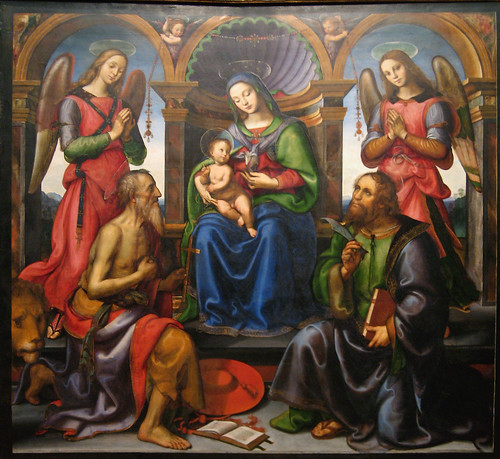
It is popular among flower arrangers because of its large, funnel-like, white bloom that has a prominent yellow spadix. Those who arrange flowers in churches are particularly drawn to the Calla Lily for two reasons. Firstly, it makes a fine show in the dark surroundings of a large building where smaller, darker coloured flowers are often overwhelmed. And secondly, the lily has symbolic connotations for the Christian religion (even a flower that is a lily in name only).The paintings of the Italian Renaissance frequently show figures holding lilies of one kind or another. In this example by Raffaellino del Garbo (c.1466-1524) Mary is holding a true lily as a symbol of her purity. The renowned Mexican painter, Diego Rivera (1886-1957) was fascinated by the Calla Lily judging by the number of his paintings that feature the flower. Probably the best known is "The Flower Vendor", but further examples abound - see here, here, and here.
Photographs of the Calla Lily usually emphasise its flawless, creamy white and gentle shading. However, in the relative darkness of a medieval church, shadows are often deeper and tinted light finds its way on to everything. Consequently my image is far from flawless, and the curved funnel has a more sombre, even slightly sinister feel.
photograph and text (c) T. Boughen
Camera: Lumix LX3
Mode: Aperture Priority
Focal Length: 5.1mm (24mm/35mm equiv.)
F No: f2
Shutter Speed: 1/60
ISO: 80
Exposure Compensation: -0.66 EV
Image Stabilisation: On
The Calla Lily, also known as the Arum Lily, is not a true lily. It belongs to the family Araceae rather than Liliaceae, and to the genus Zantedeschia. Consequently its Latin name is Zantedeschia aethiopica. Like all the flowers of this genus it originates from Africa, and in the case of Calla Lily, from areas of marsh and wetland.
It is popular among flower arrangers because of its large, funnel-like, white bloom that has a prominent yellow spadix. Those who arrange flowers in churches are particularly drawn to the Calla Lily for two reasons. Firstly, it makes a fine show in the dark surroundings of a large building where smaller, darker coloured flowers are often overwhelmed. And secondly, the lily has symbolic connotations for the Christian religion (even a flower that is a lily in name only).The paintings of the Italian Renaissance frequently show figures holding lilies of one kind or another. In this example by Raffaellino del Garbo (c.1466-1524) Mary is holding a true lily as a symbol of her purity. The renowned Mexican painter, Diego Rivera (1886-1957) was fascinated by the Calla Lily judging by the number of his paintings that feature the flower. Probably the best known is "The Flower Vendor", but further examples abound - see here, here, and here.
Photographs of the Calla Lily usually emphasise its flawless, creamy white and gentle shading. However, in the relative darkness of a medieval church, shadows are often deeper and tinted light finds its way on to everything. Consequently my image is far from flawless, and the curved funnel has a more sombre, even slightly sinister feel.
photograph and text (c) T. Boughen
Camera: Lumix LX3
Mode: Aperture Priority
Focal Length: 5.1mm (24mm/35mm equiv.)
F No: f2
Shutter Speed: 1/60
ISO: 80
Exposure Compensation: -0.66 EV
Image Stabilisation: On
Labels:
Arum lily,
Calla lily,
macro,
symbolism
Monday, March 09, 2009
In loving memory
click photo to enlargeYou wouldn't think of a church yard as a place to find humour, yet I can't pass a grave stone with the words "fell asleep" (to signify the death of the person commemorated) without a smile appearing on my face. I have this mental picture of the poor man or woman closing their eyes to rest and their wickedly grinning relatives seizing their chance to quickly pop them into their grave. Euphemisms of this sort abound in churchyards, especially on gravestones of the nineteenth and twentieth centuries. "Passed on", "Went to the Lord", "gone before", "gone away", "resting", "taken", and more, are used instead of the word "died". It seems that the longer we live, and the less we are familiar with death, the more we search for a different word or words to describe "our passing".
I find it quite surprising that the Victorians were reticent about giving death its true name: it was a much more familiar part of everyday experience in those days. The eighteenth century and earlier seemed to have less compunction about telling it like it is, and, though they decked their tombstones with symbols - a cherub to represent the departed soul, or a laurel wreath to signify the Christian triumph over death - they also carved skulls and bones, funeral shrouds and cadavers. Of course, many memorials of all periods do use the word "died", though just as many ignore it all together. The tradition I prefer is an inscription that simply records the name and dates of the deceased, with a few personal words from those who lived on - something that gives us a small insight into their life: perhaps an occupation, something of note that the departed was known for, a place of residence, or somesuch. I also find the words, "In loving memory", very appropriate, combining affection and a reminder of the purpose of any memorial, with just the right note of formality and solemnity.
Today's photograph is a detail from a memorial in a Lincolnshire churchyard. It is 12 feet tall, is topped by an angel, and has a large base on which is recorded the name of the deceased "who fell asleep" in 1898, below a wreath of roses (signifying virtue) and those well-used words. I photographed it on a frosty morning after a spider had used the marble sculpture as the site of its web. Seeing the wreath decked out in this way I was prompted to wonder whether the people commemorated there were still part of anyone's memory.
photograph & text (c) T. Boughen
Camera: Olympus E510
Mode: Aperture Priority
Focal Length: 22mm (44mm/35mm equiv.)
F No: f4.5
Shutter Speed: 1/25 seconds
ISO: 100
Exposure Compensation: -0.3 EV
Image Stabilisation: On
Labels:
death,
gravestones,
in loving memory,
memorial,
symbolism,
wreath of roses
Monday, December 08, 2008
Every picture includes two people
click photo to enlargeHere's my third and final 1960s-themed image. I've wanted to do a photograph that included eggs for a while because I find them such beautiful objects. From the "eggshell" lustre of their outer surface to the elegant shape and unlikely method of "manufacture", they are a fascinating piece of nature's handiwork that has been appropriated by designers for thousands of years. The earliest such example that I know is the Ancient Greeks' use of "egg and dart" ornament in architecture. This moulding, found on entablatures, columns and elsewhere, symbolises life (the egg) and death (the dart i.e. spear).
No such elemental symbolism can be ascribed to the eggs in this photograph. I conceived it as a semi-abstract composition, and simply used them as an irregular pattern to break the symmetry of the black and white background. I liked the soft colour, the three-dimensional qualities, and the pale shadows that they brought to the starkness of the background.
Someone looking over my shoulder at this photograph said it was reminiscent of the buttons on a clown's or harlequin's suit. Which just goes to prove the truth of the observation by the American photographer, Anselm Adams, that "There are always two people in every picture: the photographer and the viewer". And, I suppose, that every viewer brings along something different when they engage with an image.
photograph & text (c) T. Boughen
Camera: Olympus E510
Mode: Aperture Priority
Focal Length: 35mm macro (70mm/35mm equiv.)
F No: f16
Shutter Speed: 2 sec
ISO: 100
Exposure Compensation: -1.0 EV
Image Stabilisation: Off
Labels:
1960s,
Anselm Adams,
egg and dart,
eggs,
symbolism
Subscribe to:
Posts (Atom)