Showing posts with label John Betjeman. Show all posts

Tuesday, December 30, 2008

High windows

click photo to enlarge
"Rather than words comes the thought of high windows;
The sun- comprehending glass,
And beyond it, the deep blue air, that shows
Nothing, and is nowhere, and is endless."
Philip Larkin (1922-1985), English poet, novelist, jazz critic and librarian
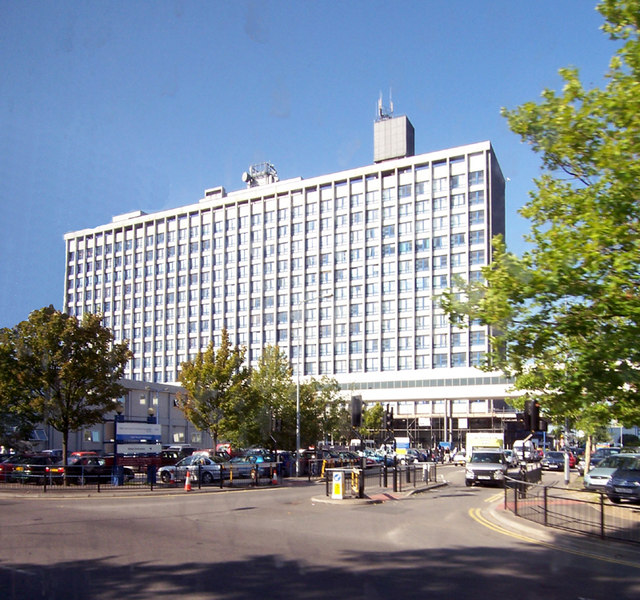
As I looked at my photograph of No 1 London Bridge, a monolithic office block pierced by large apertures, Larkin's final words from the title poem of his 1974 collection, "High Windows", came to mind. This powerful, characteristically dour work is, after "The Whitsun Weddings", Larkin's best known poem. It starts with a viscerally shocking observation that appalled many at the time, leads into a reflection on religion and life, and ends with the feeling that death is perhaps a welcome release from temporal concerns. I remember reading at the time of its publication that the poem was inspired by the ranks of faceless high windows he saw when he visited the Royal Infirmary at Hull, the city in which he lived and worked.

Samuel Johnson (1709-1784) is reported by his biographer, Boswell, to have said, "Depend upon it, sir, when a man knows he is to be hanged in a fortnight, it concentrates his mind wonderfully." Many people find that a visit to a hospital has a similar effect. Poets are no exception to this feeling, and use the thoughts such a visit provokes about their own mortality very effectively in their verse. One of the well-known poems of John Betjeman (1906-1984), "Before the Anaesthetic or A Real Fright", was inspired by a stay in the Radcliffe Infirmary, Oxford. It dwells on themes similar to those found in Larkin's poem, but revolves around the anguish of the poet's belief in Christianity.

The image above, one of several I have taken of this building, is cropped square, and is essentially symmetrical. I liked the overlapping reflections, the contrast of light and shade, the angularity, and the clouds glimpsed through the hole in the structure. When I looked up to take the shot I had no thoughts about life, death or religion. However, in a photograph of this building posted a while ago I did say it reminded me of a deeply boring Channel 4 (UK) station ident!

photograph & text (c) T. Boughen

Mode: Aperture Priority
Focal Length: 40mm (80mm/35mm equiv.)
F No: f6.3
Shutter Speed: 1/200
ISO: 100
Exposure Compensation: 0 EV
Image Stabilisation: On

Sunday, October 19, 2008

Picturing Swaton church

click photo to enlarge
"In counties less rich in ecclesiastical architecture Swaton would be outstanding."
The Buildings of England: Lincolnshire, (2nd Ed 1989) Nikolaus Pevsner & John Harris, revised by Nicholas Antram


"One of the lesser-known marvels of Lincs., magnificent and cruciform with central tower and enormous Decorated traceried windows; the nave arcades soar upward - with nave and aisles under single roof. A most distinguished looking church."
John Betjeman's Guide to English Parish Churches (1958 & 1993) John Betjeman, new material, Nigel Kerr

"What did Swaton do to deserve this aristocrat of a parish church?"
England's Thousand Best Churches (1999) Simon Jenkins

Well, given that build-up, and looking at my late afternoon photograph of what appears to be a fairly unexceptional church, you can be forgiven for wondering what all the fuss is about. However, with the end of its nave right up against the road, and hemmed in on both sides, St Michael at Swaton, Lincolnshire, is notoriously difficult to do justice to with a single photograph. This shot, from slightly south of east doesn't display the magnificent fourteenth century reticulated windows of the west of the building, the embattled nave and aisles, the lovely proportions and arrangement of parts, or, of course, the almost cathedral-like effect of the high and wide interior. In fact my image really does sell the church short! On the other hand it illustrates its context, and shows the sylvan churchyard setting, most of which, apart from small areas close to the entrance, is allowed to grow quite wild. It's a building that presents a real challenge to the photographer and I shall return with the intention of capturing something of its distinctive character when the trees have shed their leaves.

photograph & text (c) T. Boughen

Camera: Olympus E510
Mode: Aperture Priority
Focal Length: 11mm (22mm/35mm equiv.)
F No: f7.1
Shutter Speed: 1/400
ISO: 100
Exposure Compensation: -0.7 EV
Image Stabilisation: On