Showing posts sorted by relevance for query aquarium. Sort by date Show all posts

Tuesday, March 04, 2014

Where's its face?

click photo to enlarge
One of the delightful things about children is that you never know what they might say next. What can seem to be evidence of a grasshopper mind or a struggle to understand is more often than not simply an indication that children's thought isn't constrained by the same wide range of experiences that often limit adult thinking.

My wife tells a story of the dawning realisation by a small boy who knew her that my surname is the same as hers. After repeating both our names - "Mr Boughen, Mrs Boughen" a few times to fully establish the connection he said, "Do you live in the same house?" As my wife replied in the affirmative she wondered just where his mind would go next. But what he came up with was nowhere near what she thought he might say. "Does it have a chimney?" he enquired.
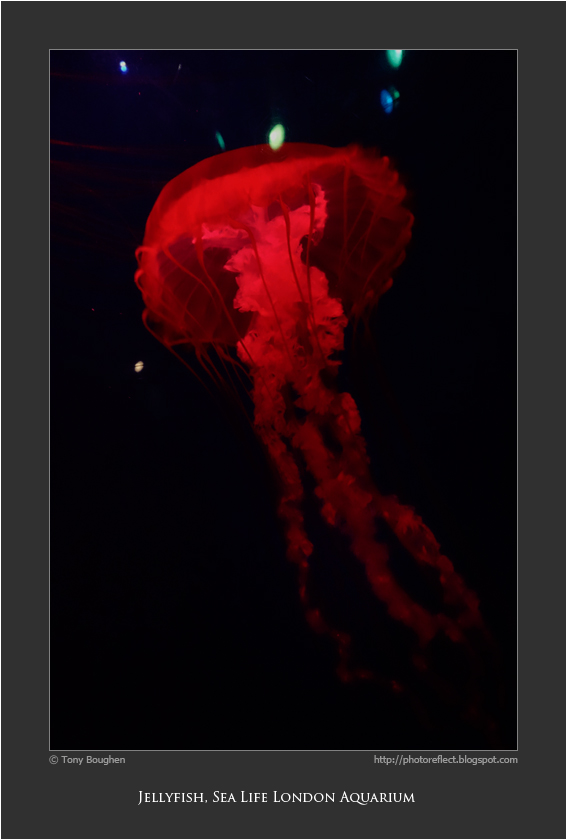

During our recent couple of days out and about in London with our granddaughter we visited the Sea Life London Aquarium. She'd been there when she was younger and had been quite scared of the sharks. On this occasion, however, she was fascinated by everything she saw and we spent a couple of hours slowly moving through the building marvelling at the variety of life on display. When we came to a tank that held some jellyfish we paused to watch them swim about by pulsating their bodies. We'd answered a lot of questions up to that point but I wasn't prepared for the one that these jellyfish prompted. "Where's its face?" she asked. A perfectly reasonable question from a child whose experience of animal life up to that point has been largely with those that have eyes and mouths. But not the easiest question for a grandfather to answer in a way that a two year old can understand.

I took quite a few photographs of the creatures in the aquarium. However, low light levels, fast moving fish and a relatively small sensor camera don't make for photographic 100% success. Quite a few shots had motion blur or other shortcomings. But the jellyfish came out rather better (as did the crocodiles, terrapins and slower moving fish). These examples were in a tank with lighting that cycled through a variety of colours. The main photograph is best of the crop for the lighting and the composition. I include the other two for contrast.

photograph and text © Tony Boughen

Photo 1
Camera: Sony RX100
Mode: Aperture Priority
Focal Length: 10.4mm (28mm - 35mm equiv.)
F No: f5
Shutter Speed: 1/30 sec
ISO:2500
Exposure Compensation: -0.3 EV
Image Stabilisation: On

Monday, January 14, 2008

Don't interact

click phot0 to enlarge
"Interactive" has to be one of my least favourite words. So-called "involvement" through "interactivity" seems to be the 21st century's ubiquitous "democratic" bolt-on feature. Everything has to be interactive. Radios want you to call in or text and give your point of view. So do TV stations with their "tickertape" messages from the public. Have you ever read any of those - they must be the new outlet for the green ink brigade. Whole programmes now feature nothing but "real" people "interacting" with each other. Websites everywhere solicit the user's input, sometimes (like Facebook) to the point of being almost "content free", apart from people craving recognition in its most meaningless form from other people. And zoos, museums and galleries have caught the interactive disease too.

A couple of years ago I went to "The Deep", a new aquarium in Hull. It had some great fish in some stunning tanks, and I enjoyed seeing them. But the whole experience was spoiled (and limited) by an interactive section with computers, buttons to push, knobs to spin, headphones to wear, etc. Most adults seemed to be walking straight past all this. Children pushed, prodded, rarely listened, and raced between interactivities so rapidly that any information that was supposed to be conveyed must have gone straight into the ether. Art galleries offer this type of thing too - draw like an Impressionist, do a jigsaw of this famous painting, remove the layers of a painting electronically to see what's underneath, all in a feeble attempt to "involve" the visitor. What I - and I suspect many others - want is a well mounted exhibition, with interpretation by someone who is knowledgeable, that entertains, challenges and informs. The money a gallery saved on interactivity over a year could mount an extra exhibition. So, I was pleased when I heard this week a politician say that Government funding of the arts was to be more focussed on quality, and less on participation and "ticking the boxes". Until I realised that this might just mean even bigger doses of the juvenilia of Damien Hurst, Tracey Emin and co, and less space for new artists!

Today's photograph shows the exterior of "The Haven" gallery in Boston, Lincolnshire. It is currently showing some landscapes by the U.S. photographer Hope Greene, and drawings by David Lloyd Brown. I liked the confusion resulting from the layering of lights, the reflected converted warehouses, the grid of the glass curtain wall, and the passing person.

POSTSCRIPT: "Don't interact" seemed a prescriptive, rather killjoy title, and I was going to change it. Then I read this article about "Facebook" in today's Guardian newspaper. It only deepened my concerns about this type of phenomenon. If only half of the article is true, this post's title is advice worth following.

photograph & text (c) T. Boughen

Camera: Olympus E510
Mode: Aperture Priority
Focal Length: 16mm (32mm/35mm equiv.)
F No: f4
Shutter Speed: 1/100
ISO: 100
Exposure Compensation: -1.0EV
Image Stabilisation: Off

Thursday, March 31, 2011

Juxtaposition

click photo to enlarge
Photographic composition can be approached in a number of ways. One that I like, and which I don't use enough since I moved to a rural location - is juxtaposition, the conscious placing of disparate objects in the frame.

This technique is one that comes easily to painters, but is slightly more difficult for photographers. Firstly the juxtaposition has to be seen, then it has to be organised into a composition. Often this will mean excluding objects and the photographer changing position to bring the juxtaposed objects into  "engagement". It is a device that can work well where the objects are figurative, but also where the intention is to construct an image with semi-abstract elements.

The other day, when walking near "The Deep" aquarium in Kingston upon Hull, I noticed a building that I'd seen before but had never looked at. It is a blocky structure, clearly utliitarian, probably connected with its futuristic looking neighbour, and has a mosaic-like decoration on its main facade. It wasn't just the building that caught my eye, however, but the building and the car park arrow on the tarmac in front of me. I framed my shot so that the ranks of parked vehicles to left and right were excluded, and let the juxtaposition of the arrow, the horizontal bands and the colourful grid work together in my composition.

photograph and text (c) T. Boughen

Camera: Canon
Mode: Aperture Priority
Focal Length: 65mm
F No: f7.1
Shutter Speed: 1/640
ISO: 100
Exposure Compensation:  -0.33 EV
Image Stabilisation: On

Wednesday, March 30, 2011

Hull and Humber

click photo to enlarge
I lived in Kingston upon Hull for several years in the 1970s and 1980s. Having been raised in the Yorkshire Dales I found moving from the hills and the drizzle to a port city in drier, brighter Eastern England quite a contrast. Hull has a range of industries along the two rivers on whose banks it stands, and I found a lot of interest and good photographic opportunities in them, as well as in its historic "old town" and docks.

Residents of this Yorkshire city invariably call it by the name that derives from the narrow river on which it was built - the River Hull. The grander version of the name bequeathed in 1299 by King Edward 1, in preference to Wyke or Wyke upon Hull, is favoured by official bodies but eschewed by the locals. On a brief, recent visit to the city I walked around the area at the confluence of the River Hull and the mighty River Humber into which the lesser river flows. The old pier head remains, but the Humber Bridge did for the "Lincoln Castle" paddle steamer that used to be the means of crossing the Humber from Yorkshire to Lincolnshire. At the junction of the rivers, on a point that once was empty of buildings, a large, futuristic looking new aquarium sits. New crossings span the River Hull, and it was as I stood on the pedestrian bridge over the water that the "Rix Eagle", a fuel bunkering lighter, passed under the tidal barrier, then beneath me, and headed out past "The Deep" into the Humber and downstream towards the commercial docks.

I photographed the long, barge-like ship as it passed below the tidal barrier, then turning, took another shot as it headed into the Humber. The latter photograph, with a very bright sky, works better in black and white, but the first shot benefits much more from colour.

photograph and text (c) T. Boughen

Main Photo
Camera: Canon
Mode: Aperture Priority
Focal Length: 24mm
F No: f7.1
Shutter Speed: 1/500
ISO: 100
Exposure Compensation:  -0.33 EV
Image Stabilisation: On

Friday, April 01, 2011

The deep end

click photo to enlarge
I've written about Kingston upon Hull's Terry Farrell designed aquarium, "The Deep", before. On that occasion I had a few thoughts about its purpose and shape, and posted a photograph of its angular steel exterior and colourful windows. That shot shows part of the elevation that faces the River Humber. On my recent visit I noticed that this area of steel has been coated with some kind of dark paint/covering: presumably the original finish has been found wanting in some way. Today's main photograph also shows part that overlooks the Humber, but this time it includes what is probably the most interesting exterior feature of the building - its sharp, glazed prow that encloses "The Observatory" cafe. The gleaming steel, angular shapes, coloured glass cladding and the the thrusting point of the tip invited a semi-abstract approach to my composition.

I also took a more distant, contextual photograph from the old pier, and this shot set me thinking once again about the design of the building. The location, on a triangular promontory, determines the overall shape, but what I wondered as I took my photograph was why the architect treats the elevation at which the visitor arrives so poorly, and applies his art to the less frequently seen elevations that front the Humber and the River Hull. Certainly anyone crossing the latter river and standing near the old pier gets a good view of the building. However, those who see the River Humber elevation is restricted to people on boats and ships. I wondered too about the overall shape as seen in my smaller photograph. It seems animal-like, with a pointed head to the right, a creature about to pounce on its prey with details that can be interpreted (am I being too fanciful?) as feet and an eye. Was that the intention? I left thinking that, firstly, I'd like to have seen that great flat wall recess or protrude in one or two places a bit more than it does, and secondly, that if the slight breaks in the incined roof line were a bit bigger they would have offered more interest. If that sounds like I'm damning what I see, I'm not - there is a lot to like, and a lot to photograph.

photograph and text (c) T. Boughen

Main Photo
Camera: Canon
Mode: Aperture Priority
Focal Length: 24mm
F No: f7.1
Shutter Speed: 1/1600
ISO: 100
Exposure Compensation:  -0.33 EV
Image Stabilisation: On

Tuesday, December 10, 2013

The Crystal, Royal Victoria Docks, London

click photos to enlarge
I returned yesterday from a visit to London and, as I sat looking through the photographs that I'd harvested during my time there, I fell to thinking about the metaphors that have been used to describe our capital city. The political reformer and farmer, William Cobbett, called it "the great wen" in his book, "The Rural Rides" that was written in the 1820s and published in 1830. A wen is a sebaceous cyst and Cobbett saw its rapid growth and the way it attracted people and money as detrimental to the country as a whole. For a couple of centuries centuries the city has colloquially been called "The Smoke" because of the amount it generated from its houses and industries. Economic geographers frequently refer to it as a "magnet" for capital due to the way it sucks in national and international investment.

What prompted these thoughts, and why was I pondering "black hole" as another suitable metaphor and rejecting it (there quite a bit that I like about London)? Well, it was something my son said as we walked past a shiny, angular, new building standing on the edge of the Royal Victoria Docks across the Thames from the Millennium Dome (now the O2 Arena). He commented that in most British provincial cities "The Crystal" - the building's name - would be a noteworthy, feted structure used to draw visitors, whereas here it was just another such building, one of so many in the London, that he'd never been in. It has been built as "a sustainable cities initiative exploring the future of cities". I imagine it's also a so-called iconic building intended to help with the regeneration of this area of former docks. The Crystal's origami-like appearance made me wonder whether Terry Farrell had a hand in its design because it put me in mind of his aquarium in Hull, "The Deep". But no, this building is the work of Chris Wilkinson of Wilkinson Eyre who says that its "crystalline geometry" is inspired by nature. There can be few natural objects that share this building's faceted exterior but I suppose some quartz formations do. For a photographer the building provides some striking shapes and reflections, and as my companions went to watch some wake-boarders using a fixed line at the edge of the old dock, I circled the building with my camera putting together a few semi-abstract compositions as well as one or two more conventional photographs.

photographs and text © Tony Boughen

Photo 1
Camera: Sony RX100
Mode: Aperture Priority
Focal Length: 19.1mm (51mm - 35mm equiv.)
F No: f5
Shutter Speed: 1/60 sec
ISO:125
Exposure Compensation: -0.3 EV
Image Stabilisation: On

Thursday, June 04, 2009

People as scale, focus and compositional element

click photo to enlarge
I've said elsewhere in this blog that people are rarely the main subject in my photo- graphs, family snaps excepted. However, I do value the contrib- ution that the human figure can make to an image. Moreover, in one area of photography I search for people where others would make every effort to remove them.

Perhaps it's my interest in painting that makes me include people in landscapes wherever it's possible. Look at landscape paintings from the Italian Renaissance through to the twentieth century and you'll usually see figures somewhere. Titian has them, Breughel too, the English landscape painters of the eighteenth and nineteenth centuries invariably include them, as do the Impressionists. But, from Cezanne onwards, and particularly where an element of abstraction is introduced, landscapes start to appear that are devoid of the human form.

On the other hand, perhaps it's because I don't compose images around people that I include them in landscapes. I think not however, preferring to see my reasons for their inclusion as three-fold. Firstly, people can give scale to those scenes that aren't always easy to read in terms of the size of the objects on view. Secondly, our eye instantly recognises and is drawn towards the human form, so it immediately confers a point of interest or focus to an image. The third point arises from the second: given the visual importance that we attach to a person in a photograph, a figure can be a useful compositional device. Moreover, even if the figure is quite small it still has a lot of visual "weight". So, a relatively insignificant, distant figure on the left of a scene can quite easily balance a large and prominent object on the right.

Today's photograph exemplifies my first two reasons for the inclusion of people. I took several shots of the Humber-facing point of this aquarium in Kingston upon Hull called "The Deep". The thrusting, prow-like shape and the aggressive architecture (by Terry Farrell & Co.), alongside the navigation lights and markers, make for an interesting photograph, even when taken against the light. But, when a family came into view at the base of the building I knew that their inclusion would add scale and a point of interest that would add significantly to the image.

photographs & text (c) T. Boughen

Camera: Olympus E510
Mode: Aperture Priority
Focal Length: 61mm (122mm/35mm equiv.)
F No: f7.1
Shutter Speed: 1/800 seconds
ISO: 100
Exposure Compensation: -1.0 EV
Image Stabilisation: On

Sunday, January 15, 2012

The sun and The Deep

click photo to enlarge
Each winter I try to take a few photographs that include the sun. I don't mean sunrise and sunset shots, though these are easier to acquire at that time of year - you don't have to be out and about early or late! No, I'm thinking more of when the sun is fully above the horizon though low in the sky: early afternoon is a good time.

What appeals to me about such images is the drama conferred by the big glowing white ball, the contrast that results from the deep shadows thrown by objects in the foreground, the flare that the lens often produces, and the sheer unpredictability of the outcome. On a recent day visit to the city of Hull I had little time for photography. However, I did manage to spend a short time around the point where the River Hull meets the River Humber. When I lived in the city I often cycled and photographed in this area so it's always a pleasure to return. On my visit I took a few shots that include the sun on the old High Street and then again from the new footbridge over the River Hull, upstream from the big, futuristic looking aquarium called "The Deep". Regular readers of this blog may remember images taken last year in this location (see this sequence). I was prompted to take today's photograph as much by the glistening mud revealed by low tide as anything else, but I was careful to use the sun as a visual counterweight to the building in my composition. The overall effect is a touch other-worldly but not, I think, unappealing.

For other winter images including the bright sun see this one with a gate and snow, this one also with snow, or perhaps this one with vapour trails.

photograph and text (c) T. Boughen

Camera: Canon
Mode: Aperture Priority
Focal Length: 24mm
F No: f6.3
Shutter Speed: 1/1000 sec
ISO: 100
Exposure Compensation:  -1.0 EV
Image Stabilisation: On

Thursday, December 29, 2011

Spalding station silhouettes

click photo to enlarge
Silhouettes are a reasonably regular feature of my photographic output. This year I've posted silhouettes of pollarded poplars, electricity pylons, rooks and lights, the disembarking Lynn ferry, and the Observatory Cafe at "The Deep" aquarium, Hull. Quite a few other images, whilst not as obviously featuring silhouettes as strongly the examples cited, nevertheless leaned heavily on dark shapes against a lighter background: shots such as this fishing boat and these shoppers for shoes.

In fact, when I look back at my "Best of..." silhouettes figure quite prominently in most of the photographic categories. For anyone who hasn't dipped into my back catalogue here are a few examples: St Anne's pier, roller coaster repair, street lights, ducks and water, Mount Pavilion, Fleetwood, dead tree, promenade seat, and one of my personal favourites, the bait digger's bike.

I find silhouettes appealing for a number of reasons. They are strikingly bold, dramatic takes on reality, a way of instantly turning the mundane into something visually arresting. Their positive/negative qualities, whereby the outline of the subject creates both the flat dark shape and the light shape that intersect like jigsaw pieces, endows images with a semi-abstract quality that I like. Then there's the counter-intuitive fact that a silhouette of an object often leads your eye to linger longer and often results in you taking in more detail than you would from a well lit photograph of the same thing. Don't believe that? Look at the photograph of the bait digger's bike again and consider whether you'd have explored it as much if the sun had been behind the camera.

Today's photograph was taken on a shopping expedition to Spalding, Lincolnshire. It was taken from a supermarket car park and shows the prominent chimneys of the railway station, a subject I've featured before. Interestingly, as I was writing this piece I remembered that today's photograph is not the first one I've taken featuring silhouetted chimneys, the end of the day and birds flying to roost. This one was taken in Fleetwood, Lancashire, in 2006.

photograph and text (c) T. Boughen

Camera: Canon
Mode: Aperture Priority
Focal Length: 100mm
F No: f5.6
Shutter Speed: 1/400
ISO: 100
Exposure Compensation:  -0.67 EV
Image Stabilisation: On

Sunday, November 24, 2013

Crystal Palace dinosaurs

click photo to enlarge
In 1851 the Great Exhibition was held in Hyde Park, London. When it closed the newly built exhibition building, an enormous plate glass and cast iron structure that came to be known as the Crystal Palace, was dis-assembled and moved to Sydenham Hill. Here it was re-built in a quite different form, becoming an exhibition space, concert hall, gallery, meeting place and museum in the newly created Crystal Palace Park. This Victorian pleasure garden, a 389 acre development of the grounds of a former mansion, also acquired a formal Italian Garden, a Great Maze, an English Landscape Garden, a cricket ground, a football stadium, aquarium, a concert bowl and much else. It also gained some areas of water with islands and it was on one of these that the most interesting attraction was sited.
In 1852 the sculptor, Benjamin Waterhouse Hawkins (1807-1894) was commissioned create 33 life-size models of extinct, prehistoric mammals and dinosaurs. He was assisted in his task by Sir Richard Owen (1804-1892), a biologist and palaeontologist, and the man who coined the word "dinosaur". The models were based on the best current interpretation of the animals' form derived from the fossils that were being collected in increasing numbers. They were probably the first ever dinosaur sculptures and the limitations of their accuracy soon became apparent as science and fresh finds threw new light on the creatures. However, they proved a great attraction, even spawning what may have been the first tie-in merchandising in the form of a set of miniatures based on the originals and available for the sum of £30. They certainly drew the crowds, and despite the ravages of time and neglect, concerted restorations have returned them to close to their original condition and they continue to be a draw, especially to children.

I'd never visited Crystal Palace Park before the autumn day on which I took these photographs. As I moved from group to group I reflected that, in terms of the appearance of the trees and shrubs, I couldn't have chosen a better time to be there. The deep reds, yellows, oranges and browns of the leaves added to the more usual greens gave the backdrop to the giant beasts an appropriately other-worldly appearance, and animated them in a way that probably doesn't happen in high summer.

photographs and text © Tony Boughen

Photo 1
Camera: Sony RX100
Mode: Aperture Priority
Focal Length: 25mm (67mm - 35mm equiv.)
F No: f4
Shutter Speed: 1/80 sec
ISO:400
Exposure Compensation: -0.7 EV
Image Stabilisation: On

Sunday, April 03, 2011

The Observatory Cafe

click photo to enlarge
I'd never been into the cafe at "The Deep" aquarium in Kingston upon Hull until a few days ago. Moreover, until we headed up to it I didn't know that it was called "The Observatory Cafe". When I got there the view of the River Humber, the River Hull, the waterside buildings and the distant shore of Lincolnshire, showed that it was well named. However, as I sat and drank my cup of tea, gazing down through the angled windows, and studying my surroundings, it occurred to me that it wasn't as well named as it could have been.

I imagine the architect envisaged diners looking out at the view and pointing out the passing river traffic. But, the days when this scene would always have had a ship or boat heading up or downstream are long past. The focus of shipping in the port of Hull is now downstream (left) of this view. One or two small craft use the River Hull, yachts and launches moored in the marina venture out at reasonably regular intervals, the occasional small vessel from the Port of Goole passes, and the docks that remain open upstream (right) of the view generate the odd craft. But the fish docks that would have sent deep-sea trawlers regularly past this point are virtually silent, and the smaller commercial traffic of the adjacent docks, has almost vanished.

There's nothing wrong with "The Observatory" as a name for this location, but it seemed to me that "The Bridge" (of either a trawler, a liner or some futuristic starship) was more appropriate. Looking at my photograph on the computer screen only reinforced this feeling. I was in two minds whether or not to turn this almost monochrome image into a black and white shot, but the blue/green tinted glass and the muted colours that just about make themselves felt gave it a quality I liked, so I stayed with colour.

photograph and text (c) T. Boughen

Camera: Canon
Mode: Aperture Priority
Focal Length: 35mm
F No: f7.1
Shutter Speed: 1/200
ISO: 100
Exposure Compensation:  -0.67 EV
Image Stabilisation: On

Monday, June 08, 2009

Windows on The Deep

click photo to enlarge
Will the day come when we lament the passing of the right angle in architecture? The answer to that will surely be, "No, there is too much that is right about the right angle, and too little that is wrong!" I ask the question because for the past couple of decades we've seen an increasing number of buildings whose aesthetic depends on acute and oblique angles (as well as curves.) Architects such as Frank Gehry and Daniel Libeskind through their various cultural buildings have been influential in this trend, a development about which I have very mixed feelings.

It seems to me that buildings such as Gehry's Walt Disney Concert Hall, Foster's 30 St Mary Axe, Libeskind's Imperial War Museum North, or Future Systems' Selfridges Department Store are expressionistic designs that have arisen for reasons other than being the best solution to the needs of the client. They are "landmark" buildings, structures that are designed to catch the eye, to promote the locality, intended to say "modern" or "the future" to all who look at them. They seem to be buildings whose forms are as they are because they can be: the product of architects who have fully grasped the change that computers and new materials have brought to the profession. They also give the impression of being the work of frustrated sculptors! I won't, however, deny that these buildings can bring focus to a location, can act as a regenerative force, and have great visual appeal. I would say, though, that those qualities should be secondary to the functional purpose of a building, and therein lies my equivocation about such structures: I'm not sure that many of them fulfill that principal objective.

I recently visited The Deep in Kingston upon Hull. This deep water aquarium by Terry Farrell sits at the confluence of the River Hull with theRiver Humber. Its angular, thrusting shape is very eye-catching, and includes few right-angles. Its raison d'etre is to assist with the regeneration and development of the river front of this part of the city. As such it was funded by the National Lottery's Millennium Commission project. It has been successful in achieving its stated aims. However, one has to ask whether the building is this shape, and made of these materials, because it's the most effective way to house the aquariums and the attendant facilities. But, my quibbles aside, there's no denying its "presence" and the use a photographer can make of its origami shape. My photograph shows a detail of the wall and windows on the River Humber elevation. I composed it with a thought to balance, line and colour, and deliberately left a sliver of sky at the top right.

photograph & text (c) T. Boughen

Camera: Olympus E510
Mode: Aperture Priority
Focal Length: 19mm (38mm/35mm equiv.)
F No: f7.1
Shutter Speed: 1/400 seconds
ISO: 100
Exposure Compensation: -0.3 EV
Image Stabilisation: On