After 310 posts I've decided to draw a line under PhotoReflect. At the moment I can't muster the time to write the "reflections"! So, I've started a new, considerably less labour-intensive blog - PhotoQuoto.
Thanks to everyone for the interest and comments over the past 15 months. I hope you enjoy my new venture. If you give it a try be sure to leave a comment.
The address is PhotoQuoto (http://photoquoto.blogspot.com)
Regards, Tony
Saturday, March 17, 2007
Sunday, March 11, 2007
Simple things
"I must go down to the seas again, to the lonely sea and the sky,
And all I ask is a tall ship and a star to steer her by,
And the wheel's kick and the wind's song and the white sail's shaking,
And a grey mist on the sea's face, and a grey dawn breaking", John Masefield (1878-1967), English poet
I find it both a wonder and a delight that, despite the technological progress that mankind makes, people still cling to the simple things in life. Take the bicycle. It is frequently voted the favourite invention of all time, yet it remains, essentially, the same classic, human-powered design that was perfected in the nineteenth century. Sinclair C5s and Segways may come and go, but the humble bicycle rolls on, evolving in small ways, but never forsaking its fundamental features.
So too with sail boats. I suppose paddled canoes came first in evolutionary terms. But it can't have been long before an alert sailor noticed the wind's effect on his upright body, and from there it would have been a small step to rigging up a sail. So, sail-powered boats of one sort or another must have been around for millennia. And they still are. The delight that sailors get from being propelled by the wind, from learning how to sail against it, and from feeling at one with the elements is palpable to anyone who has watched dinghies whizzing over the water. Yes, you can go faster with an outboard, and there is a certain sort of person to whom the motorcycle of the waves - the jet-ski - is the ultimate thrill. But the fun of slapping through the water accompanied by the sound of flapping sails remains a draw to sailors young and old.
The dinghies of the Blackpool & Fleetwood Yacht Club on the tidal River Wyre at Skippool race when the water is high. This area of estuary with its wildlife, mudflats, reedbeds and saltmarsh is a Site of Special Scientific Interest (SSSI). Yet the gentle passage of the dinghies and even the larger yachts create little disturbance, and the plants and animals co-exist happily with their human neighbours. I took this contre jour photograph early one morning as the dinghies were being readied on the slipway prior to launching at high tide. The cloud and vapour trail patterns, the light through the sails, and the silhouettes presented an evocative sight. I recorded it with a wide zoom lens at 22mm (35mm equivalent), with the camera set to Aperture Priority (f8 at 1/2000 second), ISO 100, with -1.0EV.
And all I ask is a tall ship and a star to steer her by,
And the wheel's kick and the wind's song and the white sail's shaking,
And a grey mist on the sea's face, and a grey dawn breaking", John Masefield (1878-1967), English poet
I find it both a wonder and a delight that, despite the technological progress that mankind makes, people still cling to the simple things in life. Take the bicycle. It is frequently voted the favourite invention of all time, yet it remains, essentially, the same classic, human-powered design that was perfected in the nineteenth century. Sinclair C5s and Segways may come and go, but the humble bicycle rolls on, evolving in small ways, but never forsaking its fundamental features.
So too with sail boats. I suppose paddled canoes came first in evolutionary terms. But it can't have been long before an alert sailor noticed the wind's effect on his upright body, and from there it would have been a small step to rigging up a sail. So, sail-powered boats of one sort or another must have been around for millennia. And they still are. The delight that sailors get from being propelled by the wind, from learning how to sail against it, and from feeling at one with the elements is palpable to anyone who has watched dinghies whizzing over the water. Yes, you can go faster with an outboard, and there is a certain sort of person to whom the motorcycle of the waves - the jet-ski - is the ultimate thrill. But the fun of slapping through the water accompanied by the sound of flapping sails remains a draw to sailors young and old.
The dinghies of the Blackpool & Fleetwood Yacht Club on the tidal River Wyre at Skippool race when the water is high. This area of estuary with its wildlife, mudflats, reedbeds and saltmarsh is a Site of Special Scientific Interest (SSSI). Yet the gentle passage of the dinghies and even the larger yachts create little disturbance, and the plants and animals co-exist happily with their human neighbours. I took this contre jour photograph early one morning as the dinghies were being readied on the slipway prior to launching at high tide. The cloud and vapour trail patterns, the light through the sails, and the silhouettes presented an evocative sight. I recorded it with a wide zoom lens at 22mm (35mm equivalent), with the camera set to Aperture Priority (f8 at 1/2000 second), ISO 100, with -1.0EV.
photograph & text (c) T. Boughen
Labels:
bicycles,
sailing,
simple pleasures,
Skippool
Saturday, March 10, 2007
Walking and computers
There seems to be a general feeling that computers are good for democracy. Supporters of this viewpoint cite the Chinese government's restriction of its citizens' access to the internet as telling evidence of the proposition. And it's undoubtedly true that they give the individual in a society access to information, the means to manipulate and interpret it, and the power to communicate with the like-minded and our politicians.
However, computers can also be used in an anti-democratic way too. Most notably they allow governments, through the amassing and manipulating of data, to believe that they are in a better position to direct and organise society, than are local people and local politicians: they are a dangerous, centralising force. Take the current panic over childhood obesity. The government has collected data, is collecting more, and has come up with an answer - more physical activity in schools. Surely I'm not alone in thinking that if overweight children is the problem, then making them jump about in schools isn't the answer. But, computers in the government's education department know, to the minute (they think), how much physical activity school children undertake each week, and it's not enough! So the decree went out that all, throughout the country, should receive a minimum of two hours weekly during school time. Money was spent, organisers were appointed, and a grand strategy involving webs of high schools with feeder primaries were urged into action. It will have virtually no effect! Child obesity will only be solved by deep-seated life-style changes that include eating better and eating less, and walking and cycling more. This involves government leaning on food companies, planning for bikes and pedestrians, restricting cars, and yes, education, but in the widest sense. However, those strategies don't make politicians very popular. It's much easier to have a grand, trumpeted, school-based initiative and look like you're doing something!
One thing I've started to notice is that when I go walking the majority of the people I see doing it for pleasure are "older" people. If I go to the "honey-pot" locations like the Lake District, the balance shifts towards the younger end, and organised groups of children and young teens can be seen. But elsewhere it's mainly the "oldies" - like my wife and I - people for whom walking has been a lifelong way of getting about, and a source of enjoyment. The photograph shows my wife climbing a stile over a limestone wall on Gigglewick Scars in the Yorkshire Dales. I framed the shot so the wall acts as a line leading to the figure, or from the figure into the surroundings. The image was taken with a wide zoom lens at 44mm (35mm equivalent), with the camera set to Aperture Priority (f6.3 at 1/400 second), ISO 100, with -1.0EV.
However, computers can also be used in an anti-democratic way too. Most notably they allow governments, through the amassing and manipulating of data, to believe that they are in a better position to direct and organise society, than are local people and local politicians: they are a dangerous, centralising force. Take the current panic over childhood obesity. The government has collected data, is collecting more, and has come up with an answer - more physical activity in schools. Surely I'm not alone in thinking that if overweight children is the problem, then making them jump about in schools isn't the answer. But, computers in the government's education department know, to the minute (they think), how much physical activity school children undertake each week, and it's not enough! So the decree went out that all, throughout the country, should receive a minimum of two hours weekly during school time. Money was spent, organisers were appointed, and a grand strategy involving webs of high schools with feeder primaries were urged into action. It will have virtually no effect! Child obesity will only be solved by deep-seated life-style changes that include eating better and eating less, and walking and cycling more. This involves government leaning on food companies, planning for bikes and pedestrians, restricting cars, and yes, education, but in the widest sense. However, those strategies don't make politicians very popular. It's much easier to have a grand, trumpeted, school-based initiative and look like you're doing something!
One thing I've started to notice is that when I go walking the majority of the people I see doing it for pleasure are "older" people. If I go to the "honey-pot" locations like the Lake District, the balance shifts towards the younger end, and organised groups of children and young teens can be seen. But elsewhere it's mainly the "oldies" - like my wife and I - people for whom walking has been a lifelong way of getting about, and a source of enjoyment. The photograph shows my wife climbing a stile over a limestone wall on Gigglewick Scars in the Yorkshire Dales. I framed the shot so the wall acts as a line leading to the figure, or from the figure into the surroundings. The image was taken with a wide zoom lens at 44mm (35mm equivalent), with the camera set to Aperture Priority (f6.3 at 1/400 second), ISO 100, with -1.0EV.
photograph & text (c) T. Boughen
Labels:
computers,
drystone walls,
exercise,
Giggleswick,
walking,
Yorkshire Dales
Friday, March 09, 2007
No, no to retro!
The success of the "new" Mini has been trumpeted in the press in recent days. It seems to be selling very well and production is to be increased. Commentators like it and, apparently, so do the car-buying public. I don't! My view of this car is the same as my thinking on the "new" VW Beetle - they are shams: pale imitations of the vehicles that they are designed to echo, and based on a corrupt design principle.
Alec Issigonis, the designer of the original Mini had a clear brief to make a small, mass-produced, inexpensive vehicle. He succeeded by being innovatory. The new car had to fit in a space 10 feet X 4 feet X 4 feet, the passenger cell had to be at least 6 feet long, and it had to use an existing engine. The designers came up with a monocoque shell, mounted the engine transversely, and gave it front-wheel drive. The wheels at each corner conferred great stability and handling, and the firm ride came from the use of rubber cones instead of conventional springs. Other innovations like welded seams, sliding windows and external hinges kept the cost down and contributed to a quirky and appealing aesthetic. Despite its cost being initially more than was intended people wanted to buy it, and it became a great success. By contrast the "new" Mini simply apes the appearance and details of the old car, and uses the same bog standard designs found on every new car. Retro and copyist styling of this sort shows lazy, bankrupt thinking. It's like building a mock-Georgian house in the twenty-first century. Why would you do it? People should build for now. They should create designs of their own time and push forward, not look back!
What, you're probably thinking, has this got to do with a shelter on the Blackpool's North Shore - all pediments, cartouches and ornate iron brackets. Well, new shelters have been built on the South Shore that completely disregard old designs of this sort. And, further up the coast new, modern shelters are appearing as part of Cleveleys' new sea-defences. No one thought for a moment to create shelters that looked like, or drew their inspiration from examples such as the one in the photograph. This shelter is of its time, is not without distinction, but certainly isn't of today. Car designers need to take note!
I took this shot on cold sunny day when the biting wind made a cliff-top walk a challenge rather than a pleasure. But that didn't stop the determined, two of whom I included in my image. I placed the shelter very slightly off centre to balance the people, and post-processed in contrasty black and white to emphasise the strong forms. The photograph was taken with a medium zoom lens at 36mm (35mm equivalent) with the camera set to Aperture Priority (f7.1 at 1/320 second), ISO 100, with -1.3EV.
Alec Issigonis, the designer of the original Mini had a clear brief to make a small, mass-produced, inexpensive vehicle. He succeeded by being innovatory. The new car had to fit in a space 10 feet X 4 feet X 4 feet, the passenger cell had to be at least 6 feet long, and it had to use an existing engine. The designers came up with a monocoque shell, mounted the engine transversely, and gave it front-wheel drive. The wheels at each corner conferred great stability and handling, and the firm ride came from the use of rubber cones instead of conventional springs. Other innovations like welded seams, sliding windows and external hinges kept the cost down and contributed to a quirky and appealing aesthetic. Despite its cost being initially more than was intended people wanted to buy it, and it became a great success. By contrast the "new" Mini simply apes the appearance and details of the old car, and uses the same bog standard designs found on every new car. Retro and copyist styling of this sort shows lazy, bankrupt thinking. It's like building a mock-Georgian house in the twenty-first century. Why would you do it? People should build for now. They should create designs of their own time and push forward, not look back!
What, you're probably thinking, has this got to do with a shelter on the Blackpool's North Shore - all pediments, cartouches and ornate iron brackets. Well, new shelters have been built on the South Shore that completely disregard old designs of this sort. And, further up the coast new, modern shelters are appearing as part of Cleveleys' new sea-defences. No one thought for a moment to create shelters that looked like, or drew their inspiration from examples such as the one in the photograph. This shelter is of its time, is not without distinction, but certainly isn't of today. Car designers need to take note!
I took this shot on cold sunny day when the biting wind made a cliff-top walk a challenge rather than a pleasure. But that didn't stop the determined, two of whom I included in my image. I placed the shelter very slightly off centre to balance the people, and post-processed in contrasty black and white to emphasise the strong forms. The photograph was taken with a medium zoom lens at 36mm (35mm equivalent) with the camera set to Aperture Priority (f7.1 at 1/320 second), ISO 100, with -1.3EV.
photograph & text (c) T. Boughen
Thursday, March 08, 2007
What goes around comes around
No one who knows me would say I was at the leading edge of fashion. I search out boring, sludge-coloured clothes and moan if I can't find the same garments from one decade to the next. And yet, I was wearing trainers as casual footwear in 1970! I suppose someone will tell me that wasn't unusual back then, so to bolster my credentials (I think!) I will say they were white with turquoise stripes, were made by Dunlop, and they definitely weren't black and white baseball boots (which were quite fashionable at the time).
That's probably the last occasion I was in fashion. However, I do notice fashion, even if I don't wear it, and I'm now old enough to see styles and colours coming round for the second or third time. I went to buy a lampshade the other day. The shop I entered offered any colour you liked as long as it was beige. On display nearby were cushions in various shades of brown, cream, or brown and cream. Ah, I thought - we're back in the 1970s again! I'm also old enough to know that an object becomes fashionable as soon as everyone's got rid of the old, out-moded version. I predicted that stained glass details in house windows would make a come-back in the 1980s and 1990s, because in the 1970s people were throwing the Victorian and 1930s versions away with great disdain. But, I wouldn't have predicted the re-appearance of the mortar and pestle in kitchens. I'm sure there is a high-tech kitchen gizmo that whines and grinds and produces what this old-fashioned pairing does. Yet, many kitchens I know have a copy of the original article, including my own! Truly, what goes around, comes around.
The other week, I thought I'd combine 1970s colours with a shot of our mortar and pestle. I set up this still-life to provide an assortment of textures, colours, tones and shapes. As with recent images I put the collection on a mirror, and lit it with an on-camera TTL flash bounced off a home-made reflector. I used a 70mm macro lens (35mm equivalent), with the camera set to Aperture Priority (f18 at 1/80 second), ISO 100, with -1.0EV.
That's probably the last occasion I was in fashion. However, I do notice fashion, even if I don't wear it, and I'm now old enough to see styles and colours coming round for the second or third time. I went to buy a lampshade the other day. The shop I entered offered any colour you liked as long as it was beige. On display nearby were cushions in various shades of brown, cream, or brown and cream. Ah, I thought - we're back in the 1970s again! I'm also old enough to know that an object becomes fashionable as soon as everyone's got rid of the old, out-moded version. I predicted that stained glass details in house windows would make a come-back in the 1980s and 1990s, because in the 1970s people were throwing the Victorian and 1930s versions away with great disdain. But, I wouldn't have predicted the re-appearance of the mortar and pestle in kitchens. I'm sure there is a high-tech kitchen gizmo that whines and grinds and produces what this old-fashioned pairing does. Yet, many kitchens I know have a copy of the original article, including my own! Truly, what goes around, comes around.
The other week, I thought I'd combine 1970s colours with a shot of our mortar and pestle. I set up this still-life to provide an assortment of textures, colours, tones and shapes. As with recent images I put the collection on a mirror, and lit it with an on-camera TTL flash bounced off a home-made reflector. I used a 70mm macro lens (35mm equivalent), with the camera set to Aperture Priority (f18 at 1/80 second), ISO 100, with -1.0EV.
photograph & text (c) T. Boughen
Labels:
fashion,
macro,
still life,
style
Wednesday, March 07, 2007
In praise of the dying
"When a dead tree falls the woodpeckers share in its death", Malayan proverb
In the past fortnight I have read a couple of newspaper articles lamenting the increasing amount, and persistence, of litter in the UK. In the most recent piece three journalists visited three cities - Edinburgh, Manchester and London - to see if litter was as bad as the original author claimed. Interestingly they reported that they were fairly clean! But these examples notwithstanding, it is easy to find areas that are unkempt, with plastic bags being one of the main causes of pollution.
The Irish Republic recently banned plastic bags with great effect on the appearance of the country. The free-trade flag-wavers of the main UK political parties seem unable to do anything as radical or as environmentally-friendly as this. And yet nowadays they all claim green credentials! What puzzles me however, is how on the one hand we have a litter problem, and on the other we have obsessive tidier-uppers in the countryside. Farmers, it seems, can't wait to trim (or should I say smash) hedges into rectilinear regimentation, and many old trees are grubbed up before they can fall on someone's head precipitating a legal action. Returning to the UK from nearby continental countries one is immediately struck by the orderliness of the countryside. I appreciate that this appeals to many people. However I do sometimes feel that many of our self-styled guardians of the countryside are still too over-enthusiastic in their desire for order, at the expense of wildlife and landscape.
So, when I saw these two old trees near Skippool, Lancashire, hanging on to life despite the seasonal flooding of the field in which they grow, I thought "Hooray". I was glad for the visual interest they give to the spot, for the dinners that their rotting wood gives to insect and bird life, and I was pleased that they had been either overlooked or valued as part of the landscape. Their reflections and silhouettes against the cold morning light cried out for a photograph. I used a zoom lens at 142mm (35mm equivalent), with the camera on Aperture Priority (f8 at 1/500 second), ISO 100, with -0.7EV.
In the past fortnight I have read a couple of newspaper articles lamenting the increasing amount, and persistence, of litter in the UK. In the most recent piece three journalists visited three cities - Edinburgh, Manchester and London - to see if litter was as bad as the original author claimed. Interestingly they reported that they were fairly clean! But these examples notwithstanding, it is easy to find areas that are unkempt, with plastic bags being one of the main causes of pollution.
The Irish Republic recently banned plastic bags with great effect on the appearance of the country. The free-trade flag-wavers of the main UK political parties seem unable to do anything as radical or as environmentally-friendly as this. And yet nowadays they all claim green credentials! What puzzles me however, is how on the one hand we have a litter problem, and on the other we have obsessive tidier-uppers in the countryside. Farmers, it seems, can't wait to trim (or should I say smash) hedges into rectilinear regimentation, and many old trees are grubbed up before they can fall on someone's head precipitating a legal action. Returning to the UK from nearby continental countries one is immediately struck by the orderliness of the countryside. I appreciate that this appeals to many people. However I do sometimes feel that many of our self-styled guardians of the countryside are still too over-enthusiastic in their desire for order, at the expense of wildlife and landscape.
So, when I saw these two old trees near Skippool, Lancashire, hanging on to life despite the seasonal flooding of the field in which they grow, I thought "Hooray". I was glad for the visual interest they give to the spot, for the dinners that their rotting wood gives to insect and bird life, and I was pleased that they had been either overlooked or valued as part of the landscape. Their reflections and silhouettes against the cold morning light cried out for a photograph. I used a zoom lens at 142mm (35mm equivalent), with the camera on Aperture Priority (f8 at 1/500 second), ISO 100, with -0.7EV.
photograph & text (c) T. Boughen
Labels:
environment,
silhouettes,
Skippool,
trees
Tuesday, March 06, 2007
Language and confusion
The pleasure to be found in language is limitless. You can learn history through language, conceive beauty by arranging it well in poetry and prose, better express yourself by understanding it more, create humour playing with it, and reveal your own ignorance by uttering just a few words!
In, I think, the 1970s, at the height of frosty relations between the United States and the Soviet Union, I heard a senior US politician being interviewed by the BBC. He was complaining that the Soviets weren't negotiating in good faith, and were putting obstacles in the way of reducing tension between the two super-powers. "You know", he said, embarking on what he saw as a clinching argument, "it's significant that the Russian language doesn't have a word for detente." I wanted the interviewer to point out that neither does United States English, which is why it borrowed one from the French! But he didn't, and the moment passed. But not without my concern about the safety of the world ratcheting up one more notch!
On another, more recent occasion I was talking to a young boy, newly arrived in England from Malaysia. We were talking about the differences between his country and England, and in the course of our conversation I asked if, during his weekend exploration, he'd enjoyed the pier. He paused before answering, and then politely told me that he'd enjoyed everything he'd laid eyes on, and that England was a fine country with many wonderful sights. It took me a few moments to realise that he thought I was using the word "peer", meaning "to look searchingly"- an understandable confusion by someone young whose first language wasn't English, and who clearly was doing well in it! The homophones of the English language can be decidely baffling.
Today's photograph is of the pier (as in a long structure on legs extending over water!) at St Anne's, Lancashire. I was taking a few shots of it at the end of the day, and captured this one of a figure walking in front of the ironwork. I liked the bold and delicate silhouettes making lattice-work across the orange glow of evening. My camera had a long zoom lens at 226mm (35mm equivalent), and was set to Aperture Priority (f6.3 at 1/1000 second), ISO 100, with -0.7EV.
In, I think, the 1970s, at the height of frosty relations between the United States and the Soviet Union, I heard a senior US politician being interviewed by the BBC. He was complaining that the Soviets weren't negotiating in good faith, and were putting obstacles in the way of reducing tension between the two super-powers. "You know", he said, embarking on what he saw as a clinching argument, "it's significant that the Russian language doesn't have a word for detente." I wanted the interviewer to point out that neither does United States English, which is why it borrowed one from the French! But he didn't, and the moment passed. But not without my concern about the safety of the world ratcheting up one more notch!
On another, more recent occasion I was talking to a young boy, newly arrived in England from Malaysia. We were talking about the differences between his country and England, and in the course of our conversation I asked if, during his weekend exploration, he'd enjoyed the pier. He paused before answering, and then politely told me that he'd enjoyed everything he'd laid eyes on, and that England was a fine country with many wonderful sights. It took me a few moments to realise that he thought I was using the word "peer", meaning "to look searchingly"- an understandable confusion by someone young whose first language wasn't English, and who clearly was doing well in it! The homophones of the English language can be decidely baffling.
Today's photograph is of the pier (as in a long structure on legs extending over water!) at St Anne's, Lancashire. I was taking a few shots of it at the end of the day, and captured this one of a figure walking in front of the ironwork. I liked the bold and delicate silhouettes making lattice-work across the orange glow of evening. My camera had a long zoom lens at 226mm (35mm equivalent), and was set to Aperture Priority (f6.3 at 1/1000 second), ISO 100, with -0.7EV.
photograph & text (c) T. Boughen
Labels:
language,
pier,
silhouette,
St Anne's
Monday, March 05, 2007
This bike is rubbish!
The first two-wheeler bicycle that I ever owned was assembled by my father. He took an old steel frame, stripped, it painted it, then fixed all the other components to it. A few parts he bought: some he re-used. There was a time when bicycles were repeatedly recycled! But no more. Today bicycles seem to be "use once" consumer items, much like electronic goods, furniture, and virtually anything else you care to name.
How did this situation come about? Why is a machine that has the potential to last a lifetime, with occasional component replacements, now something to be thrown away after a few years' use? I suppose the fact that western societies are richer is part of the answer. The days when a bicycle was an expensive item are (enthusiast machines excepted) long gone. Manufacture in low-labour cost economies has also had the effect of reducing the price. The use of shorter life alloy components and frames means that they wear out quicker. Furthermore, the increasing complexity of gears, and the introduction of frippery like suspension has made them less user-serviceable. Put all that together, and a scuffed, broken, or otherwise non-functioning machine is thrown away rather than repaired! And that's sad. The bicycle is an environmentally-friendly form of transport that becomes an environmental problem if its life is short. It can also become litter, like this bicycle revealed by the receding tide at Cleveleys, Lancashire.
I took this photograph just as the water had flowed away from the bike, and placed the image in the middle of the frame, knowing that its shape and the background would introduce considerable asymmetry. I used a wide zoom lens at 22mm (35mm equivalent), with the camera set to Aperture Priority (f7.1 at 1/200 second), ISO 100, with -0.3EV.
How did this situation come about? Why is a machine that has the potential to last a lifetime, with occasional component replacements, now something to be thrown away after a few years' use? I suppose the fact that western societies are richer is part of the answer. The days when a bicycle was an expensive item are (enthusiast machines excepted) long gone. Manufacture in low-labour cost economies has also had the effect of reducing the price. The use of shorter life alloy components and frames means that they wear out quicker. Furthermore, the increasing complexity of gears, and the introduction of frippery like suspension has made them less user-serviceable. Put all that together, and a scuffed, broken, or otherwise non-functioning machine is thrown away rather than repaired! And that's sad. The bicycle is an environmentally-friendly form of transport that becomes an environmental problem if its life is short. It can also become litter, like this bicycle revealed by the receding tide at Cleveleys, Lancashire.
I took this photograph just as the water had flowed away from the bike, and placed the image in the middle of the frame, knowing that its shape and the background would introduce considerable asymmetry. I used a wide zoom lens at 22mm (35mm equivalent), with the camera set to Aperture Priority (f7.1 at 1/200 second), ISO 100, with -0.3EV.
photograph & text (c) T. Boughen
Labels:
bicycles,
Cleveleys,
environment
Sunday, March 04, 2007
Thoughts from a churchyard
"Nowhere probably is there more true feeling, and nowhere worse taste, than in a churchyard", Benjamin Jowett (1817-1893), Master of Balliol College, Oxford, and theologian
Sometimes it seems that Victorian churchyards are all anguished angels, mournful maidens, painful prose, columns, urns, railings and pediments, with the occasional oddity like a downcast dog thrown in for good measure. It's perhaps this aspect of funerary sculpture that Jowett had in mind when he penned the words above. Visit a church of the second half of the nineteenth century in East Lancashire or West Yorkshire, and it often seems that taste, gravitas and discretion were unknown to the memorial masons and their patrons. The visual experience is by turns, opulent, muscular and cloying, local stone vying for attention with imported marbles. But it isn't always so.
Go to a graveyard of a century earlier, and the Georgian tombs speak of a combination of elegance and earthiness. On stones made almost exclusively of local materials, cherubs, garlands and cartouches rub shoulders with cadavers, skulls and bones. The verse is sometimes just as sentimental, but the lettering has sinuous flicks and flourishes that please the eye far more than the boldly incised, almost mechanical regularity that the Victorians prized. Perhaps too, the Georgian churchyard benefits from the patina of the extra century, and the greater spacing of the tombs. Today's photograph shows the surroundings of St Chad's, Poulton le Fylde, Lancashire. The church is an ancient building reflecting the construction of generations. A late medieval tower has a Georgian nave attached, with a semi-circular Victorian chancel and apse at the east end. The graveyard has tombs from the last four hundred years, and in the twentieth century had many of the later ones cleared. Each spring the church is surrounded by a multitude of crocuses. This draws admiring townsfolk, visitors and, inevitably, photographers. In the twenty years I have lived here I have never photographed this locally famous spring scene. This year I did! I have a feeling that Benjamin Jowett would have approved of this interesting approach to churchyard management. My image was captured with a wide zoom lens at 38mm (35mm equivalent), with the camera set to Aperture Priority (f7.1 at 1/320 second), ISO 100, with -1.0 EV.
Sometimes it seems that Victorian churchyards are all anguished angels, mournful maidens, painful prose, columns, urns, railings and pediments, with the occasional oddity like a downcast dog thrown in for good measure. It's perhaps this aspect of funerary sculpture that Jowett had in mind when he penned the words above. Visit a church of the second half of the nineteenth century in East Lancashire or West Yorkshire, and it often seems that taste, gravitas and discretion were unknown to the memorial masons and their patrons. The visual experience is by turns, opulent, muscular and cloying, local stone vying for attention with imported marbles. But it isn't always so.
Go to a graveyard of a century earlier, and the Georgian tombs speak of a combination of elegance and earthiness. On stones made almost exclusively of local materials, cherubs, garlands and cartouches rub shoulders with cadavers, skulls and bones. The verse is sometimes just as sentimental, but the lettering has sinuous flicks and flourishes that please the eye far more than the boldly incised, almost mechanical regularity that the Victorians prized. Perhaps too, the Georgian churchyard benefits from the patina of the extra century, and the greater spacing of the tombs. Today's photograph shows the surroundings of St Chad's, Poulton le Fylde, Lancashire. The church is an ancient building reflecting the construction of generations. A late medieval tower has a Georgian nave attached, with a semi-circular Victorian chancel and apse at the east end. The graveyard has tombs from the last four hundred years, and in the twentieth century had many of the later ones cleared. Each spring the church is surrounded by a multitude of crocuses. This draws admiring townsfolk, visitors and, inevitably, photographers. In the twenty years I have lived here I have never photographed this locally famous spring scene. This year I did! I have a feeling that Benjamin Jowett would have approved of this interesting approach to churchyard management. My image was captured with a wide zoom lens at 38mm (35mm equivalent), with the camera set to Aperture Priority (f7.1 at 1/320 second), ISO 100, with -1.0 EV.
photograph & text (c) T. Boughen
Labels:
church,
churchyard,
crocuses,
gravestones,
Poulton le Fylde,
spring
Saturday, March 03, 2007
Fog and photography
"It is not the clear-sighted who rule the world. Great achievements are accomplished in a blessed, warm fog", Joseph Conrad (1857-1924), Polish-born author
Fog is much used as a metaphor. Its literal obscurity and lack of clarity, the way it can bewilder and confound our senses and lead to confusion, is often used by writers to illuminate and illustrate their poetry and prose. In the quotation above Conrad uses it to explain a truth that we often forget in our awe and adulation of the "great and good" - that great triumphs are often achieved despite rather than because of the actions of the protagonists who are often shielded from the reality of the situation by blissful ignorance!
I suppose that if you live in an area that is prone to fog - say Newfoundland - you might well wish for less of it. But if, as in the UK, it is a meteorological phenomenon of the "season of mists and mellow fruitfulness", with occasional visitations at other times of year, then its appearance can be enchanting. For the photographer fog presents great opportunities: the horizon is suddenly very near; the silence that appears to accompany the arrival of fog, and the indistinctness of objects on the periphery of vision seems to make you depend more on your eyes. Colour is beautifully muted by fog, and silhouettes present themselves in places where they never do in clear daylight.
My photograph of this yacht, undergoing some refurbishment, fastened to a jetty in the tidal reaches of the River Wyre at Skippool, Lancashire, would normally have a background of river, distant riverbank and more distant hills and sky. It would be quite a busy backdrop. However the fog has removed all this visual clutter to leave simple, strongly outlined shapes against a soft, moist background. In fact, the fog has given me the chance of a better image than I would usually get at this location. I decided to simplify a little more by presenting the shot in black and white to give greater emphasis to the shapes. For this image I used a wide zoom lens at 22mm (35mm equivalent), and set the camera to Aperture Priority (f8 at 1/400 second), ISO 100, with -1.0EV.
Fog is much used as a metaphor. Its literal obscurity and lack of clarity, the way it can bewilder and confound our senses and lead to confusion, is often used by writers to illuminate and illustrate their poetry and prose. In the quotation above Conrad uses it to explain a truth that we often forget in our awe and adulation of the "great and good" - that great triumphs are often achieved despite rather than because of the actions of the protagonists who are often shielded from the reality of the situation by blissful ignorance!
I suppose that if you live in an area that is prone to fog - say Newfoundland - you might well wish for less of it. But if, as in the UK, it is a meteorological phenomenon of the "season of mists and mellow fruitfulness", with occasional visitations at other times of year, then its appearance can be enchanting. For the photographer fog presents great opportunities: the horizon is suddenly very near; the silence that appears to accompany the arrival of fog, and the indistinctness of objects on the periphery of vision seems to make you depend more on your eyes. Colour is beautifully muted by fog, and silhouettes present themselves in places where they never do in clear daylight.
My photograph of this yacht, undergoing some refurbishment, fastened to a jetty in the tidal reaches of the River Wyre at Skippool, Lancashire, would normally have a background of river, distant riverbank and more distant hills and sky. It would be quite a busy backdrop. However the fog has removed all this visual clutter to leave simple, strongly outlined shapes against a soft, moist background. In fact, the fog has given me the chance of a better image than I would usually get at this location. I decided to simplify a little more by presenting the shot in black and white to give greater emphasis to the shapes. For this image I used a wide zoom lens at 22mm (35mm equivalent), and set the camera to Aperture Priority (f8 at 1/400 second), ISO 100, with -1.0EV.
photograph & text (c) T. Boughen
Labels:
fog,
River Wyre,
Skippool,
yacht
Friday, March 02, 2007
Flotsam and jetsam
"Don't be a sinner, be a binner!", anti-beach litter slogan devised by a school student
The Irish Sea is an almost land-locked body of water. It is connected to the Atlantic Ocean in the south by the narrow St George's Channel between the Pembroke coast of Wales and Rosslare in Ireland. To the north the aptly named North Channel between the Mull of Galloway in Southern Scotland and Larne in Northern Ireland is the linking point. However, these are fairly tight straits, and therefore any item dropped into the Irish Sea has a good chance of circulating in those waters for a long time.
One consequence of this is that the sea and many of the bordering beaches have accumulations of natural and man-made debris - flotsam and jetsam. Nowhere is this more true than between Rossall Point and the mouth of the River Wyre near Fleetwood. Here the tides, winds and currents of Morecambe Bay deposit fish boxes, plastic bottles, tree trunks, fishing nets, and countless other items of detritus from land and sea. Yesterday I saw two gas bottles and three large orange fishing floats! The Marine Conservation Society's annual survey shows this beach to have copious and increasing amounts of debris. This mirrors the general MCS findings that over the past 10 years beach litter in the UK has increased by 80%. The "top twenty" items of beach litter make interesting (and depressing) reading. Interestingly, to the south of Rossall Point the beaches suffer much less. Flotsam and jetsam must pass through these waters, but the scouring action of the sea ensures that it isn't deposited in the same quantities as it is further north. With the exception, it seems, of rope and netting! These droppings from inshore trawlers and other ships frequently snag and decorate the piers, groynes and railings of the Fylde Coast. And, whilst fifty years ago this debris would have been made from natural materials, and consequently degraded quite quickly, today much of it is man-made, long-lasting and luridly coloured! It is, therefore, not surprising to find that rope, cord and net is the second most commonly found litter on UK beaches, accounting for 10% of the total amount.
My photograph shows some of this sea-borne waste wrapped around the chain railings of a Cleveleys "slade" (the local name for a slipway). Now, regardless of the fact that it is essentially "rubbish", I have to admit that the achingly bright orange and the subtler turquoise of the polypropylene, alongside the drab natural hemp, bring colour and interest to this image. In fact they make it! To capture the shot I used a wide zoom lens at 34mm (35mm equivalent) with the camera set to Aperture Priority (f8 at 1/200 second), ISO 100, with -0.3EV.
The Irish Sea is an almost land-locked body of water. It is connected to the Atlantic Ocean in the south by the narrow St George's Channel between the Pembroke coast of Wales and Rosslare in Ireland. To the north the aptly named North Channel between the Mull of Galloway in Southern Scotland and Larne in Northern Ireland is the linking point. However, these are fairly tight straits, and therefore any item dropped into the Irish Sea has a good chance of circulating in those waters for a long time.
One consequence of this is that the sea and many of the bordering beaches have accumulations of natural and man-made debris - flotsam and jetsam. Nowhere is this more true than between Rossall Point and the mouth of the River Wyre near Fleetwood. Here the tides, winds and currents of Morecambe Bay deposit fish boxes, plastic bottles, tree trunks, fishing nets, and countless other items of detritus from land and sea. Yesterday I saw two gas bottles and three large orange fishing floats! The Marine Conservation Society's annual survey shows this beach to have copious and increasing amounts of debris. This mirrors the general MCS findings that over the past 10 years beach litter in the UK has increased by 80%. The "top twenty" items of beach litter make interesting (and depressing) reading. Interestingly, to the south of Rossall Point the beaches suffer much less. Flotsam and jetsam must pass through these waters, but the scouring action of the sea ensures that it isn't deposited in the same quantities as it is further north. With the exception, it seems, of rope and netting! These droppings from inshore trawlers and other ships frequently snag and decorate the piers, groynes and railings of the Fylde Coast. And, whilst fifty years ago this debris would have been made from natural materials, and consequently degraded quite quickly, today much of it is man-made, long-lasting and luridly coloured! It is, therefore, not surprising to find that rope, cord and net is the second most commonly found litter on UK beaches, accounting for 10% of the total amount.
My photograph shows some of this sea-borne waste wrapped around the chain railings of a Cleveleys "slade" (the local name for a slipway). Now, regardless of the fact that it is essentially "rubbish", I have to admit that the achingly bright orange and the subtler turquoise of the polypropylene, alongside the drab natural hemp, bring colour and interest to this image. In fact they make it! To capture the shot I used a wide zoom lens at 34mm (35mm equivalent) with the camera set to Aperture Priority (f8 at 1/200 second), ISO 100, with -0.3EV.
photograph & text (c) T. Boughen
Labels:
beach,
Cleveleys,
Fylde Coast,
Irish Sea,
litter
Thursday, March 01, 2007
Clouds
It's cloud illusions I recall,
I really don't know clouds, at all.
Joni Mitchell (1943- ), Canadian singer, songwriter, painter
Leaving people aside, what would you say is the most beautiful sight on earth? Flowers? Birds? A favourite landscape? Or perhaps a particular work of art? There is certainly beauty in all those areas, but, if pushed, I would undoubtedly nominate the loveliness of clouds.
In many parts of the world clouds are an almost daily presence, and in some areas are a constant that people try to wish away. Perhaps it's this familiarity that makes people overlook their allure. Yet, if you lie on your back on a summer day, with a fresh breeze blowing endlessly forming and re-forming cumulus clouds across an azure sky, you can re-capture something of the sense of beauty and wonder that you probably experienced as a child, when you took more notice of clouds. Scientists have systematised clouds into types grouped by the height at which they are found. If you know something of this then you'll probably recognise stratus, cirrus, cumulo nimbus, and possibly the many other variants. But an appreciation of clouds can exist independently of any knowledge. Their beauty lies in the way the light illuminates them and pierces them, in the colours that they show at different times of day, in the contrast they make with the background sky and the land below, and in the changing shapes that bring endless delight to anyone who cares to look. It seems I'm not alone in my admiration for clouds. An organisation of enthusiasts - The Cloud Appreciation Society - has over seven and a half thousand members! Here you can read what John Ruskin had to say about the beauty of the sky.
My photograph shows clouds over the sea near Lytham windmill, Lancashire. The sun is trying to force its way through the rain-bearing, swirling mass, but with little success. I emphasised the yellow tinge to increase the dramatic effect, and gave a blue complementary tint to the rest of the image. This isn't a photograph of the scene as it actually appeared to me - it is a picture I have created out of the component parts, and that I have altered to give a melancholy, possibly spectral, mood. I used a wide zoom lens at 44mm (35mm equivalent), with the camera set to Aperture Priority (f7.1 at 1/2000 sec), ISO 100. I dialled in -1.3 EV to capture the detail of the brightest part of the clouds and to give a silhouette effect to the buildings and people.
I really don't know clouds, at all.
Joni Mitchell (1943- ), Canadian singer, songwriter, painter
Leaving people aside, what would you say is the most beautiful sight on earth? Flowers? Birds? A favourite landscape? Or perhaps a particular work of art? There is certainly beauty in all those areas, but, if pushed, I would undoubtedly nominate the loveliness of clouds.
In many parts of the world clouds are an almost daily presence, and in some areas are a constant that people try to wish away. Perhaps it's this familiarity that makes people overlook their allure. Yet, if you lie on your back on a summer day, with a fresh breeze blowing endlessly forming and re-forming cumulus clouds across an azure sky, you can re-capture something of the sense of beauty and wonder that you probably experienced as a child, when you took more notice of clouds. Scientists have systematised clouds into types grouped by the height at which they are found. If you know something of this then you'll probably recognise stratus, cirrus, cumulo nimbus, and possibly the many other variants. But an appreciation of clouds can exist independently of any knowledge. Their beauty lies in the way the light illuminates them and pierces them, in the colours that they show at different times of day, in the contrast they make with the background sky and the land below, and in the changing shapes that bring endless delight to anyone who cares to look. It seems I'm not alone in my admiration for clouds. An organisation of enthusiasts - The Cloud Appreciation Society - has over seven and a half thousand members! Here you can read what John Ruskin had to say about the beauty of the sky.
My photograph shows clouds over the sea near Lytham windmill, Lancashire. The sun is trying to force its way through the rain-bearing, swirling mass, but with little success. I emphasised the yellow tinge to increase the dramatic effect, and gave a blue complementary tint to the rest of the image. This isn't a photograph of the scene as it actually appeared to me - it is a picture I have created out of the component parts, and that I have altered to give a melancholy, possibly spectral, mood. I used a wide zoom lens at 44mm (35mm equivalent), with the camera set to Aperture Priority (f7.1 at 1/2000 sec), ISO 100. I dialled in -1.3 EV to capture the detail of the brightest part of the clouds and to give a silhouette effect to the buildings and people.
photograph & text (c) T. Boughen
Labels:
clouds,
Lytham,
natural beauty,
silhouette,
windmill
Wednesday, January 31, 2007
Taking a "break"
I have some work to do, so it's unlikely that I'll be posting to the blog during the month of February. I intend to resume normal service at the beginning of March. Thank you to everyone who has dropped by from the various photography forums, and from elsewhere. I've really appreciated your comments and feedback on both the images and my written reflections.
If you haven't had a look at the "Best of PhotoReflect" collection of images you can do so through this link, or from the Links menu to the right.
Thanks, Tony
If you haven't had a look at the "Best of PhotoReflect" collection of images you can do so through this link, or from the Links menu to the right.
Thanks, Tony
Tuesday, January 30, 2007
Railings and sacrifice
The casualties of the Second World War were many. Tens of millions of civilians died, as did millions serving in the armed forces. Cities, towns and villages were destroyed and damaged. Historic buildings, houses and workplaces fell to the indiscriminate blast of artillery shell and bomb. But for the populations under attack or occupation these were only some of the privations to be suffered. Food was in short supply. Every day the best and the worst of friends and neighbours was exposed by the stress of war. And unexpected small changes in routines, and in the appearance of surroundings, daily told of the struggle that was taking place across much of the world.
In Britain, from the outbreak of war, everyone carried a gas-mask. Sand bags were placed in locations that would be susceptible to blast damage, and lines of tape criss-crossed windows to counter the deadly flying shards that they would produce if a bomb burst nearby. If this didn't remind everyone that there was a war on, the arrival, in 1940, of gangs of men to cut down the iron railings that bordered house gardens, parks, public buildings and churches, certainly did. This measure was taken to increase the supply of the metal needed to make the weapons necessary to fight the war. It also had the psychological effect of making everyone believe that they, and their communities, were "doing their bit." However, one effect of this measure was to change the face of Britains towns and cities. Selected historic buildings were exempted from the order, but elsewhere the railings fell to the saw and blowtorch like wheat to the scythe. Towns and cities must have looked denuded. In the 1950s an urban myth went around that Winston Churchill had taken this action solely for the sake of morale, and that the railings had actually been dumped in the sea at Land's End. It was never true, but many believed it!
The church of St Peter, Fleetwood, Lancashire, a building by the noted architect, Decimus Burton, had its churchyard railings taken away during the war. Old photographs show them to be fine, sturdy shafts with foliate tops. For the six decades after the end of the war the church stood with only a low wall and the filled sockets of the old railings between its churchyard and the surrounding streets. Then, in 2005, as part of a wider refurbishment, new railings based on the original pattern, were installed. They look a fine sight, and give a visual "lift" to the building. I took this photograph of the church from one of the three corner entrances to the triangular churchyard. The remaining Victorian lantern holder seemed a good frame for the building, and I used a wide zoom lens at 22mm (35mm equivalent) to show the railings wrapping round the site. The camera was set to Aperture Priority (f8 at 1/160 second), ISO 100 and -0.7EV.
In Britain, from the outbreak of war, everyone carried a gas-mask. Sand bags were placed in locations that would be susceptible to blast damage, and lines of tape criss-crossed windows to counter the deadly flying shards that they would produce if a bomb burst nearby. If this didn't remind everyone that there was a war on, the arrival, in 1940, of gangs of men to cut down the iron railings that bordered house gardens, parks, public buildings and churches, certainly did. This measure was taken to increase the supply of the metal needed to make the weapons necessary to fight the war. It also had the psychological effect of making everyone believe that they, and their communities, were "doing their bit." However, one effect of this measure was to change the face of Britains towns and cities. Selected historic buildings were exempted from the order, but elsewhere the railings fell to the saw and blowtorch like wheat to the scythe. Towns and cities must have looked denuded. In the 1950s an urban myth went around that Winston Churchill had taken this action solely for the sake of morale, and that the railings had actually been dumped in the sea at Land's End. It was never true, but many believed it!
The church of St Peter, Fleetwood, Lancashire, a building by the noted architect, Decimus Burton, had its churchyard railings taken away during the war. Old photographs show them to be fine, sturdy shafts with foliate tops. For the six decades after the end of the war the church stood with only a low wall and the filled sockets of the old railings between its churchyard and the surrounding streets. Then, in 2005, as part of a wider refurbishment, new railings based on the original pattern, were installed. They look a fine sight, and give a visual "lift" to the building. I took this photograph of the church from one of the three corner entrances to the triangular churchyard. The remaining Victorian lantern holder seemed a good frame for the building, and I used a wide zoom lens at 22mm (35mm equivalent) to show the railings wrapping round the site. The camera was set to Aperture Priority (f8 at 1/160 second), ISO 100 and -0.7EV.
photograph & text (c) T. Boughen
Labels:
church,
Fleetwood,
Lancashire,
railings,
Victorian architecture,
WW2
Monday, January 29, 2007
Hello Vera!
One of the "quality" UK newspapers, "The Guardian", has a regular column called "Bad Science". Its purpose is to expose the pseudo-science that regularly occurs in the the press and elsewhere, to encourage rigour in the reporting of science-based matters, and, possibly, to encourage greater scepticism in the reader when confronted with news about science. In a world where hucksters proliferate it is a welcome dose of hard-edged analysis.
Recent targets of Ben Goldacre, the author of the column, are: the claims for the educational efficacy of fish-oil supplements allegedly shown in research backed by an education authority and the producers of the product; wonder HIV cures; pseudo-experts with few qualifications being used by journalists as "authorities"; and a demolition of a newspaper article (in the Sunday Times no less) that misrepresented some research by claiming it could make "gay sheep" straight! An article that I particularly enjoyed looked at the ideas of the "Brain Gym" enthusiasts - a group of educationalists who have managed to convince many schools and teachers in the UK of the wonderful, and very specific benefits that will flow from their programme of mental and physical exercises. It clearly demonstrated what I had always felt to be the case - that Brain Gym takes a few simple, self-evident propositions, such as taking regular breaks helps you to work better, and surrounds them with patently ridiculous mumbo-jumbo and unsubstantiated claims.
I was thinking about this as I photographed this rather odd looking aloe vera plant that grows in my kitchen. It is there because it's easy to grow, and for its alleged usefulness in healing minor burns - slice a leaf and rub the oozing gel over the burn for relief. The plant's powers have been valued for a long time, but scientific corroboration, as far as I can see, is not yet available. However, there are some indications that it works, and its use in the raw form causes no harm. What is clear, however, is that adding it to hair products and skin lotions, taking it in capsules, and swallowing expensive drinks containing the extract, is absolutely pointless! But it happens because this is the latest fad, and money is to be made with pseudo-science. My photograph was taken with a macro lens at 70mm (35mm equivalent). The plant was arranged against a dark background to show off its peculiar shape, and was extensively post processed and digitally enhanced. My camera was set to Aperture Priority (f18 at 1.3 seconds), with the ISO at 100 and -1.0EV. Oh, and for anyone wondering about the title of this piece, it is based on a silly UK TV advert!
Recent targets of Ben Goldacre, the author of the column, are: the claims for the educational efficacy of fish-oil supplements allegedly shown in research backed by an education authority and the producers of the product; wonder HIV cures; pseudo-experts with few qualifications being used by journalists as "authorities"; and a demolition of a newspaper article (in the Sunday Times no less) that misrepresented some research by claiming it could make "gay sheep" straight! An article that I particularly enjoyed looked at the ideas of the "Brain Gym" enthusiasts - a group of educationalists who have managed to convince many schools and teachers in the UK of the wonderful, and very specific benefits that will flow from their programme of mental and physical exercises. It clearly demonstrated what I had always felt to be the case - that Brain Gym takes a few simple, self-evident propositions, such as taking regular breaks helps you to work better, and surrounds them with patently ridiculous mumbo-jumbo and unsubstantiated claims.
I was thinking about this as I photographed this rather odd looking aloe vera plant that grows in my kitchen. It is there because it's easy to grow, and for its alleged usefulness in healing minor burns - slice a leaf and rub the oozing gel over the burn for relief. The plant's powers have been valued for a long time, but scientific corroboration, as far as I can see, is not yet available. However, there are some indications that it works, and its use in the raw form causes no harm. What is clear, however, is that adding it to hair products and skin lotions, taking it in capsules, and swallowing expensive drinks containing the extract, is absolutely pointless! But it happens because this is the latest fad, and money is to be made with pseudo-science. My photograph was taken with a macro lens at 70mm (35mm equivalent). The plant was arranged against a dark background to show off its peculiar shape, and was extensively post processed and digitally enhanced. My camera was set to Aperture Priority (f18 at 1.3 seconds), with the ISO at 100 and -1.0EV. Oh, and for anyone wondering about the title of this piece, it is based on a silly UK TV advert!
photograph & text (c) T. Boughen
Labels:
aloe vera,
Bad Science,
macro,
pseudo-science
Sunday, January 28, 2007
The beech tree
In the south of England pollen from beech trees can be detected in remains dating back to 6000BC. No longer restricted to its southern fastness, the beech is now widespread in Britain, introduced in the midlands and north for its beauty and its unique qualities.
The sturdy, tall beech tree has long been used as a windbreak around exposed farms. In Yorkshire, on the chalk Wolds, and in the limestone Dales, lines, "L" shapes and squares of trees can be seen serving this purpose. They mark the location of farms in the valleys, on the hillsides, and standing against the sky. As well as giving shelter the beech trees provide kindling, and add a background sound to the day's toil and the night's rest, as the wind rustles the leaves and moans in the branches. Throughout the country beech trees can be seen planted in copses on hilltops, in small groups or single specimens at crossroads, in churchyards, or in woodlands. Lowland areas often have carefully manicured beech hedges, thick, green and impenetrable in summer, their brown leaves of autumn clinging on deep into the winter. Country houses frequently planted avenues of the tree along roads and tracks, and grew plantations to provide wood for estate joiners and carpenters.
The iron industry of the Weald used beech trees, as did the furniture makers of Buckinghamshire, turning the wood for the legs and spindles of Windsor chairs. The largest group of beech trees in the world is to be found in this county, at Burnham Beeches. Pollarded examples here are known to be five hundred years old. Wildlife thrives in beech woods. The "mast" that the trees produce is eaten by mice, squirrels, and a variety of birds, and the massive trunks and long, spreading branches provide homes for creeping and flying creatures. I photographed these beech trees in the Forest of Bowland, Lancashire, on a sunny January day. The shallow soil and outcropping rock had been no impediment to the growth of the trees on this hillside. But it had meant that the root system was, of neccessity, near the surface. It is said that the spread of a tree's roots matches the spread of its branches, and, looking at these beech trees you could almost believe it. I took my photograph with a wide zoom lens at 22mm (35mm equivalent), with the camera set to Aperture Priority (f6.3 at 1/200 second), ISO 100, and -1.0EV.
The sturdy, tall beech tree has long been used as a windbreak around exposed farms. In Yorkshire, on the chalk Wolds, and in the limestone Dales, lines, "L" shapes and squares of trees can be seen serving this purpose. They mark the location of farms in the valleys, on the hillsides, and standing against the sky. As well as giving shelter the beech trees provide kindling, and add a background sound to the day's toil and the night's rest, as the wind rustles the leaves and moans in the branches. Throughout the country beech trees can be seen planted in copses on hilltops, in small groups or single specimens at crossroads, in churchyards, or in woodlands. Lowland areas often have carefully manicured beech hedges, thick, green and impenetrable in summer, their brown leaves of autumn clinging on deep into the winter. Country houses frequently planted avenues of the tree along roads and tracks, and grew plantations to provide wood for estate joiners and carpenters.
The iron industry of the Weald used beech trees, as did the furniture makers of Buckinghamshire, turning the wood for the legs and spindles of Windsor chairs. The largest group of beech trees in the world is to be found in this county, at Burnham Beeches. Pollarded examples here are known to be five hundred years old. Wildlife thrives in beech woods. The "mast" that the trees produce is eaten by mice, squirrels, and a variety of birds, and the massive trunks and long, spreading branches provide homes for creeping and flying creatures. I photographed these beech trees in the Forest of Bowland, Lancashire, on a sunny January day. The shallow soil and outcropping rock had been no impediment to the growth of the trees on this hillside. But it had meant that the root system was, of neccessity, near the surface. It is said that the spread of a tree's roots matches the spread of its branches, and, looking at these beech trees you could almost believe it. I took my photograph with a wide zoom lens at 22mm (35mm equivalent), with the camera set to Aperture Priority (f6.3 at 1/200 second), ISO 100, and -1.0EV.
photograph & text (c) T. Boughen
Labels:
beech,
Forest of Bowland,
Lancashire,
roots,
tree
Saturday, January 27, 2007
Blackpool semi-abstract
What's the difference between represent- ational art and abstract art? Well, most people would say that abstract art doesn't depict objects that you can see in the natural world, whereas representational art does. That gets somewhere near the heart of the matter. However, many artists have a problem with the term "abstract", and prefer "non-figurative" or non-representational" to describe their work.
That being the case, how are we to describe, say, Cubism - the early twentieth century style of Picasso and Braque. Their images included people with compound faces seen from multiple points of view, guitars that are unlike real guitars, and shapes and colours that intersect with recognisable objects, but which are like nothing found in the natural world. Interestingly, these paintings were, at the time, and for many years after, described as "abstract art". Today however, with the experience of decades of completely non-figurative art, we would no longer use that term. "Semi-abstract" is now sometimes used as a description of art that uses a mixture of figurative and non-figurative components, or that uses figurative components in a way that emphasises, say, their pattern, colour or shape. And, what applies to fine art painting also applies to photography.
I was thinking about this when I was deciding how to categorise this image that I took on Blackpool's South Promenade. It features the "fish-tail" of the vane that revolves a seat to ensure that the users are always turned away from the wind; the 235 feet high summit of "The Big One" roller coaster; some odd clouds that were originally vapour trails; and a deep blue sky. The image doesn't seek to tell you anything about each of these components - it is semi-abstract. Instead you are invited to take pleasure (if it is there to be found!) in the odd juxtaposition of these strong, strange shapes, and the combination of intense and subtle colours. Oh, and (if you haven't read the description above) to wonder what on earth these things are! To capture this image I used a wide zoom lens at 28mm (35mm equivalent), with the camera on Aperture Priority (f8 at 1/500 second), with the ISO at 100 and -1.0EV.
That being the case, how are we to describe, say, Cubism - the early twentieth century style of Picasso and Braque. Their images included people with compound faces seen from multiple points of view, guitars that are unlike real guitars, and shapes and colours that intersect with recognisable objects, but which are like nothing found in the natural world. Interestingly, these paintings were, at the time, and for many years after, described as "abstract art". Today however, with the experience of decades of completely non-figurative art, we would no longer use that term. "Semi-abstract" is now sometimes used as a description of art that uses a mixture of figurative and non-figurative components, or that uses figurative components in a way that emphasises, say, their pattern, colour or shape. And, what applies to fine art painting also applies to photography.
I was thinking about this when I was deciding how to categorise this image that I took on Blackpool's South Promenade. It features the "fish-tail" of the vane that revolves a seat to ensure that the users are always turned away from the wind; the 235 feet high summit of "The Big One" roller coaster; some odd clouds that were originally vapour trails; and a deep blue sky. The image doesn't seek to tell you anything about each of these components - it is semi-abstract. Instead you are invited to take pleasure (if it is there to be found!) in the odd juxtaposition of these strong, strange shapes, and the combination of intense and subtle colours. Oh, and (if you haven't read the description above) to wonder what on earth these things are! To capture this image I used a wide zoom lens at 28mm (35mm equivalent), with the camera on Aperture Priority (f8 at 1/500 second), with the ISO at 100 and -1.0EV.
photograph & text (c) T. Boughen
Labels:
Big One,
big wheel,
Blackpool,
rotating seat,
semi-abstract,
South Promenade
Friday, January 26, 2007
Slower days
When I was a child Sundays were different. People rose later than on Saturday or on a weekday. The streets were quieter on Sundays, not just because there were fewer private cars, but because people used them less on that day. The pace of life was more leisurely. Odd jobs would be done, a grand Sunday lunch (dinner in the North of England) would be cooked, families would sometimes have a walk together, the car would be cleaned. And yes, the bells would ring and some people would go to church. It sounds idyllic doesn't it. I don't think it was quite as wonderful as my pen portrait suggests, but Sunday was, undeniably, a different sort of day.
Then came Sunday trading. Shops were allowed to open between the hours of 10.00am and 4.00pm.. This was accompanied by protestations from church groups, trade unions representing shop workers, and others. But, there seemed to be a desire to shop on Sundays, and so the day became much more like Saturday. Most have welcomed the change. I haven't! I really liked the different, slower, more relaxed quality that Sunday brought. The contrast of this day appealed to me. Going out early in the morning and finding the streets empty and quiet was a real pleasure. It was an opportunity to slow down, take more time over things, and look more closely at my surroundings. But today, for most, that kind of Sunday is either a distant memory, or something that has never been known. I say for most, because something of that Sunday quality can be found at a seaside resort on a cold, winter, weekday morning. There are no holiday makers, seasonal shops are boarded up, and the promenade is quiet apart from the call of gulls. It's an opportunity to view the place in a more relaxed way, without the bustle of people intent on enjoyment, a way that I remember doing all those years ago.
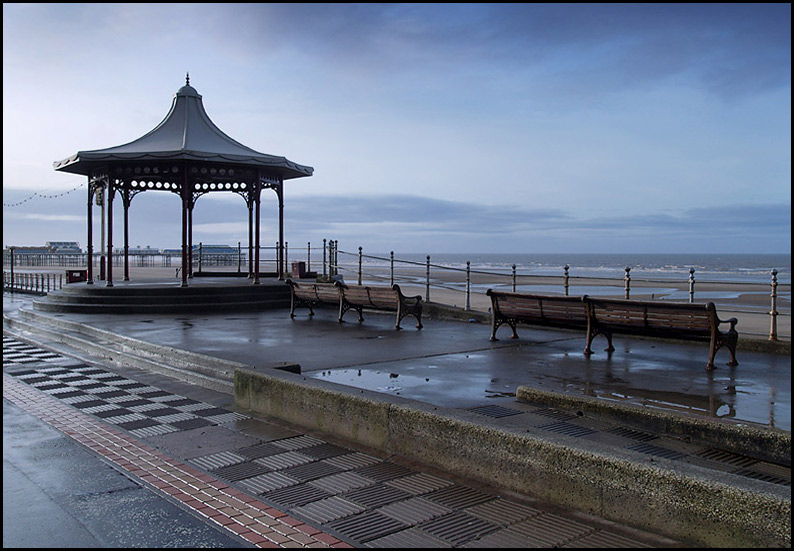
I took this photograph of the bandstand on Blackpool promenade on just such a morning. The cold, blue light of the low sun, the reflections off the wet surfaces, and the empty benches was an appealing sight to me. I composed the shot with the bandstand to the left, and the lines of the steps, benches and railings leading to it. I used a zoom lens at 34mm (35mm equivalent), with the camera set to Aperture Priority (f8 at 1/200 second), 100 ISO, and -0.3EV.
Then came Sunday trading. Shops were allowed to open between the hours of 10.00am and 4.00pm.. This was accompanied by protestations from church groups, trade unions representing shop workers, and others. But, there seemed to be a desire to shop on Sundays, and so the day became much more like Saturday. Most have welcomed the change. I haven't! I really liked the different, slower, more relaxed quality that Sunday brought. The contrast of this day appealed to me. Going out early in the morning and finding the streets empty and quiet was a real pleasure. It was an opportunity to slow down, take more time over things, and look more closely at my surroundings. But today, for most, that kind of Sunday is either a distant memory, or something that has never been known. I say for most, because something of that Sunday quality can be found at a seaside resort on a cold, winter, weekday morning. There are no holiday makers, seasonal shops are boarded up, and the promenade is quiet apart from the call of gulls. It's an opportunity to view the place in a more relaxed way, without the bustle of people intent on enjoyment, a way that I remember doing all those years ago.
I took this photograph of the bandstand on Blackpool promenade on just such a morning. The cold, blue light of the low sun, the reflections off the wet surfaces, and the empty benches was an appealing sight to me. I composed the shot with the bandstand to the left, and the lines of the steps, benches and railings leading to it. I used a zoom lens at 34mm (35mm equivalent), with the camera set to Aperture Priority (f8 at 1/200 second), 100 ISO, and -0.3EV.
photograph & text (c) T. Boughen
Thursday, January 25, 2007
Flying the flag
An observant visitor to the UK is likely to notice the relatively small number of Union flags that are flown. Compared with, say, France or the United States, our flag is all but invisible. Every now and then UK writers comment on this, and periodically politicians and nationalists try to stimulate the flying of more flags. But without much success.
Why is this? It's probably something to do with the United Kingdom being a collective of four separate countries, each with its own distinctive history, language and culture. In Scotland the cross of St Andrew seems to be flown more than formerly, perhaps reflecting its growing nationalism, whilst in Wales that country's flag flies fairly widely. Northern Ireland goes its own way, and tends to display three flags - the Union flag, the flag of Northern Ireland, and the tricolour of the Irish Repubic - depending on political persuasion! And England is simple confused. It's forgivable that people from other countries confuse the Union flag with the flag of England, but it's unfortunate when native English people do the same. Many do fly the cross of St George, but it's done with markedly less fervour than the people of the other constituent countries of the UK fly theirs.
So, when a Union flag is flown it tends to be noticed. This flag on the 1930s Casino building on Blackpool's promenade grabbed my attention immediately, and I decided to make it the focal point of an image. I have photographed the architect Joseph Emberton's Modernist masterpiece before, but this time I decided to be selective and show some of its white reinforced concrete curves against the deep blue of the January sky, enlivened by the red of the decrative wheel and that high flying flag. A zoom lens at 48mm (35mm equivalent) was used, with the camera set to Aperture Priority (f8 at 1/400 second), with the ISO at 100 and -0.7EV.
Why is this? It's probably something to do with the United Kingdom being a collective of four separate countries, each with its own distinctive history, language and culture. In Scotland the cross of St Andrew seems to be flown more than formerly, perhaps reflecting its growing nationalism, whilst in Wales that country's flag flies fairly widely. Northern Ireland goes its own way, and tends to display three flags - the Union flag, the flag of Northern Ireland, and the tricolour of the Irish Repubic - depending on political persuasion! And England is simple confused. It's forgivable that people from other countries confuse the Union flag with the flag of England, but it's unfortunate when native English people do the same. Many do fly the cross of St George, but it's done with markedly less fervour than the people of the other constituent countries of the UK fly theirs.
So, when a Union flag is flown it tends to be noticed. This flag on the 1930s Casino building on Blackpool's promenade grabbed my attention immediately, and I decided to make it the focal point of an image. I have photographed the architect Joseph Emberton's Modernist masterpiece before, but this time I decided to be selective and show some of its white reinforced concrete curves against the deep blue of the January sky, enlivened by the red of the decrative wheel and that high flying flag. A zoom lens at 48mm (35mm equivalent) was used, with the camera set to Aperture Priority (f8 at 1/400 second), with the ISO at 100 and -0.7EV.
photograph & text (c) T. Boughen
Wednesday, January 24, 2007
Ferns
Ferns came into being three hundred million years ago in the forests of the Carboniferous period. They pre-date flowering plants, and the examples that we find fossilized in rocks and coal seams look remarkably like those that we see around us today. Clearly ferns are a successful species that found their niche early in evolutionary terms.
Shady, damp places are where we see ferns. Bank sides, dark rock crevices, old walls and under the woodland canopy are typical habitats for the different species that are found across the world. Victorian gardeners favoured the fern: they collected them, cultivated them, and prized their arching fronds, indented leaves, and the way they uncurl in the spring, as if stretching from their winter sleep. However, like the laurel and the rhododendron, the fern fell out of favour and gardeners in the twentieth century saw them as "old-fashioned". The more open, brighter gardens that were created needed the particular qualities of this plant less. Today however, gardeners are re-discovering the value of the fern, particularly in smaller plots that are over-shadowed by buildings.
I found these ferns growing from the top of a wall near Scorton, Lancashire. The wall was beautifully constructed in the nineteenth century and looks like it has needed little attention since that time. Overhanging conifers shelter these ferns, and consequently the tempestuous winter weather has left them relatively unscathed. I photographed them on a cold, bright day, when shafts of sunlight were piercing the shade, illuminating the sharp, serrated fronds, and throwing their shadows across the wall. The contrast between the vegetation and the stonework seemed like a good subject for an image, and so I composed accordingly. I used a zoom lens at 110mm (35mm equivalent), with the camera set to Aperture Priority (f6.3 at 1/60 second), ISO 200 and -1.0EV.
Shady, damp places are where we see ferns. Bank sides, dark rock crevices, old walls and under the woodland canopy are typical habitats for the different species that are found across the world. Victorian gardeners favoured the fern: they collected them, cultivated them, and prized their arching fronds, indented leaves, and the way they uncurl in the spring, as if stretching from their winter sleep. However, like the laurel and the rhododendron, the fern fell out of favour and gardeners in the twentieth century saw them as "old-fashioned". The more open, brighter gardens that were created needed the particular qualities of this plant less. Today however, gardeners are re-discovering the value of the fern, particularly in smaller plots that are over-shadowed by buildings.
I found these ferns growing from the top of a wall near Scorton, Lancashire. The wall was beautifully constructed in the nineteenth century and looks like it has needed little attention since that time. Overhanging conifers shelter these ferns, and consequently the tempestuous winter weather has left them relatively unscathed. I photographed them on a cold, bright day, when shafts of sunlight were piercing the shade, illuminating the sharp, serrated fronds, and throwing their shadows across the wall. The contrast between the vegetation and the stonework seemed like a good subject for an image, and so I composed accordingly. I used a zoom lens at 110mm (35mm equivalent), with the camera set to Aperture Priority (f6.3 at 1/60 second), ISO 200 and -1.0EV.
photograph & text (c) T. Boughen
Labels:
ferns,
Lancashire,
Scorton
Subscribe to:
Posts (Atom)