I have some work to do, so it's unlikely that I'll be posting to the blog during the month of February. I intend to resume normal service at the beginning of March. Thank you to everyone who has dropped by from the various photography forums, and from elsewhere. I've really appreciated your comments and feedback on both the images and my written reflections.
If you haven't had a look at the "Best of PhotoReflect" collection of images you can do so through this link, or from the Links menu to the right.
Thanks, Tony
Wednesday, January 31, 2007
Tuesday, January 30, 2007
Railings and sacrifice
The casualties of the Second World War were many. Tens of millions of civilians died, as did millions serving in the armed forces. Cities, towns and villages were destroyed and damaged. Historic buildings, houses and workplaces fell to the indiscriminate blast of artillery shell and bomb. But for the populations under attack or occupation these were only some of the privations to be suffered. Food was in short supply. Every day the best and the worst of friends and neighbours was exposed by the stress of war. And unexpected small changes in routines, and in the appearance of surroundings, daily told of the struggle that was taking place across much of the world.
In Britain, from the outbreak of war, everyone carried a gas-mask. Sand bags were placed in locations that would be susceptible to blast damage, and lines of tape criss-crossed windows to counter the deadly flying shards that they would produce if a bomb burst nearby. If this didn't remind everyone that there was a war on, the arrival, in 1940, of gangs of men to cut down the iron railings that bordered house gardens, parks, public buildings and churches, certainly did. This measure was taken to increase the supply of the metal needed to make the weapons necessary to fight the war. It also had the psychological effect of making everyone believe that they, and their communities, were "doing their bit." However, one effect of this measure was to change the face of Britains towns and cities. Selected historic buildings were exempted from the order, but elsewhere the railings fell to the saw and blowtorch like wheat to the scythe. Towns and cities must have looked denuded. In the 1950s an urban myth went around that Winston Churchill had taken this action solely for the sake of morale, and that the railings had actually been dumped in the sea at Land's End. It was never true, but many believed it!
The church of St Peter, Fleetwood, Lancashire, a building by the noted architect, Decimus Burton, had its churchyard railings taken away during the war. Old photographs show them to be fine, sturdy shafts with foliate tops. For the six decades after the end of the war the church stood with only a low wall and the filled sockets of the old railings between its churchyard and the surrounding streets. Then, in 2005, as part of a wider refurbishment, new railings based on the original pattern, were installed. They look a fine sight, and give a visual "lift" to the building. I took this photograph of the church from one of the three corner entrances to the triangular churchyard. The remaining Victorian lantern holder seemed a good frame for the building, and I used a wide zoom lens at 22mm (35mm equivalent) to show the railings wrapping round the site. The camera was set to Aperture Priority (f8 at 1/160 second), ISO 100 and -0.7EV.
In Britain, from the outbreak of war, everyone carried a gas-mask. Sand bags were placed in locations that would be susceptible to blast damage, and lines of tape criss-crossed windows to counter the deadly flying shards that they would produce if a bomb burst nearby. If this didn't remind everyone that there was a war on, the arrival, in 1940, of gangs of men to cut down the iron railings that bordered house gardens, parks, public buildings and churches, certainly did. This measure was taken to increase the supply of the metal needed to make the weapons necessary to fight the war. It also had the psychological effect of making everyone believe that they, and their communities, were "doing their bit." However, one effect of this measure was to change the face of Britains towns and cities. Selected historic buildings were exempted from the order, but elsewhere the railings fell to the saw and blowtorch like wheat to the scythe. Towns and cities must have looked denuded. In the 1950s an urban myth went around that Winston Churchill had taken this action solely for the sake of morale, and that the railings had actually been dumped in the sea at Land's End. It was never true, but many believed it!
The church of St Peter, Fleetwood, Lancashire, a building by the noted architect, Decimus Burton, had its churchyard railings taken away during the war. Old photographs show them to be fine, sturdy shafts with foliate tops. For the six decades after the end of the war the church stood with only a low wall and the filled sockets of the old railings between its churchyard and the surrounding streets. Then, in 2005, as part of a wider refurbishment, new railings based on the original pattern, were installed. They look a fine sight, and give a visual "lift" to the building. I took this photograph of the church from one of the three corner entrances to the triangular churchyard. The remaining Victorian lantern holder seemed a good frame for the building, and I used a wide zoom lens at 22mm (35mm equivalent) to show the railings wrapping round the site. The camera was set to Aperture Priority (f8 at 1/160 second), ISO 100 and -0.7EV.
photograph & text (c) T. Boughen
Labels:
church,
Fleetwood,
Lancashire,
railings,
Victorian architecture,
WW2
Monday, January 29, 2007
Hello Vera!
One of the "quality" UK newspapers, "The Guardian", has a regular column called "Bad Science". Its purpose is to expose the pseudo-science that regularly occurs in the the press and elsewhere, to encourage rigour in the reporting of science-based matters, and, possibly, to encourage greater scepticism in the reader when confronted with news about science. In a world where hucksters proliferate it is a welcome dose of hard-edged analysis.
Recent targets of Ben Goldacre, the author of the column, are: the claims for the educational efficacy of fish-oil supplements allegedly shown in research backed by an education authority and the producers of the product; wonder HIV cures; pseudo-experts with few qualifications being used by journalists as "authorities"; and a demolition of a newspaper article (in the Sunday Times no less) that misrepresented some research by claiming it could make "gay sheep" straight! An article that I particularly enjoyed looked at the ideas of the "Brain Gym" enthusiasts - a group of educationalists who have managed to convince many schools and teachers in the UK of the wonderful, and very specific benefits that will flow from their programme of mental and physical exercises. It clearly demonstrated what I had always felt to be the case - that Brain Gym takes a few simple, self-evident propositions, such as taking regular breaks helps you to work better, and surrounds them with patently ridiculous mumbo-jumbo and unsubstantiated claims.
I was thinking about this as I photographed this rather odd looking aloe vera plant that grows in my kitchen. It is there because it's easy to grow, and for its alleged usefulness in healing minor burns - slice a leaf and rub the oozing gel over the burn for relief. The plant's powers have been valued for a long time, but scientific corroboration, as far as I can see, is not yet available. However, there are some indications that it works, and its use in the raw form causes no harm. What is clear, however, is that adding it to hair products and skin lotions, taking it in capsules, and swallowing expensive drinks containing the extract, is absolutely pointless! But it happens because this is the latest fad, and money is to be made with pseudo-science. My photograph was taken with a macro lens at 70mm (35mm equivalent). The plant was arranged against a dark background to show off its peculiar shape, and was extensively post processed and digitally enhanced. My camera was set to Aperture Priority (f18 at 1.3 seconds), with the ISO at 100 and -1.0EV. Oh, and for anyone wondering about the title of this piece, it is based on a silly UK TV advert!
Recent targets of Ben Goldacre, the author of the column, are: the claims for the educational efficacy of fish-oil supplements allegedly shown in research backed by an education authority and the producers of the product; wonder HIV cures; pseudo-experts with few qualifications being used by journalists as "authorities"; and a demolition of a newspaper article (in the Sunday Times no less) that misrepresented some research by claiming it could make "gay sheep" straight! An article that I particularly enjoyed looked at the ideas of the "Brain Gym" enthusiasts - a group of educationalists who have managed to convince many schools and teachers in the UK of the wonderful, and very specific benefits that will flow from their programme of mental and physical exercises. It clearly demonstrated what I had always felt to be the case - that Brain Gym takes a few simple, self-evident propositions, such as taking regular breaks helps you to work better, and surrounds them with patently ridiculous mumbo-jumbo and unsubstantiated claims.
I was thinking about this as I photographed this rather odd looking aloe vera plant that grows in my kitchen. It is there because it's easy to grow, and for its alleged usefulness in healing minor burns - slice a leaf and rub the oozing gel over the burn for relief. The plant's powers have been valued for a long time, but scientific corroboration, as far as I can see, is not yet available. However, there are some indications that it works, and its use in the raw form causes no harm. What is clear, however, is that adding it to hair products and skin lotions, taking it in capsules, and swallowing expensive drinks containing the extract, is absolutely pointless! But it happens because this is the latest fad, and money is to be made with pseudo-science. My photograph was taken with a macro lens at 70mm (35mm equivalent). The plant was arranged against a dark background to show off its peculiar shape, and was extensively post processed and digitally enhanced. My camera was set to Aperture Priority (f18 at 1.3 seconds), with the ISO at 100 and -1.0EV. Oh, and for anyone wondering about the title of this piece, it is based on a silly UK TV advert!
photograph & text (c) T. Boughen
Labels:
aloe vera,
Bad Science,
macro,
pseudo-science
Sunday, January 28, 2007
The beech tree
In the south of England pollen from beech trees can be detected in remains dating back to 6000BC. No longer restricted to its southern fastness, the beech is now widespread in Britain, introduced in the midlands and north for its beauty and its unique qualities.
The sturdy, tall beech tree has long been used as a windbreak around exposed farms. In Yorkshire, on the chalk Wolds, and in the limestone Dales, lines, "L" shapes and squares of trees can be seen serving this purpose. They mark the location of farms in the valleys, on the hillsides, and standing against the sky. As well as giving shelter the beech trees provide kindling, and add a background sound to the day's toil and the night's rest, as the wind rustles the leaves and moans in the branches. Throughout the country beech trees can be seen planted in copses on hilltops, in small groups or single specimens at crossroads, in churchyards, or in woodlands. Lowland areas often have carefully manicured beech hedges, thick, green and impenetrable in summer, their brown leaves of autumn clinging on deep into the winter. Country houses frequently planted avenues of the tree along roads and tracks, and grew plantations to provide wood for estate joiners and carpenters.
The iron industry of the Weald used beech trees, as did the furniture makers of Buckinghamshire, turning the wood for the legs and spindles of Windsor chairs. The largest group of beech trees in the world is to be found in this county, at Burnham Beeches. Pollarded examples here are known to be five hundred years old. Wildlife thrives in beech woods. The "mast" that the trees produce is eaten by mice, squirrels, and a variety of birds, and the massive trunks and long, spreading branches provide homes for creeping and flying creatures. I photographed these beech trees in the Forest of Bowland, Lancashire, on a sunny January day. The shallow soil and outcropping rock had been no impediment to the growth of the trees on this hillside. But it had meant that the root system was, of neccessity, near the surface. It is said that the spread of a tree's roots matches the spread of its branches, and, looking at these beech trees you could almost believe it. I took my photograph with a wide zoom lens at 22mm (35mm equivalent), with the camera set to Aperture Priority (f6.3 at 1/200 second), ISO 100, and -1.0EV.
The sturdy, tall beech tree has long been used as a windbreak around exposed farms. In Yorkshire, on the chalk Wolds, and in the limestone Dales, lines, "L" shapes and squares of trees can be seen serving this purpose. They mark the location of farms in the valleys, on the hillsides, and standing against the sky. As well as giving shelter the beech trees provide kindling, and add a background sound to the day's toil and the night's rest, as the wind rustles the leaves and moans in the branches. Throughout the country beech trees can be seen planted in copses on hilltops, in small groups or single specimens at crossroads, in churchyards, or in woodlands. Lowland areas often have carefully manicured beech hedges, thick, green and impenetrable in summer, their brown leaves of autumn clinging on deep into the winter. Country houses frequently planted avenues of the tree along roads and tracks, and grew plantations to provide wood for estate joiners and carpenters.
The iron industry of the Weald used beech trees, as did the furniture makers of Buckinghamshire, turning the wood for the legs and spindles of Windsor chairs. The largest group of beech trees in the world is to be found in this county, at Burnham Beeches. Pollarded examples here are known to be five hundred years old. Wildlife thrives in beech woods. The "mast" that the trees produce is eaten by mice, squirrels, and a variety of birds, and the massive trunks and long, spreading branches provide homes for creeping and flying creatures. I photographed these beech trees in the Forest of Bowland, Lancashire, on a sunny January day. The shallow soil and outcropping rock had been no impediment to the growth of the trees on this hillside. But it had meant that the root system was, of neccessity, near the surface. It is said that the spread of a tree's roots matches the spread of its branches, and, looking at these beech trees you could almost believe it. I took my photograph with a wide zoom lens at 22mm (35mm equivalent), with the camera set to Aperture Priority (f6.3 at 1/200 second), ISO 100, and -1.0EV.
photograph & text (c) T. Boughen
Labels:
beech,
Forest of Bowland,
Lancashire,
roots,
tree
Saturday, January 27, 2007
Blackpool semi-abstract
What's the difference between represent- ational art and abstract art? Well, most people would say that abstract art doesn't depict objects that you can see in the natural world, whereas representational art does. That gets somewhere near the heart of the matter. However, many artists have a problem with the term "abstract", and prefer "non-figurative" or non-representational" to describe their work.
That being the case, how are we to describe, say, Cubism - the early twentieth century style of Picasso and Braque. Their images included people with compound faces seen from multiple points of view, guitars that are unlike real guitars, and shapes and colours that intersect with recognisable objects, but which are like nothing found in the natural world. Interestingly, these paintings were, at the time, and for many years after, described as "abstract art". Today however, with the experience of decades of completely non-figurative art, we would no longer use that term. "Semi-abstract" is now sometimes used as a description of art that uses a mixture of figurative and non-figurative components, or that uses figurative components in a way that emphasises, say, their pattern, colour or shape. And, what applies to fine art painting also applies to photography.
I was thinking about this when I was deciding how to categorise this image that I took on Blackpool's South Promenade. It features the "fish-tail" of the vane that revolves a seat to ensure that the users are always turned away from the wind; the 235 feet high summit of "The Big One" roller coaster; some odd clouds that were originally vapour trails; and a deep blue sky. The image doesn't seek to tell you anything about each of these components - it is semi-abstract. Instead you are invited to take pleasure (if it is there to be found!) in the odd juxtaposition of these strong, strange shapes, and the combination of intense and subtle colours. Oh, and (if you haven't read the description above) to wonder what on earth these things are! To capture this image I used a wide zoom lens at 28mm (35mm equivalent), with the camera on Aperture Priority (f8 at 1/500 second), with the ISO at 100 and -1.0EV.
That being the case, how are we to describe, say, Cubism - the early twentieth century style of Picasso and Braque. Their images included people with compound faces seen from multiple points of view, guitars that are unlike real guitars, and shapes and colours that intersect with recognisable objects, but which are like nothing found in the natural world. Interestingly, these paintings were, at the time, and for many years after, described as "abstract art". Today however, with the experience of decades of completely non-figurative art, we would no longer use that term. "Semi-abstract" is now sometimes used as a description of art that uses a mixture of figurative and non-figurative components, or that uses figurative components in a way that emphasises, say, their pattern, colour or shape. And, what applies to fine art painting also applies to photography.
I was thinking about this when I was deciding how to categorise this image that I took on Blackpool's South Promenade. It features the "fish-tail" of the vane that revolves a seat to ensure that the users are always turned away from the wind; the 235 feet high summit of "The Big One" roller coaster; some odd clouds that were originally vapour trails; and a deep blue sky. The image doesn't seek to tell you anything about each of these components - it is semi-abstract. Instead you are invited to take pleasure (if it is there to be found!) in the odd juxtaposition of these strong, strange shapes, and the combination of intense and subtle colours. Oh, and (if you haven't read the description above) to wonder what on earth these things are! To capture this image I used a wide zoom lens at 28mm (35mm equivalent), with the camera on Aperture Priority (f8 at 1/500 second), with the ISO at 100 and -1.0EV.
photograph & text (c) T. Boughen
Labels:
Big One,
big wheel,
Blackpool,
rotating seat,
semi-abstract,
South Promenade
Friday, January 26, 2007
Slower days
When I was a child Sundays were different. People rose later than on Saturday or on a weekday. The streets were quieter on Sundays, not just because there were fewer private cars, but because people used them less on that day. The pace of life was more leisurely. Odd jobs would be done, a grand Sunday lunch (dinner in the North of England) would be cooked, families would sometimes have a walk together, the car would be cleaned. And yes, the bells would ring and some people would go to church. It sounds idyllic doesn't it. I don't think it was quite as wonderful as my pen portrait suggests, but Sunday was, undeniably, a different sort of day.
Then came Sunday trading. Shops were allowed to open between the hours of 10.00am and 4.00pm.. This was accompanied by protestations from church groups, trade unions representing shop workers, and others. But, there seemed to be a desire to shop on Sundays, and so the day became much more like Saturday. Most have welcomed the change. I haven't! I really liked the different, slower, more relaxed quality that Sunday brought. The contrast of this day appealed to me. Going out early in the morning and finding the streets empty and quiet was a real pleasure. It was an opportunity to slow down, take more time over things, and look more closely at my surroundings. But today, for most, that kind of Sunday is either a distant memory, or something that has never been known. I say for most, because something of that Sunday quality can be found at a seaside resort on a cold, winter, weekday morning. There are no holiday makers, seasonal shops are boarded up, and the promenade is quiet apart from the call of gulls. It's an opportunity to view the place in a more relaxed way, without the bustle of people intent on enjoyment, a way that I remember doing all those years ago.
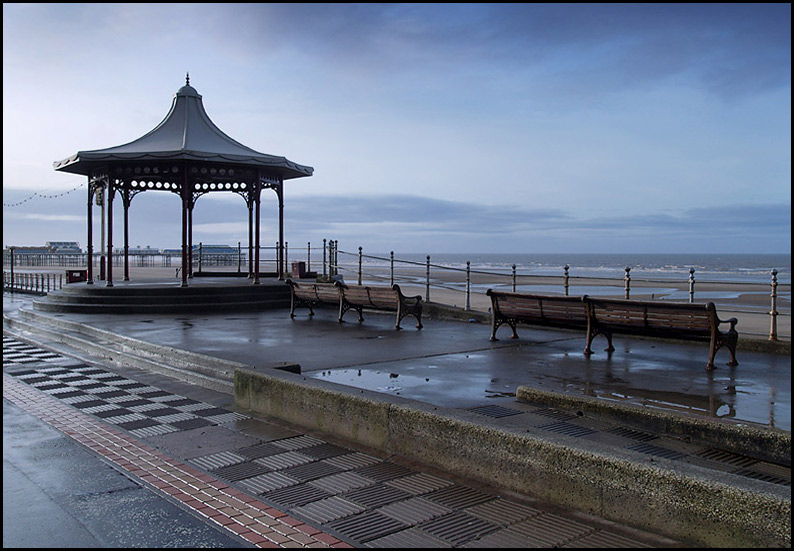
I took this photograph of the bandstand on Blackpool promenade on just such a morning. The cold, blue light of the low sun, the reflections off the wet surfaces, and the empty benches was an appealing sight to me. I composed the shot with the bandstand to the left, and the lines of the steps, benches and railings leading to it. I used a zoom lens at 34mm (35mm equivalent), with the camera set to Aperture Priority (f8 at 1/200 second), 100 ISO, and -0.3EV.
Then came Sunday trading. Shops were allowed to open between the hours of 10.00am and 4.00pm.. This was accompanied by protestations from church groups, trade unions representing shop workers, and others. But, there seemed to be a desire to shop on Sundays, and so the day became much more like Saturday. Most have welcomed the change. I haven't! I really liked the different, slower, more relaxed quality that Sunday brought. The contrast of this day appealed to me. Going out early in the morning and finding the streets empty and quiet was a real pleasure. It was an opportunity to slow down, take more time over things, and look more closely at my surroundings. But today, for most, that kind of Sunday is either a distant memory, or something that has never been known. I say for most, because something of that Sunday quality can be found at a seaside resort on a cold, winter, weekday morning. There are no holiday makers, seasonal shops are boarded up, and the promenade is quiet apart from the call of gulls. It's an opportunity to view the place in a more relaxed way, without the bustle of people intent on enjoyment, a way that I remember doing all those years ago.
I took this photograph of the bandstand on Blackpool promenade on just such a morning. The cold, blue light of the low sun, the reflections off the wet surfaces, and the empty benches was an appealing sight to me. I composed the shot with the bandstand to the left, and the lines of the steps, benches and railings leading to it. I used a zoom lens at 34mm (35mm equivalent), with the camera set to Aperture Priority (f8 at 1/200 second), 100 ISO, and -0.3EV.
photograph & text (c) T. Boughen
Thursday, January 25, 2007
Flying the flag
An observant visitor to the UK is likely to notice the relatively small number of Union flags that are flown. Compared with, say, France or the United States, our flag is all but invisible. Every now and then UK writers comment on this, and periodically politicians and nationalists try to stimulate the flying of more flags. But without much success.
Why is this? It's probably something to do with the United Kingdom being a collective of four separate countries, each with its own distinctive history, language and culture. In Scotland the cross of St Andrew seems to be flown more than formerly, perhaps reflecting its growing nationalism, whilst in Wales that country's flag flies fairly widely. Northern Ireland goes its own way, and tends to display three flags - the Union flag, the flag of Northern Ireland, and the tricolour of the Irish Repubic - depending on political persuasion! And England is simple confused. It's forgivable that people from other countries confuse the Union flag with the flag of England, but it's unfortunate when native English people do the same. Many do fly the cross of St George, but it's done with markedly less fervour than the people of the other constituent countries of the UK fly theirs.
So, when a Union flag is flown it tends to be noticed. This flag on the 1930s Casino building on Blackpool's promenade grabbed my attention immediately, and I decided to make it the focal point of an image. I have photographed the architect Joseph Emberton's Modernist masterpiece before, but this time I decided to be selective and show some of its white reinforced concrete curves against the deep blue of the January sky, enlivened by the red of the decrative wheel and that high flying flag. A zoom lens at 48mm (35mm equivalent) was used, with the camera set to Aperture Priority (f8 at 1/400 second), with the ISO at 100 and -0.7EV.
Why is this? It's probably something to do with the United Kingdom being a collective of four separate countries, each with its own distinctive history, language and culture. In Scotland the cross of St Andrew seems to be flown more than formerly, perhaps reflecting its growing nationalism, whilst in Wales that country's flag flies fairly widely. Northern Ireland goes its own way, and tends to display three flags - the Union flag, the flag of Northern Ireland, and the tricolour of the Irish Repubic - depending on political persuasion! And England is simple confused. It's forgivable that people from other countries confuse the Union flag with the flag of England, but it's unfortunate when native English people do the same. Many do fly the cross of St George, but it's done with markedly less fervour than the people of the other constituent countries of the UK fly theirs.
So, when a Union flag is flown it tends to be noticed. This flag on the 1930s Casino building on Blackpool's promenade grabbed my attention immediately, and I decided to make it the focal point of an image. I have photographed the architect Joseph Emberton's Modernist masterpiece before, but this time I decided to be selective and show some of its white reinforced concrete curves against the deep blue of the January sky, enlivened by the red of the decrative wheel and that high flying flag. A zoom lens at 48mm (35mm equivalent) was used, with the camera set to Aperture Priority (f8 at 1/400 second), with the ISO at 100 and -0.7EV.
photograph & text (c) T. Boughen
Wednesday, January 24, 2007
Ferns
Ferns came into being three hundred million years ago in the forests of the Carboniferous period. They pre-date flowering plants, and the examples that we find fossilized in rocks and coal seams look remarkably like those that we see around us today. Clearly ferns are a successful species that found their niche early in evolutionary terms.
Shady, damp places are where we see ferns. Bank sides, dark rock crevices, old walls and under the woodland canopy are typical habitats for the different species that are found across the world. Victorian gardeners favoured the fern: they collected them, cultivated them, and prized their arching fronds, indented leaves, and the way they uncurl in the spring, as if stretching from their winter sleep. However, like the laurel and the rhododendron, the fern fell out of favour and gardeners in the twentieth century saw them as "old-fashioned". The more open, brighter gardens that were created needed the particular qualities of this plant less. Today however, gardeners are re-discovering the value of the fern, particularly in smaller plots that are over-shadowed by buildings.
I found these ferns growing from the top of a wall near Scorton, Lancashire. The wall was beautifully constructed in the nineteenth century and looks like it has needed little attention since that time. Overhanging conifers shelter these ferns, and consequently the tempestuous winter weather has left them relatively unscathed. I photographed them on a cold, bright day, when shafts of sunlight were piercing the shade, illuminating the sharp, serrated fronds, and throwing their shadows across the wall. The contrast between the vegetation and the stonework seemed like a good subject for an image, and so I composed accordingly. I used a zoom lens at 110mm (35mm equivalent), with the camera set to Aperture Priority (f6.3 at 1/60 second), ISO 200 and -1.0EV.
Shady, damp places are where we see ferns. Bank sides, dark rock crevices, old walls and under the woodland canopy are typical habitats for the different species that are found across the world. Victorian gardeners favoured the fern: they collected them, cultivated them, and prized their arching fronds, indented leaves, and the way they uncurl in the spring, as if stretching from their winter sleep. However, like the laurel and the rhododendron, the fern fell out of favour and gardeners in the twentieth century saw them as "old-fashioned". The more open, brighter gardens that were created needed the particular qualities of this plant less. Today however, gardeners are re-discovering the value of the fern, particularly in smaller plots that are over-shadowed by buildings.
I found these ferns growing from the top of a wall near Scorton, Lancashire. The wall was beautifully constructed in the nineteenth century and looks like it has needed little attention since that time. Overhanging conifers shelter these ferns, and consequently the tempestuous winter weather has left them relatively unscathed. I photographed them on a cold, bright day, when shafts of sunlight were piercing the shade, illuminating the sharp, serrated fronds, and throwing their shadows across the wall. The contrast between the vegetation and the stonework seemed like a good subject for an image, and so I composed accordingly. I used a zoom lens at 110mm (35mm equivalent), with the camera set to Aperture Priority (f6.3 at 1/60 second), ISO 200 and -1.0EV.
photograph & text (c) T. Boughen
Labels:
ferns,
Lancashire,
Scorton
Tuesday, January 23, 2007
To those who have ...
It's good news that over the next two years all the states of the European Union will publish information about who actually receives the billions of euros of farm subsidies that are distributed annually. When a list of England's recipients was made public in 2005 few were surprised to find that it wasn't the small farmers struggling on marginal land who mopped up the money, it was the agri-businesses and wealthy landowners who raked it in. Another case, it seems, of "to those who have, shall be given."
The website farmsubsidy.org gives a breakdown of the current main beneficiaries of subsidies, by country. Topping the UK list is Tate & Lyle Europe, who deal mainly in sugar, and have so far accumulated the staggering sum of £356,875,121 (Euros 536,561,902). The rest of the list is a roll call of UK and international food producers. Notable recipients mentioned in the 2005 table, released by the British government under Freedom of Information legislation, include the Queen who got £546,000, and the Duke of Westminster, often described as Britain's richest man, who received £448,472. Many people are concerned that European and US subsidies not only encourage over-production and high prices, but also affect world markets and producers, and lead to the degradation of the land in the subsidised countries. The recent moves to de-couple Europe's subsidies from production and link them to environmental improvement, is to be welcomed. Whether it is the ultimate answer is still open to question.
So, the farmer who improved this land on the edge of the moorland of the Forest of Bowland in Lancashire, will receive payments for his produce and to make his land better for the area's wildlife. But it is unlikely to be massive sums, and he will still need tourism-related activities, and perhaps the renting out of shooting rights, to make ends meet. I took this photograph because the cross-shape of the fences and the placement of the two sheep seemed to make a good composition. I emphasised the main elements of the shot by converting the image to black and white. The contrasty, grainy feel, was also deliberate - it added a quality that I like. I used a long zoom lens at 300mm (35mm equivalent), with the camera set to Aperture Priority (f6.3 at 1/320) with the ISO at 100, and -0.7 EV.
The website farmsubsidy.org gives a breakdown of the current main beneficiaries of subsidies, by country. Topping the UK list is Tate & Lyle Europe, who deal mainly in sugar, and have so far accumulated the staggering sum of £356,875,121 (Euros 536,561,902). The rest of the list is a roll call of UK and international food producers. Notable recipients mentioned in the 2005 table, released by the British government under Freedom of Information legislation, include the Queen who got £546,000, and the Duke of Westminster, often described as Britain's richest man, who received £448,472. Many people are concerned that European and US subsidies not only encourage over-production and high prices, but also affect world markets and producers, and lead to the degradation of the land in the subsidised countries. The recent moves to de-couple Europe's subsidies from production and link them to environmental improvement, is to be welcomed. Whether it is the ultimate answer is still open to question.
So, the farmer who improved this land on the edge of the moorland of the Forest of Bowland in Lancashire, will receive payments for his produce and to make his land better for the area's wildlife. But it is unlikely to be massive sums, and he will still need tourism-related activities, and perhaps the renting out of shooting rights, to make ends meet. I took this photograph because the cross-shape of the fences and the placement of the two sheep seemed to make a good composition. I emphasised the main elements of the shot by converting the image to black and white. The contrasty, grainy feel, was also deliberate - it added a quality that I like. I used a long zoom lens at 300mm (35mm equivalent), with the camera set to Aperture Priority (f6.3 at 1/320) with the ISO at 100, and -0.7 EV.
photograph & text (c) T. Boughen
Monday, January 22, 2007
The power of trees
Mankind has always had a reverence for trees, and it's not hard to understand why. They are the largest of living things, and are the longest lived. Many appear to die in autumn, and burst into life again in spring. When you walk in a forest of ancient trees you feel enveloped by their branches, shaded by their leaves, and experience something of the awe, wonder, spitituality even, that accompanies walking down the nave of a Gothic Cathedral. And, when the wind stirs their branches and leaves, trees can appear to talk, in a soft rustling whisper, or in a moaning, shrieking roar!
The ancient Greeks believed in tree spirits, dryads, and thought that the gods punished those who harmed trees without first appeasing the tree nymphs. The "man in the trees" occurs in the folklore of many North European countries. As Herne, the hunter, a stag-headed man, he possesses the power to melt into the trees and disappear. The Green Man, a harbinger of spring, with a face and hair of leaves, can be found carved in stone and wood in many English medieval churches - Exeter Cathedral boasts no less than sixty green men. This imagery has been further developed by popular authors, such as J.R.R. Tolkien who created "Ents", walking trees, for his "Lord of the Rings" stories.
I was reminded of this rich tradition of tree spirits when I came across this tumble-down outbuilding on the edge of the Forest of Bowland in Lancashire. The cracks in its windows and walls were echoed by the crack-like shadows of a nearby tree, which loomed over it like a malevolent creature ready to complete the building's destruction. I photographed it from the adjacent road using a wide zoom lens at 26mm, with the camera set to Aperture Priority (f6.3 at 1/250 second), the ISO at 100, and -1.0EV.
The ancient Greeks believed in tree spirits, dryads, and thought that the gods punished those who harmed trees without first appeasing the tree nymphs. The "man in the trees" occurs in the folklore of many North European countries. As Herne, the hunter, a stag-headed man, he possesses the power to melt into the trees and disappear. The Green Man, a harbinger of spring, with a face and hair of leaves, can be found carved in stone and wood in many English medieval churches - Exeter Cathedral boasts no less than sixty green men. This imagery has been further developed by popular authors, such as J.R.R. Tolkien who created "Ents", walking trees, for his "Lord of the Rings" stories.
I was reminded of this rich tradition of tree spirits when I came across this tumble-down outbuilding on the edge of the Forest of Bowland in Lancashire. The cracks in its windows and walls were echoed by the crack-like shadows of a nearby tree, which loomed over it like a malevolent creature ready to complete the building's destruction. I photographed it from the adjacent road using a wide zoom lens at 26mm, with the camera set to Aperture Priority (f6.3 at 1/250 second), the ISO at 100, and -1.0EV.
photograph & text (c) T. Boughen
Sunday, January 21, 2007
Green lungs
If you want to know something about how a city sees itself, about its civic pride and its sense of community, you can do worse than take a walk in its parks. These public spaces will tell you a lot about both the local government and the local population.
In Britain, up until about 1980, city parks were green, vibrant, democratic places, the lungs of the urban areas. Usually laid out in the late nineteenth or early twentieth century, they were frequently a result of the philanthropy of a local person, and often bore his (it was usually a man) name. Pearson Park in Kingston upon Hull is just such an example, and still features a statue of its founder. Green open spaces, a variety of ornamental trees, statues, lakes (and rowing boats), children's play areas, sports pitches, small aviaries, a collection of animals, and conservatories, all linked by a network of meandering paths, feature in the best parks. However, during the period from 1980 to about 1995 Britain's parks were seriously neglected. This was certainly due to the contempt for local government of the successive administrations led by Margaret "there is no such thing as society" Thatcher. Councils were starved of funds and parks fell into shameful disrepair. Since the turn of the century, however, things have improved considerably, and many parks are almost back to their Victorian best.
My photograph shows the former Orangery (now the Butterfly House) in Williamson Park, Lancaster. The gift to the city of James Williamson, later Lord Ashton, a local industrialist, the park is beautifully located on a hillside overlooking Lancaster, and features a number of fine buildings and features. In front of the Butterfly House is a decorative cobble pavement, the work of Maggie Howarth, that features the red rose of Lancashire, the coat of arms of Lancaster, and other decorative morifs. For my mid-morning photograph with sharply slanting light, I crouched down low and used a wide zoom lens at 22mm (35mm equivalent), with the camera set to Aperture Priority (f7.1 at 1/320 sec), the ISO at 200, and -1.0 EV.
In Britain, up until about 1980, city parks were green, vibrant, democratic places, the lungs of the urban areas. Usually laid out in the late nineteenth or early twentieth century, they were frequently a result of the philanthropy of a local person, and often bore his (it was usually a man) name. Pearson Park in Kingston upon Hull is just such an example, and still features a statue of its founder. Green open spaces, a variety of ornamental trees, statues, lakes (and rowing boats), children's play areas, sports pitches, small aviaries, a collection of animals, and conservatories, all linked by a network of meandering paths, feature in the best parks. However, during the period from 1980 to about 1995 Britain's parks were seriously neglected. This was certainly due to the contempt for local government of the successive administrations led by Margaret "there is no such thing as society" Thatcher. Councils were starved of funds and parks fell into shameful disrepair. Since the turn of the century, however, things have improved considerably, and many parks are almost back to their Victorian best.
My photograph shows the former Orangery (now the Butterfly House) in Williamson Park, Lancaster. The gift to the city of James Williamson, later Lord Ashton, a local industrialist, the park is beautifully located on a hillside overlooking Lancaster, and features a number of fine buildings and features. In front of the Butterfly House is a decorative cobble pavement, the work of Maggie Howarth, that features the red rose of Lancashire, the coat of arms of Lancaster, and other decorative morifs. For my mid-morning photograph with sharply slanting light, I crouched down low and used a wide zoom lens at 22mm (35mm equivalent), with the camera set to Aperture Priority (f7.1 at 1/320 sec), the ISO at 200, and -1.0 EV.
photograph & text (c) T. Boughen
Saturday, January 20, 2007
In praise of low tech
How many kitchen cupboards are stuffed with electrical gadgets that are rarely, if ever, used. You know the sort of thing I mean. The "lean machine" grill that seemed a good idea to accompany the new year diet. Or the ice cream maker that held out the allure of customised, fresh ices during those hot summer days. Maybe the frothy drinks maker to keep the kids quiet. Or how about the bread maker, the coffee grinder, the yoghurt maker, the 3-tier steamer, the deep fat frier, or the electric pepper mill (with light!). Then there's my favourite - the Crumb Pet Novelty Tabletop Vacuum Cleaner (available as a pig and a sheep)! Don't believe me - look on Amazon. If one were to buy all the kitchen gadgets that are available you'd have to extend your kitchen to accommodate them.
This must be a real problem for some people because I've recently read two newspaper articles that have told readers how to sell these ill-advised purchases and unwanted gifts on eBay. Now don't get me wrong. I'm not saying there isn't a place for some labour-saving, even fun, gadgets. However, I don't think it can be denied that in the affluent west, and elsewhere for all I know, many people don't seem able to resist buying the high-tech gizmo rather than the tried and tested low-tech solution. Take juice extractors. A quick glance shows Amazon UK listing 126 devices for this purpose! The most expensive costs £140. Just how much juice are people extracting today, and from what?
My photograph shows the low-tech, traditional juice extractor, that's been used in my house for many years. It's there when needed (which isn't that often), never goes wrong, and cost very little. It also looks better than any electrical version! This is another shot taken during my break from repairing the wind-damaged fence. The glass extractor and two lemons were placed on the mirror with the black backdrop, and photographed in the same way as yesterday's image. I was going to cut a lemon in half to increase the interest of the shot, but I remembered that they had been bought to make a lemon and blueberry drizzle cake, and there's a limit to the sacrifices that I'm prepared to make for photography! The image was taken with a 70mm (35mm equivalent) macro lens, with the camera set to Aperture Priority (f18 at 1/80 second), with the camera at ISO 100 and -1.0 EV.
This must be a real problem for some people because I've recently read two newspaper articles that have told readers how to sell these ill-advised purchases and unwanted gifts on eBay. Now don't get me wrong. I'm not saying there isn't a place for some labour-saving, even fun, gadgets. However, I don't think it can be denied that in the affluent west, and elsewhere for all I know, many people don't seem able to resist buying the high-tech gizmo rather than the tried and tested low-tech solution. Take juice extractors. A quick glance shows Amazon UK listing 126 devices for this purpose! The most expensive costs £140. Just how much juice are people extracting today, and from what?
My photograph shows the low-tech, traditional juice extractor, that's been used in my house for many years. It's there when needed (which isn't that often), never goes wrong, and cost very little. It also looks better than any electrical version! This is another shot taken during my break from repairing the wind-damaged fence. The glass extractor and two lemons were placed on the mirror with the black backdrop, and photographed in the same way as yesterday's image. I was going to cut a lemon in half to increase the interest of the shot, but I remembered that they had been bought to make a lemon and blueberry drizzle cake, and there's a limit to the sacrifices that I'm prepared to make for photography! The image was taken with a 70mm (35mm equivalent) macro lens, with the camera set to Aperture Priority (f18 at 1/80 second), with the camera at ISO 100 and -1.0 EV.
photograph & text (c) T. Boughen
Friday, January 19, 2007
Nuts
When the Ice Age ended in Britain the hazel was one of the first trees to colonise the land, and for a time it must have been the dominant tree. But with warmth and time came the larger species like the oak, the lime and the pines, and the smaller hazel was pushed to the edge of the forest, or struggled under the higher leaf canopy. However, birds like the jay and the magpie and animals such as the squirrel and the wild boar ensured that it continued and spread as they ate and deposited its nuts across the land. And early man too found Britain's only native wild nut worth cultivating for its food value. Later, in medieval times it was planted and grown for food, and for its wood, being coppiced for hurdles, wattle, basketware, and many other purposes. In recent centuries cultivated varieties, the filbert and the Kentish Cob, came to dominate the market in hazelnuts for eating and today these are still grown and sold.
Walnuts were introduced into Britain by the Romans. They prized "the mast of Jove" for its nut and the topaz oil that it produced. Medieval monasteries planted walnut trees, and later it was a feature of country house orchards. The wood of the tree was also valued, and is found in high quality veneers showing its lovely swirling burr. For many years a significant number of trees could be found across the country to meet the demand for walnut. However, despite the best efforts of enthusiasts like John Evelyn, by the early twentieth century only one walnut plantation remained in England, near Colchester, Essex. Specimen trees still flourish, and the Walnut Club and others work to popularise this interesting species. The market for walnuts to be eaten has been supplied almost entirely by imports for many years.
The hazel nuts and walnuts above are the last of those bought by me for eating over the Christmas period. On a dull, damp day, engaged on repairs to my fence after heavy winds, I took a break and set up this photograph. I placed the nuts and an old nutcracker on a mirror, put a sheet of black vinyl behind, and bounced the flash off a sheet of white foamboard placed to the right. I used a 70mm (35mm equivalent) macro lens, with the camera set to Aperture Priority (f18 at 1/80 second), with the camera at ISO 100 and -1.0 EV.
Walnuts were introduced into Britain by the Romans. They prized "the mast of Jove" for its nut and the topaz oil that it produced. Medieval monasteries planted walnut trees, and later it was a feature of country house orchards. The wood of the tree was also valued, and is found in high quality veneers showing its lovely swirling burr. For many years a significant number of trees could be found across the country to meet the demand for walnut. However, despite the best efforts of enthusiasts like John Evelyn, by the early twentieth century only one walnut plantation remained in England, near Colchester, Essex. Specimen trees still flourish, and the Walnut Club and others work to popularise this interesting species. The market for walnuts to be eaten has been supplied almost entirely by imports for many years.
The hazel nuts and walnuts above are the last of those bought by me for eating over the Christmas period. On a dull, damp day, engaged on repairs to my fence after heavy winds, I took a break and set up this photograph. I placed the nuts and an old nutcracker on a mirror, put a sheet of black vinyl behind, and bounced the flash off a sheet of white foamboard placed to the right. I used a 70mm (35mm equivalent) macro lens, with the camera set to Aperture Priority (f18 at 1/80 second), with the camera at ISO 100 and -1.0 EV.
photograph & text (c) T. Boughen
Thursday, January 18, 2007
Low light, high ISO
For most of the year my camera is permanently set to ISO 100. My reasoning for this is as follows. I have a good camera with good lenses capable of resolving images well. I usually take a fair amount of care with my photographic compositions. All of my images are shot in RAW to allow the greatest flexibility in post-processing. So, why would I unneccesarily raise the ISO and introduce the image degradation that this entails?
However, there are a few occasions when I do increase the ISO. On dull winter days, typically between mid-November and the end of January I sometimes set the camera to ISO 200 and leave it at that for all my shots. Indoors, when taking family snaps, I sometimes use ISO 200 or even 400 rather than flash. And, when using a long focal length lens on darker days those same settings are useful. But, I've never used my present camera at a higher ISO setting than 400 - until a fortnight ago. I was coming to the end of a longish walk that had taken me inland and then along the shore between St Anne's and Lytham in Lancashire, when I saw this man, with his rucksack and his dogs. In the tinted light of dusk he was outlined against the water of the Ribble estuary. Southport's gasholder and buildings were dimly silhouetted beyond, and above the gulls were gliding down to their night-time roost. I could see that the man would soon run out of sand, turn away from the water's edge, and head up to the promenade. So if there was a shot to be had, I had to be quick! With no time to set up the tripod, I turned the camera to ISO 800 and fired off a few shots, more in hope than expectation.
The resulting images had visible noise, and in my haste I had underexposed too much, increasing the effect. But, some heavy post processing has produced, if not a great shot, then one that is passable, and that captures the atmosphere and empty space of the estuary at dusk. I used a long zoom lens at 268mm (35mm equivalent), with the camera set to Aperture Priority (f6.3 at 1/200 sec), ISO 800 and -0.7EV.
However, there are a few occasions when I do increase the ISO. On dull winter days, typically between mid-November and the end of January I sometimes set the camera to ISO 200 and leave it at that for all my shots. Indoors, when taking family snaps, I sometimes use ISO 200 or even 400 rather than flash. And, when using a long focal length lens on darker days those same settings are useful. But, I've never used my present camera at a higher ISO setting than 400 - until a fortnight ago. I was coming to the end of a longish walk that had taken me inland and then along the shore between St Anne's and Lytham in Lancashire, when I saw this man, with his rucksack and his dogs. In the tinted light of dusk he was outlined against the water of the Ribble estuary. Southport's gasholder and buildings were dimly silhouetted beyond, and above the gulls were gliding down to their night-time roost. I could see that the man would soon run out of sand, turn away from the water's edge, and head up to the promenade. So if there was a shot to be had, I had to be quick! With no time to set up the tripod, I turned the camera to ISO 800 and fired off a few shots, more in hope than expectation.
The resulting images had visible noise, and in my haste I had underexposed too much, increasing the effect. But, some heavy post processing has produced, if not a great shot, then one that is passable, and that captures the atmosphere and empty space of the estuary at dusk. I used a long zoom lens at 268mm (35mm equivalent), with the camera set to Aperture Priority (f6.3 at 1/200 sec), ISO 800 and -0.7EV.
photograph & text (c) T. Boughen
Wednesday, January 17, 2007
Photographing the familiar
Photographers are constantly searching for one of two things - something new to photograph, or something familiar to photograph in a new way. Many people opt for the first of these approaches because it's the easiest, and some will travel great distances to find the novel, the unfamiliar, or those subjects and places that they have seen photographed by others and which they too want to record. And that's a pity, because many would say that isn't the best way to develop photographically.
Now don't get me wrong, I've nothing against photographing new things. But, it doesn't develop your eye, or your understanding of the value of light, composition, contrast, and all the myriad things that make a good photograph. The problem is, that if you spend a lot of your time photographing the new you become too fixated on the subject at the expense of, for want of a better word, the art of creating a photograph. There is an interesting analogy with writing novels. The best writers, who write because they need to - say, Ian McEwan - usually write about that which they know. Poorer writers, who write for fame or money - the list is endless, but I'll choose Dan Brown as a well-known example - usually pick a subject for its "novelty", its popular appeal and its "saleability". Yes, often the tills ring and the books sell, but they're still rubbish produced for a market that reads and discards, and almost all will slip into oblivion in the wink of an eye. But better novels, like better photographs, are about more than just the subject, and have qualities that endure. It is these qualities that make people want to look at them again and again.
This wooden jetty that projects into the estuary of the River Ribble at Lytham is a subject I've photographed a few times. Often it's been from a distance, with a figure or two on it. This time I was captivated by the sky reflected in the wooden planks, still wet from the receding tide, and the contrast of the water upstream (left) of the jetty, with the water in its sheltered lee. I framed a symmetrical composition, and took my shot with a zoom lens at 44mm (35mm equivalent), the camera set to Aperture Priority (f6.3 at 1/250 sec), with ISO 100 and -0.7EV.
Now don't get me wrong, I've nothing against photographing new things. But, it doesn't develop your eye, or your understanding of the value of light, composition, contrast, and all the myriad things that make a good photograph. The problem is, that if you spend a lot of your time photographing the new you become too fixated on the subject at the expense of, for want of a better word, the art of creating a photograph. There is an interesting analogy with writing novels. The best writers, who write because they need to - say, Ian McEwan - usually write about that which they know. Poorer writers, who write for fame or money - the list is endless, but I'll choose Dan Brown as a well-known example - usually pick a subject for its "novelty", its popular appeal and its "saleability". Yes, often the tills ring and the books sell, but they're still rubbish produced for a market that reads and discards, and almost all will slip into oblivion in the wink of an eye. But better novels, like better photographs, are about more than just the subject, and have qualities that endure. It is these qualities that make people want to look at them again and again.
This wooden jetty that projects into the estuary of the River Ribble at Lytham is a subject I've photographed a few times. Often it's been from a distance, with a figure or two on it. This time I was captivated by the sky reflected in the wooden planks, still wet from the receding tide, and the contrast of the water upstream (left) of the jetty, with the water in its sheltered lee. I framed a symmetrical composition, and took my shot with a zoom lens at 44mm (35mm equivalent), the camera set to Aperture Priority (f6.3 at 1/250 sec), with ISO 100 and -0.7EV.
photograph & text (c) T. Boughen
Tuesday, January 16, 2007
Trams and tracks
Blackpool is known for its trams as well as its seaside entertainments. The first line opened on the Promenade in 1885, with the vehicles taking power from a slot in the ground. However, this "conduit system" was prone to trouble from rain and sea water, and the present overhead system was soon installed. The tram network expanded quickly, with lines running north to Fleetwood, south to Lytham St Annes, and out to the rapidly expanding Blackpool hinterland. In 1920 Blackpool Corporation took over the bulk of the network, and set about standardising and rationalising trams and systems.
The transport manager, far-sighted Walter Luff, began an inspired period of improvement in 1933. He ordered modern, luxurious vehicles from English Electric - double deckers, single deckers and open-topped "boat" trams. These proved attractive to the travelling public and very durable - examples continue to be used today! In the 1950s further superb trams were added to the fleet. However, by the 1960s the system was suffering from competition from buses and cars, and some lines were closed. Many cities across Britain had dug up their tramways in the post-war decades, and by the 1970s Blackpool's line between Fleetwood and Starr Gate in the south of Blackpool was the only significant UK tramway in commercial operation. The re-appearance of trams and "light rail" networks in a number of UK cities in the 1980s, 1990s and since has shown that trams can still provide reliable, mass transport in urban and suburban areas. And, in Blackpool a sleek new type of tram is being introduced alongside those venerable vehicles of yesteryear!
This photograph shows part of the promenade tracks near Gynn Square. The composition of the sweeping double curve broken by the shadows appealed to me, and I have increased the contrast to emphasize the sinuous lines. I used a zoom lens at 226mm (35mm equivalent), with the camera set to Aperture Priority (f6.3 at 1/800 sec), ISO 100, with -o.3 EV.
The transport manager, far-sighted Walter Luff, began an inspired period of improvement in 1933. He ordered modern, luxurious vehicles from English Electric - double deckers, single deckers and open-topped "boat" trams. These proved attractive to the travelling public and very durable - examples continue to be used today! In the 1950s further superb trams were added to the fleet. However, by the 1960s the system was suffering from competition from buses and cars, and some lines were closed. Many cities across Britain had dug up their tramways in the post-war decades, and by the 1970s Blackpool's line between Fleetwood and Starr Gate in the south of Blackpool was the only significant UK tramway in commercial operation. The re-appearance of trams and "light rail" networks in a number of UK cities in the 1980s, 1990s and since has shown that trams can still provide reliable, mass transport in urban and suburban areas. And, in Blackpool a sleek new type of tram is being introduced alongside those venerable vehicles of yesteryear!
This photograph shows part of the promenade tracks near Gynn Square. The composition of the sweeping double curve broken by the shadows appealed to me, and I have increased the contrast to emphasize the sinuous lines. I used a zoom lens at 226mm (35mm equivalent), with the camera set to Aperture Priority (f6.3 at 1/800 sec), ISO 100, with -o.3 EV.
photograph & text (c) T. Boughen
Monday, January 15, 2007
The answer is walking!
"All travelling becomes dull in exact proportion to its rapidity", John Ruskin (1819-1900), English art critic and author
Awareness of John Ruskin's hostility to motorised transport, particularly the spread of the railways, and the daily passage of the steam-powered gondola past his house on the edge of Coniston Water in England's Lake District, might prompt the remark, "well, he would say that wouldn't he!" But his particular problem with technology shouldn't blind us to the deeper truth of his words.
Many people would say, and I am one of them, that providing you have the time, the best way to get from one place to another is to walk. You see and learn more, you have time to reflect, and your health benefits from the exercise. And if you're a photographer walking is incontrovertibly the best way to secure the best images! But, distance and time constraints can make walking impractical, and that's why the bicycle was invented! Cycling provides many of the benefits of walking, but enables greater distances to be covered in a shorter time. The downside is that you see the world less well, even though you might see more of it, and you come into too close contact with cars! Had Ruskin lived to see air travel he would have known the full truth of his words quoted above. Flying is the most uncivilised method of transport. Passengers are treated like cattle, and the experience involves boredom that is hard to equal. Moreover it involves an environmental price that is surely unsustainable. The more you think about it, the more walking is the answer to many of today's problems. Fuel prices rising? Walk more. Job-related stress a problem? Walk it off. Putting on too many pounds? A daily walk will reverse the process!
I do a lot of walking, for my health, in pursuit of my interests, to find subjects to photograph, and to find time to think. I walk on mountains, hills, plains, valleys, by the sea, in towns and cities. It's quite the best way to experience the world. This photograph was taken whilst walking with my wife along the promenade at Blackpool, Lancashire. I have photographed at this spot once before, and thought I'd try again. The cobbled slope, the steps and railings always, it seems to me, need a figure. I composed my shot with the person going into the frame, and used the line of the railings to lead the eye through the image. I used a zoom lens at 86mm (35mm equivalent), with the camera at Aperture Priority (f7.1 at 1/200 sec), and the ISO at 100, with -0.3EV.
Awareness of John Ruskin's hostility to motorised transport, particularly the spread of the railways, and the daily passage of the steam-powered gondola past his house on the edge of Coniston Water in England's Lake District, might prompt the remark, "well, he would say that wouldn't he!" But his particular problem with technology shouldn't blind us to the deeper truth of his words.
Many people would say, and I am one of them, that providing you have the time, the best way to get from one place to another is to walk. You see and learn more, you have time to reflect, and your health benefits from the exercise. And if you're a photographer walking is incontrovertibly the best way to secure the best images! But, distance and time constraints can make walking impractical, and that's why the bicycle was invented! Cycling provides many of the benefits of walking, but enables greater distances to be covered in a shorter time. The downside is that you see the world less well, even though you might see more of it, and you come into too close contact with cars! Had Ruskin lived to see air travel he would have known the full truth of his words quoted above. Flying is the most uncivilised method of transport. Passengers are treated like cattle, and the experience involves boredom that is hard to equal. Moreover it involves an environmental price that is surely unsustainable. The more you think about it, the more walking is the answer to many of today's problems. Fuel prices rising? Walk more. Job-related stress a problem? Walk it off. Putting on too many pounds? A daily walk will reverse the process!
I do a lot of walking, for my health, in pursuit of my interests, to find subjects to photograph, and to find time to think. I walk on mountains, hills, plains, valleys, by the sea, in towns and cities. It's quite the best way to experience the world. This photograph was taken whilst walking with my wife along the promenade at Blackpool, Lancashire. I have photographed at this spot once before, and thought I'd try again. The cobbled slope, the steps and railings always, it seems to me, need a figure. I composed my shot with the person going into the frame, and used the line of the railings to lead the eye through the image. I used a zoom lens at 86mm (35mm equivalent), with the camera at Aperture Priority (f7.1 at 1/200 sec), and the ISO at 100, with -0.3EV.
photograph & text (c) T. Boughen
Sunday, January 14, 2007
Gateways and doors
A typical medieval English church has three entrance doors. The most commonly used is in the south wall of the church towards the west end, and is usually inside a porch, though it probably wasn't originally. Whilst quite a few south porches date from the fourteenth and fifteenth centuries, and a few more were built in the sixteenth century, it was the seventeenth, eighteenth and nineteenth centuries when most were constructed. The one at this church has the date 1611 carved above the entrance arch. Traditionally the service of baptism started in the south porch, entrance to the building echoing entrance to the religion. So too did the marriage service.
The west door is usually the largest and most elaborately decorated doorway of the church. The photograph shows an example that leads through the tower of the church of St Michael at St Michael's-on-Wyre, Lancashire. Much less used today than formerly, west doors were opened for processions during important ceremonial occasions. In summer many churches open this door to let the church "breathe"! The third door is commonly in the south wall near the east end of the church, and is usually quite small. It is the "priest's door". In medieval times, as its name suggest, it admitted the clergy only, usually opening straight into the chancel. Today these doors are rarely opened. This arrangement of doors results in most churchyards having a path leading to the south porch, and often another to the west door. That's the case at St Michael's. Here the gateway through to the west door has an interesting wrought iron lantern arch, probably dating from the nineteenth century, but possibly a century older.
The winter afternoon sun was throwing long shadows and giving an orange tint to the light when I took my photograph, standing in the busy road that passes the church, my wife warning me of approaching vehicles! I framed my shot to feature both the lantern and the west tower of the church, and to show the path from the gate to the west door. I used a wide zoom at 22mm (35mm equivalent), with the camera set to Aperture Priority (f8 at 1/200 sec), ISO 100, and -0.3EV.
The west door is usually the largest and most elaborately decorated doorway of the church. The photograph shows an example that leads through the tower of the church of St Michael at St Michael's-on-Wyre, Lancashire. Much less used today than formerly, west doors were opened for processions during important ceremonial occasions. In summer many churches open this door to let the church "breathe"! The third door is commonly in the south wall near the east end of the church, and is usually quite small. It is the "priest's door". In medieval times, as its name suggest, it admitted the clergy only, usually opening straight into the chancel. Today these doors are rarely opened. This arrangement of doors results in most churchyards having a path leading to the south porch, and often another to the west door. That's the case at St Michael's. Here the gateway through to the west door has an interesting wrought iron lantern arch, probably dating from the nineteenth century, but possibly a century older.
The winter afternoon sun was throwing long shadows and giving an orange tint to the light when I took my photograph, standing in the busy road that passes the church, my wife warning me of approaching vehicles! I framed my shot to feature both the lantern and the west tower of the church, and to show the path from the gate to the west door. I used a wide zoom at 22mm (35mm equivalent), with the camera set to Aperture Priority (f8 at 1/200 sec), ISO 100, and -0.3EV.
photograph & text (c) T. Boughen
Saturday, January 13, 2007
The pearl earring
The discovery of Marlene Dietrich's lost pearl earring in a drained pool at Blackpool Pleasure Beach (a large fun fair), brought the Lancashire seaside resort into the news this week. Apparently, when the actress was riding the Big Dipper in 1934, it fell into a water-ride below. This is currently being dismantled prior to the installation of a new, £8,000,000 ride.
The mainstream British daily press is a strange beast, with the populist "red tops" delivering a diet of celebrities, sensationalism and sport. Regrettably they find plenty of takers for their tittle-tattle masquerading as news. The more "serious" press does a pretty good job in reporting the domestic and foreign news, and features well-written analysis and comment. Their sales are, unfortunately, considerably lower. Maybe that's the way of the world, not just Britain. So, it was interesting to find that the news of the found earring was reported mainly in the serious press, and all but ignored in the mass market dailies! I suppose that is due to the fact that Marlene Dietrich is dead, is judged of little interest to the readers, and has been superseded by today's film-stars, reality TV non-entities and footballers' wives. Which is a pity because the story around this small discovery brought together an illuminating insight into fame, the fallen fortunes of Blackpool, and forensic skills.
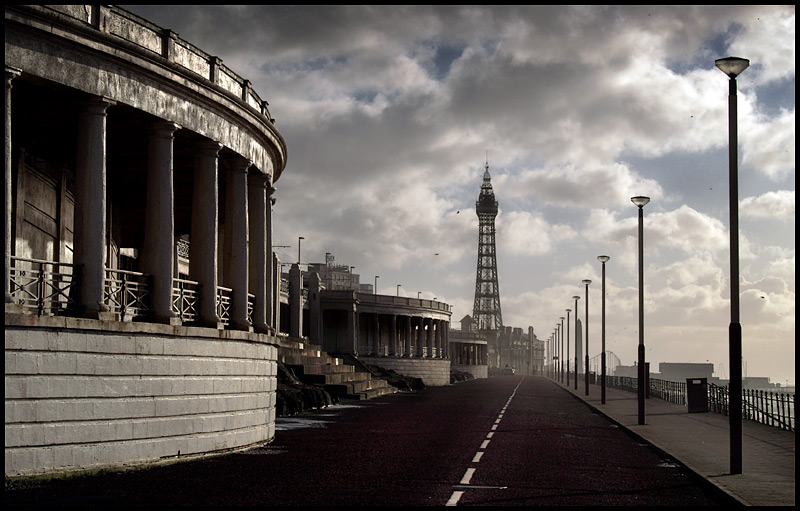
My photograph shows a view of Blackpool Tower seen from the North Shore Colonnades (see the post of Wednesday 10th January). The seafront has three levels at this location. Above the Colonnades is a footpath, tram tracks and road. The cycle path and road at the Colonnades level (seen here) is rarely used by motorised traffic. Below this road is the promenade walk and sea-wall next to the beach. The way the Colonnades, lamps and road converge near the Tower prompted me to take this shot, though I probably wouldn't have done so without the interesting quality of the light. I used a long zoom lens at 92mm (35mm equivalent), with the camera set to Aperture Priority (f7.1 at 1/1600 sec), with the ISO at 100 and -1.7EV.
The mainstream British daily press is a strange beast, with the populist "red tops" delivering a diet of celebrities, sensationalism and sport. Regrettably they find plenty of takers for their tittle-tattle masquerading as news. The more "serious" press does a pretty good job in reporting the domestic and foreign news, and features well-written analysis and comment. Their sales are, unfortunately, considerably lower. Maybe that's the way of the world, not just Britain. So, it was interesting to find that the news of the found earring was reported mainly in the serious press, and all but ignored in the mass market dailies! I suppose that is due to the fact that Marlene Dietrich is dead, is judged of little interest to the readers, and has been superseded by today's film-stars, reality TV non-entities and footballers' wives. Which is a pity because the story around this small discovery brought together an illuminating insight into fame, the fallen fortunes of Blackpool, and forensic skills.
My photograph shows a view of Blackpool Tower seen from the North Shore Colonnades (see the post of Wednesday 10th January). The seafront has three levels at this location. Above the Colonnades is a footpath, tram tracks and road. The cycle path and road at the Colonnades level (seen here) is rarely used by motorised traffic. Below this road is the promenade walk and sea-wall next to the beach. The way the Colonnades, lamps and road converge near the Tower prompted me to take this shot, though I probably wouldn't have done so without the interesting quality of the light. I used a long zoom lens at 92mm (35mm equivalent), with the camera set to Aperture Priority (f7.1 at 1/1600 sec), with the ISO at 100 and -1.7EV.
photograph & text (c) T. Boughen
Friday, January 12, 2007
Products and longevity
On 31st August 1982 I bought a Sharp EL-509 scientific calculator from the branch of Boots on Whitefriargate in the city of Kingston upon Hull, Yorkshire. I know this because I still have the calculator, and for warranty purposes the store stamped the back of the instruction manual with these details. All these years that manual has stayed in the pocket of the calculator's soft plastic case. And, every few days since the time of its purchase, the calculator has been used to do our household accounts and any other mathematical task that is required. None of this is particularly remarkable you might think. However, when I tell you that the calculator is battery powered (no solar power), and that the battery has never been changed since I bought it, then you'll concede that IS remarkable!
This fact prompts a number of thoughts. Are modern batteries deliberately made to expire quickly? I've never had any other product with a battery life to compare with this calculator. Is it still possible to buy a calculator that is capable of lasting for 25 years? Why don't other domestic electronic goods have lives of comparable longevity? Are we being ripped off by manufacturers? To what extent are we customers partly to blame for today's short product cycles and lifespans by always wanting new gadgets and fresh styling? Some of those thoughts went through my head when I bought the small lamp that features in today's photograph. It was ridiculously inexpensive, the metalwork was manufactured to an impressively high standard, and I would have expected the glass shade alone to cost twice what the whole lamp cost. But I couldn't help but wonder how long it would last. In theory there's little to go wrong, so a long life should be possible. But I had this nagging feeling that somewhere in its construction a key component had been designed to fail after a "reasonable" length of time, rendering the object useless. Time will tell!
My photograph is what I call an "abstractish" shot, showing part of the base and the stem below the shade. I liked the sheen and gloss of the metal, the reflections, and the perfection and interplay of the shapes. I placed the base on a black background to introduce more contrast, shot it from an angle to inject a dynamic note, and tried to balance the composition. I used a 70mm (35mm equivalent) lens, with the camera set to Aperture Priority (f18 at 1/2 second), ISO 100, with -0.7EV). The shot was illuminated by natural light.
This fact prompts a number of thoughts. Are modern batteries deliberately made to expire quickly? I've never had any other product with a battery life to compare with this calculator. Is it still possible to buy a calculator that is capable of lasting for 25 years? Why don't other domestic electronic goods have lives of comparable longevity? Are we being ripped off by manufacturers? To what extent are we customers partly to blame for today's short product cycles and lifespans by always wanting new gadgets and fresh styling? Some of those thoughts went through my head when I bought the small lamp that features in today's photograph. It was ridiculously inexpensive, the metalwork was manufactured to an impressively high standard, and I would have expected the glass shade alone to cost twice what the whole lamp cost. But I couldn't help but wonder how long it would last. In theory there's little to go wrong, so a long life should be possible. But I had this nagging feeling that somewhere in its construction a key component had been designed to fail after a "reasonable" length of time, rendering the object useless. Time will tell!
My photograph is what I call an "abstractish" shot, showing part of the base and the stem below the shade. I liked the sheen and gloss of the metal, the reflections, and the perfection and interplay of the shapes. I placed the base on a black background to introduce more contrast, shot it from an angle to inject a dynamic note, and tried to balance the composition. I used a 70mm (35mm equivalent) lens, with the camera set to Aperture Priority (f18 at 1/2 second), ISO 100, with -0.7EV). The shot was illuminated by natural light.
photograph & text (c) T. Boughen
Subscribe to:
Posts (Atom)