Showing posts with label Morris dancing. Show all posts

Monday, September 12, 2016

A Morris man

click photo to enlarge
It is generally thought that the name "Morris", pertaining to the English type of dance called Morris dancing, derives from "Moorish". Whether that is because of the similarity between the dances or because, as in other instances, the oddness of the dance attracted a foreign epithet, isn't known.

The earliest reference in English to Morris dancing occurs in the mid 1400s, and not until the 1600s does the spelling "Morris" appear. Many writers note that at the end of the nineteenth century Morris dancing as a conscious revival activity prevented the disappearance of the dance as a genuine folk activity of great longevity. Today it is pursued as a hobby or pastime by Morris groups throughout the country. Frequently groups follow the dance steps, patterns and tunes peculiar to the locality in which they are based, something that distinguishes (though often only for the observant) one from the other.

In recent years it has seemed that whenever I go out and about with my camera in the south of England, particularly in the west, I come across Morris dancing. Usually they are strictly traditional in all respects, though one of the most enjoyable was an updating that edged towards heavy metal! It happened again recently when we were in Gloucester. In  a public space at the centre of Gloucester Quays, a shopping centre that has sprung up in the old docks, at least two groups were putting on a display of dancing for any interested shoppers. Naturally there was The Gloucestershire Morris Men, but the troupes also included the Great Yorkshire Morris, of which "Bob" above, is a member.

photograph and text © Tony Boughen

Photo Title: Morris man, Gloucester Quays, Gloucester
Camera: Olympus E-M10
Mode: Aperture Priority
Focal Length: 150mm (300mm - 35mm equiv.)
F No: f6.3
Shutter Speed: 1/800 sec
ISO:200
Exposure Compensation: -0.3 EV
Image Stabilisation: On

Monday, July 22, 2013

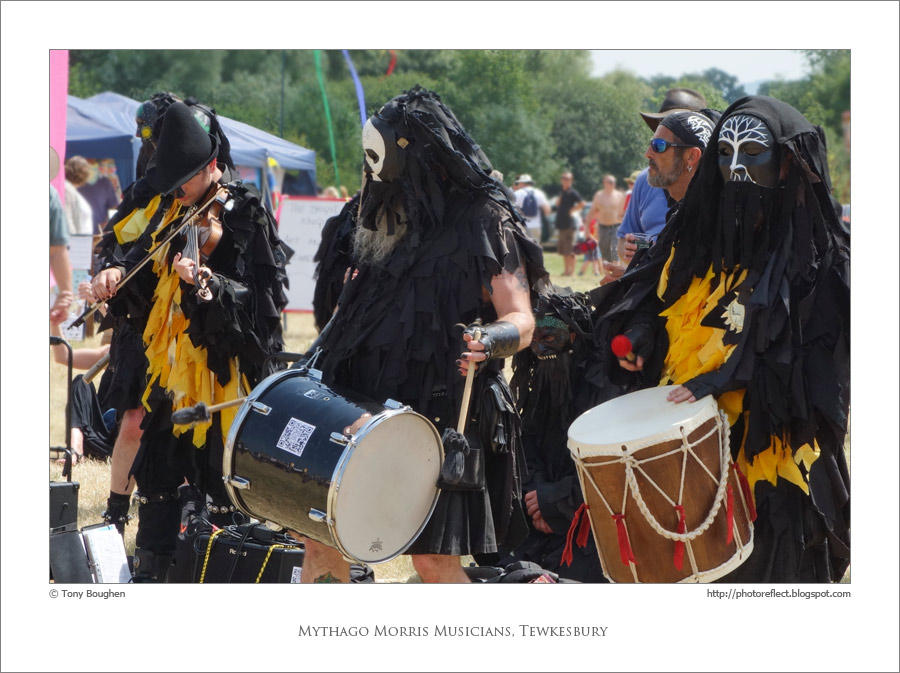
Morris dancers of Mordor?

click photo to enlarge
Morris dancers seem to be like buses: you don't see a troupe for ages then along they come in a bunch, one after the other. At least that's how it's been with us in recent years. After a long period when we saw none of these traditional English dancers, lately we've seen them everywhere. I don't think it's to do with a sudden surge in the popularity of this old style of dancing so much as the places and events that we've happened to visit.

When we were in Herefordshire recently our son suggested we go to a "medieval fayre" that was taking place over a weekend at Tewkesbury. It sounded like somewhere I might gather a few photographs. So, in temperatures approaching 30 degrees Celsius, we set off. I've never attended such an event before so I had only a hazy idea of what to expect. There were jugglers, people in medieval garb, musicians playing old instruments and singing gentle folk songs, various olde worlde games, stalls with appropriate food and clothing, weapons and armour for sale and many more "new age" style offerings. All reasonably predictable with the exception of the new-old military equipment (of which more later).

As we walked among the tents and pavilions, from the distant edge of the site came the sound of thundering drums and electric instruments playing music in a style that I can only describe as "heavy folk-rock"; imagine Fairport Convention meets Black Sabbath. As we got closer I noticed dancers clad in what appeared to be black rags, ghoulish masks and Goth boots. Then it struck me that what I was seeing and hearing was clearly the morris dancers of Mordor, a troupe more usually associated with Sauron's hordes, perhaps entertainers of the orc armies having a day off at Tewkesbury. It's usual for English morris dancers to wear neat white shirts or blouses, jackets, waiscoats, orthodox hats, feathers, neckerchiefs, ribbons and bells, and the often black and white theme to be enlivened by plentiful dashes of primary colours: see examples here and here. The contrast with the dancers shown above couldn't be more stark. Those providing the music were equally "different". The usual array of acoustic instruments was augmented by a recorder, an electric bass, amplified acoustic guitar and a number of assorted, large drums. The whole effect was decidedly rhythm heavy. I loved it! Though it was hard to see through the masks I got the impression that this morris attracted a wider age range with more younger members than is usual. I could see why. As the morris men (and women) took a break from their exertions my wife went to ask who they were and was given their card. They styled themselves Mythago Morris and hailed from the village of Ashurst, West Sussex, not too far from Brighton. In fact, nowhere near Mordor!

I took my photographs in what can only be described as difficult conditions - the sun high in the sky, the grass turned brown and light coloured against which I sought to capture detail of the the dancers' black costumes. It took a few shots and some post-processing to extract these fairly ordinary record shots.

photograph and text © Tony Boughen

Photo 1
Camera: Sony RX100Mode: Aperture Priority
Focal Length: 22.7mm (61mm - 35mm equiv.)
F No: f8
Shutter Speed: 1/400
ISO: 125
Exposure Compensation:  -1.0 EV
Image Stabilisation: On

Wednesday, October 12, 2011

Morris dancing

click photo to enlarge
"When he is dancing the true morris-man is serious of countenance, yet gay of heart; vigorous, yet restrained; a strong man rejoicing in his strength; yet graceful, controlled, and perfectly dignified withal."
Cecil Sharp (1859-1924), English folklore and folksong revivalist


Cecil Sharp had very clear and serious views on the revival of traditional English folk dance and song: the quotation above underlines this. What then would he have made of the morris dancing that I experienced at the Old Brewery, Greenwich recently. There were some serious countenances among the assembled morris men and women - mainly from the bandsmen - but in the main there was delight and enjoyment on the faces of the dancers in doing what they did.

Last year I watched some morris dancing in Pershore, Worcestershire, and reflected in the blog post that accompanied my photographs on Thomas Hardy's views about such performances. He distinguished between survivalists and revivalists, noting that the former who carry on the tradition through obligation do not show the same enthusiasm and enjoyment as those who take it up voluntarily in order to to re-kindle an ancient tradition. If Hardy is to be believed - and I think he probably over-stated his case - the Rose and Castle Morris depicted in today's images must count as revivalists because the delight they took in their performance was palpable.

One thing that I found interesting about this particular morris is the fact that, though they come from Stoke Bruerne, Northamptonshire, in the English Midlands, they dance in clogs following the tradition of Lancashire and Cheshire in north-west England.

photographs and text (c) T. Boughen

Main Photo
Camera: Canon
Mode: Aperture Priority
Focal Length: 105mm
F No: f7.1
Shutter Speed: 1/100
ISO: 160
Exposure Compensation:  -0.67 EV
Image Stabilisation: On

Tuesday, October 11, 2011

Physiognomy and morris men

click photo to enlarge
The pseudo-science of physiognomy has it that we can discern a person's character and personality from their facial characteristics. The Greeks and Romans believed that the face - and other bodily features - were an external manifestation of the inner person. Physiognomy was taught in universities in the middle ages, and it has continued to have its adherents since that time, though many in the scientific community have ridiculed its methods and findings and continue to do so.

Interestingly, one recent study indicates that 90% of people think that you can judge a person's character through their face, so it's not surprising that the idea continues to be popular, and that some serious researchers are delving into the subject once more. My experience over my lifetime is that a person's face sometimes does seem to indicate something of their character, but it just as often doesn't. That observation may be saying something about me as a judge of people but I would say that physiognomy is an unreliable indicator.

I was thinking about this when I looked at my photograph of these morris men. I came upon them in Greenwich a couple of days ago as they were taking a rest from their labours and enjoying a drink. I snapped them for their traditional outfits and for their "characterful" looks. It's tempting to look into their faces and think we can read what they are like as people. But the fact is, I have other photographs taken at the same time where, because their expressions are different, we would come to quite contrasting opinions. As you have perhaps worked out, I think physiognomy is about as scientific as astrology.

photograph and text (c) T. Boughen

Camera: Canon
Mode: Aperture Priority
Focal Length: 271mm
F No: f7.1
Shutter Speed: 1/320
ISO: 320
Exposure Compensation:  -0.67 EV
Image Stabilisation: On

Friday, July 09, 2010

Morris dancing and historical fiction

click photo to enlarge
One of the most pleasant ways to learn a little history is through good fictional writing. I'm not a particular fan of the historical novel. However, Patrick O'Brian's naval series about Captain Jack Aubrey and the surgeon/spy, Stephen Maturin, enthralled me and taught me a lot about the British navy of the late eighteenth and early nineteenth centuries. Enough, in fact to prompt me to buy and read an authoritative history of the period, N. A. M. Rodger's "The Command of the Ocean: A Naval History of Britain 1649-1815".

Similarly, the novels of Thomas Hardy are a good source of the life of rural England in the nineteenth century - both of the poor and the middle classes. I will always remember being introduced, in "The Return of the Native", to the figure of Diggory Venn, the "reddle man", a lone, itinerant worker who mixed and supplied the dye that farmers used to mark the sheep of their flocks. In the same book Hardy remarks that the genuine survival of a tradition can be distinguished from a revival by the level of enthusiasm of the performers: those who carry on a tradition through obligation will not show the same enthusiasm and enjoyment as those who participate voluntarily in a revival of an ancient tradition. Whether Hardy was right or not it is interesting to apply his thinking to the two photographs above. They show the dancers and musicians of a Morris group from Kent performing at a gathering in Pershore, Worcestershire.

photograph and text (c) T. Boughen

Photo 1 (Photo 2)
Camera: Olympus E510
Mode: Aperture Priority
Focal Length: 13mmmm (26mm/35mm equiv.)(70mm (140mm/35mm equiv.))
F No: f6.3
Shutter Speed: 1/640 (1/250)
ISO: 100
Exposure Compensation: -0.7 EV
Image Stabilisation: On

Tuesday, February 17, 2009

The Target House

click photo to enlarge
So, are the Morris dancers of England an endangered species or not? A few weeks ago a newspaper article suggested as much. It sparked a flurry of investigative journalism by other newspapers, radio and TV, and reporters found themselves getting to grips with this arcane pastime. At the end of the media's rummaging in the unfamiliar world of common figures, distinctive figures, bagmen and fools, the general consensus seemed to be that there was nothing to worry about, and the Morris was quietly (and sometimes noisily, to the sound of bells, swords and staves) thriving.

Traditions and pastimes change down the centuries, some dropping out of favour only to re-emerge as something consciously revived or re-discovered. The same is true of games. Who would have thought that the end of the twentieth century would see the re-appearance of croquet, a game that reached a peak of popularity towards the end of the nineteenth century? Yet, this apparently genteel lawn game played with mallets, hoops and ball, seemed to suit the times, and many middle-class dinner parties across the land concluded to its clack and clatter.

A question I pondered the other day was, "Will domestic archery make a comeback?" The Victorians, particularly women, greatly enjoyed this pastime, and when the men went to play billiards or blast pheasants from the sky, the ladies would often retire to a distant lawn and launch arrows at targets. It was a recent visit to Brodsworth Hall, Yorkshire, a Victorian country house and grounds now in the care of English Heritage, that set me thinking about this. Near the edge of the extensive gardens, in what must have originally been a quarry, was a long, flat grassed area with a small, one room, Victorian/Georgian building called The Target House. This was the place where the Victorian owners and their guests practised bowmanship (and presumably stored the targets.) My photograph shows part of the main elevation of the building with what appears to be an eighteenth century, classical, Venetian window filled with incongruous (probably later) Gothic glazing bars. Below is an ornate bench with a cast-iron frame. The remainder of the building with its slate roof, chimney and too-large, ornate barge board also seems to be later.

So, will archery make a comeback? The other reason I ask is that last year I bought a recurve longbow, arrows and target, re-awakening an interest that I had in my teenage years. Could it be that, for the only time in my life, I'm on the leading edge of a trend, and in a couple of years English gardens will once again resound to the thwack of arrows hitting compressed straw? Perhaps not!

photograph & text (c) T. Boughen

Camera: Olympus E510
Mode: Aperture Priority
Focal Length: 21mm (42mm/35mm equiv.)
F No: f7.1
Shutter Speed: 1/25
ISO: 100
Exposure Compensation: -0.3 EV
Image Stabilisation: On