Showing posts with label Hereford. Show all posts

Sunday, June 24, 2012

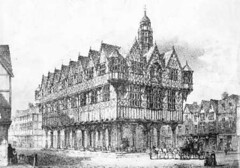
The Old House, Hereford

click photo to enlarge
The remains of the past that we see around us are there through either design, chance or a mixture of both these factors. Archaeologists tell us that humans have always revered ancestors and their artefacts, and much of what remains from earlier centuries has been kept for this reason. Visit an English town and you may see a medieval market cross, or the remains of one, something that long ago shed its purpose, but that succeeding generations have maintained because it is a comforting presence, a mark of the continuity of the settlement. Churches, castles, houses and other buildings usually survive because they are still able to fulfil their original purpose, but also because people like the reminder of the past that they embody through their materials, style and shape. However, looking at some buildings you wonder why they alone survived when so many similar structures didn't. I recently visited a building in Hereford and discovered why only a single house remains from what was once a notable town-centre terrace.

The Old House bears the date 1621, probably the year of its completion. It is a timber-framed building of the kind popular for more than two hundred years. It may have been associated with the butcher's trade because the coat of arms of the Butcher's Guild (including crossed pole axes used for slaughter) are mounted over the door in the south porch. That suggestion is strengthened by the fact that it was once part of a street called Butcher's Row. A painting of 1815 by David Cox shows it in its original context. I don't know what motivated him to paint this subject but it may have been the threat posed to the medieval buildings and the town's street plan by Hereford's "Paving, Repairing, Cleaning and Lighting Commissioners" who were anxious to modernise the centre and reduce the fire risk caused by old, decrepit, wooden buildings and narrow streets. They undertook their work from about 1810 to 1854 using coercion and compulsory purchase orders to buy and remove old buildings. By the late 1830s only two people held out against the Commissioners - the owners of the Market Hall and The Old House. In 1862 the Market Hall was demolished leaving The Old House isolated but surviving. Thereafter it housed a number of businesses including a saddler, china shop, fish shop, grocer, and two banks. In 1928 Lloyds Bank, the owners, gave the house to the City of Hereford who turned it into a museum in 1929. It has served this purpose ever since.

photographs and text © Tony Boughen

Camera: Canon
Mode: Aperture Priority
Focal Length: 24mm
F No: f8
Shutter Speed: 1/160 sec
ISO: 100
Exposure Compensation:  -0.67 EV
Image Stabilisation: On

Friday, June 01, 2012

Sundays aren't what they were

click photo to enlarge
Lazy Sunday afternoon,
I've got no mind to worry,
Close my eyes and drift away.
from Lazy Sunday Afternoon (1968) by the British band, the Small Faces

When, in my teens, I heard this popular song by the Small Faces, a single that reached number 2 in the UK charts and was a track on their early "concept"album, "Ogden's Nut Gone Flake", Sundays were very different from today.

In those increasingly remote times buying and selling on Sunday was illegal except for certain products and certain premises as detailed in the Shops Act 1950. This proscription on Sunday trading was of long standing, was sanctioned by the churches and the trade unions, and had the support of many of the public. It made Sunday a quiet day. Roads had fewer cars, pavements fewer people, the pace of the day was slower than that of the other six days. However, parks were busier, as were other places of leisure because, unable to spend their time buying, people gave more time to relaxation. Scenes such as the one in today's photograph were commonplace on Sundays, and though they are not unknown today, the parks are emptier and the pace of life of the weekend now almost matches that of the weekdays. Sundays past suited me and many others, but a large section of the population, especially those involved in retail, wanted Sundays to be a day when trading could take place. Many working people wanted it too because it gave them both of the weekend days on which they could do their shopping. Consequently, in 1994, the Sunday Trading Act came into force in England and Wales. This was something of a compromise in so far as shops could now trade, in the main, between the hours of 10.00am and 4.00pm and working on Sunday was optional for staff. These concessions were probably crucial in securing the support of the churches and the trade unions. It was a change that is unlikely to be overturned now that shopping has become the main leisure pastime. The "old" Sundays have gone for ever, something I regret, a point of view that puts me into yet another minority!

The sight of three generations of a family sauntering along the path of the riverside park in Hereford on a recent Sunday afternoon sent my mind back to those days, a time when the pace of life was less hurried, the "day of rest" was just that, was a lot quieter and there was time to sit and reflect, stand and stare, or "close my eyes and drift away", without the encouragement to go shopping being omnipresent.

photograph and text (c) T. Boughen

Camera: Canon
Mode: Aperture Priority
Focal Length: 105mm
F No: f8
Shutter Speed: 1/100
ISO: 1250
Exposure Compensation:  -0.67 EV
Image Stabilisation: On